How to Calculate Your Birth Chart: A Complete Guide to Astrological Precision
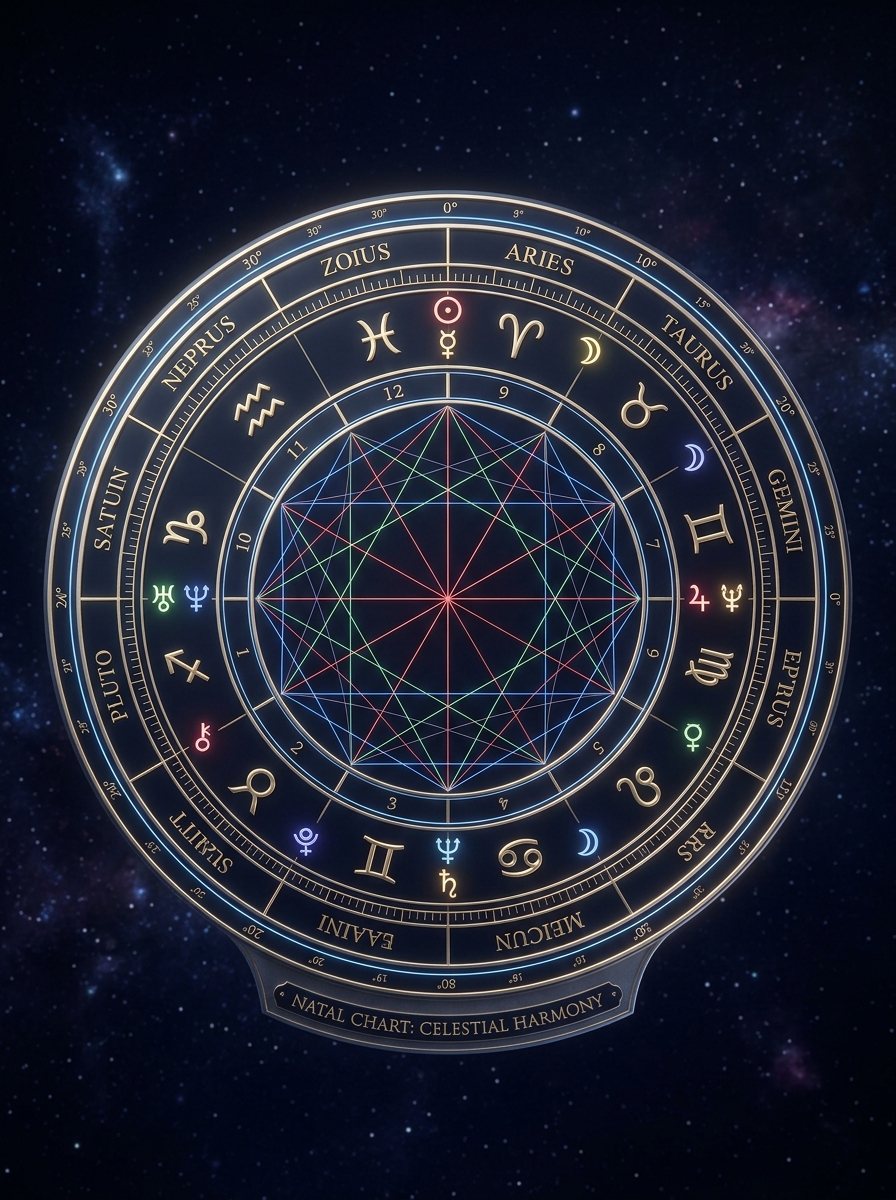
Why Birth Chart Accuracy Starts with the Exact Time and Location
A birth chart—or natal chart—is not merely a symbolic map of your personality; it is a frozen snapshot of the cosmos, captured at the precise moment you took your first breath. In the words of Carl Jung, "whatever is born or done this moment of time has the qualities of this moment of time." This is the foundational law of astrological synchronicity. To construct this psychic blueprint, we translate the three-dimensional geometry of the heavens onto a two-dimensional wheel. If the inputs to this calculation are even slightly off, the entire system loses its alignment, much like a telescope whose lens is misaligned by a fraction of a millimeter.
The reason for this extreme need for precision lies in the mechanics of our rotating planet. The Earth completes a full rotation on its axis once every twenty-four hours. This means that the entire 360-degree belt of the zodiac appears to rotate around the Earth during a single day. At a rate of fifteen degrees per hour, the sky shifts by one degree every four minutes. When we calculate a birth chart, we are pinpointing the exact degree of the zodiac that was rising on the eastern horizon at your specific birthplace. Without an exact birth time, determining this point becomes guesswork, and the structural integrity of the chart collapses.
Geographical location is just as vital. The Earth is a sphere, and your specific coordinates—latitude and longitude—determine your unique local horizon. Two individuals born at the exact same second, one in New York and the other in Los Angeles, will have completely different charts because their local horizons were pointed at different sections of the sky. The location serves as the anchor point, grounding the celestial coordinates to a specific spot on the globe. It is the intersection of time and space that creates the unique lens of the natal chart, mapping the outer astronomical reality to the inner psychological landscape.
The Astronomical Intersection of Time and Space
To understand why this matters, we must look at how astronomers and astrologers define the local sky. The meridian is an imaginary circle passing through the celestial poles and the zenith (the point directly overhead) of a specific location. The intersection of this meridian with the ecliptic (the sun's path) determines the Midheaven (Medium Coeli), which represents our highest aspirations and public life. Meanwhile, the eastern horizon determines the Ascendant. These two axes form the cross of matter, the skeletal structure of the birth chart. If you do not have the exact coordinates of your birth, the calculation engine cannot determine where these lines intersect the zodiac, rendering the entire house system inaccurate.
How a Few Minutes Shift Your Ascendant and House Placements
The Ascendant, or rising sign, is the eastern horizon of your birth chart. In psychological astrology, as pioneered by Liz Greene, the Ascendant represents the interface between the inner psyche and the outer world. It is the mask we wear, the style of our coping mechanisms, and the primary filter through which we perceive reality. Because the Ascendant shifts by one degree approximately every four minutes, a minor discrepancy in your birth time can easily push the rising sign into the next zodiacal sign. If you were born near the cusp of a sign, even a single minute of variance can alter your Ascendant from a fiery, impulsive Aries to a grounded, deliberate Taurus. This shift changes the "chart ruler" (the planet that governs the Ascendant sign), which changes the thematic focus of the entire chart.
Beyond the Ascendant, the entire twelve-house system depends on this precise boundary. Astrological houses represent the specific arenas of life where the planetary energies manifest—ranging from the personal identity of the First House to the collective unconscious of the Twelfth. When the Ascendant shifts, the cusps of all twelve houses shift along with it. A planet that is actually located in your First House of active self-expression might be calculated as residing in your Twelfth House of solitude and hidden struggles if your birth time is off by just five minutes.
This difference is psychologically profound. In the framework of Steven Forrest’s evolutionary astrology, a Twelfth-house Mars suggests that your drive, anger, and assertion are buried in the subconscious, requiring deep introspection to access and integrate. Conversely, a First-house Mars is immediate, visible, and expressed outwardly with directness. Miscalculating your birth time by a few minutes can lead to an interpretation that describes a completely different set of life lessons and psychological dynamics, pointing you toward the wrong path of self-understanding.
The Threshold of the Cusps
The boundaries between signs and houses are known as cusps, and they represent highly sensitive thresholds of transition. While some popular astrologers speak of "cusp birthdays" as a blend of two signs, technical astrology recognizes no such blending for planetary bodies; a planet is either in one sign or the next. However, for house cusps, the boundary is a sharp dividing line. When a planet sits within a degree or two of a house cusp, its psychological expression is in a state of high tension, bridging two distinct areas of life. A precise birth time is the only way to resolve whether a planet has crossed this threshold or remains behind it, ensuring that your interpretation aligns with your actual lived experience rather than a mathematical approximation.
The Impact of Time Zones and Daylight Saving Time (DST) on Calculations
One of the most complex aspects of calculating a birth chart is converting local civil time into absolute astronomical time, known as Universal Time (UT) or Greenwich Mean Time (GMT). Planetary positions are recorded in an ephemeris in GMT. Therefore, to find where the planets were when you were born, an astrologer or calculation program must subtract or add the appropriate number of hours based on your birth location's time zone. While this sounds straightforward, the history of timekeeping is a chaotic tapestry of political decisions, local adjustments, and shifting boundaries.
The implementation of Daylight Saving Time (DST) adds another layer of complication. DST shifts the clock forward by one hour during the spring and summer months to maximize daylight. If an astrological calculation program does not account for the exact DST rules in effect at your birth location and date, your chart will be calculated with a one-hour error. A one-hour error shifts the house cusps by approximately fifteen degrees, which is half of an entire zodiac sign. This error can completely scramble your house placements, pushing your sun from the Tenth House of career into the Ninth House of philosophy, or moving your moon into a different house entirely.
Historically, standardizing time was a slow and messy process. Before the late nineteenth century, most municipalities in the United States used Local Mean Time (LMT), setting their clocks to noon when the sun was directly overhead. This meant that neighboring towns could have time differences of several minutes. Furthermore, during the twentieth century, states and counties adopted and abandoned DST at their own discretion. For example, during World War II, the United States enforced "War Time," which kept clocks advanced by one hour year-round. Navigating these historical anomalies requires access to highly accurate timezone databases that track every local legislative change over the last two centuries.
Navigating the Maze of Local Civil Time
The transition from Local Mean Time to Standard Time zones, and the subsequent introduction of daylight saving variations, created a massive headache for astrologers. If you were born in a rural area during a period of transition, the official clock time recorded on your birth certificate might reflect standard time, local mean time, or a localized version of daylight saving time. To solve this, professional-grade astrological software references the IANA Time Zone Database, a collaborative compilation of global timezone history. This database ensures that when you input a location and date, the software automatically translates the local clock time to the correct Universal Time, avoiding the devastating fifteen-degree shift that manual miscalculations would cause.
Where to Locate Your Precise Birth Time on Official Records
If you want to calculate an accurate birth chart, you cannot rely on casual family memory. Mothers, despite their best efforts, often recall birth times rounded to the nearest hour or half-hour, or they may remember a time that is off by several hours due to the exhaustion and intensity of labor. To find the exact minute of your birth, you must obtain official vital records. In the United States, birth certificates are managed at the state and county levels, and they come in different formats that contain varying levels of detail.
The standard birth certificate that most people have in their files is often an "abstract" or "short form" certificate. This document is a simplified version of the record, used for basic identification, passport applications, and school registrations. Crucially, short form certificates often omit the exact time of birth entirely, listing only the date, city, and parents' names. To find your birth time, you must request a copy of the "long form" birth certificate, also known as the "vault copy" or "full-size birth certificate." This is a photocopy of the original document filled out by the hospital staff at the time of delivery, and it almost always contains the exact minute of birth, signed by the attending physician or midwife.
To obtain your long form birth certificate, you need to contact the Office of Vital Statistics or the Department of Health in the state or county where you were born. Most states allow you to order these documents online through official portals or third-party services like VitalChek. When filling out the application, you must explicitly request the "long form for genealogical or astrological purposes," as some jurisdictions default to sending the short form unless instructed otherwise.
If official government records are unavailable—perhaps due to a fire, archive loss, or home birth that was not immediately registered—there are alternative historical records that may contain the necessary data. Family bibles, baby books kept by parents, baptismal or christening certificates, and hospital souvenir records (like the card placed on the newborn's bassinet) are excellent secondary sources. Even local newspaper archives from the days following your birth might print birth announcements that include the exact time. Gathering this data is the first, indispensable step toward constructing a reliable map of your psyche.
Unearthing the Vault Copy
The distinction between the short-form abstract and the vault copy is the most common hurdle for those beginning their astrological journey. The vault copy is a direct reproduction of the original hand-signed document from the medical archive. Because it is a legal record of the physical event of birth, it captures the raw data recorded in the delivery room before it is processed into digital databases. Securing this document not only guarantees the accuracy of your astrological calculations but also provides a tangible connection to the exact physical moment you crossed the threshold into independent existence.
Leading Free Online Chart Calculators and Apps
Once you have secured your precise birth data, the next step is selecting a digital engine to calculate your chart. The internet is flooded with free birth chart generators, but they are not all created equal. Many popular lifestyle websites use simplified algorithms that do not account for complex timezone history, leading to inaccurate house placements. For a reliable, professional-grade calculation, you should look for platforms that utilize the Swiss Ephemeris.
The absolute gold standard in the astrological community is Astrodienst, hosted at Astro.com. Developed by Swiss physicists and astrologers, Astrodienst has been the trusted repository of astrological calculation for decades. Its database of global coordinates and historical time zones is incredibly robust, and it offers an unparalleled variety of calculation options, including dozens of house systems, asteroids, and progressive chart types. While the user interface can feel clinical and outdated to a modern reader, its mathematical accuracy is unmatched. Another excellent, more contemporary alternative is Astro-Seek, which combines the mathematical precision of Astrodienst with a clean, modern user experience and interactive tools that make exploring your placements intuitive.
For mobile users, dedicated apps like TimePassages or Astro Gold provide professional-grade calculation engines in the palm of your hand. TimePassages is highly regarded for its detailed, psychologically oriented interpretations, which align closely with the modern psychological astrology of Liz Greene and Steven Forrest. If you prefer a visual, tarot-infused aesthetic, apps like Labyrinthos offer beautiful, interactive ways to learn the symbolic language of astrology while keeping their mathematical engines grounded in accurate astronomical data.
The Swiss Ephemeris and Modern Astrological Calculations
The secret behind the accuracy of any professional astrological software is the Swiss Ephemeris. Created by Dieter Koch and Alois Treindl, the Swiss Ephemeris is a high-precision programming library that translates the planetary coordinates calculated by NASA's Jet Propulsion Laboratory into the zodiacal coordinates used by astrologers. It covers a span of over six thousand years, from 3000 BCE to 3000 CE, with sub-second accuracy. When you use a website or app that integrates the Swiss Ephemeris, you are using the same data that astrophysicists use to track planetary orbits, ensuring that your birth chart is built on a flawless astronomical foundation.
Why Different Astrological Websites Show Varying Results
It is a common source of confusion and frustration for beginners when they calculate their birth chart on two different websites and receive two different results. For example, your sun might be in the Ninth House on one site, but in the Tenth House on another, or your moon might appear to have changed signs entirely. These discrepancies rarely stem from calculation errors; instead, they are the result of different mathematical frameworks, zodiac systems, or database rules chosen by the website's developers.
The primary reason for house differences is the choice of the house system. The division of the sky into twelve houses is a mathematical problem with many different solutions. Quadrant house systems, such as Placidus or Koch, divide the sky based on time, calculating the time it takes for a planet to travel from the horizon to the meridian. In contrast, Whole Sign astrology is a simpler, traditional system where the entire sign of the Ascendant becomes the First House, and each subsequent sign represents a subsequent house. If a website defaults to Whole Sign and another defaults to Placidus, your planetary house placements will change dramatically. Liz Greene and other psychological astrologers often favor Placidus because its unequal house sizes reflect the unique psychological distortions and focus areas of the individual's psyche.
The second major source of variation is the choice between the Tropical and Sidereal zodiacs. The Tropical zodiac, which is used by almost all Western astrologers, is based on the seasons and the relationship between the Earth and the Sun, starting the zodiac at the vernal equinox (0 degrees Aries). The Sidereal zodiac, used in Vedic astrology (Jyotish) and some Western sidereal systems, is based on the physical constellations of stars. Because of the precession of the equinoxes, the Earth's axis wobbles slightly, causing the two zodiacs to drift apart by approximately one degree every seventy-two years. Today, there is a difference of about twenty-four degrees between them. If you calculate your chart on a site that defaults to the Sidereal zodiac, almost all of your planetary placements will shift back by nearly an entire sign.
Tropical vs. Sidereal Frameworks
To navigate these differences, you must understand the underlying philosophical divergence. The Tropical zodiac maps the symbolic relationship of the sun to the seasons of the Earth, aligning the zodiacal archetypes with the natural cycles of growth, decay, and rebirth. The Sidereal zodiac aligns with the physical stars in the sky, using a correction factor called an Ayanamsa (such as the Lahiri or Fagan-Bradley Ayanamsa) to calculate the precise coordinate offset. Neither system is mathematically incorrect; they simply measure the sky from different reference points. Understanding which system you are using is essential to interpreting your chart correctly and avoiding confusing contradictions.
Methods to Verify the Accuracy of Your Birth Chart
Even when you have a birth certificate in hand, it is wise to verify that the calculated chart accurately reflects your life. There are times when medical staff write down a birth time that is rounded to the nearest hour or half-hour, or when the hospital clock was running fast or slow. If you suspect your birth time is inaccurate, or if you have no record of your birth time at all, there are structured methods to verify and correct your chart, known in professional astrology as chart verification and rectification.
The first method is psychological verification. This involves examining the calculated placements—especially the Ascendant, Moon sign, and the house placements of personal planets—against your lived experience and core psychological patterns. In Jungian terms, this is a process of checking if the symbolic archetypes match your conscious and unconscious behaviors. For instance, if your calculated chart shows a Sagittarius Ascendant, but you have always identified with the cautious, structured, and reserved traits of Capricorn, and you possess the physical markers associated with Capricorn rising, the birth time may need to be adjusted forward by a few minutes. While this method is subjective, it serves as an important initial check.
The most rigorous method is astrological rectification. Rectification is a complex process where a professional astrologer works backward from major, documented life events to find the exact birth time that produces the transits and progressions matching those events. You compile a list of significant life milestones: marriages, divorces, the births of children, major career breakthroughs, relocations, accidents, or the deaths of close relatives. The astrologer then calculates the planetary alignments, secondary progressions, and solar arc directions for those specific dates. Because these predictive techniques are highly sensitive to the exact degree of the house cusps, finding the specific birth minute that perfectly aligns with these major life events reveals the true structure of the natal chart.
The Art of Rectification
Astrological rectification is a blend of mathematical precision and psychological detective work. It requires a deep understanding of how planetary energies manifest across time. When an astrologer rectifies a chart, they are looking for the moment where the symbolic clock of the sky matches the physical timeline of the native's life. By aligning these two dimensions, the astrologer can reconstruct an unknown or inaccurate birth time with remarkable precision, restoring the integrity of the birth chart and providing a reliable map for future self-discovery.
The Heritage and Mechanics of Manual Astrological Calculation
Before the advent of personal computers and digital calculators, constructing a birth chart was a labor-intensive mathematical ritual. Astrologers had to be skilled in spherical trigonometry, basic geometry, and arithmetic. This manual calculation process was not just a technical necessity; it was considered a sacred craft that connected the astrologer deeply to the movements of the cosmos. Esoteric authors like Aleister Crowley and A.E. Waite emphasized that the mental effort required to manually calculate a chart was a form of active meditation, forging a psychic link between the practitioner and the celestial patterns they were mapping.
The process of manual calculation begins with two essential physical reference books: an Ephemeris and a Table of Houses. The Ephemeris lists the exact coordinates of the sun, moon, and planets for every day of the year at either noon or midnight Greenwich Mean Time. The Table of Houses lists the degrees of the house cusps for various latitudes based on local sidereal time. To calculate a chart, the astrologer must first convert the native's local clock time to local mean time, and then to Greenwich Mean Time. They then calculate the interval of time between the birth and the nearest entry in the Ephemeris.
Next, the astrologer calculates the Local Sidereal Time (LST) of the birth. Sidereal time, or "star time," is measured relative to the vernal equinox rather than the sun. The astrologer takes the sidereal time at Greenwich for the birth date, adjusts it for longitude, and adds the time elapsed since the last noon or midnight. Once the LST is determined, the astrologer consults the Table of Houses for the birth latitude to find the exact degrees of the Ascendant, Midheaven, and other house cusps. Finally, they interpolate the positions of the planets, calculating how far each body traveled during the interval between the Ephemeris listing and the birth time.
The Sacred Geometry of the Wheel
Calculating a chart by hand reinforces the understanding that the astrological wheel is a geometric representation of local space. It is a map of the celestial sphere projected onto the horizon. The lines on the chart represent actual physical boundaries in the sky. By calculating these angles manually, we honor the centuries of astronomical observation and mathematical development that allow us to translate the movements of the planets into psychological insights. This heritage reminds us that astrology is not a collection of arbitrary symbols, but a system of sacred geometry that mirrors the structured complexity of the human soul.
Frequently Asked Questions about Birth Chart Calculations
What if my birth certificate only lists an approximate time or no time at all?
If your birth certificate does not list a time, or if it says something general like "around 4:00 PM," you can still calculate a partial chart. This is often called a "noon chart" or a "sunrise chart," calculated for 12:00 PM or the time of sunrise on your birth date. While a sunrise chart can show your planetary signs and aspects (except for the Moon, which can move up to six degrees in a half-day), it cannot show your Ascendant or house placements. To find these missing elements, you can consult a professional astrologer who specializes in chart rectification, a process that reconstructs your birth time using major life events.
Does daylight saving time get calculated automatically by online tools?
Most modern, reputable astrological websites and software programs (such as Astro.com and Astro-Seek) automatically calculate Daylight Saving Time (DST) based on your birth date, year, and location. These tools reference historical databases that track the complex rules of DST for different municipalities. However, if you are using a simpler calculator or if your birth occurred during a period of transition or historical irregularity (such as during wartime), it is wise to double-check the GMT offset manually to ensure the calculation engine did not make an error.
Why does my birth chart look different on a Vedic astrology site?
Your birth chart looks different on a Vedic astrology site because Vedic astrology (Jyotish) uses the Sidereal zodiac, while Western astrology uses the Tropical zodiac. The Tropical zodiac aligns with the seasons and the equinoxes, while the Sidereal zodiac aligns with the actual astronomical constellations. Because of the precession of the equinoxes, the two zodiacs are currently separated by about 24 degrees. This means that if you calculate your chart using the Sidereal zodiac, most of your planets will shift backward by almost an entire zodiac sign compared to your Western chart.
Which house system should a beginner choose?
For beginners, the Placidus house system is the most widely recommended and used in Western astrology. It is the default system on most calculation websites and matches the majority of modern astrological literature. If you prefer a simpler, cleaner structure where every house aligns perfectly with a zodiac sign, the Whole Sign house system is an excellent alternative that has seen a major resurgence in recent years. Exploring both systems can help you determine which lens offers a more accurate reflection of your personal life dynamics.
What is the difference between a birth chart and a natal chart?
There is no difference between a birth chart and a natal chart; the two terms are used interchangeably in astrology. Both refer to the map of the heavens calculated for the exact moment and location of an individual's birth. The term "natal" comes from the Latin word natalis, meaning "relating to birth." Both charts depict the positions of the sun, moon, planets, and house cusps, serving as a symbolic blueprint of your psyche and life path.
Can I calculate my birth chart if I was born at sea or on a flight?
Yes, you can calculate your birth chart if you were born at sea or on a flight, but the calculation requires coordinates rather than a city name. You must determine the approximate latitude and longitude of the vessel or aircraft at the time of your birth. Once you have these coordinates, you can input them directly into a professional calculator like Astrodienst. The time zone used will typically be the ship's clock time or the standard time zone of the nearest landmass, which must be converted to Universal Time.
How does the location of birth affect planetary placements?
The geographical location of your birth does not change the zodiac signs or degrees of the planets, as their positions are calculated relative to the center of the Earth. However, the location determines your local horizon and meridian, which define the Ascendant, Midheaven, and the boundaries of the twelve houses. Therefore, changing the birth location will shift which houses your planets reside in, altering how those planetary energies are expressed in your daily life.
Is a birth chart calculation based on astronomy or superstition?
A birth chart calculation is based entirely on high-precision astronomy. The math used to determine the coordinates of the planets and the angles of the houses is identical to the calculations used by astronomers and space agencies to track celestial bodies. The interpretation of these symbols is where astrology enters the realm of archetypal psychology and metaphysics, but the foundation of the chart itself is a purely mathematical representation of the solar system.
Can my birth chart change over time?
Your natal birth chart is a fixed map of the moment of your birth and does not change. It represents your lifetime potential and core psychological blueprint. However, your relationship to your chart changes as you grow. Astrologers use predictive techniques, such as transits (the current movements of the planets relative to your birth chart) and progressions (symbolic planetary movements representing inner evolution), to map how you grow, mature, and navigate different cycles throughout your life.
Comments
Loading comments…