The Mystic Rectangle in Astrology: Integrating Polarities and Finding the Inner Temenos
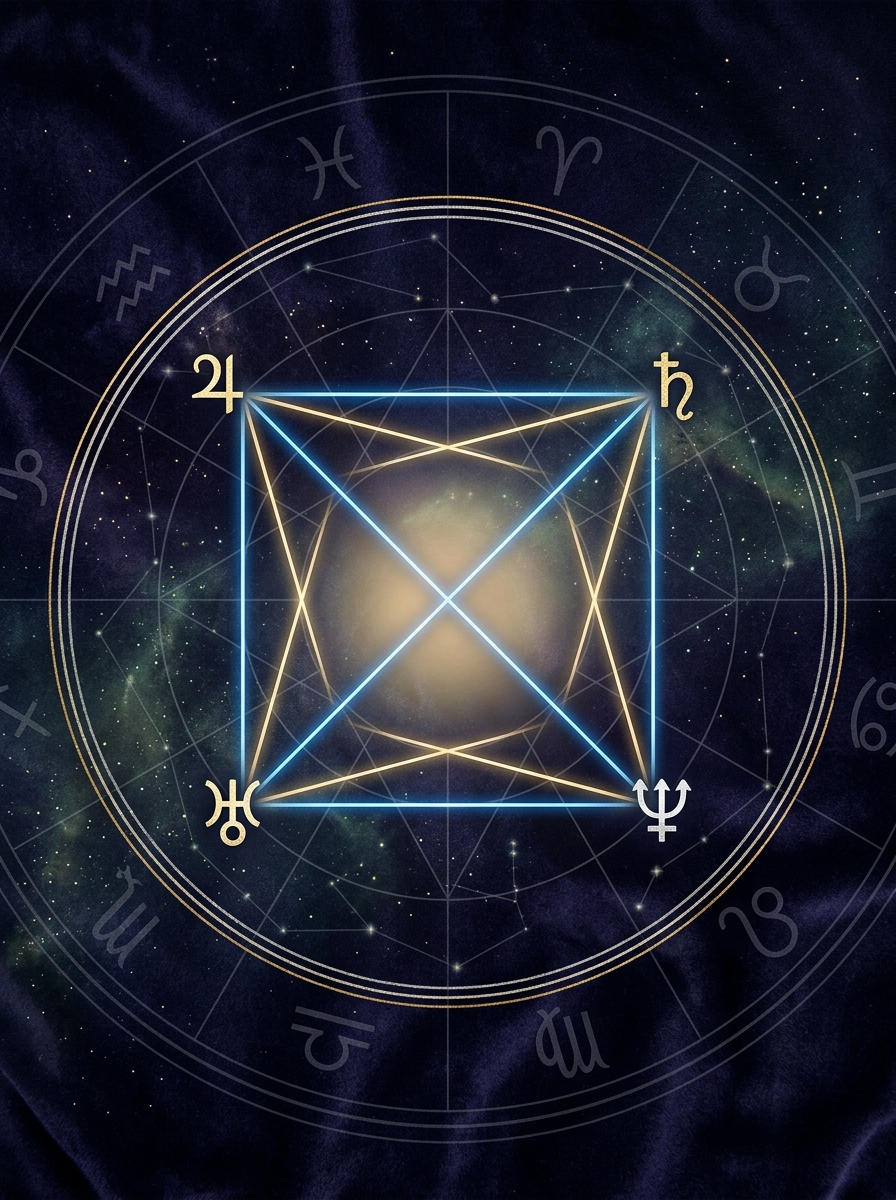
The Anatomy of the Mystic Rectangle: Geometric Perfection in the Cosmos
To look at a birth chart and see a Mystic Rectangle is to view one of the most aesthetically balanced and architecturally sound structures available in the celestial lexicon. At its core, this rare configuration requires four distinct planetary bodies, each positioned at specific angles to the others to form a highly symmetrical geometric box. Specifically, the pattern consists of two pairs of opposing planets. These two oppositions run parallel to each other, creating a long-sided rectangular shape in the circular wheel of the chart. But the magic of the Mystic Rectangle lies in how these opposing poles are connected: the vertices are linked by two sextiles (60-degree aspects) along the shorter sides of the rectangle, and two trines (120-degree aspects) running along the longer sides.
Mathematically and visually, the configuration is a masterpiece of sacred geometry. If you trace the aspect lines, you see a crisscross pattern in the center—the two oppositions crossing each other—contained within the protective outer perimeter of the sextiles and trines. This creates a closed-circuit energy system. Every planet involved is connected to every other planet in the configuration by either a hard aspect (the opposition) or a soft aspect (the trine or the sextile). In the language of traditional astrology, this means that any transit activating one corner of the Mystic Rectangle immediately reverberates through all four corners, triggering a synchronized response across the entire system.
The Mathematics of Redemptive Aspects
In the Western esoteric tradition, aspects are not merely distances; they are dynamic relationships between distinct archetypal forces. The opposition (180 degrees) is an aspect of division, projection, and relational confrontation. When two planets oppose each other, they represent polarized drives within the psyche that seem initially irreconcilable. One planet is often projected onto the external world or other people, while the individual identifies with the other. The tension is palpable, demanding resolution. The psychological weight of this confrontation can lead to projection, where we see in others the exact qualities we repress within ourselves.
However, in the Mystic Rectangle, the raw friction of the two oppositions is structurally redeemed. Every planet forming an opposition is also simultaneously forming a trine to one planet and a sextile to another. The trine represents a flowing, natural channel of shared element or compatible energy, allowing the planets to cooperate without conscious effort. The sextile represents an open door of opportunity, requiring a small amount of conscious intention to activate, but offering a highly productive cooperative pathway once engaged. Thus, the configuration contains its own built-in release valves. The tension generated by the oppositions does not build up until it explodes, nor does it freeze the individual in a state of chronic indecision. Instead, it is channeled smoothly through the trines and sextiles, turning raw psychological friction into refined creative expression.
The orb of influence for these aspects is typically held between 5 to 8 degrees. A tighter orb of 1 to 3 degrees creates a highly compulsive, immediate circuit where the energies are bound together inseparably. In such cases, the individual feels the call to integrate their polarities early in life, often through intense relational crises or vocational pivots. Wider orbs offer a gentler integration path, though they require more conscious application to make the most of the flowing aspect channels.
Polar Opposites in Parallel: The Complementary Axes
What makes the Mystic Rectangle unique is that it operates as a double-axis system. Unlike a T-Square, which has a focal planet under immense pressure, or a Grand Cross, which locks four planets in a four-way struggle of squares and oppositions, the Mystic Rectangle utilizes parallel oppositions. The two oppositions do not cross at right angles (90 degrees), which would create squares and generate acute distress. Instead, they cross at gentler angles, allowing the polarized elements to view each other with a degree of perspective.
Because the planets are in opposite signs, they naturally occupy polar elements—either Fire and Air, or Earth and Water. These polarities are fundamentally complementary. Fire needs Air to burn, and Air is warmed and energized by Fire. Earth contains and shapes Water, while Water nourishes and fertilizes Earth. The parallel nature of the oppositions means that the individual is working with two sets of complementary dialogues simultaneously.
For example, if the rectangle is set in Earth and Water signs, the individual might have Taurus opposing Scorpio on one axis, and Virgo opposing Pisces on the other. The practical, sensory realism of Taurus and Virgo is challenged and enriched by the deep, emotional, and mystical currents of Scorpio and Pisces. The dual axis ensures that the psyche is never allowed to settle into a simplistic, one-dimensional viewpoint. It is constantly invited to hold the tension of opposites, finding a middle path that honors both the concrete and the transcendent.
Furthermore, this elemental purity means the Mystic Rectangle is either entirely feminine (Earth/Water) or entirely masculine (Fire/Air). A feminine Mystic Rectangle operates through receptive, intuitive, and somatic channels, integrating through emotional processing and physical manifestation. A masculine Mystic Rectangle operates through active, intellectual, and expressive channels, reconciling opposites through philosophy, communication, and social engagement.
Tension as Creative Fuel: Beyond the Trap of Astrological Stasis
One of the greatest misconceptions in popular astrology is the idea that harmonious aspects (trines and sextiles) are inherently superior to challenging ones (squares and oppositions). Individuals with charts dominated by soft aspects often find themselves drifting through life, comfortable but unchallenged, lacking the necessary friction to initiate significant growth or creative output. Conversely, those with highly challenged charts may experience immense struggle but often produce monumental achievements, driven by the sheer necessity of resolving their inner conflicts. The Mystic Rectangle offers the best of both worlds: it contains enough inherent tension to act as a powerful engine for growth, combined with the structural harmony needed to translate that tension into constructive action.
In this configuration, tension is not a defect; it is the fuel. Without the two central oppositions, the trines and sextiles would lack direction. The oppositions act like the tightly wound spring in a mechanical clock, providing the raw energy that drives the gears. The individual is constantly poked, prodded, and challenged by the internal polarities. They cannot simply rest on their laurels because the opposing planets refuse to let them remain complacent. Whenever they attempt to overidentify with one side of the polarity—say, focusing exclusively on external career success at the expense of inner emotional life—the opposing planet asserts itself, often through external events or relationships, forcing them to re-evaluate.
The Crucible of the Oppositions: Psychological Friction
In the alchemical tradition, which Carl Jung used extensively to describe the process of psychological integration, transformation cannot occur without heat and containment. The Mystic Rectangle acts as both the crucible (the vessel) and the fire. The oppositions represent the fire—the heat of conflicting desires, viewpoints, and drives. The trines and sextiles represent the strong, stable walls of the vessel, ensuring that the heat does not destroy the psychological structure.
Consider the individual with a Mystic Rectangle involving Mars and Venus. The raw drive for self-assertion, conquest, and independence (Mars) is in direct opposition to the desire for connection, harmony, and relationship (Venus). In a standard chart, this opposition can manifest as a chaotic cycle of intense passion followed by explosive conflict, or a chronic pattern of sacrificing one's own needs to keep the peace. In the Mystic Rectangle, however, this Mars-Venus dialogue is stabilized. The Mars energy is tempered by a trine to a third planet, perhaps Saturn, which teaches the individual to discipline their drive. The Venus energy is supported by a trine to another planet, perhaps Neptune, which elevates their personal relationships into a search for universal love. The oppositions force the individual to confront their relationship dynamics, but the harmonious connections provide the maturity and vision to handle those dynamics with grace.
Instead of producing neurosis or paralysis, this setup encourages a state of dynamic equilibrium. The individual becomes highly resilient. They learn to tolerate ambiguity and conflict, understanding that opposites are not enemies but partners in a larger dance. This capacity to hold competing truths without collapsing into one-sidedness is one of the hallmarks of psychological maturity and spiritual depth.
The Role of Planetary Speeds and Retrogrades
The velocity and direction of the planets involved in the Mystic Rectangle introduce another layer of complexity to this creative engine. When fast-moving personal planets (such as Mercury or Venus) are paired with slow-moving outer planets (such as Pluto or Neptune), the timing of integration changes. The personal planet experiences the opposition as an immediate, daily psychological pressure, while the outer planet acts as a slow, generational undertow pulling the individual toward collective transformation.
If one or more planets in the configuration are retrograde, the tension is directed inward. A retrograde planet in the Mystic Rectangle suggests that the integration process must first occur in the deep recesses of the private self before it can be effectively lived out in the external world. For example, a retrograde Saturn in opposition to a direct Moon requires the individual to restructure their internal emotional boundaries and conquer their inner critic before they can establish mature, stable relationships in their outer life. The retrograde energy slows down the external manifestation of the rectangle, forcing a deeper, more contemplative engagement with the polarities involved.
The Psychological Temenos and Mandala: A Jungian Architecture of the Self
To understand the deeper, psychological significance of the Mystic Rectangle, we must turn to the work of Carl Gustav Jung. Jung wrote extensively about the "mandala"—a Sanskrit word meaning "circle"—as a symbolic representation of the Self and the wholeness of the psyche. Mandalas are typically characterized by a circular boundary containing a quaternary structure, often a square or a rectangle, with a clear center point. Jung observed that when his patients were undergoing intense periods of psychological disorientation or individuation, they would spontaneously draw or paint mandalas. The act of creating these highly symmetrical, structured designs served to organize and contain the chaotic contents of the unconscious, helping to stabilize the ego and align it with the deeper Self.
The Mystic Rectangle is, in essence, a celestial mandala written into the birth chart. Its four corners represent a quaternary structure of the psyche. In Jungian psychology, the number four is associated with wholeness, structure, and realization (as seen in the four cognitive functions: thinking, feeling, sensation, and intuition). By placing four planets in a balanced, rectangular relationship, the birth chart establishes a natural template for psychic wholeness. The configuration acts as a protective boundary—a psychological "temenos," or sacred space—within which the individual can safely confront and integrate their deepest conflicts.
The Ego-Self Axis and Inner Stabilization
Within the temenos of the Mystic Rectangle, the ego-Self axis is stabilized. The ego, representing our conscious identity, often feels threatened by the vast, chaotic currents of the personal and collective unconscious. When faced with powerful archetypal forces, the ego can easily become overwhelmed, leading to inflation, depression, or fragmentation. The Mystic Rectangle, however, provides a highly organized framework that prevents these extreme fluctuations.
Because the configuration is a closed system, any energy entering it is distributed evenly. If a difficult life event activates one of the oppositions, the shock is absorbed and moderated by the trines and sextiles. The individual does not lose their balance; instead, they are able to stand in the center of the rectangle, observing the conflict with a degree of psychological detachment. This central point of the rectangle represents the Self—the organizing principle of the psyche that transcends the ego.
By centering themselves within this celestial mandala, the individual can engage in what Jung called the "transcendent function"—the psychological process of reconciling opposites to create a new, third perspective that is greater than the sum of its parts. The Mystic Rectangle does not eliminate conflict; rather, it elevates it to a sacred art. The individual begins to see their personal struggles not as meaningless suffering, but as the necessary labor of the soul seeking integration. They become alchemists, using the vessel of the rectangle to refine their personality and bring the ego into alignment with the Self.
Active Imagination and the Integration of Shadow Elements
For those carrying this configuration, Jung’s method of Active Imagination becomes an indispensable tool. Active imagination involves consciously entering the imaginal realm to dialogue with the archetypal figures residing in the unconscious. Because the Mystic Rectangle contains two oppositions, there are always two distinct pairs of opposing voices shouting for attention within the psyche.
By employing active imagination, the individual can invite these opposing planetary archetypes to sit down at a psychic round table. If Mars and Venus are in opposition, the individual can visualize the inner Warrior and the inner Lover, allowing them to speak, express their grievances, and negotiate their needs. The presence of the trines and sextiles ensures that these dialogues do not devolve into shouting matches. Instead, the supporting planets act as mediators, offering creative compromises and practical solutions. This active dialogue prevents the shadow sides of the planets from operating destructively in the outer life, ensuring that the raw energy of the oppositions is integrated into a coherent, conscious identity.
Activating the Flow: Distinguishing the Mystic Rectangle from the Grand Trine
It is instructive to compare the Mystic Rectangle with another famous astrological configuration: the Grand Trine. The Grand Trine consists of three planets of the same element forming an equilateral triangle. It is widely considered one of the most fortunate patterns in astrology, associated with talent, ease, and luck. However, seasoned astrologers, including Liz Greene and Steven Forrest, have long pointed out the shadow side of the Grand Trine: its tendency toward inertia and complacency.
Because a Grand Trine is composed entirely of flowing, harmonious aspects, there is no inherent tension within the system. The energy circulates effortlessly, like water in a closed pool. While this creates a sense of peace and natural talent in a specific area, it often lacks the drive to manifest that talent in the real world. The individual may become lazy, avoiding challenges and retreating into the comfort of their inner world whenever difficulties arise. They are like a gifted musician who never practices because playing comes too easily, or a writer who dreams of great novels but never sits down to write them.
The Mystic Rectangle, by contrast, is a highly active and productive configuration. It contains the flowing ease of the trine, but it anchors that ease with the structural tension of the opposition. It does not allow for passive complacency. Where the Grand Trine is a closed triangle of comfort, the Mystic Rectangle is an engine of transformation.
| Feature | The Grand Trine | The Mystic Rectangle |
|---|---|---|
| Aspect Composition | Three Trines (120°) | Two Oppositions (180°), Two Trines (120°), Two Sextiles (60°) |
| Energy Dynamic | Passive, circulating, closed loop | Active, dynamic, integrating polarities |
| Motivation Level | Low (tends toward complacency and ease) | High (driven by the tension of oppositions) |
| Psychological Focus | Preservation of comfort and natural talent | Growth, individuation, and reconciling opposites |
| External Manifestation | Inherent gifts that may remain unexpressed | Tangible creations, problem-solving, resilience |
Overcoming the Inertia of Harmony: The Slippery Slope of Comfort
To fully realize the potential of a Mystic Rectangle, the individual must learn to consciously navigate its different aspects. The danger of this configuration is not paralysis from conflict, but rather a subtle form of dynamic avoidance. Because the trines and sextiles offer such easy pathways, the individual may use them to escape the deep work of the oppositions. When the tension between the opposing planets becomes too uncomfortable, they may choose to slide along the trine path, using their natural talents to distract themselves from the underlying psychological split.
For instance, if the opposition is between Mercury (rational thought) and Neptune (mystical intuition), the individual may feel torn between logical analysis and spiritual surrender. If they refuse to hold this tension, they might escape into the trine of Mercury to Pluto, using obsessive research or intellectual dominance to ignore the Neptunian call to let go of control. Alternatively, they might slide along the Neptune trine to Jupiter, losing themselves in spiritual escapism to avoid the hard work of critical thinking.
Activating the true power of the Mystic Rectangle requires the individual to face the oppositions head-on. They must stand firm at the center of the axes, refusing to run away to the comfortable corners. By doing so, they allow the tension to build until a creative synthesis emerges. The trines and sextiles are then used not as escape routes, but as the practical tools to manifest this synthesis in the physical world. The individual becomes a bridge-builder, translating their deep inner resolutions into concrete works of art, philosophy, or social contribution.
Practical Application in the Birth Chart: Houses, Regents, and Conscious Discipline
While the geometric theory of the Mystic Rectangle is elegant, its true value lies in how it manifests in the daily life of the individual. To analyze a Mystic Rectangle in a specific birth chart, we must look beyond the aspects themselves and consider the houses they occupy, the planetary regents involved, and the level of conscious discipline the individual brings to their chart.
The houses occupied by the four planets indicate the specific areas of life where the drama of integration will play out. Because the configuration consists of two oppositions, it will always span two pairs of opposite houses. Typically, these will be the relationship houses (1st and 7th houses, or 2nd and 8th houses), the mental and spiritual houses (3rd and 9th houses, or 4th and 10th houses), or the service and isolation houses (5th and 11th houses, or 6th and 12th houses).
The Angular, Succedent, and Cadent Dynamic
The placement of the Mystic Rectangle within the three house classifications (angular, succedent, or cadent) determines the primary mode of its manifestation in the physical world.
If the rectangle is placed in the angular houses (1st, 4th, 7th, and 10th), the work of integration is highly visible and action-oriented. The individual’s core identity (1st), family foundations (4th), partnerships (7th), and public career (10th) are all bound together. Every personal choice affects their relationship status; every career move impacts their home life. The tension is immediate and demands outward, behavioral resolution. These individuals often become public leaders, pioneering new paths by resolving highly visible structural conflicts in their fields.
If the configuration falls in the succedent houses (2nd, 5th, 8th, and 11th), the focus shifts to values, resources, and creative expression. The individual must reconcile their personal finances and self-worth (2nd) with shared investments and intimacy (8th), while balancing personal creative joy (5th) with collective group affiliations (11th). The work here is one of stabilizing resources and expressing creative genius. The tension forces the individual to build solid financial and emotional foundations, utilizing their talents to serve both the self and the community.
If the rectangle occupies the cadent houses (3rd, 6th, 9th, and 12th), the dynamic is intellectual, spiritual, and service-oriented. The balance between local communication (3rd) and higher philosophy (9th) runs parallel to the integration of daily work habits (6th) and spiritual surrender (12th). This is the classic signature of the writer, teacher, or spiritual healer. The work is deeply internal, focusing on mental restructuring, daily service, and accessing the collective unconscious. The individual integrates their opposites through writing, teaching, and acts of selfless service.
The Esoteric Path: Historical Lineages and Alchemy of the Rectangle
In the broader context of Western esotericism, the Mystic Rectangle has long been associated with the process of spiritual alchemy—specifically the stage of the coniunctio, or the sacred marriage of opposites. In alchemical texts, the goal was not merely to create gold from lead, but to purify the soul of the alchemist by dissolving old, rigid structures (solutio) and coagulating the purified elements into a new, divine form (coagulatio).
The geometry of the rectangle mirrors this alchemical work. The two oppositions represent the dual forces of Sol (the Sun, representing conscious will) and Luna (the Moon, representing receptive soul), or the alchemical Sulfur and Mercury. These forces must be brought into direct contact and held together until they merge. The trines and sextiles act as the alchemical catalysts, facilitating the transition from conflict to union.
The Hermetic Tradition and the Quaternary Mystery
Historically, astrologers working within the lineage of the Hermetic Order of the Golden Dawn, such as Arthur Edward Waite, recognized the importance of such balanced configurations. They saw them as astrological signatures of those who were called to the path of initiation. The rectangle was viewed as a representation of the four elements (Fire, Earth, Air, Water) brought into perfect harmony around a central spirit—the classic esoteric formula of the Pentagrammaton, where the fifth element of Spirit dominates and directs the four physical elements.
Aleister Crowley, in his writings on the Thoth Tarot and esoteric geometry, frequently alluded to the balance of the four elements as a prerequisite for the Great Work. Without a balanced quaternary foundation, any attempt to invoke higher spiritual forces would result in psychological imbalance or madness. The Mystic Rectangle provides this exact foundation. It is a stable base, an altar upon which the sacred fire of spirit can burn without consuming the temple.
For the modern seeker, the Mystic Rectangle is a signpost pointing toward the path of the integrated mystic. It suggests that the individual's greatest trials (the oppositions) are intimately connected to their greatest gifts (the trines and sextiles). By embracing the discipline of the path, they can turn their natal chart from a map of internal conflict into a blueprint for spiritual illumination.
Frequently Asked Questions
What does it mean if my Mystic Rectangle is activated by a major transit?
When a slow-moving outer planet (such as Saturn, Uranus, Neptune, or Pluto) transits and aspects one of the planets in your Mystic Rectangle, it activates the entire configuration simultaneously. Because the system is interconnected, the transit will not feel like an isolated event affecting only one area of your life. Instead, it will trigger a comprehensive shift across all the houses and planetary energies involved. While this can feel intense and overwhelming, it also represents a period of accelerated growth and integration. The key during such transits is to remain centered in the middle of the rectangle, using your established trines and sextiles to channel the incoming energy productively. Rather than reacting impulsively, utilize the structure to ground the transit's electrical charge.
Can a Mystic Rectangle include Chiron or the Lunar Nodes?
Astrologers differ on this point, but most modern, psychologically oriented astrologers agree that Chiron and the Lunar Nodes can participate in a Mystic Rectangle, though their influence may feel slightly different than that of a major planet. Chiron brings a deep theme of wounding and healing to the configuration, suggesting that the integration of opposites is central to your healing journey. The Lunar Nodes bring a sense of destiny and evolutionary direction, indicating that learning to balance and use this rectangle is a primary goal of your soul's growth in this lifetime. When these sensitive points are involved, the integration work becomes less about active doing and more about karmic reconciliation and vulnerability.
Is a Mystic Rectangle always beneficial, or can it manifest negatively?
No astrological configuration is purely positive or negative; all depend on the consciousness of the individual. The shadow side of the Mystic Rectangle is the temptation to use its harmonious pathways to avoid confronting the deep, uncomfortable truths of the oppositions. If you continually choose the path of least resistance (the trines and sextiles) to escape conflict, you may create a life that looks balanced on the surface but is hollow underneath. Real growth requires you to face the tension of the oppositions directly, using the harmony of the rest of the configuration to support that work rather than avoid it. Without conscious awareness, the rectangle can become a gilded cage of self-reinforcing habits.
How rare is the Mystic Rectangle in a birth chart?
The Mystic Rectangle is considered a relatively rare configuration because it requires four planets to be positioned at very specific, harmonious angles to one another within a narrow orb of influence (typically 5 to 8 degrees). It requires a precise alignment of two oppositions, two trines, and two sextiles. Because of this mathematical precision, only a small percentage of the population has a fully formed Mystic Rectangle in their natal chart. If you have one, it is a significant feature of your astrological blueprint, indicating a strong potential for psychological integration and creative achievement.
What should I do if one corner of my Mystic Rectangle is unrepresented or empty?
If a chart exhibits three planets that would form a Mystic Rectangle but lacks the fourth, it is referred to as a "three-quarter" or "incomplete" rectangle. The empty corner represents a highly sensitive point in space, known as a sensitive point or vacancy. When transiting planets pass through this empty degree, they temporarily complete the Mystic Rectangle, triggering a sudden, brief period of integration and flow. Alternatively, another person whose natal planets occupy that empty degree can complete the configuration for you. In relationships, this synastry connection can feel incredibly stabilizing, as if the other person provides the missing piece of your psychological mandala, helping you balance your internal opposites.
How does a Mystic Rectangle behave differently when set in Masculine versus Feminine signs?
A Mystic Rectangle set in Masculine signs (Fire and Air) operates primarily through mental, social, and action-oriented dynamics. The integration occurs through intellectual exchange, philosophical exploration, and direct external action. The tension is discussed, analyzed, and solved through communication and changes in outer behavior. A Mystic Rectangle set in Feminine signs (Earth and Water) operates through emotional, somatic, and receptive dynamics. Reconciling opposites in a feminine rectangle requires deep emotional processing, somatic integration, and connecting with the body’s wisdom. The tension is resolved not by thinking it through, but by feeling it through, allowing the internal landscape to shift organically.
Comments
Loading comments…