The Celestial Blueprint: Navigating Your Daily, Weekly, and Monthly Horoscopes
The Cosmic Loom: Astronomy, Ephemerides, and the Craft of Horoscope Writing
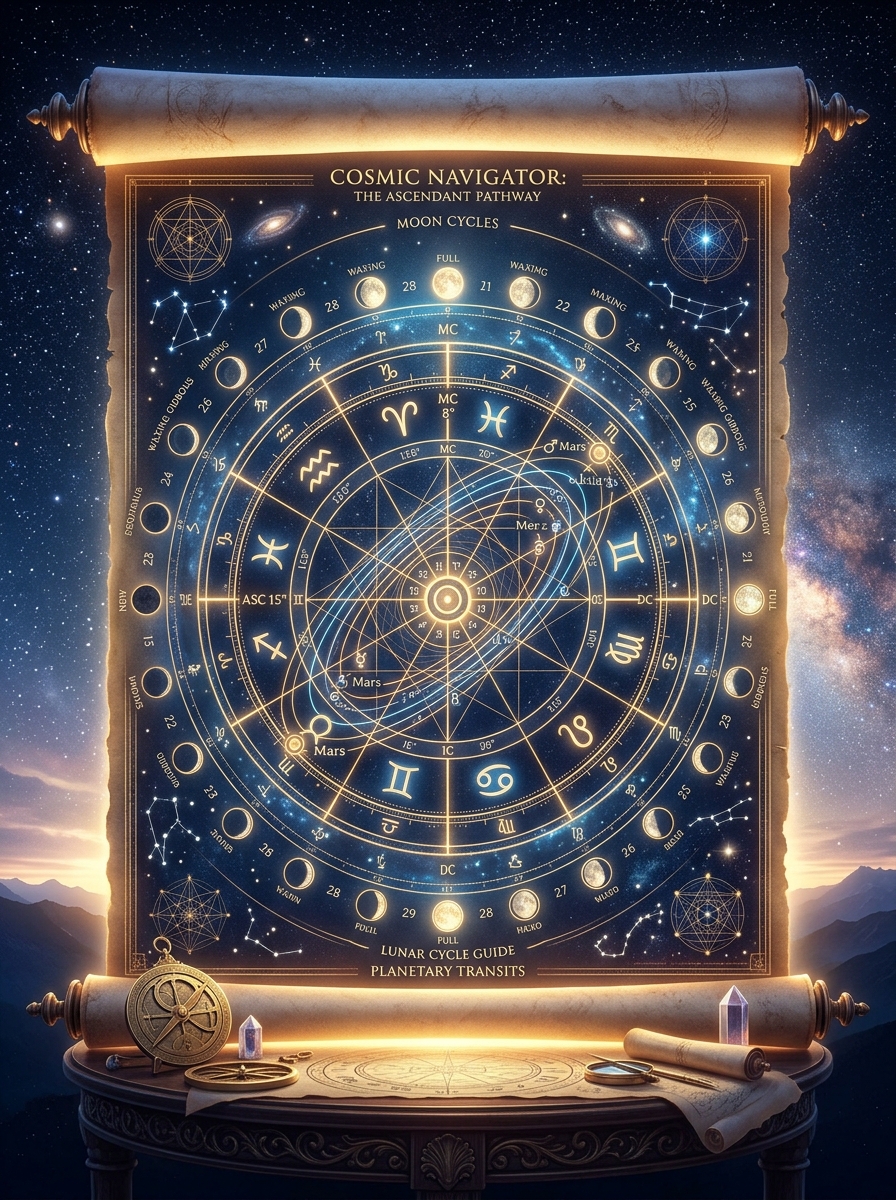
In contemporary media, horoscopes are frequently relegated to the margins of newsprint or the scroll of digital lifestyle feeds, reduced to brief paragraphs offering vague promises of financial windfalls or unexpected romantic encounters. This superficial treatment obscures a profound truth: the genuine craft of horoscope writing is a sophisticated art built upon rigorous astronomical and mathematical foundations. Far from being arbitrary fabrications, authentic forecasts are calculated interpretations of real-time celestial mechanics. To understand this practice is to view the heavens as a dynamic, geometric map—a cosmic loom where the orbits of the planets are woven against the backdrop of the ecliptic.
Ephemerides and Mathematical Rigor in Astrology
The starting point for any authentic astrological forecast is the ephemeris. An ephemeris is a precise table detailing the calculated positions of the Sun, Moon, and planets at specific, regular intervals, such as midnight or noon Greenwich Mean Time. Historically calculated by hand using spherical trigonometry, modern ephemerides are compiled using advanced orbital algorithms provided by institutions like NASA’s Jet Propulsion Laboratory. When an astrologer sits down to write a forecast, their first step is not creative writing, but astronomical calculation. They trace the celestial longitude of the transiting bodies, identifying the exact degrees of the zodiac that the planets occupy on a given day. This geometric mapping provides the objective, empirical data from which symbolic meaning is derived.
Astrologers analyze the speed of planetary movements, their directional changes (such as retrograde and direct stations), and the angular relationships they form with one another, known as aspects. A transit occurs when a moving planet reaches a specific degree of the zodiac that aligns with a natal position or creates a significant angle in the sky. For instance, if transiting Saturn forms a ninety-degree square aspect to the transiting Sun, this geometry represents a period of structural tension and pressure. The astrologer translates this astronomical relationship into a psychological description of the collective mood, framing it as a time for consolidation, setting limits, and necessary maturation. This process requires a deep familiarity with the symbolic language of astrology, but it remains tethered to the actual movement of physical bodies in space.
Transits and the Quality of Time
This methodology relies on a concept that Carl Jung explored extensively: the idea that time possesses a qualitative, not just a quantitative, dimension. While a clock measures the quantity of minutes passing, astrology maps the quality of those minutes. This qualitative time is determined by the shifting configurations of the celestial bodies. A daily horoscope, a weekly forecast, and a monthly guide operate on distinct temporal scales, each tracking different layers of this cosmic weather. Daily forecasts focus primarily on the Moon, the swiftest-moving body, which traverses a zodiac sign in approximately two and a half days. Because of its speed, the Moon reflects the rapid, fluctuating tides of our immediate emotional and somatic states, serving as a daily weather report for the subconscious.
Weekly forecasts expand the lens to include the inner planets—Mercury, Venus, and Mars. These bodies move slower than the Moon but fast enough to mark weekly shifts in our intellectual focus, relational dynamics, and physical drive. Astrologers track their ingresses—the moments they cross the threshold into a new sign—and the major aspects they form, offering strategies for navigating communication, social engagements, and professional assertions. Monthly guides look at the largest cycles: the lunation cycle of the New and Full Moons, and the slow transits of the outer planets—Jupiter, Saturn, Uranus, Neptune, and Pluto. These outer planets move slowly, sometimes spending years or decades in a single sign, and their transits represent the broad, systemic shifts in our psychological growth. By synthesizing these varying speeds, the astrologer weaves a multi-tiered narrative that allows readers to orient themselves within the complex, unfolding cycles of their lives.
The Lunar Compass: Tracking the Moon's Journey Through the Zodiac
The Moon is the closest celestial body to Earth, and its rapid orbit makes it the primary timekeeper of our daily psychological experience. Completing its journey through all twelve signs of the zodiac in approximately twenty-eight days, the Moon acts as a celestial compass, charting the shifting tides of the human subconscious, instinctual reactions, and somatic states. While the Sun represents the conscious ego and the active pursuit of our destiny, the Moon governs the receptive, reflective, and emotional dimensions of the psyche. By tracking the Moon’s movement, we gain a practical tool for navigating the immediate emotional weather of daily life.
The Lunar Modalities and Elemental Tides
As the Moon transits through each sign, it colors the collective emotional atmosphere with the qualities of that sign's element and modality. In fire signs (Aries, Leo, Sagittarius), the lunar tide is active, expressive, and passionate, often manifesting as an instinctual need for action, recognition, or adventure. During these days, the emotional energy is warm and outward-facing, but it can also bring impatience and a lower threshold for frustration. When the Moon enters earth signs (Taurus, Virgo, Capricorn), the atmospheric pressure shifts toward the physical, practical, and somatic. These are days to ground oneself in the senses, attend to material responsibilities, and find security in structured routines. Emotional stability is sought through tangible actions and physical comfort.
Air sign transits (Gemini, Libra, Aquarius) bring a lighter, more intellectual, and communicative energy. The emotional response is characterized by curiosity, social engagement, and a need to process feelings through verbal expression or abstract ideas. These days favor networking, dialogue, and collaborative brainstorming. Finally, when the Moon plunges into water signs (Cancer, Scorpio, Pisces), the collective focus turns inward toward the subjective, intuitive, and highly sensitive depths of the psyche. These transits amplify our empathy and emotional awareness, but they can also trigger defensiveness, moodiness, and a desire to retreat into a protective sanctuary. Understanding these elemental shifts allows us to align our daily schedules with the prevailing psychological current, choosing when to push forward and when to rest.
The Lunation Cycle as a Psychological Roadmap
The monthly journey of the Moon is punctuated by its changing relationship with the Sun, a cycle of light and dark that serves as a profound psychological roadmap. The lunation cycle begins with the New Moon, a moment of alignment when the Moon is dark and invisible from Earth. Symbolically, this represents a phase of latency, introspection, and the planting of intentions. It is a time to quiet the conscious mind, look inward, and identify the seeds of growth we wish to cultivate in the coming month. As the Moon waxes, gathering light, the energy builds, demanding action, adaptation, and the implementation of our plans. This phase of active building culminates in the Full Moon, when the Moon is fully illuminated by the Sun.
The Full Moon represents a peak of emotional expression, illumination, and culmination. Hidden dynamics are brought to light, and projects initiated at the New Moon reach a point of completion or crisis. This is often a highly charged emotional time, as the subconscious is fully exposed to the light of consciousness. Following the Full Moon, the Moon begins its waning phase, a period of release, integration, and reflection. During this time, we are encouraged to harvest the lessons of the cycle, prune away what no longer serves us, and prepare for the quietude of the next New Moon. By aligning our monthly planning with this natural pulse of build and release, we move out of the exhausting paradigm of constant, linear production and enter a sustainable, cyclical rhythm that honors the health of our nervous systems.
Beyond Fate: Psychological Astrology, Archetypal Weather, and Free Will
In the mid-twentieth century, the field of astrology underwent a profound revolution. Drawing on the pioneering depth psychology of Carl Jung, astrologers like Liz Greene and Steven Forrest began to strip away the fatalistic, predictive layer that had characterized the practice for centuries. This shift gave birth to psychological astrology, an approach that rejects the notion of a deterministic fate in favor of an archetypal framework. Rather than viewing the planets as external forces that dictate events, psychological astrology understands them as symbols of the internal, universal patterns of the human psyche. The cosmos is not something that happens to us; it is a mirror reflecting our inner development.
Jungian Synchronicity and the Mirror of the Cosmos
Central to this psychological perspective is Carl Jung’s concept of synchronicity, which he defined as an acausal connecting principle. Jung proposed that events can be meaningfully related without having a direct cause-and-effect relationship. In astrological terms, this means that the alignment of Mars in the sky does not exert a gravitational pull that makes you angry; rather, the outer movements of the solar system and the inner experiences of humanity are synchronized. They reflect the same archetypal pattern at the same time, much like two clocks ticking in unison. The planets are not causes; they are signs.
This understanding transforms how we read and interpret horoscopes. A transit forecast is not a prediction of what will happen to you; it is a report on the archetypal weather. Just as a meteorological forecast tells you to expect rain so you can prepare, a transit forecast alerts you to the emotional and psychological conditions of your environment. For example, a transit of Pluto does not guarantee a financial or physical loss. Instead, it indicates that you are entering a symbolic winter—a period of psychological purging, where you are invited to confront your shadow, let go of outdated attachments, and undergo a process of rebirth. By understanding the transit in this light, you are empowered to work with the energy consciously, rather than experiencing it as a hostile, external event.
Liz Greene, Steven Forrest, and the Evolution of Agency
This archetypal reframing preserves the vital principle of human free will and agency. Steven Forrest, a leading voice in evolutionary and psychological astrology, emphasizes that the birth chart does not represent a static fate, but a set of evolutionary questions and potentials. Every astrological archetype has a wide spectrum of manifestation, ranging from unconscious, destructive expressions to conscious, creative integrations. A transit of Uranus, for instance, represents the archetype of the revolutionary, the catalyst for freedom and change. An individual operating unconsciously might experience this as a chaotic disruption, a sudden breakdown of stability, or an impulse to act out destructively. A conscious individual, however, can channel that same energy to break free from suffocating habits, innovate in their career, or embrace a more authentic path.
Liz Greene, co-founder of the Centre for Psychological Astrology, emphasizes that planetary transits act as psychological catalysts, bringing split-off or repressed parts of the self (the shadow) into conscious awareness. When we experience a transit of a difficult planet like Saturn or Pluto, it often manifests externally as a challenging situation or conflict with another person. Through the lens of depth psychology, this external event is recognized as a projection of our own unconscious material. The transit does not cause the event; it simply indicates that the time is ripe for the integration of this unconscious content. By reframing the transit as an opportunity to reclaim our projected power, we move from being victims of fate to active participants in our psychological evolution.
Furthermore, the psychological approach integrates the rich symbolic traditions of Western esotericism, including the archetypal images of the Tarot. The Rider-Waite-Smith tradition, developed in part by Arthur Edward Waite, shares a deep symbolic language with astrology. Just as the Major Arcana of the Tarot represent the stages of psychological individuation, the transits of the planets map the timing of these inner initiations. Esoteric practitioners often notice how the tarot card of the Tower resonates with sudden Uranian shifts, or how the Hermit reflects a Saturnian phase of isolation and structured self-examination. In his writing, Aleister Crowley also noted how planetary aspects mirror the alchemical combinations of the soul. When we read a horoscope, we are looking at the planetary coordinates of our current developmental stage. The forecast does not rob us of choice; it illuminates the options. It shows us where our personal blind spots, or shadow elements, are being triggered, and invites us to integrate them into our conscious awareness. In this way, astrology ceases to be a tool of fortune-telling and becomes an instrument for self-discovery and psychological liberation.
The Solar House System: How One Sky Speaks to Twelve Different Signs
One of the most common questions from skeptics and newcomers alike is how a single sky can speak to twelve different signs of the zodiac. On any given day, the planetary positions are identical for everyone on Earth. How, then, can a horoscope claim that Scorpio is experiencing a career transition while Taurus is focused on relationship harmony? The solution to this paradox lies in the structural mechanics of the Solar House System, a geometric framework that rotates the sky to create twelve unique perspectives from a single celestial configuration.
The Sunrise Chart and Equal House Division
In a personalized birth chart, the houses are calculated based on the exact time and geographical location of birth. The eastern horizon at that precise moment becomes the Ascendant, which marks the cusp of the First House. The remaining eleven houses rotate from that point, partitioning the sky into twelve sectors that represent different areas of human experience—from identity and finances to career and subconscious processing. However, when writing horoscopes for a general audience, the astrologer does not have access to individual birth times. To solve this, they construct what is known as a Solar Sunrise Chart.
The Solar Sunrise Chart assumes the Sun is rising on the eastern horizon at the moment of birth, placing the zero degree of the reader's Sun sign (or Rising sign) on the cusp of the First House. Using an Equal House system, the zodiac is then divided into twelve equal thirty-degree segments, with each subsequent sign occupying a subsequent house. For example, if you are reading the forecast for Aries, the sign of Aries is placed on the First House. Taurus becomes the Second House, Gemini the Third House, Cancer the Fourth House, and so on, creating a unique structural map for that sign. This geometric rotation explains how one set of planetary positions yields twelve completely different narratives.
While quadrant systems like Placidus or Koch calculate house cusps based on the intersection of the ecliptic with the local horizon and meridian—making them highly dependent on the exact latitude of birth—the Equal House and Whole Sign systems offer a more uniform geometric structure. By allocating an equal thirty-degree segment of the ecliptic to each house, these systems maintain a consistent relationship between the signs and the life sectors. This structural consistency is particularly valuable for general horoscopes, as it allows the astrologer to map transiting planets to specific houses without needing the highly individualized calculations required by quadrant systems.
The Rotation of the Houses: A Planetary Example
To see this system in action, let us trace a specific planetary transit through this rotated wheel. Imagine that Mars is currently transiting through the sign of Cancer. Mars represents the archetype of drive, energy, assertion, and potential conflict. Because the Solar House System rotates the wheel for each sign, Mars will occupy a different sector of life for every one of the twelve signs.
For Cancer, the transit of Mars occurs in the First House, which governs physical energy, self-assertion, and personal identity. Cancer individuals may feel a surge of physical vitality, a desire to take the initiative, or a need to set firm boundaries, but they must also watch for irritability and ego conflicts. For Aries, however, Cancer represents the Fourth House, which governs home, family, and inner roots. The energy of Mars is directed inward, prompting Aries readers to renovate their living spaces, address family conflicts, or confront private, emotional patterns. Meanwhile, for Capricorn, Cancer represents the Seventh House of partnerships. For Capricorn, the transit of Mars does not manifest as a personal surge of energy or a domestic project; it manifests in the sphere of relationships, highlighting active collaborations, passionate encounters, or tension with a partner. This geometric shifting demonstrates that the astrological weather is never uniform; its impact depends entirely on where it falls within the structure of your solar houses.
Optimizing Your Reading: Integrating Sun, Moon, and Rising Signs
For many people, their interaction with astrology begins and ends with their Sun sign. While the Sun represents the vital core of our identity and the direction of our hero's journey, it is only one component of a complex, multidimensional birth chart. To read a general horoscope with accuracy and depth, one must learn to integrate what astrologers call the Astrological Trinity: the Sun, the Moon, and the Ascendant (or Rising sign). By reading the forecasts for all three placements and synthesizing their meanings, you can create a highly personalized, psychological guide.
The Astrological Trinity: Ego, Emotion, and Environment
To integrate these three points, we must first understand their distinct psychological functions. The Sun sign is the conscious self, the ego, and the path of creative self-expression. It represents what we are learning to become—our ultimate developmental goal. When you read the horoscope for your Sun sign, you are gaining insight into how the current transits are affecting your sense of purpose, your vitality, and your conscious path of growth.
The Moon sign, on the other hand, represents the subconscious mind, the emotional template, and the somatic body. It governs how we react instinctively, how we seek comfort, and how we process emotional experiences. Reading the forecast for your Moon sign helps you understand your immediate emotional reactions to the cosmic currents. It tells you how to care for your nervous system during intense transits and provides a barometer for your internal state.
The Rising sign, or Ascendant, is the physical lens through which we interact with the world. It represents our primary approach to life, our outer personality, and the actual circumstances of our daily environment. In terms of horoscope mechanics, the Rising sign is the most crucial point to read. Because general horoscopes are calculated using house systems that start with the sign on the horizon, reading the forecast for your Rising sign will align the houses of the horoscope with the actual house structure of your personal birth chart. If a transit is occurring in the career house of the Rising sign forecast, it is highly likely to manifest as a real, physical event in your professional life.
Synthesizing Your Daily, Weekly, and Monthly Forecasts
The art of reading horoscopes lies in the synthesis of these three elements. Rather than looking for a single, literal prediction, you should view the forecasts for your Sun, Moon, and Rising signs as different layers of a single psychological landscape. By combining them, you can map the circumstantial, emotional, and conscious aspects of your experience.
Consider the example of an individual with a Scorpio Sun, a Taurus Moon, and a Leo Rising. To navigate the week's transits, this person would begin by reading the forecast for Leo, their Rising sign. This Leo forecast will outline the concrete areas of life where the planetary energy is manifesting—for instance, indicating that a solar transit is spotlighting their career and public reputation. Next, they would read the Scorpio forecast, their Sun sign, to understand how this career focus aligns with their core developmental path, perhaps suggesting a need to embrace personal power or undergo an inner transformation. Finally, they would read the Taurus forecast, their Moon sign, to understand how their subconscious is reacting to this professional pressure, advising them to seek physical grounding, stability, and sensory comfort to balance the external demands. By synthesizing these three perspectives, the reader gains a comprehensive, empowering roadmap that respects both their outer reality and their inner complexity.
Sign-by-Sign Forecast Directory: Daily, Weekly, and Monthly Guides
To assist you in navigating the archetypal currents of the cosmos, our platform offers a comprehensive, sign-by-sign directory of astrological forecasts. These guides are updated in real-time, translating the objective mathematics of astronomical transits into practical, psychological insights. By offering daily, weekly, and monthly forecasts for all twelve signs of the zodiac, this directory serves as an active directory for conscious living, allowing you to track the celestial weather and make aligned choices.
Accessing Your Sign's Cosmic Roadmap
The sign-by-sign directory is structured to accommodate the varying rhythms of daily life and long-term planning. To get the most out of this resource, we recommend bookmarking the pages for your Sun, Moon, and Rising signs, creating a personalized reading list that you can consult regularly. Each sign’s guide is divided into three distinct temporal views:
The Daily Guides are designed for quick, mindful check-ins. Centered on the swift movement of the Moon and minor planetary aspects, these daily readings provide a snapshot of the emotional and somatic atmosphere. They offer practical advice on how to manage your energy, suggestions for daily challenges, and insights into the collective mood. Use these guides as part of a morning reflection practice to set your intentions and identify potential emotional triggers.
The Weekly Forecasts expand the perspective, focusing on the movement of the inner planets and their major aspects. Here, you will find detailed strategies for the week ahead, detailing ingress dates, planetary retrogrades, and the key alignments affecting communication, creativity, and relationships. These guides are excellent for tactical planning, helping you determine the best times for collaborative projects, difficult conversations, or quiet introspection.
The Monthly Overviews provide a deep dive into the overarching themes of the month. Tracing the major lunations, planetary shifts, and outer planet movements, these guides offer a psychological roadmap for the weeks ahead. They highlight the primary developmental lessons of the current season, helping you review long-term goals, track personal evolution, and understand the deeper structural shifts occurring in your life.
Structure and Utility of the Guides
By navigating through this directory, you are not engaging in a passive exercise of fortune-telling; you are actively collaborating with your own psychological development. Each forecast is written with a sophisticated, non-deterministic approach, framing transits as opportunities for conscious integration. The guides do not tell you what will happen to you, but rather what is unfolding within you.
Whether you are seeking to understand the somatic demands of a Moon in Scorpio, the relational adjustments required by a Venus retrograde, or the long-term career structuring of a Saturn transit, the sign-by-sign directory provides the archetypal coordinates you need. Use these forecasts to develop greater self-awareness, practice self-compassion, and cultivate the resilience necessary to navigate the ever-changing tides of your life. Select your sign below to access your daily, weekly, and monthly forecasts:
- Aries: Forecasts for the Ram
- Taurus: Forecasts for the Bull
- Gemini: Forecasts for the Twins
- Cancer: Forecasts for the Crab
- Leo: Forecasts for the Lion
- Virgo: Forecasts for the Virgin
- Libra: Forecasts for the Scales
- Scorpio: Forecasts for the Scorpion
- Sagittarius: Forecasts for the Archer
- Capricorn: Forecasts for the Sea-Goat
- Aquarius: Forecasts for the Water-Bearer
- Pisces: Forecasts for the Fish
Frequently Asked Questions
Why do some horoscopes seem inaccurate for my sign?
General horoscopes are calculated for entire signs, which groups millions of individuals together under a single archetype. Because your personal birth chart is a unique blueprint with planets at varying degrees, a general sign forecast cannot capture every detail of your life. To increase the accuracy of a general forecast, read the update for your Rising sign (Ascendant). This aligns the house system of the forecast with the actual house structure of your birth chart, placing the transiting planets in the correct sectors of your life.
Is astrology deterministic, or do I have free will?
Astrology is not deterministic and does not predict unalterable outcomes. Instead, it acts as a symbolic weather report, mapping the archetypal climate and psychological tendencies of the collective sky. You always possess free will and personal agency. The transits represent the energetic environment, but you choose how to respond, act, and grow within that environment. Understanding the transits allows you to make conscious, empowered decisions rather than reacting unconsciously to the planetary weather.
How often should I check my daily, weekly, and monthly horoscopes?
Use these forecasts as tools for mindfulness and self-reflection rather than rigid guides. Daily forecasts are excellent for tracking immediate emotional trends and somatic responses; weekly forecasts are helpful for planning communication, relationships, and projects; and monthly forecasts are ideal for deep psychological reflection, helping you track long-term cycles of personal growth and evolution.
What is the difference between my Sun sign and my Rising sign in forecasts?
Your Sun sign represents your conscious identity, vitality, and your core evolutionary path of growth (your hero's journey). Your Rising sign (Ascendant) represents the cusp of your First House, governing your physical personality, external circumstances, and the structural areas of life (the houses) where transiting planets manifest physically.
Can horoscopes predict health, financial, or legal outcomes?
No. Authentic psychological astrology does not make definitive predictions about health, financial, or legal matters. It identifies the archetypal and psychological dynamics at play, helping you understand your inner motivations and the timing of your developmental cycles so you can make informed, conscious decisions in these practical areas of your life.
Comments
Loading comments…