The Alchemy of Togetherness: A Psychological Guide to Relationship Astrology
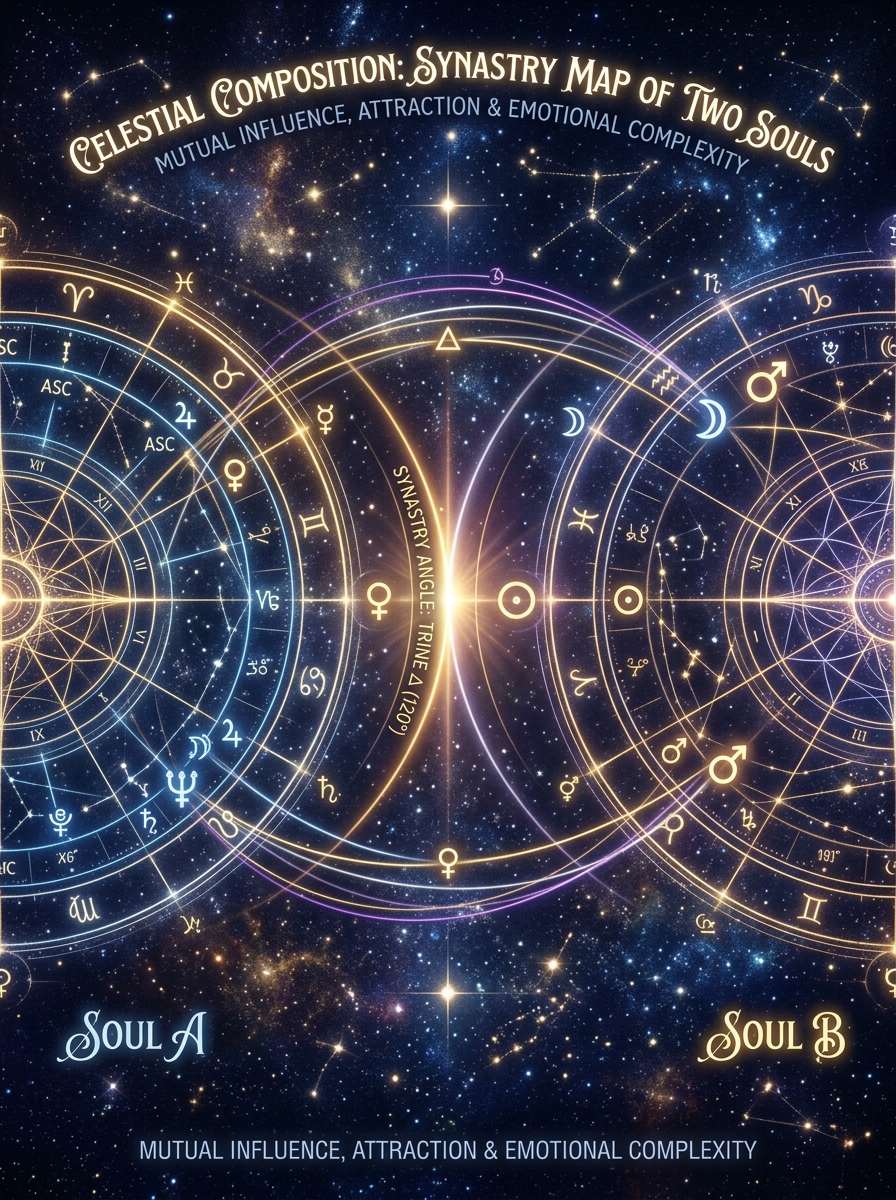
The Architecture of Relationship Astrology: Chemistry versus the Third Entity
When two individuals enter into a significant relationship, a profound psychological and energetic field is instantly activated. Analyzing this connection requires moving beyond basic star-sign compatibility to examine the complex, multi-dimensional structures that define interpersonal dynamics. In the realm of modern astrological practice, we address this complexity through three primary, distinct techniques: Synastry (the chart overlay), the Composite Chart (the midpoint chart), and the Davison Chart (the time-space midpoint). Each technique offers a unique psychological lens, allowing practitioners to explore different layers of the partnership.
At the heart of relationship astrology lies a crucial distinction: the difference between the direct chemistry between two individuals and the container of the relationship itself. When you interact with a partner, your individual personalities, personal histories, and psychological structures collide. This is the realm of direct reaction, friction, passion, and attraction. However, as a connection deepens over time, the partnership begins to take on a life of its own. It develops unique habits, a distinct public presence, its own shared narrative, and an independent developmental trajectory. Astrologers refer to this emerging reality as "the relationship itself"—an autonomous entity that exists alongside the two individuals.
Ego Overlays versus Autonomous Systems
To understand how astrology captures this phenomenon, we must look at how the different chart techniques are constructed. Synastry represents the direct, face-to-face interaction between two people. By overlaying one person's natal chart onto another's, we map how one partner's planetary energy stimulates the houses and planets of the other. It is a dualistic model, reflecting the dance of two separate egos. In this space, we ask: "How do I affect you, and how do you affect me? Where do my planetary triggers activate your psychological complexes?"
In contrast, the Composite and Davison charts shift the focus from the individuals to the relationship as a singular system. Rather than keeping the two charts separate, these techniques synthesize them to produce a third, independent chart. This third chart does not describe either partner individually; instead, it serves as the blueprint for the relationship's unique identity, purpose, and emotional climate. The relationship is treated as a living organism with its own evolutionary path and developmental needs.
Understanding when to focus on the individual interactions (Synastry) and when to examine the system as a whole (Composite and Davison) is the foundation of sophisticated relationship analysis. By integrating these perspectives, we gain a comprehensive view of how a couple relates, where their shared growth lies, and how they can navigate the inevitable challenges of long-term intimacy. This systemic approach helps us see that a relationship is not merely a collection of individual traits, but a third field of intelligence.
Synastry: The Chemistry and Friction of Two Egos
Synastry is the study of how two distinct energy systems impact each other. Historically, this is the most common form of relationship astrology, generated by comparing the positions of planets in both natal charts. In a synastry reading, we look at two primary factors: house overlays and inter-chart aspects. House overlays show where one partner's energy lands in the other's life, while aspects show the harmony or tension between their respective psychological drives.
When we examine synastry, we are observing the immediate, day-to-day dynamics of the couple. For example, if your partner’s Venus lands in your fourth house, their presence naturally brings a sense of comfort, emotional safety, and domestic harmony to your private world. Conversely, if their Mars lands in your tenth house, they may stimulate your career ambitions, but they could also trigger power struggles or tension regarding your public life and career direction. Synastry maps the immediate reactions, attractions, and behavioral patterns that occur when two people live and interact in close proximity.
Projection and the Jungian Mirror in Synastry
From a psychological perspective, synastry acts as a map of interpersonal projection. Carl Jung asserted that we frequently project our unintegrated shadow aspects, repressed desires, and archetypal expectations onto the people around us. In relationships, this projection is especially intense. Synastry highlights these dynamics by showing where one partner's planets aspect the other's, revealing what qualities we are looking for in a partner and what parts of ourselves we are projecting onto them.
For instance, if an individual has an unintegrated Mars in their natal chart, they may consistently attract partners whose Mars conjuncts their Ascendant or Sun. The partner acts as a mirror, acting out the assertion, passion, or anger that the individual has struggled to own within themselves. Liz Greene, a pioneer of psychological astrology, notes that the aspects in synastry show where we are bound to hook into each other's unresolved psychological complexes. A Saturn-Moon square between charts, for example, often triggers mutual projections of parental expectations, limitation, and emotional safety, forcing both partners to confront their childhood wounds.
By analyzing these inter-chart aspects, we can see where the chemistry is natural and fluid, and where the friction will arise. Hard aspects (squares and oppositions) between personal planets indicate areas where the two egos will clash, demanding conscious negotiation and growth. Soft aspects (trines and sextiles) offer areas of easy alignment, providing the supportive framework that allows the relationship to withstand stress. Ultimately, synastry shows us the raw material of the connection—the immediate attraction, the psychological projections, and the day-to-day friction of two lives intertwining. It is the map of how two egos react when they stand face-to-face.
The Composite Chart: Calculating the Alchemical Third
If synastry represents the face-to-face dance of two individuals, the Composite Chart represents the container in which they dance. The Composite Chart is a mathematical construct, calculated by finding the exact midpoints between the planets and angles of two birth charts. For instance, the Composite Sun is the mathematical midpoint between the two natal Suns, the Composite Moon is the midpoint between the two natal Moons, and the Ascendant is calculated using midpoint equations for the coordinate values.
This mathematical synthesis produces a single, unified chart. The Composite Chart does not belong to either person; it belongs to the relationship. It is the blueprint of the third entity created by the union. As Robert Hand noted in his seminal work on the subject, when two people come together, a new psychological system is created, and this system has its own distinct characteristics that cannot be predicted by looking at either individual chart alone. The Composite Chart describes the nature, purpose, and destiny of this shared system.
The Vas Hermeticum of Midpoint Astrology
To understand the deeper psychological meaning of the Composite Chart, we can turn to the alchemical concepts adopted by Carl Jung. Jung used the term vas hermeticum (the hermetic vessel) to describe the psychological container of a relationship. In alchemy, the vessel must be sealed and strong enough to withstand the intense heat required for transformation. Without a secure vessel, the raw materials escape, and the alchemical process fails.
The Composite Chart serves as this vas hermeticum. It describes the strength, stability, and nature of the container that holds the couple together. A relationship with a strong Composite Chart can withstand immense external pressure and internal conflict, allowing both partners to undergo deep personal transformation. The placements in the Composite Chart show what the relationship requires to remain stable, how it handles crisis, and what its ultimate creative output will be.
From this perspective, the Composite Chart is less about how the partners feel about each other, and more about what the relationship demands of them. A couple may have challenging synastry, yet possess a highly supportive Composite Chart that makes their shared life feel meaningful and stable. Conversely, a couple with highly harmonious synastry might have a weak or unstable Composite Chart, leading to a relationship that, despite initial chemistry, lacks the container necessary to survive long-term challenges. The Composite Chart reveals the deeper structural integrity of the partnership. It is the alchemical container where two souls are cooked and transformed.
The Davison Chart: The Time-Space Midpoint and Concrete Reality
While the Composite Chart is calculated using the mathematical midpoints of individual planetary positions, the Davison Chart uses a different approach. Developed by astrologer Ronald Davison, this technique calculates the midpoint in time and space between two births. It identifies the exact date, time, and geographic location that sits precisely halfway between the birth data of the two individuals. A new chart is then cast for this specific time-space coordinate.
Because it is cast for a real moment in time and space, the Davison Chart is a fully integrated astronomical chart. In a standard Composite Chart, because the midpoints are calculated planet-by-planet, the resulting planetary relationships do not correspond to any actual astronomical sky. For example, a Composite Chart can occasionally feature Mercury and Venus at angles to the Sun that are astronomically impossible in a real sky. The Davison Chart avoids this, presenting a map of the heavens as they actually existed at the midpoint of the two lives.
Midpoint Calculation vs. Real-Time Spacetime Points
The difference in calculation between the Composite and Davison charts leads to a subtle but important difference in interpretation. The Composite Chart is primarily psychological and energetic; it represents the internal, subjective experience of the relationship and the shared psychological complexes of the couple. It is the internal blueprint of their union.
The Davison Chart, because it represents a real event in spacetime, is often associated with the concrete, physical manifestation of the relationship in the outer world. It describes how the relationship interacts with the material environment, the events the couple will face together, and the physical circumstances of their lives. If the Composite Chart is the soul of the relationship, the Davison Chart is its physical body.
This distinction is particularly useful when working with transits. While transits to the Composite Chart show the psychological shifts and energetic cycles of the partnership, transits to the Davison Chart often correlate with concrete, external events. A transit of Saturn to the Davison Ascendant, for example, might coincide with a physical relocation, a formal marriage commitment, or a period of material stress, whereas the same transit to the Composite Ascendant might manifest as a subjective feeling of heavy responsibility or emotional distance within the partnership. Both charts are valuable, offering complementary views of the relationship's inner and outer reality.
The Composite Sun: The Relationship's Core Identity and Evolutionary Journey
The Sun is the central organizing principle of any astrological chart, and in the Composite Chart, it represents the core identity, vitality, and evolutionary purpose of the relationship. It is the engine that drives the partnership forward, representing the shared hero's journey that the couple must undertake together. The house placement of the Composite Sun reveals where the relationship must focus its energy to find fulfillment, express its creative potential, and fulfill its ultimate purpose.
When a couple understands their Composite Sun, they gain clarity on the core mission of their union. The Sun shows why the relationship exists and what it is trying to build. If the Sun is neglected, the relationship loses its vitality and begins to feel empty or directionless. By consciously aligning with the energy of the Composite Sun, the couple can navigate challenges with a shared sense of meaning and direction.
The Composite Sun in the 4th House
When the Composite Sun falls in the fourth house of the Composite Chart, the relationship's primary focus is the creation of a secure emotional foundation, a nurturing home environment, and a deep sense of shared belonging. This placement emphasizes the private life of the couple, prioritizing domestic stability and emotional intimacy over public recognition or social activity.
For a couple with a fourth-house Composite Sun, their home is their sanctuary. The evolutionary journey of this relationship involves building a safe space where both partners can explore their deepest vulnerabilities and heal childhood wounds. The challenge here is to avoid becoming overly insular or defensive, resisting the temptation to shut out the external world. If the couple fails to cultivate their inner domestic life, the relationship can feel hollow, lacking a true anchor. When consciously integrated, this placement allows the couple to build an unshakeable inner security that anchors their shared life, making the home a center of emotional regeneration.
The Composite Sun in the 5th House
With the Composite Sun in the fifth house, the relationship is fueled by play, creative expression, romance, and joy. The core identity of this partnership is centered on the celebration of life, artistic collaboration, and the shared experience of pleasure. This is a highly expressive, visible placement that thrives on spontaneity and fun.
The evolutionary path for a fifth-house Composite Sun involves maintaining the spark of romance and creative collaboration over the long term. The relationship thrives when the couple engages in creative projects, parenting, hobbies, or social activities that allow them to express their vitality. The pitfall of this placement is a tendency to avoid deeper, more difficult emotional work in favor of superficial pleasure or constant entertainment. When conflicts arise, there can be a reluctance to address them if they disrupt the "fun" dynamic. By balancing play with responsibility, this relationship can remain a source of inspiration and renewal for both partners.
The Composite Sun in the 7th House
The seventh house is the traditional house of partnership, and when the Composite Sun resides here, the relationship's core identity is focused directly on the concept of equality, balance, and mutual support. This placement highlights the couple as a distinct unit, and they are often perceived by others as a classic, committed partnership.
For a seventh-house Composite Sun, the shared journey is about learning the art of conscious relationship. The couple is driven to create harmony, resolve conflicts through dialogue, and support each other's individual growth. The danger with this placement is an over-identification with the relationship itself, leading to co-dependency or a loss of individual identity. Partners may feel that they only exist in relation to the other, neglecting their personal development. When both partners maintain their independence while committing to the shared path, the relationship becomes a powerful vehicle for mutual self-actualization.
The Composite Sun in the 12th House
A twelfth-house Composite Sun is one of the most complex and misunderstood placements in relationship astrology. The twelfth house is the realm of the unconscious, spiritual dissolution, and hidden dynamics. When the Sun falls here, the relationship's core purpose is deeply spiritual, psychological, and evolutionary, requiring a surrender of ego demands in service of a higher connection.
This placement often indicates a relationship that feels private, hidden, or operating behind the scenes. The couple may share a deep interest in spiritual practices, psychological exploration, or artistic endeavors that require introspection. The evolutionary challenge of the twelfth-house Composite Sun is navigating projections, hidden resentments, or feelings of isolation. If the partners try to run the relationship on standard ego terms, they may experience confusion or disillusionment. However, if they commit to a path of mutual compassion, psychological honesty, and spiritual growth, this placement can facilitate a profound, soul-level bond that transcends ordinary boundaries.
The Composite Moon: The Emotional Ecosystem and Shared Sanctuary
If the Composite Sun is the relationship's conscious purpose, the Composite Moon is its unconscious emotional ecosystem. The Moon represents the instinctual needs of the partnership, the daily routine, the non-verbal communication, and the shared daily vibe of the couple. It describes what makes the relationship feel safe, how the partners comfort each other, and the emotional atmosphere that fills their shared space.
A healthy Composite Moon is essential for the long-term survival of a relationship. It provides the instinctual safety net that allows the partners to relax, recharge, and feel emotionally secure in each other's presence. When the Composite Moon is well-integrated, the couple shares a natural, intuitive understanding of each other's feelings and needs, creating a nurturing sanctuary that protects them from external stress.
The Composite Moon in the 2nd House
When the Composite Moon is placed in the second house, the couple's emotional security is closely tied to stability, material comfort, and shared values. The relationship thrives when there is a sense of physical and financial predictability, sensory grounding, and a shared appreciation for the simple pleasures of life.
For this placement, emotional safety is built through concrete, tangible actions. Creating a comfortable living space, establishing stable financial habits, and sharing physical affection are vital for maintaining the relationship's emotional health. The evolutionary challenge for a second-house Composite Moon is avoiding the trap of materialism or resistance to change. If the couple equates emotional security solely with financial accumulation or static routines, they may stifle their emotional growth and become stuck in comfortable but stagnant habits. When used consciously, this placement provides a stable, grounding anchor that allows both partners to feel safe, valued, and physically supported.
The Composite Moon in the 8th House
The eighth house is the polar opposite of the second house, representing deep psychological intimacy, shared resources, transformational crises, and vulnerability. When the Composite Moon falls in the eighth house, the emotional ecosystem of the relationship is intense, complex, and deeply psychological. This is not a placement for casual connection; it demands total emotional honesty and a willingness to confront the shadow.
With an eighth-house Composite Moon, the couple shares a powerful intuitive bond, often sensing each other's unexpressed feelings, fears, and desires. The relationship is a catalyst for deep psychological transformation, forcing both partners to confront their deepest fears regarding vulnerability, control, and abandonment. The challenge of this placement is managing intense emotional power struggles, jealousy, or unconscious manipulation. If emotional issues are swept under the rug, they will fester and erupt in destructive ways. By channeling this energy into psychological exploration, shared healing, and deep intimacy, the relationship becomes an alchemical crucible, transforming pain into profound emotional resilience.
Composite Mercury: The Intellectual Weave and Shared Mental Framework
Composite Mercury represents the communication dynamics, cognitive processing, and intellectual connection of the partnership. It is the mental weave that connects the two minds, describing how the couple exchanges ideas, resolves conflicts, and conceptualizes their shared reality. Without a functional Composite Mercury, even the deepest emotional connection can suffer from misunderstandings and frustration.
This placement shows the style of dialogue that defines the relationship. A harmonious Composite Mercury allows for fluid conversation, shared intellectual interests, and the ability to discuss difficult topics with clarity and mutual respect. The house and sign placements of Composite Mercury indicate the subjects the couple will discuss most frequently and the mental framework they will use to make sense of their lives together.
For example, when Composite Mercury falls in the first house, communication is central to the relationship's identity. The couple is highly expressive, and they often speak as a single voice, quickly sharing their thoughts with each other and the world. In the ninth house, Composite Mercury indicates a relationship focused on intellectual exploration, philosophy, travel, and belief systems. The communication here is expansive, aimed at broadening the couple's horizon and searching for ultimate meaning.
The evolutionary task of Composite Mercury is to build a shared language. This involves learning how to translate individual thoughts and feelings into a communication style that works for the partnership. In relationships where Mercury is challenged—such as when it forms hard aspects to Saturn or Neptune—the couple may struggle with recurring misunderstandings, mental projection, or an inability to find common ground during disagreements. By consciously working to understand their Composite Mercury, the partners can develop better listening habits, refine their communication styles, and build an intellectual connection that supports their mutual growth, turning communication into a bridge rather than a barrier.
Practical Application: Navigating the Charts and Avoiding Astrological Fatalism
To apply relationship astrology effectively, practitioners must know how to synthesize these different tools and guide clients with a focus on growth and conscious choice. Using relationship charts responsibly requires avoiding the trap of astrological fatalism. A chart is not a deterministic blueprint that dictates the success or failure of a relationship; instead, it is a map of potential, showing the challenges, strengths, and developmental opportunities available to the couple.
When to Use Synastry, Composite, or Davison
Choosing the right technique depends on the specific questions the couple or practitioner wants to address.
- Synastry is the best tool for analyzing the early stages of a relationship, exploring individual attractions, and understanding direct interpersonal chemistry. It is highly effective for identifying specific triggers, mapping projections, and understanding how the two egos clash or align on a daily basis.
- The Composite Chart is the primary tool for analyzing long-term, committed partnerships. It is best used when the relationship has established its own identity and the partners want to understand the deeper purpose, emotional needs, and structural stability of their connection.
- The Davison Chart is particularly useful for analyzing how the relationship manifests in the physical world, tracking external events, and analyzing family dynamics. It is also the most reliable chart for tracking transits to see when the relationship will face concrete developmental milestones or external challenges.
The Power of Conscious Agency Over Deterministic Placements
One of the most common pitfalls in relationship astrology is the belief that certain placements or aspects doom a relationship to failure. An astrologer might look at a square between Composite Saturn and the Composite Sun and conclude that the relationship is too heavy, restrictive, or destined to end in separation. This fatalistic approach ignores the role of conscious choice and personal responsibility.
In psychological and evolutionary astrology, every aspect and placement is an invitation to grow. A hard aspect like a Saturn-Sun square does not mean failure; rather, it indicates that the relationship requires conscious effort, structure, and maturity to thrive. It shows where the couple will have to work harder to build trust and define boundaries, but it also offers the potential for an enduring, resilient bond. Similarly, a twelfth-house Composite Sun is not an automatic sentence of confusion and deception; it is an invitation to build a deeply spiritual, compassionate connection that transcends ego demands.
The goal of relationship astrology is to raise the couple's conscious awareness of their dynamics. By identifying their shared patterns, projections, and developmental challenges, the partners can move from unconscious reaction to conscious action. They can choose to work with the energies of their charts constructively, using the friction of their connection as fuel for individual and shared transformation. Ultimately, the stars map the territory, but the couple chooses how to walk the path, turning challenges into opportunities for evolutionary growth.
FAQ: Frequently Asked Questions
What is the fundamental difference between Synastry and a Composite Chart?
Synastry maps the direct, face-to-face interaction and chemistry between two separate individuals by overlaying one birth chart onto the other. It shows how Person A triggers Person B and vice versa, detailing the day-to-day attraction and ego friction. The Composite Chart, calculated using the mathematical midpoints of both partners' planetary positions, represents the relationship itself as an autonomous third entity with its own unique identity, purpose, and emotional needs.
Why does my Composite Chart show different placements than my Davison Chart?
The Composite Chart is calculated by finding the mathematical midpoints of individual planets, creating a psychological and energetic blueprint of the relationship's inner dynamics. The Davison Chart is calculated by finding the midpoint in time and space of the two births, casting a real astronomical chart for that specific coordinate. While the Composite Chart focuses on the internal psychological dynamics, the Davison Chart is often associated with the concrete, physical manifestation and events of the relationship.
Can a relationship survive difficult placements like a 12th House Composite Sun or an 8th House Composite Moon?
Yes, absolutely. In psychological and evolutionary astrology, no placement is inherently negative. A twelfth-house Composite Sun indicates a relationship with a deep spiritual or psychological purpose, requiring the couple to look beyond ego gratification and explore the unconscious. An eighth-house Composite Moon demands absolute emotional honesty and a willingness to navigate intense psychological intimacy. While these placements can be challenging, they also offer the potential for profound healing, self-actualization, and a deep bond when approached with conscious awareness.
How do transits affect Composite and Davison charts differently?
Transits to the Composite Chart typically correlate with internal, psychological shifts, emotional cycles, and energetic changes within the relationship. Transits to the Davison Chart, which is cast for a real moment in spacetime, are more closely linked to concrete, physical events, material changes, and external circumstances that affect the couple's shared life, such as relocations, financial shifts, or changes in legal status.
How can we use relationship astrology to resolve ongoing communication issues?
By analyzing Composite Mercury, the couple can gain insight into their shared communication style, mental framework, and how they process information together. Understanding the house and sign placements of Composite Mercury, as well as any aspects it makes, reveals the root causes of misunderstandings, helps the couple identify unconscious mental projections, and allows them to consciously build a shared language that supports mutual understanding and conflict resolution.
Is a lack of harmonious aspects in Synastry a sign that a relationship won't work?
Not necessarily. A lack of soft, harmonious aspects in synastry may mean that the initial chemistry requires more effort to feel smooth, or that there is less default alignment. However, relationships with many hard aspects often have high levels of attraction and provide powerful catalysts for personal growth. The success of a relationship depends on the conscious willingness of both partners to work through the friction and the structural strength of the relationship container as shown in the Composite Chart.
Comments
Loading comments…