Birth Chart: The Complete Guide to Reading Your Natal Chart
What a Birth Chart Actually Is
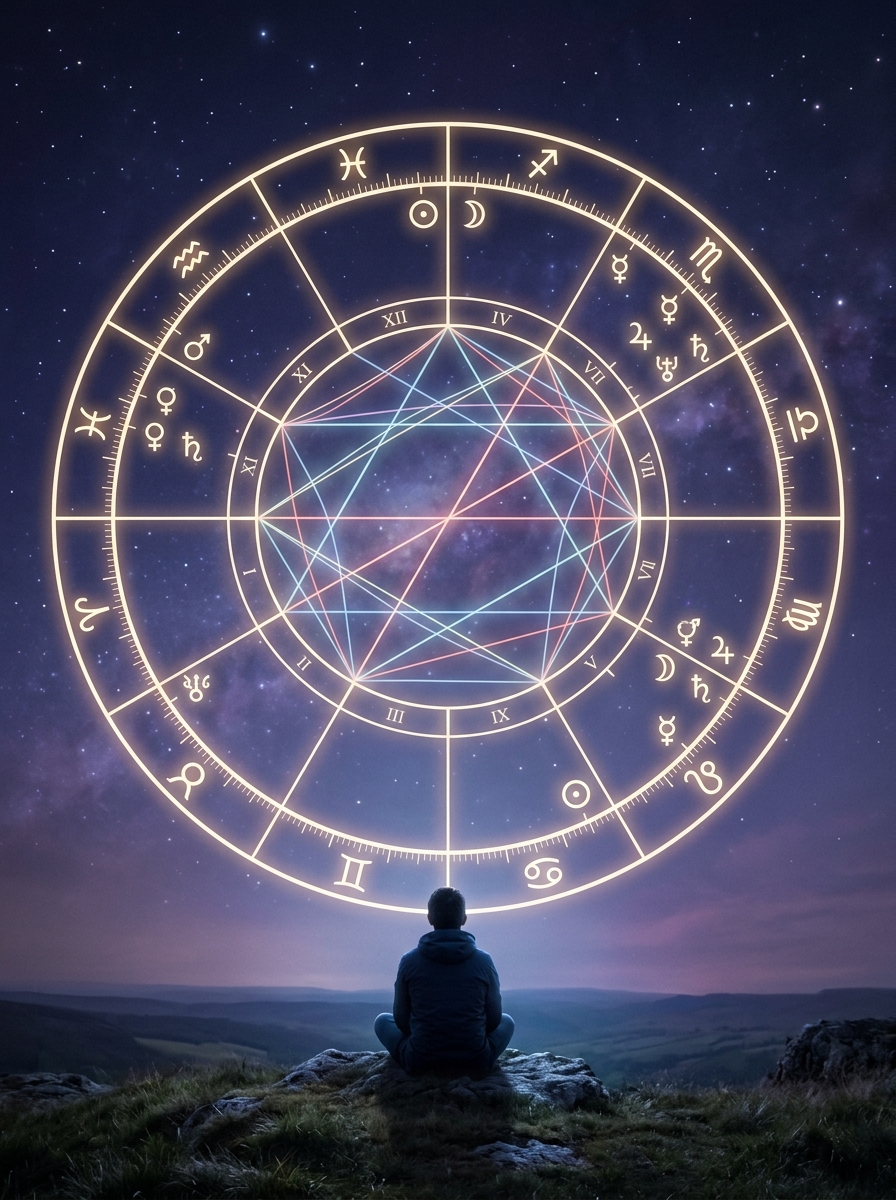
A birth chart—also called a natal chart—is a circular diagram that captures the precise positions of the Sun, Moon, and eight other planetary bodies at the exact moment, date, and geographic location of your birth. Think of it as a photograph of the heavens taken at the split second you drew your first breath. That photograph does not move. It is a fixed symbolic snapshot, as unique to you as your fingerprints, and it serves as the foundational document of serious Western astrological practice.
The chart itself is divided into twelve wedge-shaped sectors called houses, each governing a specific domain of lived experience—from identity and money to relationships, death, and spiritual aspiration. Layered over these houses are the ten classical planets, each occupying a particular sign of the zodiac and falling into one or more houses. Finally, the angular distances between those planets—called aspects—describe the quality of their relationship: whether they amplify each other, challenge each other, or blend their energies with relative ease.
Beyond the ten planets, a complete birth chart also tracks secondary points of symbolic weight. Chiron, the "wounded healer" asteroid, shows where early wounding generates long-term wisdom. The Lunar Nodes—the North Node and South Node—form an axis that many astrologers read as a karmic compass: the South Node describes patterns carried in from the past (or from earlier in this life), while the North Node points toward soul growth and the territory that will feel both challenging and deeply rewarding to develop.
At the leftmost edge of the chart sits the Ascendant, or rising sign—the degree of the zodiac that was literally climbing over the eastern horizon at the moment of your birth. The Ascendant is arguably the most time-sensitive point in the entire chart; it shifts by roughly one degree every four minutes. This is why birth time accuracy matters so profoundly in serious astrological work. Even a fifteen-minute discrepancy can relocate planets between houses and change the rising sign entirely.
The Anatomy of the Chart Wheel
Reading a birth chart requires understanding its spatial grammar. The wheel is oriented with the Ascendant on the far left (the nine o'clock position), the Descendant directly opposite on the right, the Midheaven (MC) at the top, and the IC (Imum Coeli) at the bottom. These four points—collectively called the angles—are the most sensitive and personal coordinates in the chart. Planets placed near the angles carry enormous weight; they tend to express themselves with unusual force in that person's life.
The twelve houses radiate outward from these angles in counterclockwise order. Each house begins at a cusp—the boundary line where one house ends and the next begins. The sign on that cusp colors the quality of that life area. A person with Scorpio on the seventh-house cusp experiences partnership very differently from someone with Libra there, even if both have Venus in Taurus.
Astrologers like Liz Greene have described the birth chart as "a map of the psyche"—a phrase that gestures toward the Jungian origins of modern psychological astrology. Carl Jung himself was fascinated by astrology and corresponded with astrologers throughout his career, viewing the chart as a synchronistic diagram of archetypal forces at work in the individual. In this tradition, the chart is not a prediction machine. It is a symbolic mirror. How those energies express depends, in large part, on the consciousness and choices of the person living beneath that sky.
The Big Three: Sun, Moon, and Ascendant
Ask any contemporary astrologer what a newcomer should learn first, and the answer is almost always the same: the Big Three. The Sun sign, Moon sign, and Ascendant form the essential triad of the natal chart, and understanding how they interact gives you the clearest immediate picture of who someone is—and why they sometimes seem entirely different from what their Sun sign would suggest.
The Sun: Core Identity and Vital Force
In Western astrology, the Sun represents the central principle of the self—the hero's arc, in Jungian terms, or what Steven Forrest calls "the evolutionary intention" of the incarnation. Your Sun sign describes the quality of consciousness you are developing throughout your lifetime. It is not who you already are; it is who you are in the process of becoming.
This is why young people often feel that their Sun sign doesn't quite fit yet. A twenty-year-old Capricorn may still be learning what discipline, ambition, and long-term vision actually mean for them. A twenty-year-old Aries is still discovering how to direct initiative without combusting. The Sun sign is a lifelong project, not a fixed label.
The Sun's house placement adds critical context. A Sagittarius Sun in the second house expresses that philosophical, expansive Sagittarian energy through the domain of resources, money, and self-worth—perhaps through a philosophical relationship to wealth, a tendency to be generous to a fault, or a career in publishing that generates income. A Sagittarius Sun in the ninth house, by contrast, lives out that same energy in its home territory: foreign travel, higher education, religion, and the search for meaning.
The Moon: Emotional Memory and Inner Landscape
If the Sun is who you are becoming, the Moon is who you already were before you had any choice in the matter. The Moon in a natal chart describes the emotional body: the instinctive reactions, the needs that feel non-negotiable, the conditions under which you feel safe or unsafe, the texture of your inner life. It is the imprint of early emotional experience, particularly the relationship with the mother or primary caregiver.
A person with the Moon in Cancer needs deep belonging, domestic security, and emotional reciprocity. A person with the Moon in Aquarius needs freedom, intellectual stimulation, and space to be unconventional—even within close relationships. These are not preferences; they are requirements. When the Moon's needs go chronically unmet, people do not simply feel inconvenient sadness. They experience a kind of existential homelessness.
The Moon also rules the body's instinctive rhythms: sleep, appetite, mood cycles, and the way the nervous system responds to stress. Astrologers working in the tradition of Liz Greene's psychological model pay close attention to Moon placements because they reveal the invisible emotional logic operating beneath conscious behavior.
The Ascendant: The Mask, the Filter, and the Skeleton
The Ascendant is the most misunderstood of the Big Three. It is often called the "mask" or "outer persona"—the face you present to the world before people truly know you. But the Ascendant is much more than a social veneer. It is the filter through which all other chart energies pass before they reach the outside world, and it is also the structural skeleton of the entire chart, since it determines the order and orientation of all twelve houses.
A person with a Scorpio Ascendant will experience everything—including their Gemini Sun and Sagittarius Moon—through a Scorpionic filter: intense, probing, strategic, and quietly magnetic. They may be far more Geminian on the inside than they appear in initial encounters, but the first impression will always carry that Scorpionic weight.
Understanding the Ascendant dissolves one of the most common frustrations newcomers bring to astrology: "Why don't I feel like my sign?" More often than not, the answer is that they feel far more like their Moon or their Ascendant—or both.
The Twelve Houses: Where Life Happens
The twelve houses are the stage upon which the planetary actors perform. While the signs describe how energy operates and the planets describe what kind of energy is at play, the houses answer where—which area of life becomes the theater for that energy's expression.
The system most widely used in contemporary American astrology is Placidus, though Whole Sign houses have surged in popularity in recent years, particularly among practitioners working in the Hellenistic revival tradition spearheaded by scholars like Robert Hand and Chris Brennan.
The first house is the domain of identity, physical appearance, and the way the self meets the world. It begins at the Ascendant and sets the foundational tone of the entire chart. Planets here are exceptionally prominent in the personality.
The second house governs material resources, personal values, self-worth, and the relationship to money and possessions. It is not merely about what you own but about what you value—including yourself.
The third house rules communication, the local environment, siblings, early education, and the mechanics of the mind. Planets here often describe a strong relationship to language, writing, or the neighborhood.
The fourth house (the IC is its cusp) describes home, ancestry, roots, the private self, and one of the parents—traditionally the mother or the more domestic parent. It is the foundation of psychological security.
The fifth house is the realm of creative self-expression, romantic play, children, pleasure, and the performing arts. It describes how the individual ego delights in itself and in the act of creation.
The sixth house governs daily work routines, health practices, service to others, and the rituals that sustain the body. It is also the domain of the relationship between body and mind—a natural territory for someone interested in holistic health.
The seventh house (the Descendant) describes one-to-one partnership in all its forms: romantic, business, legal, and adversarial. What the seventh house contains reveals not only what we seek in others but what we project outward and then encounter "out there."
The eighth house is one of the most complex sectors of the chart: shared resources, inheritance, death, transformation, sexuality, the occult, and the deep psyche. Planets here operate at an enormous depth of field and are often associated with both crisis and profound regeneration.
The ninth house encompasses higher education, philosophy, religion, long-distance travel, foreign cultures, and the search for meaning. This is the house of the examined life.
The tenth house (the Midheaven) describes public reputation, career, authority, and the legacy one builds in the world. It is often the most visible point in the chart and describes how the individual interfaces with social structure and public life.
The eleventh house governs friendships, community, collective ideals, future visions, and social causes. It describes the relationship between the individual and the tribe they choose.
The twelfth house is the most enigmatic sector: solitude, hidden enemies, spiritual retreat, the unconscious, karma, and the dissolving of ego boundaries. It is associated with institutions like hospitals, prisons, and monasteries—places of voluntary or involuntary withdrawal. Planets here operate below the threshold of normal awareness and often represent energies that have been suppressed or that operate in secret.
Planetary Aspects: The Conversations Between Planets
If the planets are characters in a story, aspects are the dialogue between them. An aspect is formed when two or more planets occupy positions that create a specific angular relationship—measured in degrees along the ecliptic. These angles carry distinct energetic qualities, ranging from harmony to friction to tension so productive it becomes the engine of the entire chart.
The Five Major Aspects
Conjunction (0°): Two planets occupy the same degree, blending their energies completely. The effect depends entirely on which planets are involved. A Venus-Jupiter conjunction in Taurus is one of the most pleasant signatures in astrology—expansive, sensuous, generous. A Saturn-Mars conjunction in Scorpio is a pressure cooker of discipline, aggression, and strategic power.
Sextile (60°): Planets in sextile are two signs apart and share a complementary elemental relationship—fire and air, or earth and water. The sextile is often described as a door left ajar: there is flow and opportunity, but it requires intention to activate. It rarely forces things into motion the way harder aspects do.
Square (90°): Planets ninety degrees apart occupy signs of the same modality—cardinal, fixed, or mutable—but incompatible elements. The square is one of the primary drivers of action in a chart. It generates friction, frustration, and urgency. It forces resolution. Many highly accomplished people have charts loaded with squares; the discomfort becomes fuel. Carl Jung wrote extensively about the tension of opposites as the motor of psychological growth, and the square is the astrological embodiment of that principle.
Trine (120°): Planets one hundred twenty degrees apart share the same element—fire, earth, air, or water—and therefore "speak the same language." The trine represents natural talent, ease of flow, and areas of life where things tend to work out without extraordinary effort. The shadow side of the trine is complacency: talents that go undeveloped because they were never truly challenged.
Opposition (180°): Two planets directly across the chart from each other. Like the square, the opposition carries tension—but where the square is internalized conflict, the opposition tends to manifest through other people, partnerships, and relationships. We tend to project one pole of the opposition onto others. A person with a Sun-Saturn opposition may experience their discipline deficit or harsh inner critic as the behavior of a difficult boss or demanding partner, until they recognize that both poles live inside themselves.
Applying and Separating Aspects
A subtlety that separates serious chart reading from surface-level interpretation is the distinction between applying and separating aspects. An aspect is applying when the faster planet is moving toward the exact degree of the slower planet; it is separating when it has already passed. Applying aspects carry a quality of anticipation and unresolved potential; separating aspects often feel more integrated and completed. This distinction is fundamental in classical and Hellenistic astrology and is being revived in contemporary practice.
Transits and the Living Chart
The natal chart is static, but the sky never is. At any given moment, the planets continue their orbits, forming new aspects to the fixed positions in your birth chart. These moving planetary contacts are called transits, and they are the primary tool astrologers use to understand the timing of events, cycles, and inner shifts.
A transit occurs when a current planet passes over a natal planet, angle, or sensitive point in your chart. The transit carries the energy of the transiting planet, modified by the type of aspect it forms and the house it passes through. When Saturn transits your natal Sun, for example, you are likely to experience a period of increased responsibility, sober self-reckoning, and the restructuring of identity. It may feel heavy. It usually produces lasting growth.
Saturn Returns: The Archetypal Coming-of-Age Transit
The most culturally recognized transit in American popular astrology is the Saturn Return—the moment, roughly every 29.5 years, when Saturn returns to the exact degree and sign it occupied at your birth. The first Saturn Return, occurring between the ages of twenty-seven and thirty, is widely experienced as a period of profound restructuring: relationships that no longer serve the authentic self tend to dissolve; careers chosen for external approval rather than genuine vocation begin to feel hollow; a more serious, autonomous adulthood demands to be built from scratch.
Steven Forrest describes the Saturn Return as "a summons from the authentic self"—a period not of punishment but of accountability. The second Saturn Return, around age fifty-nine, carries similar archetypal weight, pushing the individual toward legacy, wisdom, and the integration of a lifetime's lessons.
Outer Planet Transits and Generational Shifts
Beyond Saturn, the outer planets—Uranus, Neptune, and Pluto—move so slowly that their transits to personal planets mark truly epochal chapters in a life. A Pluto transit to the natal Moon (a transit that may last two to three years, given Pluto's retrograde cycles) can correspond to the complete dismantling and reconstruction of emotional identity—the kind of experience people describe as "hitting bottom" or "being reborn." A Neptune transit to the natal Venus often coincides with periods of idealized love, creative inspiration, spiritual longing, and, at its shadow extreme, romantic disillusionment.
The art of transit work lies in resisting prediction and embracing interpretation. The transit does not dictate what will happen; it describes the nature of the cycle available to you and the archetypal territory you are being called to inhabit.
Birth Chart vs. Sun Sign: Why Your Horoscope Never Quite Fits
The Sun sign, that familiar twelve-category shorthand published in magazines and apps, is derived from one single placement in the birth chart: the position of the Sun. For someone born while the Sun was moving through Virgo, that person is a "Virgo." Full stop. No other information is considered.
The birth chart, by contrast, contains ten planets, twelve houses, several important secondary points, and dozens of angular relationships—all of which interact in ways that are unique to the specific degree, minute, and geographic location of your birth. The gap between a Sun sign horoscope and a real chart reading is roughly analogous to the gap between a personality quiz and a thorough psychological assessment.
This is why two people born under the same Sun sign can feel—and behave—almost nothing alike. A Scorpio with the Moon in Gemini and a Sagittarius Ascendant will move through the world with a very different texture than a Scorpio with the Moon in Taurus and a Cancer Ascendant. The Sun sign provides a silhouette. The natal chart provides a portrait.
The Role of the Moon Sign in Daily Life
Many people find that their Moon sign feels more immediately, viscerally accurate than their Sun sign—particularly in the domain of emotional life and instinctive behavior. If you have ever read your Sun sign description and thought "that's not me at all," but your Moon sign description landed like a revelation, that is precisely why. The Moon governs the parts of ourselves we did not choose and did not construct: the automatic reactions, the longing, the private interior.
Sun sign horoscopes are also problematic from a strictly technical standpoint: they are calculated using the solar house system, which arbitrarily places the Sun sign as the first house and rotates the others accordingly. This bears almost no relationship to the actual houses in your natal chart.
The Historical Evolution of the Natal Chart
The birth chart as we know it did not spring fully formed from any single tradition. It is the accumulated inheritance of at least three thousand years of astronomical observation, theological speculation, and mathematical refinement—a living artifact of the human compulsion to find pattern and meaning in the sky.
Mesopotamian Origins
The earliest astrological records belong to Mesopotamia—Babylon and Assyria in particular—and date to roughly the second millennium BCE. These records are emphatically not natal charts in the modern sense. They are mundane documents: records of celestial omens relating to the fate of the king and the kingdom. If Mars appeared red at the horizon before a military campaign, the omen was interpreted as relevant to the army, not to any individual. The sky spoke to the collective, through the vehicle of its sovereign.
The oldest surviving individual horoscope, recorded on a clay tablet, dates to 410 BCE—a document that records the birth of a specific person and the planetary positions at that moment. This marks the beginning of the long turn toward the individual as the primary subject of astrological inquiry.
Hellenistic Alexandria and the Invention of the Ascendant
The decisive transformation occurred in Hellenistic Egypt, particularly in Alexandria, between roughly the second century BCE and the second century CE. This period saw the synthesis of Babylonian astronomical data, Egyptian religious symbolism, and Greek philosophical frameworks into a coherent system that looks, in its basic structure, remarkably like modern Western astrology.
The Ascendant was invented in this period—or rather, its significance as the personal time-marker of the chart was fully theorized here. The twelve houses were systematized. Ptolemy's Tetrabiblos (second century CE) codified much of the Hellenistic system in a form that remained authoritative for over a millennium.
Islamic Transmission and Mathematical Refinement
After the fall of Rome, the center of astrological scholarship shifted to the Islamic world. Arab and Persian scholars translated the Greek texts, preserved them during the centuries when they were lost to Western Europe, and made significant advances in the mathematical precision of chart calculation. Figures like al-Kindi and Abu Ma'shar were both practicing astrologers and serious astronomers, and the instruments they refined—including the astrolabe—made chart calculation more accurate and accessible.
This tradition flowed back into Western Europe through medieval Spain, particularly through the translation centers of Toledo, where Arabic texts were rendered into Latin and eventually made their way into the hands of European scholars.
Renaissance Humanism and Reformation
The Renaissance brought astrology to the height of its social prestige in Europe. Astrologers served at royal courts, cast charts for political decisions, and were regarded as serious scholars. The humanistic emphasis on the individual—on human agency and self-determination—deepened the tradition of natal chart interpretation, since it aligned naturally with the idea that understanding one's chart could inform better choices.
The Reformation and then the Scientific Revolution of the seventeenth century began to erode astrology's institutional standing. By the eighteenth century, astrology was largely relegated to almanacs and popular superstition in the eyes of the educated classes. But the tradition never disappeared.
The Psychological Revival
The great twentieth-century renewal of astrology in the English-speaking world was inseparable from the rise of depth psychology. Carl Jung's theory of archetypes—of universal symbolic patterns operative in the unconscious—provided a compelling theoretical framework for astrological interpretation that did not require literal belief in planetary causation.
Dane Rudhyar was the pivotal figure in this synthesis, reframing the birth chart as a holistic mandala of psychological potential rather than a fate-map. His work directly influenced Liz Greene, whose collaboration with the Jungian analyst Howard Sasportas produced a body of literature—Saturn: A New Look at an Old Devil, The Astrology of Fate, The Development of the Personality—that remains the gold standard of psychological astrology. Greene's approach is rigorous, unsentimental, and genuinely sophisticated; she draws on myth, fairy tale, clinical case history, and chart analysis with equal facility.
Steven Forrest, working from the American West Coast, extended this tradition in a more explicitly narrative, evolutionary direction. His evolutionary astrology treats the chart not as a description of fixed character but as a soul's chosen curriculum—a set of themes deliberately selected for growth. This approach has been enormously influential in the contemporary American astrological community.
FAQ
What information do I need to get an accurate birth chart?
You need three things: your date of birth (day, month, and year), your exact time of birth (ideally to the minute), and your place of birth (city and country). The date and location determine the positions of the slower-moving planets, which change signs over weeks or years. The birth time is essential for calculating the Ascendant and house cusps, which shift by roughly one degree every four minutes. If you don't have your birth time, your birth certificate is the first place to look; many US hospitals recorded it. If it's unavailable, a skilled astrologer can sometimes perform a process called chart rectification, working backward from significant life events to estimate the correct time.
Why does my chart feel more accurate than my Sun sign?
Because the Sun sign is only one of many placements in your complete chart, and it describes one specific dimension of who you are—the core of your evolving conscious identity. Your Moon sign governs your emotional instincts, your Ascendant shapes your physical presence and the lens through which all your other energies are filtered, and each of your other planets adds further specificity. Most people feel that their Moon sign describes their inner experience most immediately, and many find their Ascendant is the most recognizable in their exterior behavior. The more you know about your complete chart, the more the oversimplifications of Sun sign astrology tend to dissolve.
What is the difference between a natal chart and a progressed chart?
A natal chart is fixed: it represents the sky at the exact moment of your birth and does not change throughout your life. A progressed chart—particularly the secondary progressions system—moves the natal chart forward symbolically, with each day after birth representing one year of life. Progressions describe slow, internal developmental shifts: a progressed Sun changing signs, for example, often corresponds to a significant shift in identity, life direction, and values over roughly the span of that sign's thirty degrees (approximately thirty years). Progressions are used alongside transits to build a complete picture of timing and cycles.
Are birth chart readings deterministic? Do they predict the future?
In contemporary Western psychological astrology, the answer is: emphatically no. The chart describes archetypal territory, energetic themes, and symbolic timing—not predetermined events. Two people can have the same Pluto transit in the same year and experience it in entirely different ways, depending on their psychological maturity, their life circumstances, and their choices. The tradition from Liz Greene and Steven Forrest through to most contemporary practitioners treats the chart as a map of potential, not a script. The French Renaissance astrologer Jean-Baptiste Morin notwithstanding, the dominant modern position is that awareness of one's chart expands the range of conscious response available—it does not close it down.
How do I begin learning to read my own birth chart?
Start with your Big Three—Sun, Moon, and Ascendant—and understand each one individually before you start combining them. Then locate your planets in their houses and read about what each house governs. Next, identify any planets near the four angles of your chart (Ascendant, Descendant, Midheaven, and IC), since these carry the most weight. Resist the impulse to reduce your chart to a fixed personality description. The best approach is to hold each placement as a question—a territory of experience to explore—rather than as a label. Recommended reading for the self-study path includes Steven Forrest's The Inner Sky, Liz Greene's Saturn: A New Look at an Old Devil, and Howard Sasportas's The Twelve Houses. These texts are intellectually rigorous, psychologically sophisticated, and written for a serious adult reader.
What is chart synastry, and how does it relate to the natal chart?
Synastry is the practice of comparing two natal charts to understand the dynamics of a relationship—romantic, professional, or otherwise. The astrologer overlays one chart onto the other and examines how each person's planets aspect the other's. A Venus-Mars conjunction between two charts often generates powerful attraction; a Saturn-Moon opposition can describe one partner feeling restricted or judged by the other. Synastry is one of the most requested forms of astrological consultation in the contemporary American market, and it depends entirely on having accurate natal charts for both individuals. Without solid birth data for each person, synastry analysis is unreliable.
Comments
Loading comments…