Imum Coeli: The Astrological Root of the Soul
The Foundation of the Chart: What the Imum Coeli Represents
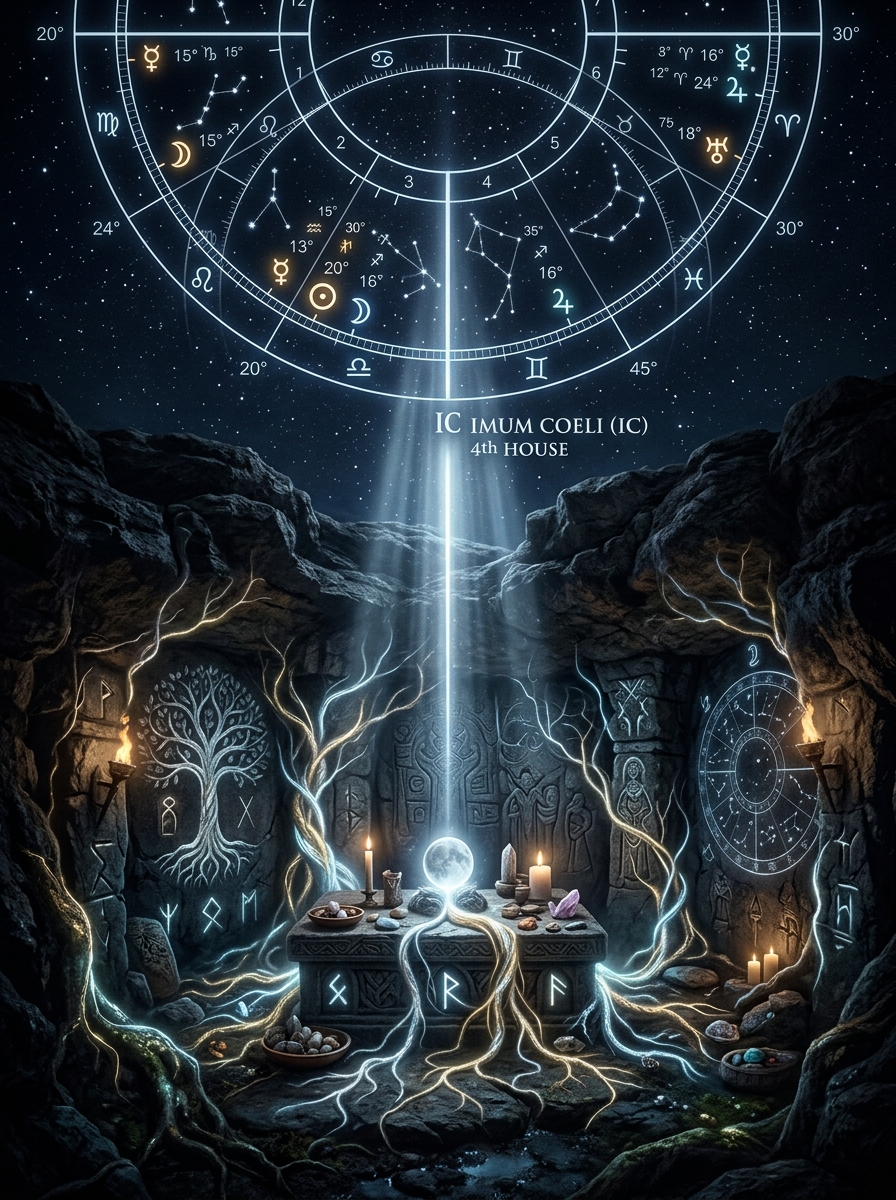
In the structural architecture of the natal chart, the Imum Coeli (IC)—which translates from the Latin as "the bottom of the sky"—serves as the absolute anchor of the human psyche. Located at the lowest vertical intersection where the meridian line crosses the ecliptic, the IC marks the cusp of the Fourth House, functioning as the psychological bedrock upon which the rest of the astrological wheel is built. While the Midheaven (MC) rises toward the visible zenith of the outer world to represent our public achievements, careers, and the social masks we wear, the Imum Coeli represents the hidden, subterranean root system of the individual. It is the midnight point of the soul, representing the most private, nocturnal, and subjective sphere of human experience. If we conceive of the natal chart as a tree, the Midheaven represents the branches reaching toward the light, while the Imum Coeli represents the vast, invisible roots anchoring the tree into the dark, nourishing soil.
Locating the IC on Your Birth Chart
To locate the Imum Coeli on a birth chart, one must examine the vertical axis of the chart wheel, directly opposite the Midheaven. In quadrant-based house systems like Placidus or Koch, the IC serves as the exact cusp of the Fourth House, anchoring the lowest point of the chart. However, in non-quadrant house systems such as Whole Sign or Equal House, the IC is not locked to the Fourth House cusp and can float dynamically through the Third, Fourth, or Fifth Houses, though its fundamental psychological meaning remains focused on our internal foundations. Locating the IC requires an exceptionally precise birth time and geographical location, as the meridian axis rotates rapidly, changing signs approximately every two hours. The sign on the IC, along with any planets placed close to this cusp, reveals the unique energetic signature of our private sanctuary, our early environment, and the quality of our basic psychological security.
The Private Self vs. The Public Persona
The Imum Coeli represents the self we return to when the front door is locked and we are completely alone. It is the unmasked, raw, and unvarnished aspect of our personality. While the Midheaven is our public persona, the face we present to our employers, colleagues, and the public, the IC is the self that needs no performance. Liz Greene has noted that without a strong, healthy connection to the IC, an individual's outer success (MC) becomes hollow and fragile, vulnerable to sudden collapse. The IC represents our need for retreat, privacy, and absolute rest. It is where we find emotional security and subjective reality, far from the demands of external validation. Here, we do not achieve; we simply exist, drawing energy from the quiet spaces of our lives to sustain our outer efforts.
The Mystery of the Midnight Sun: Mythological and Esoteric Symbolism of the IC
Esoterically, the Imum Coeli is associated with the mythological concept of the "midnight sun." While the Midheaven corresponds to the midday sun—representing consciousness, light, and outer clarity—the IC represents the sun at its point of maximum darkness. In the Western esoteric tradition, this midnight point is not a place of void or spiritual death, but rather a space of potent gestation and alchemical transformation. It is the womb of the chart, where the seeds of the future self lie dormant during the winter of the soul before eventually germinating and breaking through the surface of consciousness.
Esoteric Meanings and the Midnight Point of the Soul
The Imum Coeli represents the descent into the underworld—the mythological night journey of the hero. Astrologer Dane Rudhyar described the IC as the point of maximal integration and internalization. It is here that we digest our daily experiences, converting them into the raw material of character. Esoterically, the IC acts as a portal to the collective unconscious and the deep reservoir of ancestral memory. It is the quiet crucible where the alchemical nigredo—the blackening of the prima materia—takes place. To access the wisdom of the IC, one must be willing to turn their attention downward, away from the noise of the outer world, descending into the silence of the subconscious to retrieve the hidden gold of self-recollection.
Alchemical Metaphors of the Subterranean Journey
In the alchemical process, the descent into the earth is symbolized by the Latin acronym VITRIOL: Visita Interiora Terrae Rectificando Invenies Occultum Lapidem ("Visit the interior of the earth; by rectification you will find the hidden stone"). This journey corresponds directly to the psychological exploration of the Imum Coeli. Liz Greene and other psychological astrologers emphasize that the IC contains our psychological shadow—the repressed, unacknowledged parts of ourselves that we must confront to achieve wholeness. This is the domain of the night, where we must navigate our deepest fears, vulnerabilities, and secrets. By engaging with these subterranean forces, we initiate the alchemical work of integration, transforming our raw unconscious impulses into conscious self-awareness.
The Fourth House and Psychological Heritage: Family, Ancestry, and the Parental Debate
As the cusp of the Fourth House, the Imum Coeli is the astrological repository for our early childhood conditioning, family heritage, and psychological inheritance. This is the domain of the home, the domestic environment, and the emotional foundation established during our formative years. In the language of analytical psychology, the IC represents the personal unconscious and the transgenerational complexes that shape our behavior long before we have the conscious capacity to examine them. It holds the memories of our childhood home, the spoken and unspoken rules of our family system, and the unresolved emotional patterns of our ancestors.
Jungian Perspectives and Transgenerational Trauma
Applying the concepts of Carl Jung to the natal chart, we find that the IC is the place where ancestral patterns and familial complexes reside. Astrologers like Liz Greene and Howard Sasportas have written extensively on how unresolved family trauma is passed down through the generations, often appearing as planets conjunct or making hard aspects to the IC. The sign and planets on this cusp describe the specific nature of the family myths we inherit. If there is unexpressed grief, secrets, or trauma in our family tree, it will be reflected at the base of our chart. Healing, from a Jungian astrological perspective, involves descending into this psychological basement, shining the light of consciousness on these inherited patterns, and transforming transgenerational baggage into ancestral wisdom.
The Parental Cusp: Mother or Father?
A long-standing debate exists within Western psychological astrology regarding which parent is represented by the Imum Coeli and the Fourth House. Classical astrology traditionally assigned the Fourth House to the father, as the provider of the family name, heritage, and structure. However, modern psychological astrologers, including Howard Sasportas, frequently reverse this alignment, associating the Fourth House and the IC with the mother. They argue that the base of the chart represents the early maternal matrix—the womb, the primary caregiver, and the emotional environment of infancy—while the Tenth House and Midheaven represent the father or the parent who guides the child into the outer world. Steven Forrest suggests a more flexible approach, viewing the IC as representing the most influential parent in terms of our private, emotional development, or the subjective experience of our early nurturing, regardless of gender.
Planetary Placements on the Imum Coeli: How the Planets Shape Your Foundations
When planets reside in close conjunction with the Imum Coeli, they exert a powerful, defining influence on the individual’s subjective sense of security, childhood experience, and ancestral inheritance. Because the IC is a deeply private point, these planetary energies are often hidden from the public eye, operating beneath the surface of conscious awareness. They represent the psychological themes that play out in our domestic life and in our most private moments. Understanding these placements allows us to decipher the specific dynamics that govern our inner world, helping us to align our daily lives with our deepest psychological needs.
The Inner Planets: Moon, Mercury, Venus, and Mars at the Root
The placement of the Moon conjunct the Imum Coeli indicates a profound, instinctual need for emotional safety, belonging, and connection to one's roots. Individuals with this placement are deeply sensitive to the emotional atmosphere of their home, seeking a domestic environment that serves as a nurturing sanctuary. Their childhood is often characterized by a strong, sometimes symbiotic bond with the mother or primary caregiver, and their adult security is closely tied to their connection to the past, family heritage, and domestic comfort.
When Mercury conjuncts the IC, the home becomes a laboratory for the mind. These individuals require a domestic space that is intellectually stimulating, filled with books, ideas, and constant dialogue. Their childhood may have involved frequent relocations, a busy household, or an early environment where communication and intellectual achievement were highly prioritized. In adulthood, they use their private spaces as a retreat for writing, study, and mental reflection, though they must guard against a tendency to bring mental restlessness and anxiety into their place of rest.
Venus conjunct the Imum Coeli infuses the private life with a search for beauty, peace, and aesthetic harmony. These individuals have a deep love for nesting, desiring a home that is physically beautiful, comfortable, and welcoming. Their early environment may have been artistic or marked by a strong family emphasis on keeping the peace, sometimes at the expense of addressing real conflicts. In their personal lives, they seek relationships that provide domestic harmony, using their home as a space to host loved ones and cultivate artistic expression.
With Mars conjunct the Imum Coeli, the domestic sphere is often marked by high energy, restlessness, and occasional conflict. Their early home environment may have been volatile, competitive, or characterized by power struggles, forcing them to develop a strong defense system early in life. In adulthood, they may experience tension or restlessness within the home, requiring them to find constructive outlets for their physical energy and assertion. However, this placement also provides a powerful reservoir of inner strength, determination, and the ability to fight for one’s personal boundaries.
The Social Planets: Jupiter and Saturn as Architectural Pillars
Jupiter conjunct the Imum Coeli brings a sense of expansion, optimism, and abundance to the foundations of the psyche. These individuals often experience their early home life as supportive, generous, or philosophically rich, perhaps growing up in a large family or a home that valued education, travel, and religious exploration. This placement instills a deep, fundamental belief in their own basic security and the goodness of life, providing an inner safety net that allows them to take risks in the outer world. In adulthood, they seek spacious, comfortable homes that allow them to expand their horizons.
Conversely, Saturn conjunct the Imum Coeli represents a foundation built on duty, responsibility, and limitation. Their childhood may have felt emotionally cold, restrictive, or burdened by heavy expectations, requiring them to grow up quickly and take on adult responsibilities. This placement can create a persistent fear of instability or rejection, leading the individual to build a highly controlled and structured private life. As they mature, the work of Saturn at the IC involves developing authentic self-reliance, transforming their early feelings of inadequacy into an unshakeable, self-authored inner authority.
The Outer Planets: Uranus, Neptune, and Pluto in the Depths
Uranus conjunct the Imum Coeli signifies a highly unconventional, unstable, or rapidly changing foundational experience. Their childhood home may have been characterized by sudden relocations, eccentric family members, or a general lack of predictability, leaving them with a sense of being an outsider within their own family. In adulthood, they value absolute freedom in their private lives, resisting traditional domestic setups and requiring a home that allows for individuality and independence. Their path involves liberating themselves from ancestral expectations to forge their own unique path.
Neptune conjunct the Imum Coeli introduces a quality of mystery, idealization, and boundarylessness to the root of the chart. Their early home life may have been confusing, chaotic, or marked by sacrifice, illness, or unspoken family secrets, such as addiction or hidden grief. These individuals often experience a deep longing for a perfect, idealized home, which can lead to disappointment in their actual domestic life. However, this placement is also a source of profound spiritual sensitivity, creative imagination, and empathy, allowing them to channel their ancestral history into artistic or spiritual pursuits.
Pluto conjunct the Imum Coeli indicates intense, transformative psychological dynamics operating at the base of the psyche. Their childhood may have been marked by power struggles, emotional crises, or a profound loss of control, forcing them to confront the darker aspects of human nature early on. This placement often points to deep family secrets and transgenerational trauma that must be brought to light. The path of Pluto at the IC is one of complete psychological death and rebirth, requiring the individual to dive into the unconscious, confront their deepest fears, and reclaim their personal power, ultimately becoming a source of healing for themselves and others.
The Axis of Self-Realization: The Dynamic Balance Between the Imum Coeli and Midheaven
No house cusp in the natal chart operates in isolation, and the Imum Coeli can only be fully understood when viewed in relation to its opposite pole, the Midheaven. Together, they form the vertical meridian axis of the horoscope—the spine of the natal chart. This axis represents the path of self-realization, a continuous feedback loop between our inner foundations (IC) and our outer achievements (MC). While the Midheaven represents our conscious goals, social status, and professional calling, the Imum Coeli represents the unconscious root system that supports these ambitions. To focus exclusively on the Midheaven without tending to the Imum Coeli leads to psychological fragmentation, career burnout, and a sense of alienation, whereas retreating permanently into the IC prevents us from actualizing our potential in the collective world.
Integrating the IC-MC Axis for Personal Growth
True psychological maturity requires a conscious integration of the IC-MC axis. We must learn to navigate the tension between our public roles and our private needs. In contemporary society, there is a strong cultural bias toward Midheaven activities—achievement, visibility, productivity, and status. This bias often leads individuals to neglect the quiet, nocturnal work of the Imum Coeli, resulting in a hollow sense of success. Astrologers like Liz Greene emphasize that our public life is only as stable as our private foundation. Integrating this axis involves recognizing that the energy we invest in our inner healing, domestic life, and self-care directly nourishes our ability to contribute meaningfully to the outer world. It is about creating a secure inner home from which we can step out into the public arena with confidence.
Tending to Your Roots to Fuel Your Vocation
Steven Forrest describes the relationship between the IC and MC as the balance between roots and fruit. Our career aspirations and outer vocation must grow organically out of our deepest personal truths and psychological reality. If we pursue a career that is disconnected from our core values—often represented by the sign and planets on our IC—we will experience a sense of emotional emptiness, no matter how much success we achieve. By aligning our outer vocation with our inner roots, we ensure that our achievements are authentic and sustainable. Tending to our roots means honoring our need for privacy, processing our childhood conditioning, and cultivating a domestic environment that truly restores us. Only then can our Midheaven ambitions bear healthy, lasting fruit.
Transits to the Imum Coeli: Navigating Deep Psychological Shifts
Transits to the Imum Coeli represent some of the most significant turning points in an individual's life, marking periods of profound internal restructuring, domestic change, and psychological rebirth. When slow-moving outer planets—such as Saturn, Uranus, Neptune, or Pluto—cross the IC cusp, they act as catalysts that dismantle old psychological structures, forcing us to reexamine our foundations. Because the IC is connected to our home, family, and deepest sense of security, these transits often coincide with physical relocations, shifts in family dynamics, or major changes in the household, alongside deep inner transformations.
The Catalyst of Outer Planet Transits to the Cusp
A transit of Saturn to the Imum Coeli often brings a period of consolidation, heavy responsibility, and definition to the home and inner life. It may feel like a time of restriction or isolation, but its purpose is to help us build a more durable foundation. It demands that we take responsibility for our emotional security, rather than relying on external sources.
Uranus transiting the IC, by contrast, brings sudden, unpredictable disruptions and a desire for liberation. This transit frequently triggers unexpected physical moves, family separations, or a sudden break from traditional domestic structures. It challenges us to free ourselves from ancestral conditioning and create a home environment that reflects our true individuality.
When Neptune transits the IC, the boundaries of our private life dissolve. This can be a period of confusion, uncertainty, or vulnerability within the home, perhaps involving physical issues like water damage or psychological challenges such as family secrets emerging. Yet, it is also a time of deep spiritual opening, allowing us to connect with our ancestral lineage on a mystical level and find comfort in spiritual surrender.
Pluto transiting the IC is perhaps the most intense of all, triggering a complete death-and-rebirth cycle of the foundations. It forces us to confront repressed childhood memories, family power dynamics, and transgenerational trauma, requiring us to clear out the old psychological basement so we can rebuild our lives on a foundation of authentic personal power.
Navigating the Psychological Basements of Transition
Navigating these transits requires a willingness to descend into the psychological basement of the self. Instead of resisting the changes occurring in our external lives—such as a relocation or a shift in family relationships—we must look inward to understand what these changes are asking of our psyche. These periods demand that we release outdated coping mechanisms, heal unresolved childhood wounds, and reevaluate what truly makes us feel safe. While the process of deconstructing our foundations can be disorienting and uncomfortable, it is a necessary part of our evolution. By consciously working with these planetary energies, we can emerge from these transits with a renewed sense of self, having built an inner sanctuary that is resilient enough to withstand any outer storm.
The Sign Placements on the Imum Coeli: Archetypes of the Subterranean Soul
The zodiac sign occupying the cusp of the Imum Coeli describes the psychological flavor and elemental nature of our deepest, most private self. It defines the specific environmental qualities we require to feel secure, recharge our energy, and construct a stable inner life. By grouping the sign placements of the IC by their respective elements—Fire, Earth, Air, and Water—we can understand the broad arquetypical patterns that govern our private sanctuary and the nature of our early emotional conditioning.
The Element of Fire: Aries, Leo, and Sagittarius at the Base
When a Fire sign occupies the Imum Coeli, the private life is characterized by dynamism, independence, and a need for self-assertion. These individuals often grow up in active, competitive, or highly expressive households where individuality was encouraged, though they may also have experienced early conflict or a lack of emotional quietude. In adulthood, they require a home that allows them to express their passion and autonomy, often treating their domestic space as a base of operations for their next adventure rather than a place of absolute silence. An Aries IC seeks physical outlets and personal space to recharge, a Leo IC desires a warm, creative, and prideful domestic sanctuary, and a Sagittarius IC needs a home filled with books, travel memorabilia, and a sense of philosophical freedom.
The Element of Earth: Taurus, Virgo, and Capricorn at the Bedrock
An Earth sign on the Imum Coeli indicates a deep psychological need for stability, structure, and sensory comfort at the foundations of the personality. Their early environment was often marked by a focus on practicality, material security, and physical routines, which can instill a strong work ethic but also a fear of financial or physical instability. In their adult lives, these individuals seek a highly grounded, organized, and physically secure domestic environment. A Taurus IC recharges through sensory pleasure, stability, and contact with nature, a Virgo IC finds peace in cleanliness, order, and daily health rituals, and a Capricorn IC builds a structured, traditional home, using self-reliance as their primary emotional defense mechanism.
The Element of Air: Gemini, Libra, and Aquarius at the Root
With an Air sign residing on the Imum Coeli, the foundations of the psyche are built on communication, intellectual stimulation, and social connection. Their childhood home was likely a place of learning, reading, and constant conversation, though it may have lacked emotional depth or consistency at times. In adulthood, they recharge their energy by engaging with ideas, writing, and connecting with others. They need a home that is light, airy, and filled with books, technology, and spaces for social interaction. A Gemini IC treats the home as a library or communication hub, a Libra IC seeks artistic harmony, beautiful decor, and relational peace in their sanctuary, and an Aquarius IC requires an unconventional, independent domestic life, often creating a hub for community or forward-thinking projects.
The Element of Water: Cancer, Scorpio, and Pisces in the Depths
A Water sign on the Imum Coeli points to a highly sensitive, intuitive, and emotionally intense foundational experience. Their early environment was likely marked by a strong, sometimes overwhelming emotional atmosphere, forcing them to develop high empathy and psychic sensitivity to navigate their family dynamics. In their personal lives, they require a domestic sanctuary that offers absolute privacy, emotional depth, and spiritual renewal. A Cancer IC seeks a cozy, womb-like home where they can nurture their family and connect with their ancestral past, a Scorpio IC requires a highly private, secure refuge where they can undergo psychological transformation and confront their shadow, and a Pisces IC finds peace in a mystical, boundaryless space that allows them to retreat from the harshness of the outer world through art, music, or spiritual practice.
Frequently Asked Questions
How do I find the Imum Coeli in my natal chart?
To find your Imum Coeli (IC), you will need your exact date, time, and city of birth. Once you input these details into an astrological chart generator, look for the vertical line that divides the chart. The IC is the point at the very bottom of this line, directly opposite the Midheaven (MC) at the top. In most house systems, it marks the beginning cusp of the Fourth House. Because the Earth rotates rapidly, the sign on the IC changes approximately every two hours, making an accurate birth time essential for identifying this point correctly.
What is the psychological difference between the Fourth House and the Imum Coeli?
While the Fourth House and the Imum Coeli are closely related, they represent slightly different layers of the psyche. The Fourth House is the broader arena of life that governs the home, family, real estate, and your domestic environment. The Imum Coeli is the specific, highly concentrated cusp of this house, representing the deepest, most unconscious root of your psychological foundations. You can think of the Fourth House as the house itself, and the IC as the very center of the foundation upon which the house rests.
Can having no planets conjunct the Imum Coeli indicate a lack of family connection?
No, having an "empty" Imum Coeli (meaning no planets are conjunct this point) does not indicate a lack of family connection or a weak psychological foundation. It simply means that your ancestral roots and private life are not the primary areas of planetary focus in this lifetime. To understand your IC and Fourth House dynamics when no planets are present, look to the ruler of the sign occupying your IC. The house placement and aspects of that ruling planet will describe how you express your private self and process family heritage.
How do transits to the Imum Coeli affect family relationships and the home?
Transits to the Imum Coeli frequently trigger major external and internal changes related to your domestic life. Externally, they often coincide with physical relocations, buying or selling a home, family expansions, or changes in household members. Internally, these transits act as psychological catalysts, demanding that you reevaluate your emotional foundations and heal unresolved family conditioning. Transits of outer planets like Uranus, netune, or Pluto can represent profound turning points, helping you release ancestral patterns and build a more authentic sense of inner security.
Can the Imum Coeli help resolve transgenerational trauma?
Yes, the Imum Coeli is one of the most powerful tools in natal astrology for identifying and resolving transgenerational trauma. The sign on the IC, along with any conjunct planets, reveals the psychological complexes and unspoken rules passed down through your family lineage. By consciously exploring these energies, you can identify patterns of behavior or emotional wounding that do not belong to you, but were inherited from your ancestors. Bringing these unconscious patterns into the light of awareness allows you to break the cycle and cultivate true emotional healing.
Comments
Loading comments…