Planetary Retrograde: The Art of Moving Backward to Move Forward
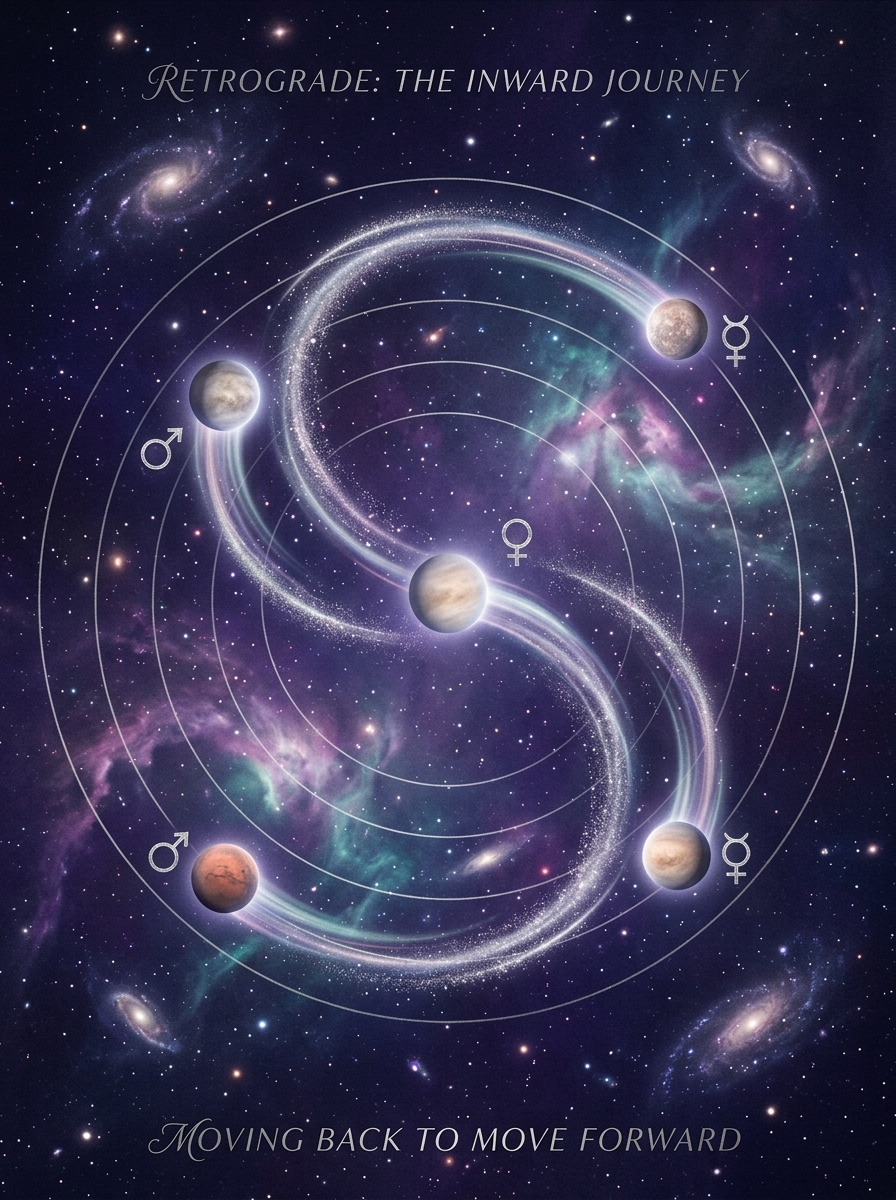
What Is Planetary Retrograde? Rethinking the Backward Planet
Every few months, the internet collectively holds its breath. Memes flood social feeds. Someone's grandmother warns about signing documents. Millennials blame their bad dates on Mercury. The phrase "Mercury is in retrograde" has become cultural shorthand for everything going sideways — a cosmic scapegoat served up fresh three or four times a year.
That cultural reflex, half-joking as it is, points toward something genuinely interesting. Planetary retrograde is real — astronomically measurable, symbolically potent, and woven through the history of Western astrology since Hellenistic times. But the internet version of retrograde, reduced to technological glitches and broken relationships, strips away the depth that makes it worth paying attention to in the first place.
The core idea is elegant. At certain intervals, any planet in our solar system will appear, from Earth's perspective, to halt its normal forward movement through the zodiac, reverse course, and travel backward through a portion of the sky before resuming its usual direction. This apparent backward motion is what astrologers call a retrograde. It is not a curse, not a cosmic punishment, and not a reason to spend three weeks frozen in anxious inaction. It is, in the language of the tradition, an invitation.
The Problem with Panic
The sensationalism surrounding retrogrades — particularly Mercury's — has obscured a genuinely useful framework. When astrologers in any era described a retrograde planet as weakened or malefic, they were working within a technical system of planetary dignity and debility. A planet "in detriment" or retrograde wasn't a warning to cower indoors. It was a description of the kind of energy available: less outwardly directed, more turned in on itself, less efficient in the world and more powerful in the interior.
The modern misreading flattens this nuance into prohibition. Don't do anything important. Don't communicate. Don't travel. Don't exist. This is astrology functioning as superstition rather than as a symbolic language. Steven Forrest, one of the most influential evolutionary astrologers of the past half century, has consistently argued that the job of astrology is not to help people avoid experience but to help them show up to their experience with more awareness. Retrograde periods, in that framing, are periods when a particular kind of awareness is called for — not paralysis.
The Core Principle: Apparent Motion as Inner Motion
The symbolic genius of retrograde astrology lies in a simple correspondence: when a planet appears to move backward in the sky, the themes it governs are understood to turn inward in the psyche. The external expression of that planetary energy grows quieter, more hesitant, more prone to doubling back on itself — and the interior expression grows louder, more active, more insistent on being heard.
This is not arbitrary symbolism. It follows an elegant poetic logic. A planet that rules outward communication, when retrograde, redirects that communicative energy inward, toward internal dialogue, unspoken truths, old conversations that want revisiting. A planet that rules desire and pleasure, when retrograde, draws those energies away from their usual external objects and back toward questions of what we actually value, what we genuinely want beneath the surface of social performance. The cosmos seems to be saying: not forward, not yet. There is something here that needs your attention first.
The Illusion of Perspective: How Retrograde Actually Works
Understanding the astronomy of retrograde doesn't diminish its astrological meaning — it deepens it. The fact that retrograde motion is an optical illusion created by perspective and relative speed is itself a profound metaphor. What we perceive as reality is always filtered through the position from which we observe it. The planets aren't lying to us; we're just looking from a particular vantage point.
Orbital Speeds and the Passing-Train Effect
All the planets in our solar system orbit the Sun in the same direction — counterclockwise when viewed from above the north pole. None of them ever actually reverse their orbit. Retrograde is entirely a product of relative motion.
Here's the key dynamic: planets closer to the Sun move faster in their orbits than planets farther away. This is Kepler's third law in action. Earth completes its orbit in one year. Mars takes about twenty-two months. Jupiter takes nearly twelve years. When Earth, in its faster inner orbit, catches up to and then overtakes a slower outer planet, the outer planet appears to drift backward relative to the stars, just as a slower car on a highway appears to move backward relative to your position when you accelerate past it.
This "passing train" or "passing car" analogy is the cleanest way to grasp the mechanics. Sit in a fast-moving train as it passes a slower train on an adjacent track. For a moment, the slower train appears to be moving backward. Neither train has changed direction. What has changed is the angle of your perspective. From the Sun's vantage point — the heliocentric view — nothing unusual is happening. But from Earth, from the geocentric vantage point that astrology has always worked from, the planet is moving backward, and that perspective is real and meaningful.
Inner Planets and Inferior Conjunctions
The mechanics differ slightly for Mercury and Venus, the two planets whose orbits lie inside Earth's. Because they orbit closer to the Sun than Earth does, they never appear far from the Sun in our sky — Mercury stays within roughly 28 degrees of it, Venus within roughly 47 degrees. Their retrogrades occur not when Earth overtakes them (as with outer planets) but when they overtake Earth, swinging between the Earth and the Sun in what's called an inferior conjunction.
During this phase, the inner planet is moving in the same direction as Earth but faster, swooping past on the inside lane. From our perspective, it appears to reverse and then, once past, resume forward motion. The inferior conjunction — Mercury or Venus passing directly between Earth and the Sun — is often considered the most charged and generative moment of the entire retrograde cycle, the equivalent of a New Moon in the planet's cycle. Energy that has been accumulating throughout the retrograde period begins to crystallize into a new intention, a new understanding, a new beginning in the themes that planet governs.
Cazimi: The Heart of the Sun
Esoteric astrology preserves a beautiful concept for the rare moment when a planet passes so precisely in front of the Sun's disc that it is considered "in the heart of the Sun" — the condition called cazimi, from the Arabic term for "as if at the heart." A planet cazimi is considered ennobled rather than afflicted, its energy purified by its intimate union with the solar source.
For Mercury specifically, the cazimi moment during an inferior conjunction is considered a window of unusual clarity — a flash of insight, a penetrating understanding that arrives precisely because the mind has been through the retrograde's process of dissolution and review. It is the still point before the tide turns.
Outer Planets and Opposition
For the outer planets — Mars, Jupiter, Saturn, Uranus, Neptune, and Pluto — the retrograde trigger is different. These planets station retrograde when Earth is approaching opposition to them, meaning Earth is passing between the planet and the Sun. At exact opposition, the outer planet is at its closest to Earth and visible all night. The retrograde period for outer planets typically encompasses a window centered on the opposition, with the planet stationing retrograde a few weeks before opposition and stationing direct a few weeks after. These are, accordingly, the moments when the outer planet's energy is most palpable, most available for conscious engagement.
The Sacred Pause: Psychological and Archetypal Meaning
Astrology has always been a symbolic language, and the most powerful development in twentieth-century astrology was its deliberate integration with depth psychology. The encounter between the symbolic vocabulary of the planets and the inner landscape mapped by Jung and his successors transformed astrology from a system of prediction into a tool for individuation. Retrograde cycles are one of the places where that integration yields its most compelling insights.
Jung's Regression of the Libido
Carl Jung's concept of the regression of the libido describes a natural and necessary psychological movement. When the libido — the psychic energy that drives growth, desire, and outward activity — meets an insurmountable obstacle in the outer world, it doesn't simply stop. It turns inward, descending into the unconscious, drawing forgotten or unprocessed material back up to the surface. This regression, Jung argued, is not pathological. It is purposive. The libido retreats from the world in order to gather resources from the deeper layers of the psyche before a new advance becomes possible.
This is precisely what astrological retrograde describes at the planetary level. When Mercury retrogrades, the Mercurial libido — the energy of perception, communication, and cognitive processing — regresses. It moves away from the forward momentum of articulating thoughts, making deals, and navigating logistics, and sinks back into review, reconsideration, and the retrieval of ideas or communications that were shelved or overlooked. The apparent backward motion in the sky mirrors the inward turn of psychic energy.
Rudhyar's Systole and Diastole
Dane Rudhyar, the French-American composer and astrologer who developed humanistic astrology in the mid-twentieth century, framed all planetary cycles through the organic metaphor of the heartbeat: systole and diastole, expansion and contraction, outbreath and inbreath. In Rudhyar's vision, the cosmos breathes, and every cycle of apparent backward motion represents a diastolic contraction — not a failure or an aberration, but the necessary complementary rhythm to the systolic expansion of forward motion.
This framing strips retrograde of any taint of malevolence. A heart that only expanded would rupture. A life that only moved forward, never pausing to integrate, review, and consolidate, would eventually crack under the weight of unprocessed experience. Retrograde seasons are the psyche's diastole. They are built into the system not as obstacles but as essential maintenance. To resist the retrograde contraction is to resist the rhythm of life itself.
Liz Greene and the Unconscious Agenda
Liz Greene, whose work on Saturn and on the outer planets remains among the most psychologically rigorous in the field, has consistently emphasized that planets do not act on us from outside. They describe processes already operating within the psyche. A Saturn transit doesn't bring limitation from beyond; it makes visible the places where the psyche is already encountering the weight of its own structure, the cost of its own choices. Retrograde periods work similarly.
When a planet retrogrades over a sensitive point in your natal chart, it is not introducing a new theme so much as returning to an old one — offering a second and sometimes a third pass at material that was not fully processed the first time around. This multi-pass structure is one of retrograde's most practical gifts. Life rarely gives us enough time to integrate a major insight on the first encounter. The retrograde cycle literally builds repetition into the cosmic schedule.
The Shadow Zones: Reading the Full Retrograde Cycle
Most people track only the official retrograde dates — the span between the planet's station retrograde and its station direct. This is a useful shorthand, but it misses roughly half of the cycle's meaningful territory. To read a retrograde cycle fully, you have to include the shadow periods that precede and follow it.
The Pre-Shadow Period
Every retrograde begins not at the station but weeks earlier, when the planet first crosses the degree at which it will eventually station direct. This is the beginning of what practitioners call the pre-shadow or first shadow. During this period, the planet is moving normally in direct motion, but it is traversing territory it will retrace twice more before the cycle ends. The themes and events that emerge during the pre-shadow are frequently the seeds of the retrograde narrative — the first appearances of characters, conversations, decisions, or tensions that will deepen and complicate once the retrograde proper begins.
Paying attention to the pre-shadow trains you to read the retrograde's story from its opening chapter rather than catching it in the middle.
The Stations: Retrograde and Direct
The stations — the brief periods when the planet appears virtually motionless before changing direction — are the hinge points of the cycle. A station is not a single day; depending on the planet, it can last from a few days to over a week. During this time, the planet's symbolism is at peak intensity and concentration. A planet stationing retrograde feels like a gear slipping — something that was moving forward catches, hesitates, and begins to pull back. A planet stationing direct feels like a long-held breath finally released.
Astrologers pay particular attention to any natal planets or chart angles that a transiting planet stations on. If Mercury stations retrograde precisely conjunct your natal Venus, the Venus themes — relationships, values, creative sensibility — will carry the full weight of the Mercury retrograde's reflective and revisionary energy throughout the cycle.
The Post-Shadow and Integration
After the planet stations direct, the retrograde isn't finished. The planet must now traverse the same degrees it covered during its backward passage, moving forward for the final time. This post-shadow period is where the retrograde's lessons crystallize. The insights reached during the reflective retrograde period can now begin to be expressed, communicated, and applied in the outward world — but gradually, as the planet slowly clears the shadow.
The full cycle — pre-shadow, retrograde, direct station, post-shadow — is the complete arc of integration. If you made an important decision at the retrograde station and wonder why it still feels unresolved weeks after the planet turned direct, the answer is often simply that the shadow hasn't fully cleared. Patience is part of the practice.
Mercury and Venus Retrograde: The Inner Planets Turn Inward
Because Mercury and Venus orbit closer to the Sun than Earth does, they retrograde more frequently than the outer planets — and for shorter durations. Their retrogrades are also more personally intimate, touching the dimensions of everyday life that we navigate hourly: thought, speech, perception, relationship, pleasure, and worth.
Mercury Retrograde: Communication in Review
Mercury retrogrades three or four times per year, spending approximately three weeks in apparent backward motion each time. In the natal chart, Mercury describes the shape of the mind — how you think, how you communicate, what you notice, how you learn. When Mercury retrogrades, that entire cognitive and communicative apparatus turns inward.
The practical signatures are familiar: miscommunications multiply, messages go astray, technology reveals its fragility, travel plans require backup plans. But the deeper invitation is subtler. Mercury retrograde is an ideal period for the work of mental revision — re-reading, re-writing, re-thinking, re-speaking truths that weren't fully articulated the first time. The prefix "re-" is genuinely useful here. Anything that begins with "re-" tends to find natural support during Mercury retrograde: reconnect, reconsider, revise, revisit, resolve.
Each Mercury retrograde cycle also occurs in a particular element over a roughly one-year period before shifting. Mercury retrogrades through fire signs, then earth signs, then air, then water. The elemental emphasis shapes the territory being reviewed: fire retrogrades work through identity, courage, and forward vision; earth retrogrades work through practical systems, resources, and material stability; air retrogrades concentrate on communication networks, information, and ideas; water retrogrades move into emotional processing, intuition, and relational history.
Venus Retrograde: Love, Worth, and Beauty Under Revision
Venus retrogrades less frequently than Mercury — roughly once every eighteen months — but for a longer period, approximately forty days. Because Venus's retrograde cycle follows a precise five-fold symmetry over eight years (the famous Venus pentagram), its retrogrades return to the same general zodiac regions in a recognizable pattern that some astrologers call Venus's "rose cycle."
Where Mercury retrograde is about the mind reviewing itself, Venus retrograde is about the heart and the value system reviewing themselves. Venus governs how we relate: to others, to beauty, to money, to pleasure, to our own worth. During its retrograde, the normally outward-flowing energy of attraction, receptivity, and affection turns inward. Relationships often come under review — not necessarily to end, but to be examined with greater clarity than the warmth of Venus direct typically permits.
This is why Venus retrograde periods are associated with the return of former partners, the resurfacing of unresolved relational dynamics, and a more critical eye turned on one's own patterns in love. The question Venus retrograde poses is not "who do I love?" but "do I know what I actually value, and does my life reflect that?" Financial and artistic decisions made under Venus retrograde often require revision once the planet turns direct, because the aesthetic and relational sense is operating from an inward orientation that may not fully account for external reception.
Mars and the Outer Planets: Archetypal Depths
The outer planets retrograde for significantly longer periods than the inner planets — and the outermost planets spend more than half of each year in retrograde. This changes the nature of their retrograde influence. Where Mercury and Venus retrogrades are distinct events with clear beginnings and endings, the retrogrades of Jupiter, Saturn, Uranus, Neptune, and Pluto are almost permanent conditions, part of the continuous background texture of astrological weather.
Mars Retrograde: The Will Turns Inward
Mars retrogrades approximately every twenty-six months, spending roughly ten weeks moving backward. Unlike the near-annual recurrence of Mercury retrograde, Mars retrograde is a rarer event, and its effects are correspondingly more significant when they arrive.
Mars governs will, desire, drive, aggression, courage, and the capacity for direct action. During its retrograde, that entire energy complex turns inward. The external expression of Martian drive — initiating, competing, pursuing, confronting — tends to become less effective, more prone to misfiring, or simply more exhausting than usual. The internal expression — examining what you actually want, where your anger originates, what you are willing to fight for, whether your current actions align with your deepest desires — becomes correspondingly more available.
Liz Greene's work on Mars and sexuality illuminates the retrograde period particularly well. She describes Mars as the planet of "going out to get what you want," the energy of desire seeking its object in the world. When that energy retrogrades, it stops going out and starts asking harder questions: What do I actually want? What desires am I pursuing because I was told to want them rather than because they genuinely fire me? Mars retrograde, handled well, is a profound recalibration of authentic desire.
The shadow side is real: Mars retrograde periods are historically associated with frustrated initiatives, delayed conflicts that eventually erupt at higher intensity, and projects launched under the retrograde that require significant revision. Starting major physical endeavors — particularly anything requiring sustained drive, confrontation, or competitive energy — during Mars retrograde often means revisiting the foundation before the project can solidify.
Jupiter and Saturn Retrograde: Faith and Structure Revisited
Jupiter retrogrades for roughly four months of every year. Saturn retrogrades for approximately four and a half months. Because these retrogrades are annual and prolonged, their influence operates more like a seasonal rhythm than a discrete event — and yet the retrograde periods of both planets carry meaningful symbolic weight, particularly in transit work.
Jupiter governs expansion, faith, philosophy, abundance, and the quest for meaning. Its retrograde is less about external contraction and more about the internalization of its expansive quality: a period for deepening philosophical understanding, for consolidating growth rather than chasing more of it, for reviewing whether the beliefs and worldview you're operating from still genuinely serve your evolution. Steven Forrest describes Jupiter as "the planet of faith" — faith in the universe's fundamental benevolence, in the availability of opportunity, in the possibility of growth. Jupiter retrograde asks you to take that faith inward and examine whether it's living in your bones or merely decorating your bookshelves.
Saturn retrograde intensifies the planet's already stern demand for accountability. Saturn governs structure, discipline, responsibility, karma, and the long arc of maturation. When it retrogrades, the structures of your outer life are frequently less relevant than the inner structures — the psychological frameworks, the internalized authorities, the patterns of self-discipline or self-punishment that shape your relationship to work, time, and limitation. Retrograde Saturn asks: which structures are genuinely supporting your growth, and which are simply inherited constraints you've never consciously examined?
Uranus, Neptune, and Pluto: Collective Archaeology
The three outermost planets — Uranus, Neptune, and Pluto — each spend roughly five to six months of every year retrograde. At that frequency, their retrogrades are less individual events and more part of a continuous generational background. The specificity of their retrograde influence is felt most acutely when they station on a sensitive natal point, or when their retrograde motion activates an ongoing transit that was already underway in direct motion.
Uranus retrograde deepens the planet's already disruptive work of liberation and awakening. The outer-world shocks and sudden reversals associated with Uranus transits may quiet somewhat during retrograde, as the revolutionary energy moves inward — but the inner disruptions, the sudden recognitions of where you've been living inauthentically, can be more powerful precisely because they occur in the privacy of the psyche.
Neptune retrograde is perhaps the subtlest. Neptune's signature is already interior — it governs dreams, illusions, spiritual longing, the dissolution of boundaries, and the thinning of the veil between ordinary consciousness and the oceanic depths beneath it. When Neptune retrogrades, the already porous boundary between the real and the imagined can become even more fluid. It's a period when spiritual practice deepens, when the enchantments of the outer world lose some of their glamour, and when the soul's longing for genuine transcendence speaks more plainly.
Pluto retrograde, given that Pluto moves so slowly that it spends decades in each sign, operates primarily at generational and transpersonal levels. The retrograde phase is when Pluto's transformative work — the excavation of what is unconscious, the composting of what has died, the reorganization of power — becomes more internal than external. Major Pluto retrograde transits to personal planets can precipitate periods of profound psychological excavation: the surfacing of material from deep in the personal or collective shadow, demanding not suppression but honest encounter.
Navigating the Cycles: A Practical Map for the Retrograde Season
Knowing the symbolism of retrograde is useful only insofar as it shapes how you move through time. The point isn't to accumulate arcane knowledge; the point is to live with greater consciousness and less unnecessary friction. Here are the principles that make retrograde periods genuinely workable.
What to Embrace
The retrograde period is made for everything that begins with "re-." Revisit unfinished projects. Reconnect with people you've lost touch with — though with awareness, since old relationships resurface for a reason that may not always be healthy forward motion. Revise creative work. Re-examine decisions you made in the previous cycle. Recover energy you've been depleting in directions that don't align with your genuine values. Rest in ways the forward-rush of ordinary time rarely permits.
This is also an excellent time for research, study, contemplation, and journaling. The inward orientation of retrograde energy supports the kind of reflective thinking that yields genuine insight rather than merely recycling the assumptions you already hold. Meditation and dreamwork tend to be unusually productive during retrograde periods, particularly for planets that govern the interior life.
What to Approach with Caution
The honest answer is that very little needs to be flatly avoided — but quite a bit deserves extra attention and deliberateness. Commitments made during a retrograde period often require renegotiation once the planet turns direct. This doesn't mean don't make them; it means make them with more than usual care, with built-in flexibility, and with the expectation that you may see them differently in a few weeks. Sign the contract, but read every paragraph. Have the important conversation, but leave room for a follow-up.
New launches and initiations are more likely to require revision later — not necessarily more likely to fail, but less likely to land exactly as intended on the first attempt. If you're launching a business, publishing something major, or making a declaration that will be difficult to walk back, doing so under the pre-shadow or post-shadow rather than the retrograde itself is a reasonable preference. When delay is possible, it's worth considering. When it isn't, proceed with full presence and the understanding that course corrections are part of the plan.
Working with the Full Cycle
The most sophisticated way to engage a retrograde is to track the entire cycle — pre-shadow, retrograde proper, station direct, post-shadow — as a single narrative arc with a beginning, middle, and end. Notice what themes emerge in the pre-shadow. Those early signals are the opening chapter of the retrograde's story. Deepen into the retrograde period with questions rather than conclusions: What is asking to be reviewed? What have I been avoiding? What is trying to come back around for a second look?
At the direct station, allow a brief pause before assuming the cycle is complete. The themes of the retrograde need a moment to begin expressing themselves in the outer world again. And in the post-shadow, attend to how the insights of the retrograde integrate into your forward-moving life. The retrograde cycle, worked consciously, completes the integration that unconsious living tends to defer indefinitely.
This, ultimately, is what the tradition means when it calls retrograde a time of inner work. Not paralysis. Not passive suffering through a hostile cosmos. Active engagement with the material that surfaces when the world's noise quiets enough to hear it. The planets moving backward are not breaking your life. They're asking you to look more carefully at it.
Frequently asked questions
- Is planetary retrograde actually real, or is it purely an illusion?
- It's an optical illusion from Earth's vantage point — no planet ever literally reverses its orbit. What we observe is a relative-motion effect produced by different orbital speeds. When Earth overtakes a slower outer planet, or when a faster inner planet overtakes Earth, the planet appears to drift backward against the fixed backdrop of the zodiac constellations. Picture two cars on a highway: as the faster vehicle passes the slower one, the slower car seems to slide rearward in your peripheral vision even though it's still moving forward. Astrology doesn't dispute the physics; it works with the symbolism of how the planet appears from where we actually stand — on Earth, embedded in lived experience.
- Does Mercury retrograde really cause communication breakdowns and tech failures?
- Not through any direct causal mechanism — Mercury's orbital position has no known physical pathway to scramble your Wi-Fi or prompt your ex to resurface. What astrology proposes is subtler and psychological: Mercury retrograde is a period when the archetypal energy associated with communication, cognition, and logistics pulls inward for review. You may become more prone to miscommunication because you're operating in a reflective mode while the world still demands outward performance. The 'failures' people document tend to be pre-existing weaknesses exposed — contracts that weren't read carefully, plans with shaky foundations, conversations that were never fully resolved. Retrograde doesn't create the crack; it illuminates what was already fragile.
- What does it mean when a planet is 'stationing retrograde' or 'stationing direct'?
- A station is the brief period just before or just after a planet officially changes apparent direction. When a planet stations retrograde, it slows almost to a complete standstill in the sky before reversing. When it stations direct, it halts again before resuming forward motion. These stations are considered the most concentrated and intense points of the entire retrograde cycle — the planetary symbolism is felt most acutely when the planet is most still, the way a musical note resonates longest when held. If a transiting planet is stationing precisely on one of your natal chart placements, the themes associated with that planet will feel unusually vivid, pressurized, and inescapable during that window.
- Should I really avoid signing contracts and launching projects during a retrograde?
- This has become retrograde orthodoxy, and it deserves a far more nuanced reading. For Mercury retrograde specifically, extra scrutiny on communication-heavy transactions is genuinely sensible — read fine print twice, confirm logistics, build buffer time into travel. But wholesale avoidance is neither practical nor astrologically rigorous. Life does not pause for planetary stations. What retrogrades actually ask for is heightened consciousness, not paralysis. If a meaningful opportunity arrives during a retrograde period, the wise response is to engage it with more than usual self-awareness — not to refuse it out of fear. The question isn't 'should I act?' but 'am I acting from clarity and genuine intention, or from unexamined impulse?'
- What is the retrograde shadow period and does it actually matter?
- The shadow period — sometimes called the retrograde storm or pre/post-shadow — refers to the span of zodiac degrees the planet passes through just before it stations retrograde and just after it stations direct. During the pre-shadow, the planet travels across the degrees it will later retrace, planting the thematic seeds of the upcoming cycle. During the post-shadow, it crosses those degrees one final time, integrating the retrograde's lessons into forward momentum. Many experienced practitioners consider the full retrograde cycle to include both shadows, which significantly extends the active window. In practice, retrograde themes often begin surfacing before the official station date, and full resolution rarely arrives until the planet has completely cleared its shadow.
- Are natal retrograde planets a problem in a birth chart?
- Not at all — roughly thirty percent of people are born with Mercury retrograde, and natal retrograde placements are extremely common given how much of each year the outer planets spend in apparent backward motion. A natal retrograde planet indicates an energy that is naturally more internalized, reflective, or operating through an unconventional developmental arc. Someone with natal Mercury retrograde may think differently from the norm, process information more privately, or have an unusually complex relationship with language and expression. Someone with natal Venus retrograde may approach love and self-worth in ways that feel out of phase with prevailing cultural expectations — not deficient, but oriented inward first. When a transiting planet stations direct over a natal retrograde, notable activations and breakthroughs frequently follow.
Comments
Loading comments…