What Is Tarot? The Ultimate Guide to History, Symbolism, and Self-Discovery
Demystifying the Deck: The Anatomy of Tarot
To the uninitiated, a Tarot deck can seem like a confusing maze of medieval imagery, strange symbols, and cryptic titles. However, once you understand its underlying architecture, you realize it is a beautifully organized map of the human experience. A standard Tarot deck consists of seventy-eight cards, divided into two primary sections: the Major Arcana and the Minor Arcana. The word arcana itself comes from the Latin arcanum, meaning "secret" or "mystery." In a modern context, these mysteries are not gatekept secrets meant to obscure the truth, but rather deep psychological and spiritual insights waiting to be uncovered through intuitive study. By learning this structure, you gain a framework for understanding not just the cards, but the patterns of your own life.
The Major Arcana: The Fool’s Journey
The twenty-two cards of the Major Arcana represent the grand, thematic patterns of human life. They trace what mythologist Joseph Campbell called the hero’s journey, or what esoteric traditions refer to as the "Fool’s Journey." The journey begins with The Fool, numbered zero, representing pure potential, innocence, and the leap of faith into the unknown. As the Fool travels through the sequence, they encounter various external guides, internal forces, and existential crises.
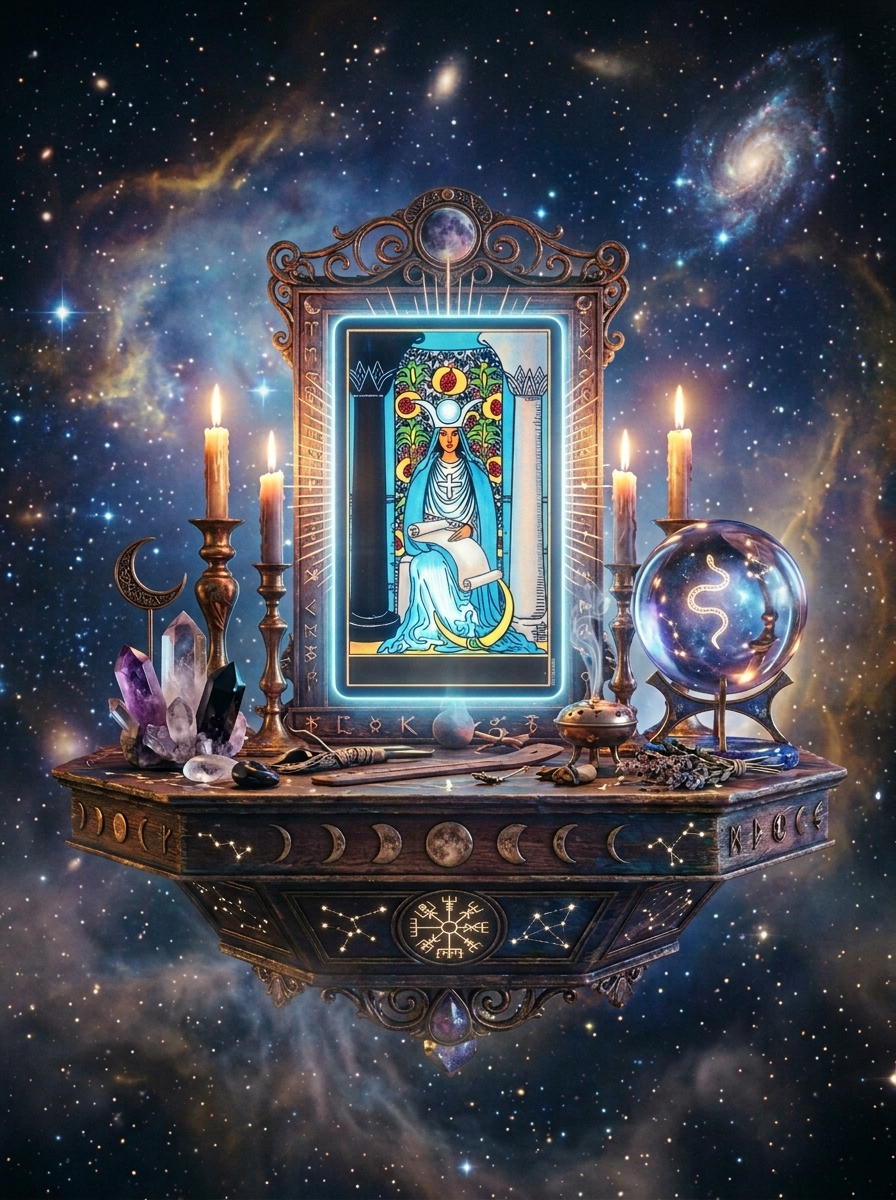
The early cards of the Major Arcana—such as The Magician, The High Priestess, The Empress, and The Emperor—symbolize the formative influences of early life, representing willpower, intuition, nurturing, and structure. The Magician represents the active, conscious mind, channeling cosmic energy into physical reality through focused will. The High Priestess represents the unconscious mind, sitting at the threshold of the mysterious temple, holding a scroll of secret law. The Empress represents the fertile abundance of nature and the nurturing maternal principle, while the Emperor represents structure, order, rules, and patriarchal authority.
As the journey progresses, the Fool encounters more complex archetypal forces. The Hierophant teaches tradition and societal belief systems, while The Lovers present the challenges of choice and alignment of values. The Chariot represents willpower and victory through self-discipline, while Strength showcases the quiet control of inner beastly instincts. The Hermit offers the light of self-reflection in solitude, while the Wheel of Fortune introduces the unpredictable cycles of change. Justice calls for objective truth and karmic balance.
The journey culminates in a series of intense cosmic cards: Death, which signals necessary endings and transformation; The Devil, representing our attachments, illusions, and shadow selves; and The Star, offering hope, peace, and spiritual renewal. The Moon brings us face to face with illusion, anxiety, and the shadow side of our dreams, while the Sun shines light, warmth, and vitality upon our path. Finally, the Fool reaches The World, card twenty-one, representing completion, integration, and wholeness. When a Major Arcana card appears in a reading, it signals that a major life lesson, archetypal theme, or significant karmic shift is at play. These are not passing daily events, but the tectonic movements of the soul.
The Minor Arcana: The Drama of Everyday Life
If the Major Arcana represents the macrocosm of our spiritual development, the fifty-six cards of the Minor Arcana depict the microcosm of our daily existence. These cards mirror the mundane challenges, emotional fluctuations, intellectual struggles, and physical realities that fill our routine lives. While a Major Arcana card might point to a spiritual crisis of identity, a Minor Arcana card shows how that crisis manifests in your morning argument with a colleague or your anxiety over a monthly bill.
To understand the Minor Arcana, it is helpful to look at the progression of the numbers from Ace to Ten. Aces represent seeds, new beginnings, potential, and raw energy. Twos represent choices, balance, partnership, and duality. Threes represent initial growth, expression, collaboration, and expansion. Fours represent stability, boundaries, stagnation, and rest. Fives represent conflict, instability, loss, and challenges. Sixes represent harmony, recovery, support, and transition. Sevens represent evaluation, strategy, illusion, and inner work. Eights represent dedication, speed, restriction, and transformation. Nines represent culmination, independence, worry, or self-satisfaction. Tens represent the ultimate completion of the cycle, representing either absolute success or total collapse.
By studying these everyday scenes and their numerical progressions, we learn to recognize the sacred within the ordinary. We understand that our daily choices are the crucible in which our spiritual destiny is forged. The Minor Arcana shows us that no detail of human life is too small to contain spiritual significance.
The Four Suits and the Elements
The four suits of the Minor Arcana correspond to the four classical elements of Western esoteric philosophy, each representing a distinct arena of human experience:
- Wands (Fire): Associated with creativity, passion, inspiration, ambition, and spiritual drive. Wands represent the spark of energy that initiates action and the willpower required to overcome obstacles. In readings, they speak to career callings, creative projects, and the fire of desire.
- Cups (Water): Associated with emotions, relationships, intuition, dreams, and healing. Cups dive into the fluid realm of the heart, mapping the highs of love and connection alongside the lows of grief, disappointment, and emotional stagnation.
- Swords (Air): Associated with the mind, intellect, communication, conflict, and truth. Swords are double-edged; they represent the power of clear thought and logical analysis, but they also depict the mental anguish of anxiety, betrayal, and self-doubt. They remind us that our thoughts can be our greatest tools or our most painful prisons.
- Pentacles (Earth): Associated with the material world, money, work, home, health, and physical manifestation. Pentacles ground the deck in reality, addressing career stability, financial security, bodily health, and the slow, steady cultivation of long-term goals.
Each suit also contains four Court cards: the Page, the Knight, the Queen, and the King. Esoteric writers like Liz Greene have highlighted how these figures can represent actual people in our lives, facets of our own personalities, or stages of developmental mastery. The Page represents the curiosity and open mind of a beginner, carrying messages and learning the basics of their element. The Knight represents action, drive, and sometimes impulsive movement, carrying the element out into the world with passion. The Queen represents internalized mastery, emotional intelligence, and receptive strength, holding space and ruling with quiet wisdom. The King represents externalized mastery, leadership, and authority over the suit’s element, establishing order and making decisions for the collective.
The Mechanics of a Reading: Shuffling, Spreads, and Reversals
Conducting a Tarot reading is a structured, collaborative conversation between your conscious mind, your intuitive self, and the symbolic language of the cards. It is a misconception that you must possess supernatural "gifts" or be a psychic to read Tarot. Instead, Tarot functions as a visual language. Just as you learn to read letters on a page, you can learn to read the symbols, colors, numbers, and narrative arcs depicted on the cards. The mechanics of a reading provide the necessary container to channel this symbolic language into practical, actionable insights.
Formulating the Question: Agency Over Fortune-Telling
The quality of your Tarot reading is directly tied to the quality of the question you ask. When people approach Tarot as a deterministic fortune-telling tool, they often ask passive, disempowering questions, such as "Will I get back with my ex?" or "When will I get a promotion?" These questions assume that the future is entirely fixed and that the querent (the person asking the question) has no agency in their own life. This creates a psychological dependency where the seeker waits for external forces to decide their fate.
Instead, contemporary psychological Tarot practitioners, inspired by modern astrologers like Steven Forrest, emphasize formulation that preserves personal responsibility. Shift the question from passive anticipation to active exploration. Instead of asking "Will I get the job?" ask "What energies should I embody to perform my best in the interview?" or "What hidden obstacles am I ignoring in my current career path?" By framing questions around how to navigate situations rather than what will happen, Tarot becomes a tool for empowerment, self-reflection, and personal growth. It changes the role of the seeker from a passive observer to an active participant in their own destiny.
The Art of the Shuffle and Pull
Once the question is clear, the reader shuffles the cards. The physical act of shuffling serves multiple purposes. Practically, it randomizes the deck, clearing the physical order of previous readings. Ritualistically, it acts as a meditative bridge, allowing the reader to quiet their analytical mind, slow their breathing, and focus their attention on the query. Some readers like to clear the cards' energy by knocking on the deck or passing it through incense smoke before shuffling.
There is no single "correct" way to shuffle; you can use the riffle shuffle, hand-over-hand, or simply spread the cards face down on a table and mix them in a circular motion (often called "washing" the cards). The key is the intent behind the motion. While shuffling, focus your mind on the essence of your question. When you feel a sense of completion—often signaled by an intuitive pause, a deep breath, or a feeling of calmness—stop shuffling. You can then cut the deck into piles (often three piles, restacked in any order) or simply pull cards directly from the top. The cards are then laid out in a specific arrangement, known as a spread, which assigns a contextual meaning to each card’s position.
Reading Reversals: Shadows and Internalized Energy
When cards are turned upside down in a reading, they are known as reversals. Beginning readers often dread reversals, assuming they automatically invert a positive card into a negative one, or herald disaster. In practice, however, reversals add subtle nuance to a reading, representing internalized energy, blocks, or shadow aspects of the card's archetype.
For example, the Three of Cups upright represents celebration, community, and shared joy. When reversed, it does not mean you will never have friends again; rather, it might indicate that you are feeling isolated from your community, that a social group has become gossipy or toxic, or that you need to celebrate your achievements internally before seeking external validation. Esoteric thinker Aleister Crowley often integrated these nuanced, darker shades of meaning to avoid binary, simplistic interpretations. Reversals invite us to look beneath the surface and confront the hidden dynamics of our situations. They show where energy is not flowing freely, prompting us to examine what is blocked within our psyche.
Practical Layouts: Beginner-Friendly Tarot Spreads
To make sense of the cards you pull, you need a framework that translates individual card meanings into a cohesive narrative. Spreads provide this framework by giving each position in the layout a specific role. For beginners, starting with massive, complex spreads like the Celtic Cross can be overwhelming. It is far better to master simple layouts that encourage deep interpretation rather than broad, shallow readings.
The Daily Card Draw: The Daily Mirror
The single-card draw is the most potent tool for learning Tarot and integrating it into a daily mindfulness practice. Each morning, after centering yourself, shuffle the deck and draw one card. Ask a simple, open-ended question: "What energy should I be mindful of today?" or "What aspect of myself needs my attention?"
Keep the card on your desk or return to its imagery throughout the day. If you draw the Five of Swords, watch for moments of unnecessary conflict or pyrric victories where winning a point costs you a relationship. If you draw the Nine of Pentacles, look for opportunities to appreciate your material security and enjoy the fruits of your labor. At the end of the day, write down how the card’s themes manifested in your life. This practice builds a personal, experiential relationship with the cards, grounding the abstract esotericism of the deck in the concrete realities of daily life. Over time, this daily journal becomes a powerful record of your psychological growth and patterns.
The Past, Present, and Future Spread
The classic Three-Card Spread is the workhorse of the Tarot world. It is elegant, versatile, and instantly provides a narrative structure. In this layout, three cards are placed side by side from left to right:
- Card 1 (Left): Past. Represents the foundational events, past choices, or inherited beliefs that have led you to the current situation. It provides context and reminds you of where you have come from. It shows the roots of the tree you are currently climbing.
- Card 2 (Middle): Present. Illustrates the current state of affairs, the immediate energy surrounding you, and the choices that are currently available. It represents the point of power where your agency resides. It is the reality you must face right now.
- Card 3 (Right): Future. Shows the logical outcome of your current trajectory if you continue on your present path without making changes. This is not a fixed destiny, but a projection of momentum. If you do not like the future card, the present card shows you where you have the power to steer in a new direction.
This spread can easily be adapted to other three-card frameworks: Mind/Body/Spirit, Situation/Obstacle/Advice, or Option A/Option B/How to Choose. Its simplicity allows the reader to focus on the relationships and transitions between the cards.
The Yes/No Spread: Seeking Immediate Clarity
While Tarot is best suited for complex self-reflection, there are times when you need a straightforward answer. The Yes/No spread can offer clarity, but it should be approached with nuance. Rather than looking for a simple binary, use a three-card layout to analyze the forces working for and against your query.
Assign the cards values based on their general tone (upright Major Arcana, Cups, Pentacles, and Wands are generally positive/yes; Swords and reversed cards are generally cautious/no). Beyond the simple count, examine the elemental dignities. For instance, if you ask "Should I move to a new apartment?" and pull the Three of Wands (creation/expansion), the Eight of Swords (restriction/fear), and the Ten of Pentacles (long-term stability), the cards are not giving you a flat yes or no. They are showing you that while moving represents exciting growth (Three of Wands) and long-term security (Ten of Pentacles), your mind is trapped by anxiety about the transition (Eight of Swords). The spread answers "Yes, but you must first address your mental fears." This approach honors your intelligence and situation instead of giving a simplistic, mechanical answer.
Origins and Evolution: The Renaissance Court Game
To understand Tarot, we must separate its historical reality from its occult mythology. For centuries, writers claimed that Tarot was a secret book of ancient Egyptian wisdom, smuggled out of burning libraries by priests disguised as nomads. While this myth is beautiful and poetically rich, modern historical scholarship has revealed a different, yet equally fascinating origin.
Tarot did not begin as an occult divination tool. It was invented in northern Italy during the first half of the fifteenth century, emerging in wealthy Renaissance courts such as Milan, Ferrara, and Bologna. The earliest surviving cards are the Visconti-Sforza decks, commissioned by the ruling families of Milan in the 1440s. These decks were hand-painted, gilded with gold leaf, and incredibly expensive, designed as luxury items to showcase the wealth and sophistication of the aristocracy.
Originally, these decks were called carte da trionfi—cards of triumphs. They were used to play a complex trick-taking card game similar to bridge, which eventually became known as tarocchi. The twenty-two trump cards were added to a standard deck of playing cards to act as permanent wild cards. The imagery on these trump cards was not designed to transmit hidden hermetic codes, but to act as a cosmological mirror of the medieval and Renaissance worldview. They featured figures familiar to any Renaissance Italian: the Emperor, the Pope, the virtues of Justice, Temperance, and Fortitude, the wheel of fortune, and the final judgment. The game of tarocchi was an intellectual exercise, a playful way to engage with the moral, political, and spiritual forces of the era.
As the game spread across Europe, particularly into France, the designs were standardized. The deck we now know as the Tarot of Marseilles became the dominant pattern, featuring woodblock prints with simple color palettes. For nearly three centuries, players across Europe shuffled these cards to score points, capture trumps, and enjoy social gatherings, entirely unaware that future occultists would claim the cards held the keys to the universe.
From Game to Esoteric Philosophy: The Occult Renaissance
The transformation of Tarot from an innocent parlor game into a profound system of esoteric philosophy began in late eighteenth-century France. In 1781, a French Protestant clergyman and scholar named Antoine Court de Gébelin published a volume of his massive work Monde Primitif. In it, he asserted that he had discovered the lost wisdom of ancient Egypt hidden in plain sight within the Swiss Tarot cards. He claimed the cards represented the Book of Thoth, a legendary book of wisdom written by the Egyptian god of magic. He believed the name "Tarot" derived from the Egyptian words tar, meaning path, and ro, meaning royal—making Tarot the "Royal Path of Life."
Although Court de Gébelin’s linguistic and historical theories were later debunked, they sparked a massive wave of occult interest in the cards. Shortly after, a French seed merchant turned fortune-teller named Jean-Baptiste Alliette, writing under the pseudonym Etteilla, published the first practical manuals for Tarot divination. Etteilla corrected what he believed were corruptions in the traditional card designs, created his own custom astrological tarot deck, and established the foundational meanings for upright and reversed cards that still influence readers today.
In the mid-nineteenth century, the French occultist Éliphas Lévi made a monumental breakthrough that cemented Tarot’s place in the Western mystery tradition. Lévi recognized that the twenty-two cards of the Major Arcana corresponded perfectly to the twenty-two letters of the Hebrew alphabet and the twenty-two paths of the Qabalistic Tree of Life. By linking Tarot to Qabalah, Hermeticism, and alchemy, Lévi transformed the deck into a comprehensive key to the Western esoteric system.
This work culminated in the early twentieth century within the Hermetic Order of the Golden Dawn in London. Arthur Edward Waite, a prominent member of the Order, sought to create a deck that would express the deep mystical principles of his philosophy. He partnered with the artist Pamela Colman Smith, a fellow Golden Dawn member and talented illustrator. Released in 1909, the Rider-Waite-Smith (RWS) deck revolutionized Tarot. Pamela Colman Smith’s genius was to illustrate the Minor Arcana cards with fully realized, narrative scenes featuring human figures, rather than the simple, abstract pip arrangements of previous decks. This visual change democratized Tarot, making the cards instantly accessible to the intuition of the modern reader.
The Psychological Mirror: Jungian Archetypes and the Collective Unconscious
In the mid-twentieth century, Tarot underwent a second revolution, moving from the realm of occult prediction to the field of depth psychology. The key figure in this transition was the Swiss psychiatrist Carl Gustav Jung. While Jung never wrote a book specifically about Tarot, he recognized that the cards were a brilliant, non-linear system for exploring the human psyche.
Jung proposed that humanity shares a collective unconscious—a deep layer of the mind containing universal, inherited patterns, symbols, and instincts that he called archetypes. These archetypes—such as the Mother, the Father, the Shadow, the Sage, and the Anima—are the building blocks of human mythology, dreams, and art. Jung observed that the Major Arcana of the Tarot is a collection of these archetypal patterns made visible. The Empress is the Great Mother; the Emperor is the Archetypal Father; the Devil is the personal and collective Shadow; the Hermit is the Wise Old Man.
Jung also introduced the concept of synchronicity, which he defined as "meaningful coincidence." Synchronicity explains how Tarot works without relying on supernatural magic. When we shuffle and pull cards, the physical state of the deck aligns with our psychological state at that moment. The cards we draw are not accidental; they are a symbolic representation of our current unconscious landscape.
When we conduct a Tarot reading, we are not looking at a magical screen showing external future events. Instead, we are looking into a psychological mirror. Through the psychological process of projection, we cast our unconscious thoughts, fears, and hopes onto the rich, ambiguous symbols of the cards. The deck bypasses our conscious ego, which is often defensive or confused, and allows us to access the deeper wisdom of our unconscious minds.
Modern psychological tarot practitioners, such as Liz Greene and Steven Forrest, use the cards as a tool for active imagination, helping clients identify internal conflicts, explore their shadow selves, and align with their authentic developmental paths. Tarot is no longer seen as a tool to appease a deterministic fate, but as a language of the soul that restores agency to the individual.
Ethics and Boundaries: What Tarot Is Not
As Tarot has gained mainstream popularity in the United States, it is essential to establish clear ethical boundaries. Because the cards deal with deep symbols and emotional issues, they can easily be misused if the reader or the client does not understand the limitations of the practice. To use Tarot responsibly, we must be clear about what Tarot is not.
First, Tarot is not an absolute predictive tool. The cards show trends, energies, and potential outcomes based on your current trajectory. They do not show an unalterable future. If a reading warns of a difficult outcome, it is not a curse; it is an invitation to change your behavior, thoughts, or actions to avoid that outcome. The future is a fluid landscape shaped by your choices, and Tarot should always reinforce your free will and personal responsibility, never strip it away. A reading should leave you feeling empowered to make choices, not paralyzed by dread of an unavoidable fate.
Second, Tarot is not a substitute for professional counsel. A Tarot reader is not a doctor, a therapist, a lawyer, or a financial advisor. While a reading can offer profound emotional comfort and psychological clarity, it cannot diagnose an illness, prescribe treatment, resolve legal disputes, or manage an investment portfolio. If a client is experiencing severe mental health struggles, they need a licensed therapist, not a card spread. Ethical Tarot readers know their limits, clearly communicate these boundaries to their clients, and do not hesitate to refer them to qualified professionals when necessary.
Third, Tarot is not a tool for invading the privacy of others. Readings should focus on the seeker's own experiences, feelings, and choices. Asking questions like "What is my ex-partner doing right now?" or "Is my boss planning to fire my coworker?" crosses an ethical boundary. A responsible reading reframes these questions to focus on the querent, such as "How can I find peace regarding my past relationship?" or "How can I best navigate the professional anxiety I feel in my workplace?"
Frequently Asked Questions About Tarot
Do I need to be psychic or have a "gift" to read Tarot?
No. Anyone can learn to read Tarot. It is a visual language based on symbol, color, number, and narrative structure. While natural intuition is helpful, the ability to read the cards is a skill that is developed through study, observation, and practice, much like learning to play an instrument or speak a foreign language. You do not need to hear voices or see spirits; you simply need to pay attention to the images and learn how they connect to human experiences. Over time, you will find that the cards help you cultivate your own natural intuition, making it stronger and more reliable.
Is it bad luck to buy your own first Tarot deck?
This is a common superstition with no historical or practical basis. The myth likely originated during the occult revival to add a layer of mystery and exclusivity to the practice. In reality, buying your own deck is a wonderful way to ensure you select one whose artwork, symbolism, and theme resonate deeply with you. You do not need to wait for someone to gift you a deck to begin your journey. Choose a deck that speaks to you, and start reading without hesitation.
How should I store or cleanse my Tarot deck?
How you care for your deck is a personal choice. Some readers prefer to wrap their decks in silk scarves or store them in wooden boxes, while others simply keep them in their original cardboard boxes on a bookshelf. If you feel a deck has accumulated "heavy" or confusing energy after a difficult reading, you can cleanse it by shuffling it thoroughly, placing it in sunlight or moonlight, or passing it through the smoke of clearing incense like cedar or rosemary. The key is to find a practice that helps you mentally reset and focus your intentions before your next reading.
Can Tarot cards predict the exact future?
No. Tarot cards project the path of least resistance based on your current choices, beliefs, and energies. The future is not a fixed destination; it is a dynamic process. The cards act as a weather report: they can warn you of rain, but you still have the choice to wear a raincoat, stay inside, or carry an umbrella. The ultimate power to shape your life always remains with you, not with the cards. Tarot should be used as a map for navigation, not a script to be followed blindly.
What is the difference between Tarot and Oracle cards?
Tarot decks have a strict, traditional structure. They always contain seventy-eight cards divided into twenty-two Major Arcana and fifty-six Minor Arcana across four specific suits. Oracle decks, on the other hand, have no set structure, number of cards, or specific suits. The creator of an oracle deck designs their own system, themes, and guidebook from scratch. Tarot is a structured language with historical rules, while oracle cards are freer, more intuitive, and open-ended. Many readers use both in combination.
Comments
Loading comments…