Death and Judgement Tarot Combination: The End That Calls You Forward
The Core Dynamic: Reckoning After Release
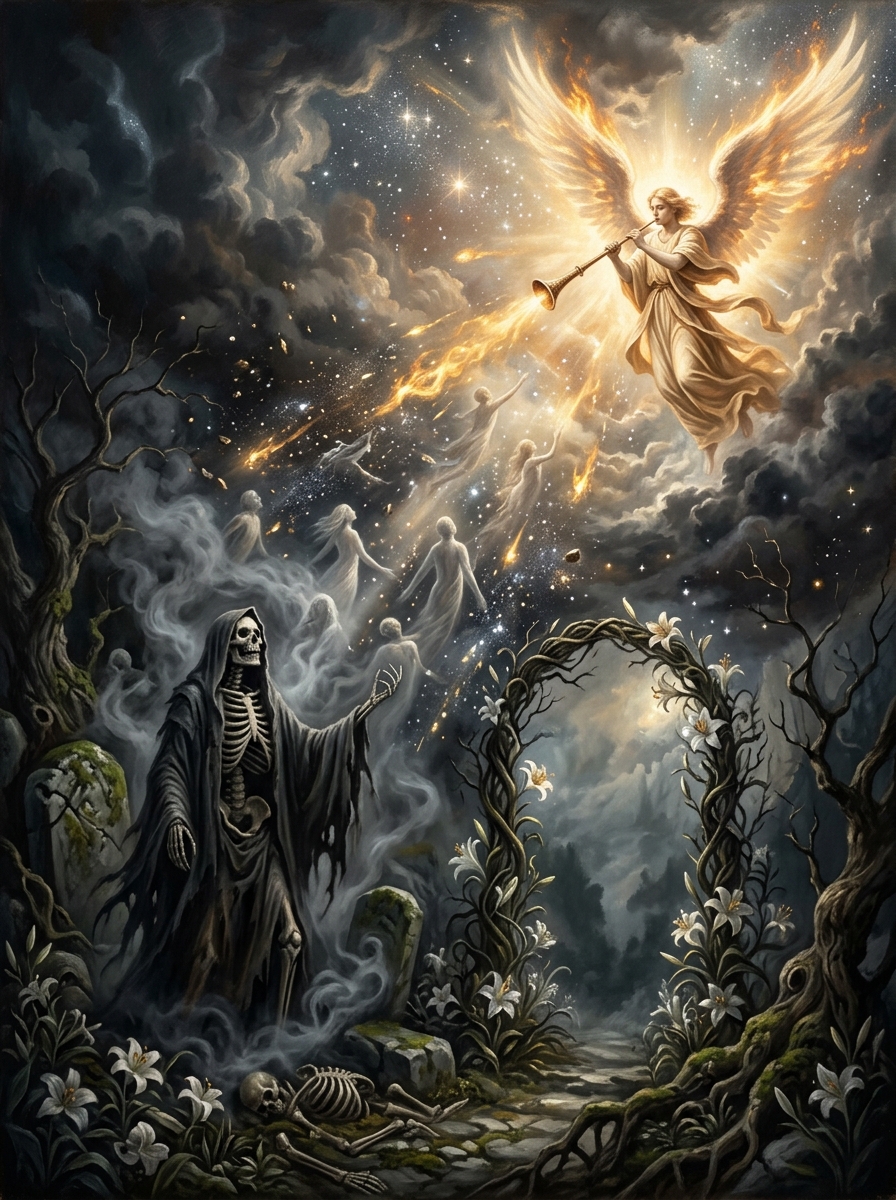
Death and Judgement together form a sequence, not a static pairing. Death is the armored rider who clears the field — the end of a chapter, a relationship, a career identity, an inner fiction. Judgement is the trumpet that sounds after the dust settles, calling the dead to rise and account for what they have become. In the Rider-Waite-Smith imagery, Death carries a black banner emblazoned with a white rose: purity through dissolution. Judgement shows figures emerging from tombs beneath an archangel’s horn, their arms raised in recognition of a summons that bypasses the ego entirely.
What makes this combination distinct from Death alone or Judgement alone is the moral momentum. Death removes; Judgement reanimates with purpose. The old self does not simply vanish — it is measured against the soul’s next assignment. You are not being asked to accept an ending; you are being asked to answer for what the ending has made possible. For the psychological dimension of this reckoning, see The Death Tarot Card and Judgement Tarot Card — but here the emphasis is on the irreducible sequence: first dissolution, then verdict.
Psychological Roots: Ego Death and the Call to Individuation
At the psychic level, this pairing stages a confrontation with the persona — the social mask that survives through repetition and approval. Death cuts that loop. It removes the job title, the relational pattern, the belief that once held the self together. What remains is not a vacuum but a stripped-down awareness that can no longer pretend. Judgement then asks the raw psyche to integrate what was previously split off: denied grief, buried ambition, truth about a relationship that both partners avoided.
Jung would recognize this as the death of persona followed by the beginning of individuation. The first is subtractive, the second is generative. But there is a danger: if the ego refuses the call — if it tries to resurrect the old form through denial, nostalgia, or forced positivity — the pairing turns shadow. Instead of awakening, the person experiences chronic guilt, self-flagellation, or a manic attempt to “fix” what is already finished. The shadow of this combination is not destruction but false resurrection: pretending the trumpet called for a different outcome than the one that arrived.
For those stuck in that loop, the Shadow Work Tarot Spread can clarify which buried material still needs to surface. But when the pairing matures, it produces a quiet authority. The person stops defending irrelevance. They begin to live from a place of earned truth.
How It Matures vs. How It Goes Shadow
A mature Death and Judgement feels not like catastrophe but like the end of a long trance. The ending may still hurt, but it comes with a strange relief — the weight of pretense lifts. The person who emerges is less performative, more willing to speak what they know, less afraid of being judged because they have already faced the internal verdict. This is the resurrection the card promises: not a return to the old life but the capacity to inhabit a life that is genuinely one’s own.
The shadow expression, in contrast, is marked by rigidity. Instead of allowing the ending to complete, the person tries to manage it with over-analysis, control, or spiritual bypassing (“it was all meant to be”). They may cling to a relationship that has already died emotionally, or stay in a career that hollows them out, because the alternative — hearing the trumpet — feels too exposing. In this state, the pairing manifests as repeated crisis: the universe keeps ringing the bell until someone answers.
Compare this with Death and The Tower, where the destruction is sudden and cataclysmic. Here, the destruction is more gradual, but the judgment is sharper. Tower breaks the house; Death and Judgement demand you answer for why you built it there in the first place.
One Life, Many Arenas: Love, Work, and the Soul’s Next Assignment
Because the dynamic of Death-and-Judgement is universal, it expresses differently in love, career, and spiritual development — but the underlying pattern is identical. The following applications are not separate sections; they are examples of the single movement described above.
In love, this pairing often marks a relationship that has exhausted its original premise. Death says the old contract — the one based on projection, need, or habit — is no longer viable. Judgement then demands honesty: what was actually true between you? If both partners can meet that question without defense, the bond can be reborn on a deeper foundation. If not, the ending becomes a clean severance rather than a prolonged farewell. The Lovers and Death combination describes a similar crossroads, but here the added layer of Judgement makes the choice irreversible — once you know, you cannot unknow.
In career, the pairing appears when a job, title, or professional identity has died — through layoff, resignation, or quiet burnout — and the soul now demands work that aligns with conscience and talent. Death removes the shell of obligation; Judgement introduces vocation. Not every post-loss job counts; the real question is whether the new role answers the summons or merely fills the space. For a structured approach, the Career Tarot Spread can clarify whether the next step is a true call or a reaction to fear.
Spiritually, this combination often describes a conversion experience — not necessarily religious, but an inner recognition that the old worldview no longer holds. A belief dies, a prayer is answered in unexpected form, a life direction crystallizes. The person feels both stripped and filled. This is the domain of Judgement and The World, which completes the cycle through integration. But Death and Judgement get there first through dissolution and awakening.
The Summons and the Responsibility to Answer
The final meaning of this pairing is that a life lived by default has become impossible. Death has cleared enough ground; Judgement now insists you choose what grows there. The trumpet does not ask for your opinion — it asks for your presence. Once you have heard it, the old excuses lose their authority. You know what is finished. You know what is being asked. The work is to live as if you heard it.
In timing, this pair tends to indicate a threshold rather than a process. Something has reached the point where reversal is unlikely, and the only honest response is to step forward. If surrounding cards in a spread suggest support — like Death and Temperance — the transition can be measured and healing. If the spread includes The Moon and Judgement, unresolved fear or secrecy may be muffling the call. But in all cases, the summons itself is the point.
You are not being asked to grieve forever. You are being asked to rise.
Related
- Judgement and The World: The Final Call and the Finished Circle
- Judgement and The Hierophant: The Verdict of the Soul and the Law of Meaning
- Judgement and the Magician: The Sound of Awakening Becoming Action
- The Star and Judgement: Hope Answering the Call
- The Sun and Judgement Tarot Combination: Radiance Answering the Call
Comments
Loading comments…