Death and The Tower Tarot Combination: The Crucible of Radical Rebirth
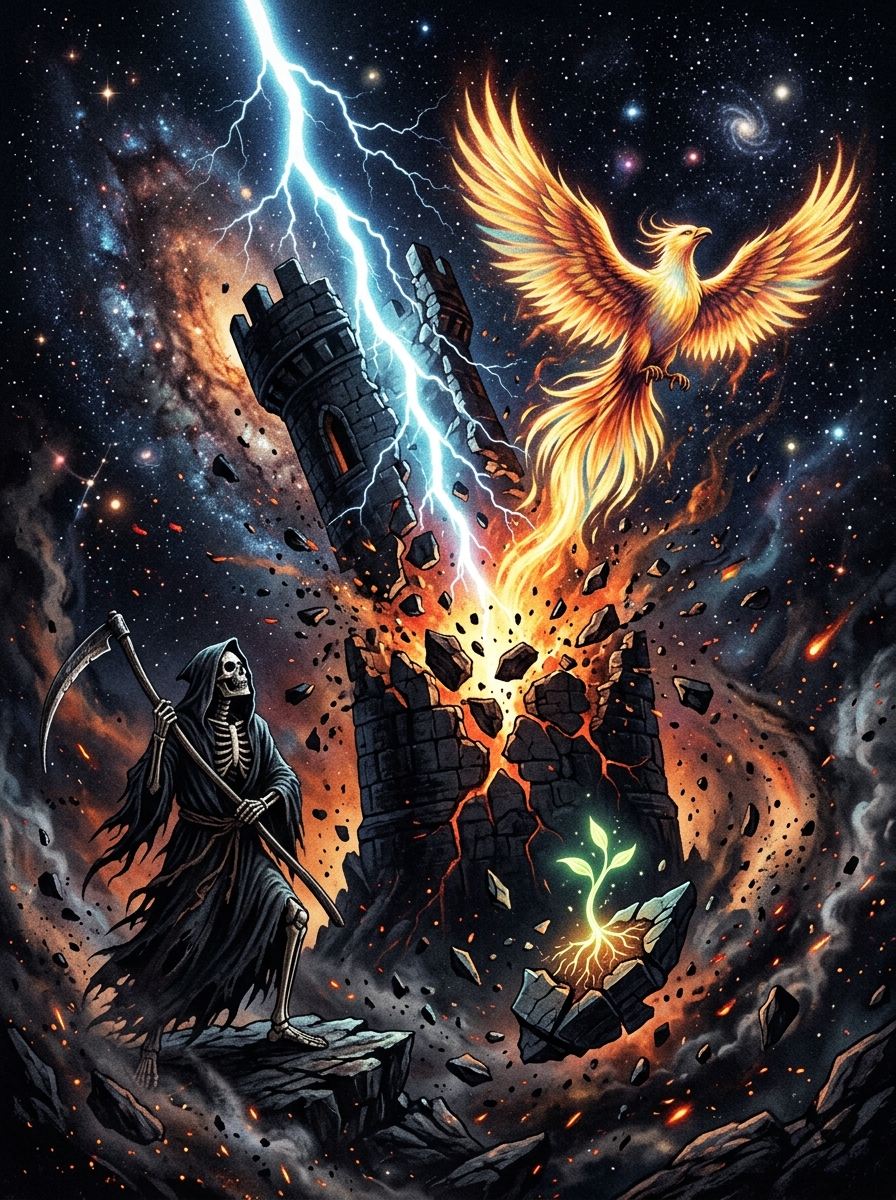
The Archetypal Synthesis: Slow Composting Meets the Lightning Strike
The Anatomy of Plutonian Decay
In the grand symbolic architecture of the tarot’s Major Arcana, few card combinations provoke as much immediate, visceral dread as the pairing of Death and The Tower. To the uninitiated, they seem like a double portion of doom: one represents the silent sweep of the reaper’s scythe, while the other shows a stone monolith shattered by lightning, its occupants falling headlong into a fiery abyss. Yet, when we approach these cards through the lens of psychological astrology and Western esoteric philosophy, we discover that they are not harbingers of literal, physical catastrophe. Instead, they represent a highly coordinated, dual-engine system of psychic regeneration. Together, they form the ultimate crucible of the soul, ensuring that when the ego becomes too rigid to grow, the universe has a reliable mechanism to restore flow and vitality to the life path.
To understand how these two powerful forces interact, we must first examine their contrasting methods of operation. The Death card, traditionally ruled by Scorpio and modernly associated with Pluto, is the archetype of slow, organic composting. Death is the quiet, internal harvester that operates in the dark, subterranean chambers of the personal unconscious. It represents the natural lifecycle of endings, decay, and the gradual dissolution of attachments. When we experience a Death process, it is rarely loud or sudden; instead, it is a slow, heavy feeling of stagnation, a sense that a particular chapter of our lives has lost its vital juice. The leaves turn brown, fall to the ground, and slowly rot into the soil. In the Rider-Waite-Smith deck, Arthur Edward Waite depicted Death as a skeletal knight clad in black armor riding a pale horse. While his appearance is imposing, he carries a black banner emblazoned with a white rose—the symbol of purification and rebirth. In the background, the sun rises between two towers, representing the promise of a new dawn that lies beyond the threshold of endings. Death requires of us a slow, willing surrender to the natural tides of time, a period of mourning, and the active patience of allowing the old identity to rot away so that its nutrients can feed the next phase of our growth.
The Uranian Shockwave
In stark contrast, The Tower, ruled by Mars and closely aligned with the erratic, revolutionary energy of Uranus, is the archetype of the sudden, external lightning strike. The Tower does not wait for organic decay. It is the sudden, violent rupture of the structures we have built to protect our egos and secure our lives. Where Death is the quiet rotting of the roots, The Tower is the sudden storm that tears the canopy away. It represents the dramatic collapse of belief systems, careers, marriages, or identities that were built on false premises, compromise, or rigid defenses. The image on the card is stark: a crown-topped stone fortress is struck by a bolt of lightning, blowing the crown off and sending the occupants falling into the dark. This crown is the ego-persona, the false crown of sovereignty we wear when we believe we are in absolute control of our lives. The lightning bolt is the flash of objective truth, a sudden Uranian revelation or a Martian severance that shatters our illusions in a single, irreversible moment.
The profound synthesis of these two cards lies in their sequence and cooperation. When they appear together, they indicate that the soul is undergoing both an internal dissolution and an external restructuring. If we have ignored the quiet warnings of the Death card—if we have clung to a dead relationship, a soul-crushing job, or a dysfunctional habit out of fear of the unknown—we build a rigid fortress of denial. The longer we resist the slow, composting process of Pluto, the more psychic tension we accumulate. Eventually, this tension reaches a breaking point, and the universe delivers the sudden, Uranian lightning strike of The Tower. The Tower is the external manifestation of the inner decay we refused to acknowledge. Together, they strip the individual of all false security, leaving them to stand naked in the wreckage of their former life, but finally free to rebuild on a foundation of absolute truth. This transition is not an act of cosmic cruelty, but a sacred necessity, for only by clearing away the rubble of our defenses can we connect with the indestructible core of the self.
The Dissolution of Ego Defenses: Jungian Perspectives on Endings
The Collapse of the Persona
To fully grasp the psychological necessity of the Death and Tower combination, we must turn to the concepts of Carl Jung, particularly his definitions of the ego, the persona, and the shadow. The ego is the center of our conscious awareness, the part of us that seeks security, predictability, and control. To navigate society, the ego constructs a persona—a social mask that represents how we wish to be perceived by the world. While the persona is a necessary tool for social interaction, the danger arises when we identify too closely with it, forgetting that we are far deeper and more complex than our social roles. For example, a person may build a rigid persona as the "perfect provider," the "indispensable employee," or the "spiritual savior." When we lock ourselves inside these rigid roles, we repress our shadow—the unacknowledged, unacceptable parts of our psyche—and build psychological fortresses to keep the shadow out.
This is where the combination of Death and The Tower acts as an aggressive psychological intervention. The Death card represents the initial, internal pressure of the unconscious demanding integration. It is the slow, Pluto-ruled process of shadow work, where the ego is forced to descend into the underworld to confront the parts of the self it has denied. Astrologer Liz Greene, in her extensive work on the psychological dimensions of the outer planets, describes this Plutonian process as an irresistible call to surrender. The ego cannot fight Pluto; it can only yield. If the ego refuses this surrender, locking itself tighter inside its fortress, the psychic energy constricts, turning sour and stagnant. We feel an underlying sense of depression, anxiety, or emptiness—clear signs that our current psychological structures have outlived their usefulness.
When the ego’s defenses are impenetrable to the quiet invitations of Death, the archetype of The Tower is activated as an external shockwave. The Tower represents the sudden, disruptive emergence of the repressed shadow into conscious awareness, often projected onto external events. The lightning strike is the moment of objective insight that shatters the persona. In Jungian terms, this is a crisis of ego-death. The structures of the mind that we believed were permanent—our reputation, our moral superiority, our intellectual certainty—are revealed to be fragile illusions. The occupants of the tower fall because their high-altitude isolation from the ground of reality is no longer sustainable.
This psychological collapse is not a punishment; it is a vital act of liberation. In the works of Steven Forrest, this collapse is framed as a necessary dismantling of the ego-shell. Just as a seed must split open and destroy its outer casing for the sprout to emerge, the human personality must periodically undergo the destruction of its rigid defenses to allow the authentic Self to manifest. The true Self, in Jungian psychology, is the archetype of wholeness that transcends the ego. While the ego perceives the fall of the tower as an existential catastrophe, the Self recognizes it as the beginning of true individuation. By letting go of the false crown of control and standing in the ruins of the persona, the individual is forced to look downward, discovering that the only indestructible foundation is the authentic, spiritual core that lies beneath the wreckage. Without this periodic dismantling, our consciousness would remain arrested, unable to adapt to the evolving demands of our spiritual destiny.
Love and Relationships: Breaking Codependency and Navigating High-Intensity Shifts
The Death of the Relationship Contract
In the realm of love, intimacy, and human connection, the combination of Death and The Tower represents a high-stakes transition that brooks no compromise. When these cards appear in a relationship reading, they indicate that the existing relational dynamics have reached a terminal point. The universe is demanding a complete, root-and-branch restructuring of how the partners relate to one another. For couples who have built their connection on a foundation of unspoken agreements, codependency, or mutual ego-defense, this combination can feel like an emotional earthquake.
At the heart of many long-term relationships is an unwritten contract: "I will support your illusions if you support mine." This contract provides a comfortable sense of security, but it eventually becomes a prison that stunts individual growth. The Death card represents the slow, Plutonian decay of this contract. One or both partners begin to feel a growing sense of alienation, a quiet realization that the relationship is no longer spiritually alive. This is the stage of emotional composting, where the old patterns of communication, the power struggles, and the romanticized illusions of the early days begin to rot away. It is an uncomfortable, grieving process that requires radical honesty. If the couple has the courage to sit with this discomfort, acknowledging the death of the old dynamic, they can consciously begin to negotiate a new, mature way of relating. For example, they may realize that their relationship has become centered on parenting or financial management, while their emotional and physical intimacy has completely withered.
Rebuilding from the Relational Ash
However, if the partners resist this decay—if they cling to the illusion of the perfect relationship out of fear of loneliness, or if they repress their growing dissatisfaction—they set the stage for The Tower’s lightning strike. In relationships, The Tower often manifests as a sudden, explosive crisis. It may be the revelation of an affair, an unexpected request for divorce, or an external crisis that forces the couple to confront their hidden fault lines. The facade of the relationship is shattered in an instant, and the partners are forced to confront the raw, unvarnished truth of who they are and what they have built.
Navigating this relational fire requires a willingness to let the old structure burn completely. Many couples make the mistake of trying to rebuild their relationship immediately using the same old blueprints and damaged bricks. They negotiate, make promises, and try to restore the status quo as quickly as possible to escape the anxiety of the void. But the Death and Tower combination warns that the status quo is dead. The old contract cannot be salvaged. To survive this transit, the relationship must be rebuilt from the ash up. This means establishing a new connection based on absolute, vulnerability-testing honesty, where both partners are willing to be seen in their raw, imperfect humanity. In some cases, the combination indicates that the relationship itself must end, as its evolutionary purpose has been fully served. In either case, the destruction of the old form is the prerequisite for the birth of a more authentic, conscious capacity for love. It forces us to realize that true intimacy is not the absence of conflict or change, but the ability to grow together through the fire of transformation.
Career, Money, and Ambition: Facing Professional Disruptions and Rebuilding Foundations
The Fall of the Corporate Tower
When the focus of a life transition shifts to career, financial security, and material ambition, the combination of Death and The Tower acts as a radical, often painful course correction. Many of us invest an enormous amount of energy into building our professional lives, constructing impressive towers of prestige, title, and financial stability. We identify ourselves by our job descriptions and seek validation through our professional achievements, believing that our material success will protect us from the uncertainties of life. However, when these professional structures are built on the quicksand of compromise, self-betrayal, or outgrown ambitions, they cannot survive the combined energies of Pluto and Mars.
The Death card in a professional context represents the slow, quiet erosion of our passion and alignment. We may go to work every day, perform our duties, and collect our paychecks, but internally, something has died. The motivation is gone, the inspiration has evaporated, and we feel a growing sense of spiritual stagnation. We are composting in our cubicles, but out of fear of financial instability or loss of status, we refuse to make a change. We cling to the golden handcuffs of a secure position, even as it drains our life force.
Rebuilding Ambition on Ethical Foundations
If we refuse to heed this internal decay, the universe intervenes with the sudden, disruptive strike of The Tower. In the career sphere, this often manifests as a sudden layoff, the collapse of a company, a professional scandal, or the unexpected termination of a project. It is a shocking, humbling experience that shatters our professional persona and leaves us facing financial anxiety and uncertainty. The tower we worked so hard to build is reduced to rubble in a single day.
We must recognize that the panic of losing a job is often a panic of losing our identity. When our identity is tied up in a title, the loss of that title feels like a death. In this sense, the professional disruption is a spiritual initiation, forcing us to discover who we are when the corporate armor is stripped away. The true security is not in the company or the bank account, but in our capacity to adapt, create, and align with the organic flow of our destiny. The destruction of these outgrown structures creates the necessary clearing for us to rebuild our professional lives on solid, ethical, and authentic foundations. It forces us to ask deep, uncomfortable questions: Who were we building this tower for? Was it to satisfy our own soul’s calling, or was it to meet the expectations of society, our parents, or our egos? By stripping away the false security of the persona, the combination of Death and The Tower invites us to align our work with our true values. It challenges us to build a professional life that is not just a monument to our vanity, but an authentic expression of our unique gifts and ethical commitments, ensuring that our daily labor is spiritually nourishing and aligned with the collective good.
Astrological and Alchemical Underpinnings: Scorpio, Mars, and the Purification by Fire
Putrefactio: The Blackening of the Soul
To understand the mechanics of the transformation brought about by Death and The Tower, we must examine their deep roots in astrological and alchemical traditions. These ancient frameworks provide a map of the territory, helping us to normalize the intense emotional and psychological states that accompany these cards. Astrologically, the Death card is ruled by Scorpio, the sign of fixed water. Scorpio is modernly ruled by Pluto, the lord of the underworld, and was traditionally ruled by Mars. It represents the deep, hidden currents of the psyche, the mysteries of sex, death, and regeneration, and the capacity to face the shadow without blinking. Scorpio’s element is water, but it is not the fresh, running water of a stream; it is the still, deep water of the swamp, where organic decomposition takes place.
In the alchemical tradition, Scorpio and the Death card correspond to the stage of putrefactio (or nigredo, the blackening). In putrefactio, the raw material of the psyche is sealed in the alchemical vessel and allowed to decompose. This is a dark, wet, and often depressing phase, where everything we thought we knew about ourselves is broken down into its basic components. It is the necessary rot that precedes the germination of the seed. Without putrefactio, the raw materials remain hard, rigid, and resistant to transformation. The soul must learn to dwell in this dark, quiet space, allowing the decay of the ego to run its natural course without rushing to find a solution. When a transit of Pluto aspecting natal planets occurs, it mirrors this slow, inevitable pressure to release what has decayed, prompting an internal restructuring that is both deep and lasting.
Calcinatio: The Purifying Fire
If Death is the wet, slow decomposition of putrefactio, The Tower is the dry, explosive heat of calcinatio. Astrologically, The Tower is ruled by Mars, the planet of cardinal fire, action, drive, and severance, and is modernly associated with the sudden, revolutionary lightning strikes of Uranus. Mars is the blade that cuts away what is dead, while Uranus is the lightning bolt that brings sudden, shocking illumination. When The Tower is activated, the psyche is subjected to calcinatio—the alchemical process of heating a solid substance to high temperatures in the presence of oxygen to burn away all volatile impurities.
In calcinatio, the fire does not destroy the essence of the substance; it only destroys the dross, leaving behind a highly stable, purified oxide. Aleister Crowley, in his commentary on the Tower card (which he called The War card in his Thoth deck), emphasized that this martial fire is not purely destructive. It is the liberating energy of the life force itself breaking through the artificial structures of the ego. The lightning strike is the descent of spirit into matter, a sudden influx of cosmic energy that shatters the stone fortress of our illusions. The fire of the Tower is a cleansing agent, burning away the falseness, the compromise, and the pride that have accumulated in our lives. Together, Pluto’s putrefactio and Uranus/Mars’s calcinatio form a complete alchemical process: first, the slow, emotional dissolution of our old identity, and then the sudden, purifying fire that burns away the remnants of our defenses, leaving behind only the indestructible gold of the true Self. This alchemical cycle is reflected astrologically when Uranus transits a sensitive point in the chart, bringing sudden breakups, sudden relocations, or sudden career shifts that serve as the external crucible for our spiritual purification.
Evolutionary Advice: Active Patience and Surrendering the Illusion of Control
The Art of Active Patience
When we are caught in the middle of a Death and Tower transition, our instinctive reaction is to panic, to fight, and to try to regain control. The ego hates the void; it is terrified of the space between what was and what will be. We want to negotiate, to sweep up the broken bricks of our collapsed tower, and to rebuild the structure as quickly as possible. We want to bypass the grief of Death and the shock of The Tower, rushing straight to the promise of rebirth. But this combination warns that any attempt to force a premature resolution will only prolong our suffering and result in building another fragile structure that will eventually have to be destroyed.
Evolutionary astrologer Steven Forrest advocates for a practice he calls active patience during these intense periods. Active patience is not passive resignation or helpless victimhood. Instead, it is the conscious, courageous choice to cooperate with the process of transformation. It is the willingness to sit in the ruins of the tower, to let the dust settle, and to feel the grief of the loss without trying to fix it. Active patience means recognizing that the composting process of Death cannot be rushed. Just as you cannot force a seed to grow faster by pulling on its sprout, you cannot force your new life path to emerge until the old identity has fully decomposed. It requires us to dwell in the liminal space, trusting that the silence and emptiness are not signs of failure, but the fertile ground of our future growth. In practice, this means resisting the urge to jump immediately into a new job or relationship just to escape the discomfort of being alone or unemployed. It means allowing ourselves to mourn, to reflect, and to ask what these endings are trying to teach us.
Aligning with the Self
Surrendering the illusion of control is the ultimate challenge of this combination. The ego believes that if it is not managing, organizing, and controlling every aspect of life, everything will fall apart. But the fall of the tower is proof that the ego's control was an illusion all along. The true coordinator of our lives is the Self—the deeper, spiritual core of our being that knows exactly what experiences we need for our evolutionary growth.
During a Death and Tower transit, our work is to withdraw our energy from the outer world of action and align ourselves with the Self. This means prioritizing practices that connect us to our inner landscape: meditation, dream analysis, journaling, and spending time in nature. We must learn to listen to the quiet, subtle promptings of the unconscious, rather than the loud, panicked demands of the ego. When we align with the Self, we realize that the destruction of our old life is not a tragedy, but a sacred act of preparation. The soil is never more fertile than it is after a forest fire. By surrendering our rigid plans and allowing the old structures to fall, we clear the space for a life that is infinitely more authentic, resilient, and aligned with our soul’s true destiny. We learn to become like bamboo—flexible enough to bend in the storm of The Tower, and deeply rooted enough in the rich soil of Death to grow stronger once the wind has passed.
Frequently Asked Questions
Does the Death and The Tower combination predict literal, physical disaster?
No, it does not. In modern psychological tarot, the cards represent internal states, psychological shifts, and evolutionary milestones rather than literal, physical events. While this combination can coincide with challenging external disruptions—such as a job loss, a divorce, or a sudden change in circumstances—these events are understood as the external manifestations of internal processes. The primary focus of Death and The Tower is the dismantling of obsolete ego structures and the liberation of the individual. The "destruction" they bring is not designed to harm you, but to free you from stagnant situations and rigid psychological defenses that are stunting your spiritual growth. By viewing these disruptions through a symbolic and evolutionary lens, we can shift our attitude from fear to curiosity, asking what new possibilities are opening up as the old forms collapse.
How can I distinguish between a Death process and a Tower process in my life?
A Death process is characterized by a slow, internal, and organic feeling of ending, stagnation, or decay. It is the quiet realization that a particular phase of your life has lost its meaning, resembling a season of autumn or winter. It requires mourning, reflection, and the patience to let things dissolve naturally. A Tower process, on the other hand, is sudden, loud, and disruptive. It often comes from the outside world as an unexpected shock—a sudden phone call, a layoff, or an explosive revelation. While Death asks you to slowly let go, The Tower tears the object of your attachment out of your hands, forcing you to confront the truth immediately. Death is the slow composting of the roots; The Tower is the sudden lightning bolt that shatters the fortress of the persona.
What does it mean when one of these cards appears reversed in a reading?
In psychological tarot, reversals often indicate that the energy of the card is being resisted, repressed, or turned inward. If the Death card is reversed, it suggests a profound resistance to letting go of what is already dead, leading to emotional stagnation, depression, and a stubborn refusal to grieve. If The Tower is reversed, it can indicate that you are trying to cling to a collapsing structure, attempting to patch up the cracks in a wall that needs to be torn down. A reversed Tower warns that resisting the necessary destruction will only prolong your anxiety and delay the inevitable rebuilding process. It is a call to stop fighting the fire and allow the old form to burn away, recognizing that the collapse is an essential step toward your eventual regeneration.
How can I support someone else who is experiencing a Death and Tower transit?
The most important way to support someone going through this transition is to hold space for their grief and shock without trying to "fix" their situation or cheer them up. The ego-death of these cards is a painful, disorienting experience, and well-meaning attempts to offer quick solutions or positive platitudes can invalidate their pain. Avoid telling them that "everything happens for a reason" or urging them to rebuild immediately. Instead, offer a steady, non-judgmental presence. Encourage them to feel their anger and sorrow, remind them that their feelings are valid, and help them secure their basic physical needs while the emotional dust settles. Simply being there with them in the ruins is often the most profound support you can offer.
What is the spiritual significance of the integration phase after the dust settles?
The integration phase is where the true alchemy of this combination takes place. Once the tower has collapsed and the composting of the old identity is complete, you are left in a state of emptiness, often referred to as the fertile void or the liminal space. The spiritual significance of this phase is the opportunity it provides to connect with your authentic Self, free from the demands of your former persona. It is a time for quiet reflection, listening to your intuition, and slowly testing the ground to see what feels truly aligned. Rebuilding should not be rushed; it is a deliberate, conscious process of laying new foundations that are rooted in absolute honesty and spiritual integrity, ensuring that the new structure you build is resilient and aligned with your soul's calling.
Can the Death and Tower combination represent positive transitions?
Yes, absolutely. While the experience of these cards is often uncomfortable and intense, their ultimate goal is positive, liberating, and life-affirming. In the wake of a Tower event, individuals frequently report a profound sense of relief, as if a heavy burden they had been carrying for years has suddenly been lifted. The destruction of a dysfunctional relationship or a soul-crushing career path, while initially shocking, frees up an enormous amount of psychic energy that was previously bound up in maintaining a facade. The positive dimension of this combination lies in the radical freedom it brings—the freedom to live authentically, to speak your truth, and to align your daily life with your deepest spiritual values. The crucible of Death and The Tower is the mechanism through which we are forged into more resilient, conscious, and integrated human beings.
Comments
Loading comments…