The Death and The Devil Tarot Card Combination: A Deep Esoteric and Psychological Guide
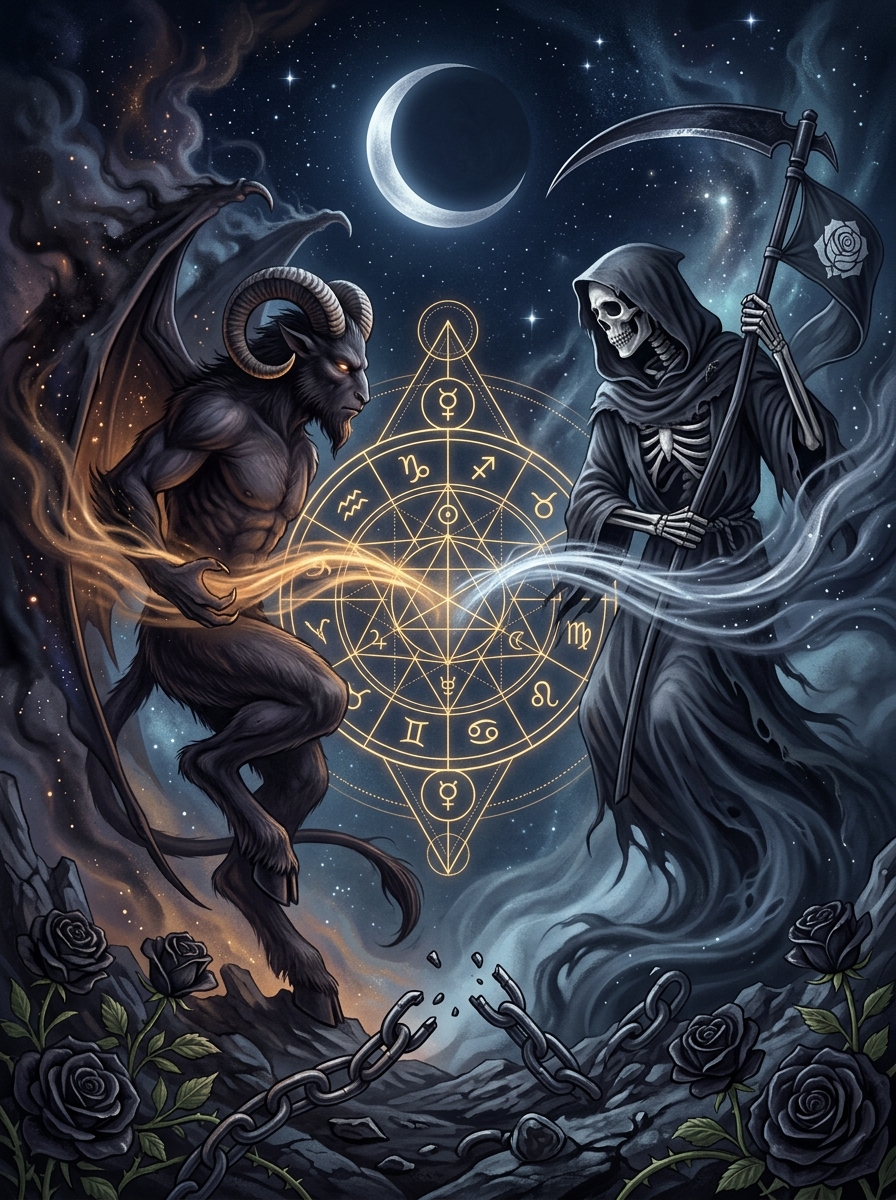
The Archetypal Dynamics of Death and The Devil: Dissolution and Density
To look upon the combination of Death (Arcanum XIII) and The Devil (Arcanum XV) in a Tarot spread is to gaze directly into the alchemical crucible of the soul. These are two of the most historically misunderstood and feared cards in the Major Arcana, yet their synthesis represents one of the most profound evolutionary dynamics available to human consciousness. While the Devil represents the dense gravity of material reality, attachment, and the ego's self-imposed prison, Death functions as the ultimate spiritual catalyst—an unyielding force of dissolution and renewal that dismantles what the Devil has bound. Together, they represent the absolute collapse of toxic attachments and the subsequent liberation of the authentic self.
This pairing is an existential threshold. When these cards appear together, it signals that the reader is locked in a battle between the desire for safety through control and the evolutionary necessity of surrender. The Devil holds up a mirror to our shadow, showing us where we have traded our spiritual sovereignty for material security, toxic relationships, or compulsive behaviors. Death arrives not as an enemy, but as the great equalizer, cutting the ropes of our captivity when we lack the strength to untie them ourselves. This is the archetypal process of dying to the old self to be reborn into a wider, more conscious reality.
The Anatomy of Arcanum XIII: The Necessity of Ending
Arcanum XIII, traditionally titled Death, is rarely a harbinger of physical mortality; rather, it is the archetype of transition, impermanence, and clean slates. In the Rider-Waite-Smith system, Death is depicted as a skeletal knight in black armor riding a white horse, moving relentlessly across a landscape where king, bishop, and child alike fall before him. This imagery emphasizes the absolute impartiality of change. Esoterically, Death represents the natural clearing away of the old to make way for the new. It is the autumn leaf returning to the soil, the shedding of a serpent’s skin, and the inevitable decay that must precede any organic rebirth. Without Death, life becomes congested, stagnant, and choked by its own excess. Psychologically, it represents the willingness to let go of outworn identities, beliefs, and relationships that no longer serve the evolutionary path.
In the teachings of Arthur Edward Waite, Death represents the transition from the material state of consciousness to the spiritual. The rising sun in the background of the card signifies that every ending contains the seed of a new dawn. When we resist this card, we suffer because we cling to form rather than flow. Death teaches us that impermanence is a fundamental law of the universe, and that our psychological survival depends on our ability to grieve, let go, and trust the empty space left behind.
The Anatomy of Arcanum XV: The Gravity of Matter
In stark contrast, Arcanum XV, The Devil, represents the peak of material density and ego-attachment. Depicted as a winged, horned beast presiding over a chained man and woman, the Devil represents the illusions of the material world, the shadow aspects of the psyche, and the instinctual drives that keep us bound to primal survival mechanisms. The chains around the necks of the figures are notably loose, suggesting that their imprisonment is self-imposed, maintained through fear, ignorance, or comfort. The Devil is the realm of addictions, codependency, greed, and the projection of our disowned power onto external circumstances.
Yet, as Carl Jung observed, the Devil is also the necessary adversary—the force that locks us in the dark until we develop the strength and awareness required to free ourselves. It represents the Capricornian impulse to build rigid structures of defense and control. The Devil forces us to look at the animal nature within us, the raw instincts and passions that we often repress or deny in the name of civilization. By confronting the Devil, we face the parts of ourselves that are bound to fear and limitation, paving the way for the evolutionary pressure of Death to break the chains.
Kabbalistic and Esoteric Correspondences on the Tree of Life
To understand the deeper currents of the Death and Devil combination, we must look to the Hermetic Qabalah and the Tree of Life. In this esoteric framework, the Major Arcana correspond to paths that connect the ten Sephirot, or divine emanations. Both Death and the Devil are positioned on paths that lead towards the center of the Tree, Tiphereth, which represents the Beauty, harmony, and the awakened Self. This indicates that both the descent into the material shadow and the subsequent dissolution of the ego are necessary steps on the path of spiritual initiation and self-realization.
These paths are not easy walks; they are trials of fire and water. They demand that the initiate face the terrifying aspects of the unconscious before they can stand in the light of the divine center. By examining the Hebrew letters and paths associated with these cards, we can trace the precise energetic mechanism through which they transform human consciousness.
The Paths of Nun and Ayin
The Death card corresponds to the Hebrew letter Nun, meaning "fish," and represents the 24th Path on the Tree of Life, which connects Netzach (Victory/Emotion) to Tiphereth. This path represents the movement of emotional energy and desire through the process of death and rebirth. Nun is associated with Scorpio, the sign of deep emotional waters, secrets, and sexual regeneration. It is the path of letting go of emotional attachments, allowing the ego's passions to dissolve so that the spiritual heart can open.
The Devil card corresponds to the Hebrew letter Ayin, meaning "eye," and represents the 26th Path on the Tree of Life, which connects Hod (Splendor/Intellect) to Tiphereth. Ayin represents vision, perception, and the organ of sight. However, on the Path of the Devil, this sight is often distorted, focusing only on the material surface and creating the illusion of separation. It is the path of facing the material world in all its density and recognizing that our limitations are self-created. Ayin is associated with Capricorn, the sign of structure, discipline, and the material matrix.
When these two paths are active simultaneously, they form a powerful pincer movement on the psyche. The Path of Ayin forces us to see our material bondage and the illusions we have built, while the Path of Nun provides the liquid fire that dissolves these structures. Together, they clear the intellectual distortions of Hod and the emotional entanglements of Netzach, returning the seeker to the balanced state of Tiphereth.
The Mediating Power of Teth: Kundalini and Strength
A key esoteric key to navigating this intense combination lies in the Path of Teth, which is associated with the Strength card (traditionally Arcanum XI or VIII) and represents the Serpent Power or Kundalini. The Path of Teth runs horizontally across the Tree of Life, connecting Chesed (Mercy) to Geburah (Severity). It acts as a mediating force between the spiritual expansion of Chesed and the structural discipline of Geburah.
Teth, meaning "serpent," represents the primal, instinctual energy that lies coiled at the base of the spine. When we confront the Devil (Ayin) and allow our old forms to die (Nun), we release a massive amount of bound energy. If this energy is not directed consciously, it can manifest as chaos, obsession, or psychological fragmentation. The Strength card (Teth) represents the conscious integration of this primal energy. By gently taming the lion of our animal instincts and directing the serpent power upward, we can utilize the raw power of the Devil and the transformative force of Death to fuel our spiritual evolution. Strength teaches us that we do not conquer our shadow by repressing it, but by loving it and integrating it into our wholeness.
Confronting the Shadow: Jungian Perspectives and the Nigredo Stage
Psychologically, the combination of Death and The Devil represents the ultimate confrontation with the shadow. Carl Jung defined the shadow as the unconscious repository of all our repressed desires, fears, instincts, and socially unacceptable traits. The Devil is the personification of this shadow, representing the dark mirror we avoid looking into. When we ignore our shadow, it gains power, operating in the background of our lives and manifesting as self-sabotaging behaviors, codependent relationships, and addictions.
To heal, we must first look into the Devil's mirror. We must acknowledge our capacity for selfishness, greed, anger, and fear. However, simply acknowledging the shadow is not enough. We must also be willing to let go of the patterns that feed it. This is where the Death card enters as the psychological scalpel, cutting away the dead tissue of our personality to allow new growth to emerge.
This psychological dynamic is further complicated by shadow projection. Often, we project our inner Devil onto others, accusing our partners, employers, or society of manipulation, control, and greed while remaining blind to our own manipulations and desire for power. The loose chains of the Devil remind us that we are complicit in our imprisonment. By projecting our shadow outward, we give away our agency. Only when the cold, uncompromising clarity of the Death card cuts through these projections are we forced to look inward, reclaim our disowned power, and take responsibility for our psychological state.
The Psychological Scalpel: Cutting the Chains
The chains that bind the figures in the Devil card are loose, meaning they can be removed at any time. Yet, the figures remain bound because they are afraid of the void that lies beyond the Devil's realm. The Death card is the force that forces us into that void. It acts as a psychological scalpel, slicing through the rationalizations and excuses we use to stay small. It demands that we let our old, defensive identities die so that we can step into our true authority.
This process corresponds to the alchemical stage of Nigredo, or the blackening. In alchemy, the Nigredo is the initial stage of the Great Work, where the raw material is broken down, decomposed, and reduced to its primal state. It is a period of darkness, depression, and confusion. It is the dark night of the soul, where all our old structures collapse and we are left with nothing but our raw essence. The Nigredo is not a punishment; it is a necessary purification. Without the decomposition of the old, the gold of the integrated self cannot be synthesized.
If we try to salvage parts of our old identity during the Nigredo, the work remains incomplete, leading to a perpetual state of stagnation. Death forces the absolute dissolution of the prime matter, ensuring that the purification is thorough. This process also guards us against the trap of spiritual bypassing. Spiritual bypassing is the tendency to use spiritual practices and beliefs to avoid confronting our psychological wounds and shadow aspects. We focus on "love and light" while ignoring the rot in our basement. The combination of Death and The Devil makes spiritual bypassing impossible. It drags us down into the mud and the dark, forcing us to do the heavy, painful work of integration before we can ascend.
Planetary Tension: Astrological Alignments of Pluto and Saturn
Astrologically, the combination of Death and The Devil is mirrored in the relationship between Pluto and Saturn. In modern astrology, Death is ruled by Pluto (the lord of the underworld and transformation) through its association with Scorpio. The Devil is ruled by Saturn (the lord of structure, limitation, and karma) through its association with Capricorn. When these two planetary energies clash, they create a crucible of structural breakdown and deep evolutionary pressure.
This astrological tension is felt both collectively and individually. It represents the collision between the unstoppable force of evolutionary change (Pluto) and the immovable object of material structure and defense (Saturn). It is the crumbling of old empires, the collapse of rigid belief systems, and the dismantling of the ego's defenses. When these celestial bodies interact, we are called to evaluate what is truly permanent versus what is merely a defensive construct of the ego.
The Saturn-Pluto Crucible: Structural Decomposition
Saturn represents our boundaries, our rules, our fears, and the structures we build to protect ourselves from the chaos of the world. It is the skeleton of our psyche. Pluto represents the raw, volcanic force of evolution that lies beneath the surface. When Pluto transits Saturn, or when these two cards appear together, the structures of Saturn are tested. If those structures are built on a foundation of illusion, fear, or corruption (the Devil), Pluto (Death) will dismantle them.
This dynamic can be understood through the relationship between the signs Capricorn and Scorpio. Capricorn is cardinal earth, focused on building tangible structures, maintaining social order, and achieving public success. Scorpio is fixed water, focused on emotional depth, psychological honesty, and the mysteries of life, death, and rebirth. When Capricorn's rigid earth is subjected to the intense, volcanic waters of Scorpio, the ground begins to shift. If the structures of Capricorn are too dry and unyielding, they will not bend; they will break.
In the historical cycle of astrology, Saturn-Pluto conjunctions occur roughly every 33 to 38 years. These periods are characterized by significant global restructuring, the collapse of outdated institutions, and the redistribution of power. On an individual level, this crucible forces us to face our deepest fears of loss and instability. When the Saturnian structures of our lives fall apart, we experience a profound sense of psychological gravity. It is a time where we cannot force or rush outcomes; we must submit to the slow, heavy decay of what is no longer viable.
Liz Greene, in her seminal work on Saturn, describes the ringed planet as the gateway to the subconscious, representing the fears we must overcome to achieve self-realization. She notes that Saturnian suffering is always a sign of resistance to growth. When Pluto aligns with Saturn, this resistance is met with a force that cannot be denied. The old defenses must crumble. Steven Forrest emphasizes that Pluto represents the evolutionary path of the soul, which often requires the death of the personality's desires. The Saturn-Pluto crucible is the process of stripping away everything that is false, leaving only the indestructible core of the self.
This decomposition is not comfortable. It feels like the end of the world because, for the ego, it is. But as the old, rigid structures collapse, they release the energy that was trapped within them, providing the raw material for a new, more flexible, and more authentic life.
Love and Relationships: Magnetic Intensity, Codependency, and Boundaries
In relationship readings, the appearance of Death and The Devil is a powerful indicator of intense, karmic connections that are ripe for deep psychological work. This combination rarely points to a simple, peaceful relationship. Instead, it signifies a connection characterized by high magnetic intensity, power struggles, and the potential for codependency.
The Devil represents the magnetic pull that draws two people together. It is the realm of infatuation, sexual obsession, and trauma bonding. In this state, we project our disowned shadow aspects onto the partner, seeing them as either the source of all our happiness or the cause of all our pain. We become chained to their reactions, losing our sovereignty in the process. We tell ourselves we cannot live without them, mistaking obsession for love. This obsessive bond is often reinforced by the fear of abandonment, which triggers the Devil's instinct to hold on tight, control, and manipulate.
This is where the Death card must intervene. If the relationship is to survive, the old, codependent dynamics must die. This requires a painful process of disillusionment, where we withdraw our projections and see the partner as a human being rather than a savior or a demon. Death demands that we cut the chains of attachment and establish clear, healthy boundaries.
This process is further complicated by the fear of exposure. The Devil represents the fear of our true, messy nature being seen, prompting us to hide behind masks of perfection or attempt to control our partner. Death, however, strips away all pretense, demanding raw emotional nudity. We are forced to step out of the pursuer-distancer cycle and address the core wounds that drive our relationship behaviors.
Setting boundaries under this combination is an act of spiritual survival. It means saying no to the Devil's temptation to merge completely and lose oneself. It means recognizing that we are responsible for our own happiness and healing. We can utilize the Scorpio energy of Death to have difficult, raw, and brutally honest conversations that dismantle these codependent games. These conversations are not meant to destroy love, but to destroy the illusion of possession that masquerades as love.
In the vocabulary of evolutionary astrology and psychodynamics, this transition is described as moving from a plutonic power struggle to a saturnian boundary structure. When we cease trying to manipulate the partner's feelings, we free up an enormous amount of psychic energy that can be redirected toward our own creative and spiritual pursuits. This is why the process of dismantling a trauma bond, although excruciatingly painful, is always followed by a surge of personal power and self-confidence. The seeker realizes that the love and security they sought in the partner was actually their own power reflected back at them.
Interdependence, rather than codependency, becomes the goal. We must learn to stand in our own authority before we can build a healthy, mutually supportive partnership. This requires us to accept the temporary grief of loneliness as we let go of the habit of using the partner to regulate our emotional states. If both partners are willing to do this work, the relationship can undergo a profound resurrection, transforming from a codependent prison into a vessel for mutual evolution. If they are not, Death will bring the relationship to a final, inevitable end.
Career, Money, and Practical Wisdom: Ethics, Restructuring, and Authentic Alignment
In the realms of career, finance, and practical life, Death and The Devil represent a period of crisis that demands a radical restructuring of our values and goals. The Devil in career often manifests as the "golden handcuffs"—a high-paying job that drains the soul, or a pursuit of status, power, and wealth at the expense of our ethics and well-being. It represents the fear of scarcity that keeps us trapped in toxic work environments.
When Death appears alongside the Devil, it signifies that the time for compromise is over. The old career structure is no longer sustainable. This may manifest externally as a job loss, a business failure, or the collapse of an industry. Alternately, it can manifest internally as a profound sense of burnout and a refusal to continue selling one's soul for a paycheck.
This combination demands that we re-evaluate our relationship with money and status. It asks us to look at where we have compromised our integrity for security, and where we have let greed or fear dictate our choices. The advice of this pairing is to let the old, unaligned career path die, even if it means entering a period of uncertainty. If success has been achieved through corporate manipulation or cutting corners, Death represents the swift, inevitable consequences of those actions.
Practical wisdom under these cards involves active patience. We must resist the urge to rush into another Devil-like situation just to escape the anxiety of the void. We must allow the old structures to crumble completely and use this time to align our work with our authentic values. Rebuilding must be slow, deliberate, and based on solid Saturnian principles of discipline, ethics, and long-term sustainability, rather than quick-fix promises.
From a practical standpoint, this means developing a robust financial contingency plan and focusing on skill acquisition during periods of career transition. We must learn to tolerate the discomfort of empty space—the gap between the old job and the new one—without rushing to fill it with another unaligned commitment. This is where Saturn's discipline meets Pluto's depth: we use the silence of the transition to listen to our inner guidance, ensuring that our next professional venture is built on a foundation of absolute truth and utility.
Navigating this transition requires a thorough self-audit. We must ask ourselves why we allowed ourselves to be chained by the golden handcuffs in the first place. Was it a childhood fear of poverty? Was it a need for societal validation? By examining these roots, we can build a new career path that is not just financially stable, but spiritually and psychologically aligned. This process is not a passive waiting game; it is an active engagement with our vocational truth, accepting the temporary loss of status as the price of admission for long-term freedom.
Often, this combination acts as an invitation to transition into fields related to psychology, healing, crisis management, or esoteric wisdom. In these fields, a deep understanding of the human shadow and the dynamics of transformation is not a liability, but a primary asset. Just as a gardener prunes healthy branches to encourage a more fruitful harvest, we must learn to prune outworn professional connections to allow our true calling to flourish.
FAQ: Navigating the Alchemy of Death and The Devil
Does the combination of Death and The Devil always predict physical death or disaster?
No, it does not. In modern Tarot practice, these cards are interpreted psychologically and esoterically. They represent internal states of transformation and structural change rather than physical events. While they can correspond to challenging external events like job losses or relationship endings, their primary focus is on the psychological and spiritual opportunities these challenges present. They predict the death of an old way of being, not physical mortality. The combination indicates that the structures holding you back must dissolve so that you can step into a more authentic version of yourself.
How can I tell if I am experiencing the alchemical Nigredo stage or simply clinical depression?
The Nigredo stage and clinical depression share many features, including feelings of darkness, loss of meaning, and fatigue. However, they are distinct processes. The Nigredo is a purposeful psychological decomposition aimed at integration and rebirth. It is accompanied by a sense of deep inquiry and a willingness to face the shadow, even when painful. Clinical depression, on the other hand, is a medical condition characterized by a persistent lack of vitality, hopelessness, and chemical imbalances. While the Nigredo can trigger depressive states, it is crucial to seek professional support if you experience persistent symptoms that interfere with your safety and daily functioning.
What does the Death and Devil pairing mean in a career reading when I am looking for a new job?
In a career reading, this combination suggests that you are breaking free from a cycle of toxic work environments or unfulfilling jobs. It indicates that you must not settle for another job just for financial security if it compromises your values. The Devil represents the temptation of the "golden handcuffs," while Death indicates the need to let that cycle end. It advises you to use this transition period to identify your true values and build a career path that is authentically aligned, even if it requires starting from the ground up. Do not rush the process; let the old career identity die completely.
If this combination appears in a reading about a partner, does it mean we are soulmates or trauma-bonded?
It is highly likely that this indicates a trauma bond or a connection based on projection and shadow dynamics rather than a healthy, balanced soulmate connection. The Devil represents the intense, addictive attraction of the shadow, while Death indicates that these dynamics must be dismantled. While such relationships can be deeply transformative, they are also highly challenging and can become toxic if the codependency is not addressed. The cards advise you to prioritize your own boundaries and sovereignty, acknowledging that the bond must either transform completely or end.
How do I practice Jungian shadow work when these two cards dominate my tarot spreads?
When these cards dominate your spreads, shadow work becomes a necessity. Start by identifying the traits in others that trigger the strongest emotional reactions in you, as these often point to your own projected shadow. Journal about your fears, your hidden desires, and the habits you use to avoid uncomfortable emotions. Use the Death card's energy to consciously release these defense mechanisms. Be gentle with yourself, as this work is demanding, and consider working with a therapist to navigate the deeper layers of the unconscious. Reclaim the energy bound in your shadow and direct it toward positive self-creation.
What rituals or practical exercises can I perform when working with the Death and Devil energy?
When working with this energy, practical rituals can help ground the psychological transitions. One effective exercise is the "Attachment Burn." Write down the habits, relationships, or beliefs that represent your Devil (your chains) on a piece of paper. Consciously acknowledge how they served to protect you in the past. Then, in a safe space, burn the paper, visualizing the fire of Death dissolving these bonds and releasing the trapped energy back to you. Another exercise is "Mirror Work," where you gaze into your own eyes and speak aloud the aspects of your shadow you have run from, accepting them as part of your human experience.
Comments
Loading comments…