Death and The Tower Tarot Combination: The Collapse That Clears the Way
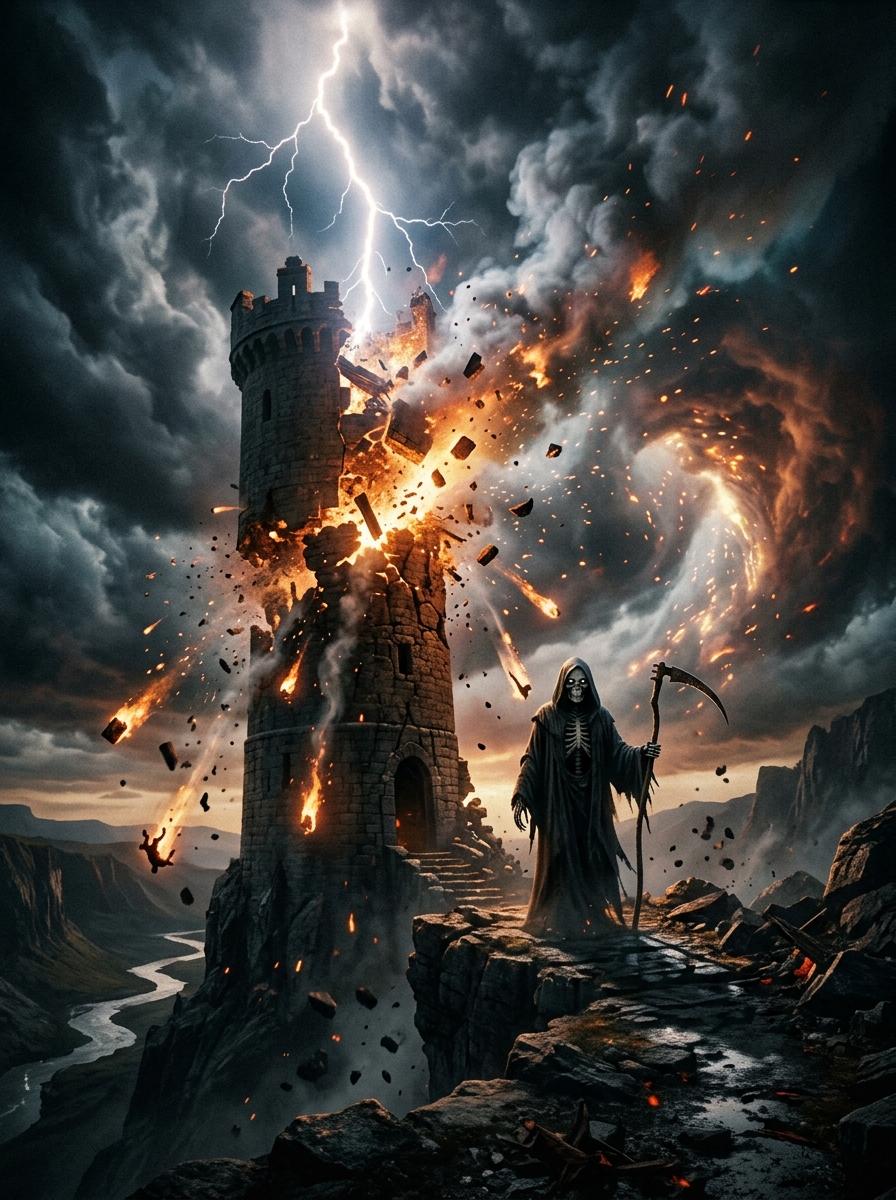
The Collapse That Clears the Way
When Death and The Tower appear together, the reading does not describe ordinary change. It describes a structure that can no longer contain truth, followed by the irreversible clearing that makes new life possible. Death ends what has outlived its season; The Tower ends what was already false, brittle, or overbuilt. Together they announce a collapse that is also a purification — the same event seen from two different angles of necessity.
The distinction between the two cards matters. Death is organic: a season closes, skin is shed, identity is remade from within. It is numbered XIII in the Major Arcana, a number that breaks the comfort of sequence, ruled by transformation and compost. The Tower, numbered XVI, is explosive: illusion is struck, ego defenses fail, plans crack open under pressure or at speed. Both carry a Mars-ruled quality of forceful severance, but their timing differs. Death finishes; The Tower detonates. In combination, the cards say the old form is not merely fading. It is being broken down because the soul, the psyche, or reality itself will not support it any longer. For a full foundation on the individual cards, see The Death Tarot Card: Meaning, Symbolism, and Spiritual Transformation and The Tower Tarot Card Meaning: Archetypal Symbolism, Interpretations, and Guidance.
This pairing is often harsher than Death with gentler transformation cards like Temperance, or The Tower with eventual relief like the Star. It does not promise easy integration. It announces necessity. The question is not whether change is coming; it is whether you will cooperate with the truth before the truth removes your scaffolding for you.
Why It Strikes as Both Grief and Shock
The psyche experiences Death and The Tower as a single blow: grief and shock, release and disruption, finality and collapse. In Jungian terms, The Tower shatters an inflated identification — the part of the ego that believed it was safe, special, or permanent. Death then strips away the obsolete persona that identification had been holding together. Together they expose how much energy has been spent defending an identity that no longer serves individuation.
This is why the combination can feel humiliating. Something in the ego thought it had built a solid life. Something deeper knew the foundation was rotten. The cards do not simply remove comfort; they remove false order. Stability built on denial is just delayed fracture, and these cards cut time short. The two forces operate differently: Death works from within, like a snake shedding skin that has already loosened; The Tower works from without, like lightning that finds the hidden crack. In a reading, the person often senses both movements at once — an ending that feels both overdue and sudden.
For a deeper exploration of what emerges when the ego stops defending, the Shadow Work Tarot Spread: A Jungian Guide to Psychological Integration offers a structured way to meet what the collapse reveals.
When the Ego Fights — The Shadow Side
The natural response to this kind of pairing is resistance. The ego tries to salvage the old shape, negotiate with the ruin, or pretend the collapse is not happening. But Death does not bargain, and The Tower does not reward cleverness when the premises are false. Resistance multiplies the damage. The shadow expression of this combination includes denial (refusing to name the ending), paralysis (freezing in the wreckage instead of moving through), and premature reconstruction (building the same trap under a prettier name).
A common trap is confusing intensity with destiny. The Tower feels like revelation because it is sudden, but suddenness is not the same as clarity. Another is romanticizing the wreckage — treating the collapse as a heroic ordeal rather than a necessary correction. The cards that surround this pair in a spread will indicate whether the path leads toward reintegration or deeper rupture. Compare the energy here with the more deliberate dissolution of Death and Temperance, or the ego-chain that must be broken in the Death and The Devil Tarot Card Combination: A Deep Esoteric and Psychological Guide and The Devil and The Tower Tarot Card Combination: Alchemy of the Shattered Ego. Those pairs share the same pressure-cooker quality but with different flavors of bondage and release.
The wiser response is not to fight the collapse but to let it finish speaking. That means sitting with the question: What false certainty is being removed? What truer life has been trying to emerge underneath? The shattered narrative can be awful, but it can also be the only doorway through which the psyche stops living by reflex.
One Dynamic, Many Expressions
The same collapse plays out differently across domains, but the underlying dynamic remains unchanged: a false form is broken so that truth can take its place. In love, this pair ends denial before it ends the relationship. Sometimes the relationship ends; sometimes the fantasy ends, and what remains must be rebuilt on altered terms. The Tower brings down the hidden architecture — the rescuer fantasy, the unspoken contract, the projection — while Death ensures the collapse is not merely dramatic but meaningful. For a contrasting energy where choice plays a larger role, see The Lovers and Death Tarot Card Combination: Choices, Endings, and Psychological Rebirth.
In career, the cards describe an ending to a false structure — a role, a company, a professional identity that has become untenable. This is not the energy of gradual pivoting; it is abrupt market shift, firing, reorganization, or internal clarity that makes the external collapse unavoidable. What dies is often not your vocation itself, but the form it has taken. A title can die before a calling does. A brand can break before the work does. The urge to force continuity is usually the wrong instinct. Instead, inventory what remains after the shock: skills, relationships, transferable authority, real desire.
In health or identity, the pair can surface as a diagnosis, a physical breakdown, or a psychological crisis that forces a fundamental reorientation of how you live. The message is the same: something in the way you have been occupying your body or your life is no longer sustainable. The collapse is not punishment; it is reality catching up with a system that was running on borrowed time.
The Practice: Surrender Without Passivity
The spiritual lesson of Death and The Tower is not “accept whatever happens.” It is that when reality removes a false form, resistance only multiplies the damage. The cards ask for intelligent surrender: the willingness to let the ending be real, while staying lucid enough to discern what is actually being removed. This is not passivity; it is strategic mourning. Death asks for grief with dignity. The Tower asks for truth without varnish.
In practical terms, this means three things. First, stop defending what has failed. Second, stop confusing intensity with destiny — just because something feels powerful does not mean it is true. Third, stop postponing the life that becomes possible once the false structure is gone. Take the loss seriously, but do not romanticize the wreckage. The Tower and The Star Tarot Combination: From Ego Demolition to Spiritual Dawn shows what becomes possible when the collapse clears the view, and the Fool and Death Tarot: Archetypes of Dissolution and Genesis illustrates how surrender can become initiation rather than catastrophe.
For the luminous aftermath, Death and The Sun Tarot Card Combination: The Archetypal Path of Spiritual Resurrection and The Tower and The Sun Tarot Combination: Archetypal Rupture and Radiant Integration show what becomes possible when destruction gives way to conscious life. Death and The Tower land in your spread not to curse you, but to enforce the honesty that a lesser life was never worth preserving. The answer is not to salvage the old shape. It is to let the collapse finish speaking. Then you can begin again without the lie that nearly buried you.
Related
- The Devil and The Tower: When the False Structure Breaks
- The Hermit and The Tower: Solitude After the Collapse
- The Tower and The Sun Tarot Combination: Rupture Into Revelation
- The Tower and The Magician: When Collapse Becomes Spellwork
- The Wheel of Fortune and Death Tarot Combination: Fate Turns, Forms Fall
Comments
Loading comments…