Venus Trine Pluto: Magnetic Love, Depth, and the Will to Transform
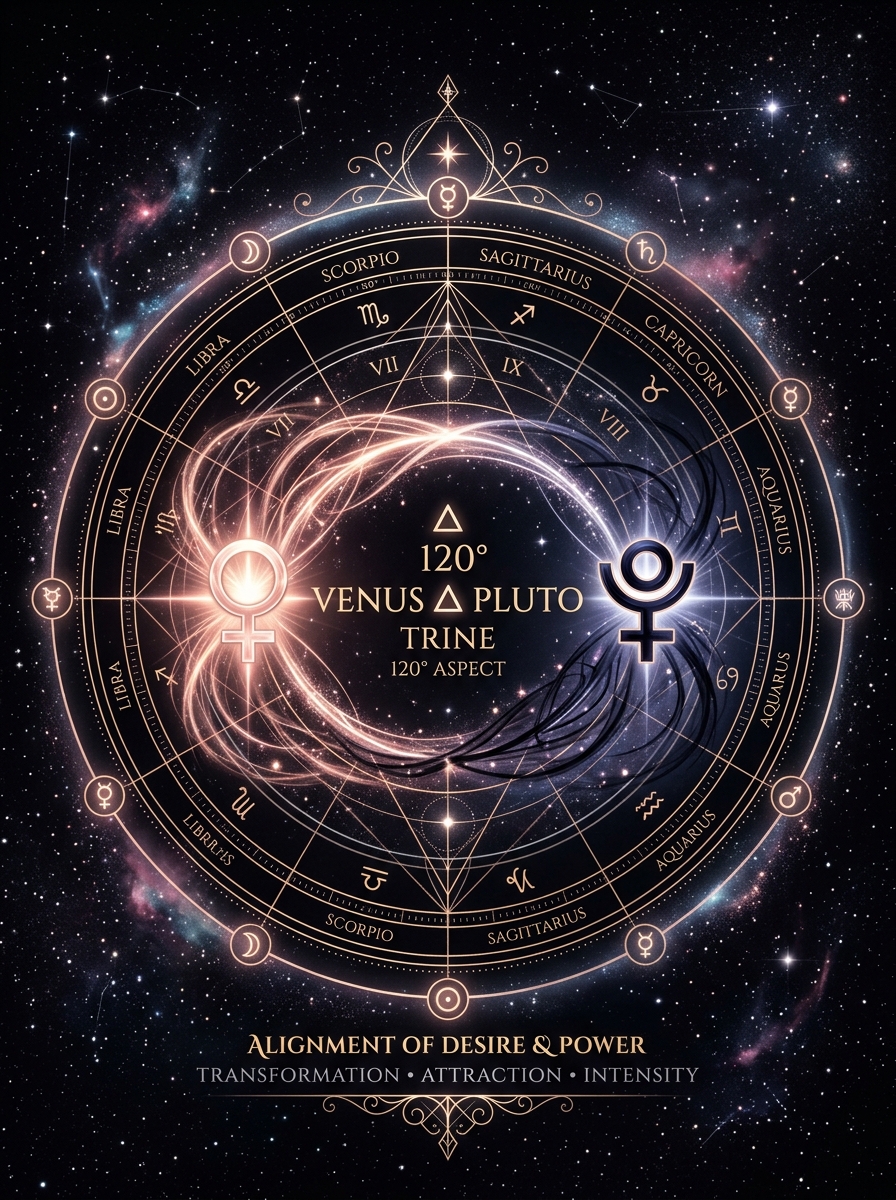
Venus Trine Pluto: The Cooperation of Depth and Desire
Venus trine Pluto is one of the natal chart’s most quietly potent arrangements: the drives to love and to transform are not at odds. Venus wants to attract, harmonize, value; Pluto wants to penetrate, purify, excavate. In a trine, those currents flow in the same element, so the native rarely has to choose between tenderness and intensity. The result is a person who carries an almost preternatural instinct for emotional truth, aesthetic depth, and relational honesty. This is not a “light” aspect, even when the life looks graceful on the surface. The ease is structural: the geometry of the trine aspect creates a natural channel, not a guarantee of comfort.
People with this aspect are usually drawn to what is real rather than what is merely pleasant. They sense, under the surface, what is counterfeit and what must change if love is to remain alive. Their charm is not decorative; it is investigative. They draw things out of others — confession, longing, loyalty, grief — often without effort. The same instinct that makes them magnetic can also make them quietly controlling if left unexamined.
The Psychological Architecture: Comfort with Intensity
The natal Venus trine Pluto native tends to be unusually comfortable with emotional voltage. Where others flinch, they lean in. They are rarely satisfied by thin relationships, shallow beauty, or polite evasion. This is not a taste for drama for its own sake; it is a need for meaning. Venus here is not seeking distraction — it seeks substance. Pluto provides the psychological stamina to hold what is heavy.
Because the aspect belongs to the same element, the native’s instincts are smooth, not jagged. They often know how to say the difficult thing beautifully, or how to create an atmosphere where hidden material can surface without humiliation. In Jungian terms, they have a natural rapport with the shadow — their own and others’. This can make them exceptional in fields that require reading subtext: therapy, negotiation, art, diplomacy, healing. The danger is not excess feeling but the temptation to equate depth with possession. A trine does not erase shadow; it can hide it by making the talent feel effortless. The native may assume that because they can go deep, they are entitled to go everywhere. That is emotional trespass disguised as intimacy.
The house placement of Pluto shapes where this intensity lands. If Pluto sits in a relationship house, the depth expresses through partnerships; if in the 12th house, it routes through private psychology and solitude. For a deeper understanding of how Pluto operates in hidden territory, see Pluto in the 12th House. The aspect’s voltage is constant; the costume changes.
The Mature Expression: Transmutation, Not Seizure
At its highest, Venus trine Pluto is an aspect of grace under depth. The native learns to love without collapse, desire without manipulation, and remain open without becoming porous. They develop a kind of emotional alchemy: they can take what is raw — jealousy, grief, fear — and make it beautiful without domesticating it. This is the essence of Plutonian transmutation applied to Venusian affairs. Relationships improve when the native is allowed to be honest about power, need, and consequence. They may even serve as emotional midwives for others, helping people move through difficult truths without losing dignity.
In creative life, this aspect produces work with uncommon voltage — art that is not merely pretty but pressurized. The medium may be music, design, poetry, fashion, or even scent; the signature is the same: beauty that carries an undertow. Think of a rose with roots in mineral darkness. This is not about shock value; it is about resonance. The native’s work often lingers in the mind long after the first encounter.
But the shadow is real. Because this aspect makes loyalty and penetration feel natural, the native may believe their depth gives them license. They may demand total transparency from partners while keeping their own interior chamber sealed. Or they may unconsciously equate being desired with being safe, leading to emotional espionage, testing, or a habit of curating the relational environment until only the strongest remain. The adolescent expression of this aspect is addiction to intensity; the mature one is a disciplined capacity to stay present without needing to control. For a comparative look at how Pluto transforms through crisis-driven dynamics, Pluto in the 8th House offers a related but more confrontational model.
How It Plays Out in a Life: Love, Work, and Self-Repair
The native’s life tends to be shaped by an underlying question: What am I worth when I am fully known? That question colors everything — relationships, career, money, self-esteem.
In love and partnership, this aspect favors connection that can hold shadow without collapsing. The native is drawn to partners who are complicated, wounded, powerful, or transformative. They need trust, but not predictability for its own sake; they need the sense that the bond can metabolize crisis. When healthy, this yields a loyalty that is both fierce and tender. When unhealthy, it becomes a fortress of mutual suspicion wrapped in passion. The trine can make compromise feel noble, but not every compromise is soulful — some are just avoidant. The native does best with partners who tolerate honesty and do not mistake vulnerability for weakness.
In creativity and vocation, the aspect favors work that requires emotional x-ray vision. The native has a fine instinct for what people really want, even when the stated request is something else. This can serve careers in branding, design, psychology, luxury goods, negotiation, fundraising, or investigative work. If Venus is prominently placed, the aspect can become a major signature of artistic magnetism; if Pluto is angular, the work may carry public weight. See how Venus in the 10th House can turn grace into visible authority, and how Pluto in the 10th House reveals power entering the public sphere.
In the work of self-repair, this aspect is not only about attraction — it is about integration. Venus represents what we value in ourselves; Pluto reveals where value has been damaged by fear, betrayal, or inherited shame. People with this trine often undergo deep shifts in self-worth when they recognize that intensity does not have to mean danger. Their task is to stop mistaking emotional depth for emotional emergency. They learn that real intimacy does not require surveillance, and that power is most beautiful when it does not need to prove itself. For a broader perspective on how Pluto transforms through time, the dynamics of Pluto Transits echo the same theme: pressure yields evolution, not destruction.
What This Aspect Asks of You
The highest expression of Venus trine Pluto is not seduction; it is consecration. The native learns to place love, beauty, and desire in the service of transformation rather than possession. They develop taste that is less about surface and more about truth. They come to understand that depth can be tender, and tenderness can be strong. That is the secret architecture of the trine: not ease for its own sake, but a current strong enough to carry beauty through the underworld and back.
Related
- Venus Opposite Pluto: Love Under Pressure, Desire Under the Veil
- Venus Conjunct Pluto: Love That Fuses, Wants, and Transforms
- Venus Square Pluto: Love at the Edge of Power
- Neptune Trine Pluto: The Deep Current of Spiritual and Psychological Transformation
- Venus Sextile Pluto: The Magnetism of Depth and Desirable Power
Comments
Loading comments…