Pluto Transits: The Alchemy of Death, Rebirth, and Personal Power
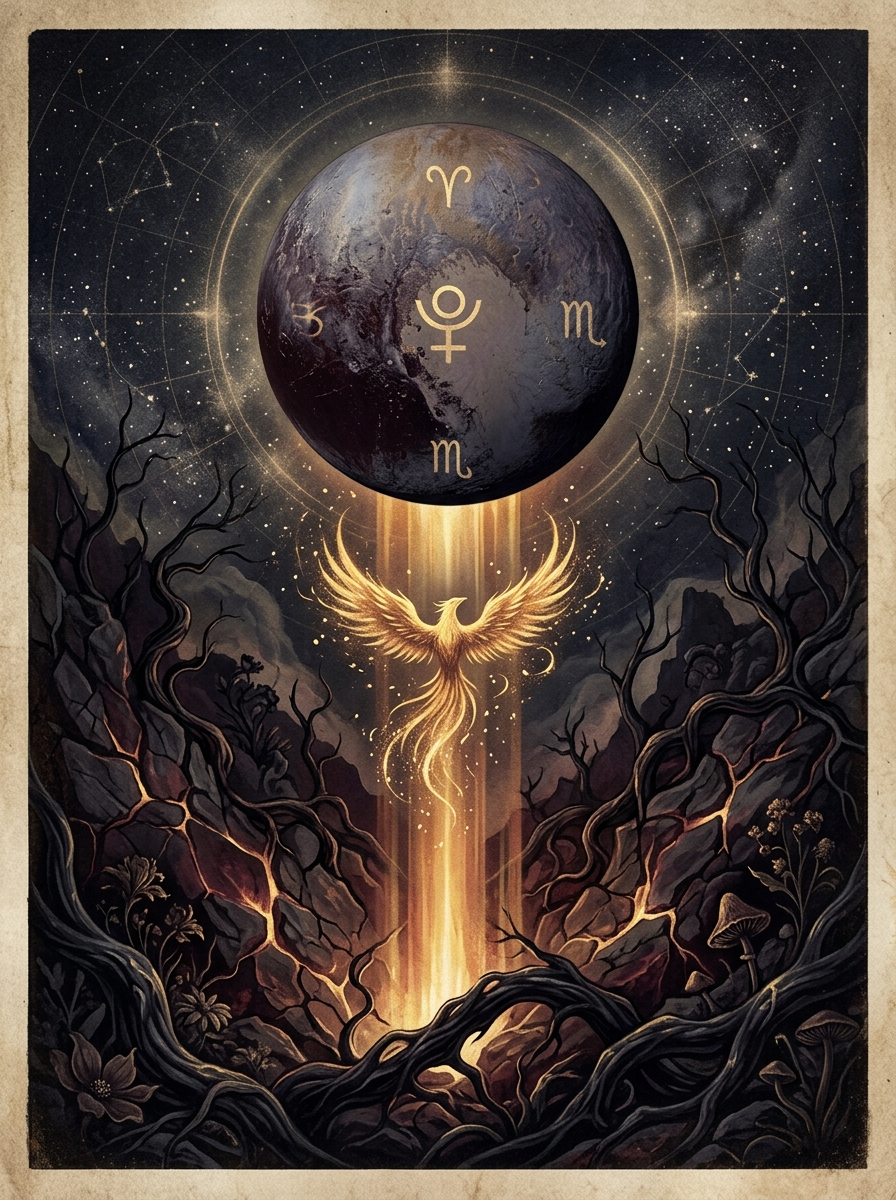
The Lord of the Underworld: The Metaphysics of Pluto Transits
In the celestial architecture of the human psyche, Pluto operates as the divine surgeon, the alchemical fire, and the inescapable agent of evolutionary necessity. Discovered in 1930 during a historical epoch defined by the rise of psychoanalysis, the split of the atom, and the emergence of totalitarian regimes, Pluto represents the archetypal forces of the collective unconscious, primal power, and the biological necessity of decay and regeneration. In psychological astrology, as championed by pioneers like Liz Greene and Steven Forrest, Pluto is the astrological counterpart to Carl Jung’s concept of the shadow and the process of individuation. It represents the psychic drive to eliminate what is obsolete, compost what is dead, and retrieve the latent power buried beneath layers of ego defenses and cultural conditioning. When Pluto contacts a point in the natal chart, it initiates a purification process that cannot be bypassed, bargained with, or delayed.
To understand a Pluto transit, one must first distinguish it from the other outer planetary forces. Where Saturn builds structures, establishes boundaries, and demands discipline, and Uranus shatters those boundaries with sudden lightning bolts of liberation and rebellion, Pluto operates in the dark, subterranean depths of the soul. Its movement is slow, silent, and absolute. While a Neptune transit dissolves reality into a misty ocean of spiritual longing or escapist confusion, Pluto burns away illusions through the direct confrontation with raw, unvarnished truth. It is the archetype of Lord Hades, the keeper of hidden wealth—Plouton meaning "the wealthy one" in Greek—who reminds us that our greatest psychological treasures are buried in the underworld of the unconscious. In the esoteric system of Aleister Crowley, this corresponds to the process of purification and the crucible of the alchemical retort, where the base elements must be reduced to ash before they can be reconstituted into the philosopher's stone.
Astrologically, Pluto’s cycle is highly unique due to its extremely elliptical and inclined orbit. It takes approximately 248 years to make a complete journey around the Sun. Because of this orbital eccentricity, Pluto does not spend an equal amount of time in each sign. It can rush through Scorpio in a mere 12 years, yet languish in Taurus for over 30 years. Consequently, the length and intensity of Pluto transits to our natal charts are highly variable. When Pluto transits a planet or angle, the encounter is not a brief storm but a multi-year epoch—typically lasting between three and five years due to retrograde loops. This extended duration is purposeful; it prevents the ego from simply holding its breath until the crisis passes. Pluto demands a fundamental, irrevocable structural overhaul of the area of life it touches, leaving no stone unturned in its quest for total honesty and integration.
During a Pluto transit, the individual is initiated into a classic mythic cycle of death, descent, and rebirth. In the initial phase, there is often a sense of impending collapse. Structures, relationships, or career identities that we have relied upon for security begin to decay or feel hollow. If the ego attempts to cling to these dying forms, Pluto’s grip tightens, manifesting as external crises, power struggles, or intense psychological anxiety. The second phase is the descent—the dark night of the soul—where we must confront our deepest fears, compulsions, and feelings of powerlessness. Finally, in the third phase, as we surrender our need for ego control and integrate the shadow patterns that have kept us bound, we experience a resurrection. We emerge not merely healed, but fundamentally reconstituted, possessing a clean, authentic reservoir of personal power that can never be taken away from us.
The Elliptical Path: Pluto's Journey Through the Natal Houses
As Pluto travels slowly through the houses of the natal chart, it highlights the specific areas of life where we are called to experience structural death and psychological renewal. Because Pluto remains in a single house for decades, its house transits represent major biographical chapters, defining long-term developmental themes and shifting our values from the ground up.
Pluto in the First House: Reconstructing the Ego
When Pluto crosses the Ascendant and begins its long journey through the first house, the primary target of transformation is the ego personality, the physical body, and the persona we present to the world. This transit often begins with a profound identity crisis. The old way of presenting oneself to society no longer works, and the individual may feel invisible, exposed, or intensely self-conscious. There is a compulsive urge to strip away the mask.
In the early stages of this transit, individuals frequently encounter external power struggles that force them to stand up for themselves, or they may experience physical health challenges that demand a total restructuring of their relationship with their body. The first house Pluto transit is a call to claim one's authentic presence. As the ego defenses are systematically dismantled, the individual learns to stop projecting their power onto others. By the time Pluto exits the first house, the personality has been forged in fire; the person emerges with a magnetic, authoritative presence, grounded in deep self-knowledge and a quiet, unshakeable sense of self-worth.
Pluto in the Seventh House: The Crucible of Relationship
Pluto’s entry into the seventh house shifts the alchemical fire from the subjective self to the mirror of the other. The seventh house governs committed partnerships, marriages, business alliances, and open enemies. Under this transit, relationships become the primary mirror through which the individual must confront their own unconscious shadow.
Typically, this transit manifests as intense, magnetically charged encounters. The individual may be drawn to partners who are powerful, secretive, controlling, or undergoing deep crises of their own. Alternatively, they may find themselves acting out controlling or possessive behaviors, driven by an unconscious fear of abandonment or betrayal. Power struggles, manipulation, and secrets within partnerships are common. The evolutionary purpose of Pluto in the seventh house is not to destroy relationships, but to destroy the unconscious contracts that bind partners in codependent, manipulative cycles. It forces the individual to reclaim their projected power, recognizing that the qualities they fear or worship in the partner are actually disowned aspects of their own psyche.
Pluto in the Tenth House: Power, Legacy, and Career Rebirth
Crossing the Midheaven (MC) and entering the tenth house, Pluto targets the individual’s public standing, professional calling, and relationship to authority. This is a highly significant biographical epoch, often marking a dramatic rise to prominence, a public fall from grace, or a complete and radical career pivot.
Under this transit, the individual is forced to examine why they seek authority and status. If their career has been built on a foundation of pleasing parents, securing external validation, or maintaining control over others, Pluto will systematically dismantle those ambitions. Professional crises, conflicts with bosses or authority figures, or the sudden collapse of a business can occur. However, if the individual aligns with their true calling and is willing to let go of superficial prestige, Pluto offers the keys to extraordinary professional empowerment. It allows them to become a channel for collective power, establishing a legacy that is deeply rooted in authenticity and societal transformation rather than mere ego inflation.
Alchemical Fires: Hard Aspects vs. Soft Aspects in Plutonian Evolution
To navigate Pluto transits effectively, we must analyze the specific geometrical relationships—aspects—Pluto forms with our natal planets. Astrological aspects are categorized into hard aspects (conjunctions, squares, and oppositions) and soft aspects (sextiles and trines), each representing a different pathway of evolutionary integration.
Hard aspects from transiting Pluto are dynamic, crisis-driven, and demanding. The conjunction represents a concentrated merging of energies. When Pluto conjuncts a natal planet, it infuses that planet with an intense, obsessive, and single-minded drive, completely overriding the planet’s normal functioning until it is thoroughly purified. The square, representing a ninety-degree angle, brings a sense of structural blockage and internal friction. It forces a crisis of action, presenting the individual with external challenges that feel like a direct threat to their survival, compelling them to make difficult, irrevocable choices. The opposition, occurring at one hundred and eighty degrees, projects the Plutonian dynamic outward onto the environment. The individual feels as though they are under siege by external forces, facing powerful opponents, systemic obstacles, or relational betrayals that force them to find a balance between their own will and the forces of the outside world.
In contrast, soft aspects from transiting Pluto offer a more fluid, organic, and integrative path of growth. The trine, representing a hundred and twenty degrees of separation, establishes a harmonious flow of energy between Pluto and the natal planet. During a Pluto trine, the individual experiences a natural, supportive opening to do deep psychological work. Insights from the unconscious flow easily into conscious awareness, and efforts to heal trauma, break bad habits, or reform structures are met with minimal external resistance. The sextile, representing sixty degrees, provides a supportive opportunity for conscious integration. While it requires more deliberate effort than the trine, the sextile acts as a bridge, allowing the individual to easily apply Plutonian discipline, focus, and depth to the natal planet's affairs, facilitating a quiet, steady, and constructive evolution of the soul.
The Metals of the Soul: Pluto Transits to Natal Planets
When transiting Pluto contacts the natal planets, it initiates a process of psychological alchemy, transmuting the base metals of our functional ego components into the gold of conscious, integrated awareness. This process requires a willingness to let go of old behavioral patterns that were once survival mechanisms but have now become prisons.
Pluto Transiting the Sun and Moon: Identity and Instinct
A Pluto transit to the natal Sun strikes at the very core of the individual's conscious identity, purpose, and creative will. The Sun represents the hero's journey, the light of conscious awareness, and the organizing center of the personality. When Pluto conjuncts, squares, or opposes the Sun, the light of the conscious self is temporarily eclipsed by the shadows of the underworld. The individual may experience a profound loss of confidence, a questioning of their life path, or a sense of ego death. They are forced to confront their relationship to authority, power, and the masculine principle (often represented by the father). The goal of this transit is the purification of the will. The false, socially constructed ego must die so that the authentic, self-generating spiritual self can be born, standing independent of external approval or structural validation.
When Pluto contacts the natal Moon, the alchemical fire turns to the emotional body, the instinctual self, and the foundations of psychological safety. The Moon governs our emotional patterns, our memories, our home, and our relationship to the mother or nurturing figures. A Pluto-Moon transit can trigger intense emotional crises, bringing long-buried childhood traumas, family secrets, and instinctual fears to the surface. The individual may experience overwhelming feelings of grief, rage, or anxiety, often accompanied by a compulsive need to control their environment or the people within it. This is a profound opportunity for deep emotional shadow work. By allowing these intense feelings to flow without judgment, the individual cleanses their emotional basement, releasing ancestral patterns of fear and control, and developing an extraordinary capacity for emotional resilience, inner security, and self-nurturance.
Pluto Transiting Venus, Mars, and Mercury: Desire, Will, and Mind
Transits of Pluto to the personal planets—Venus, Mars, and Mercury—restructure our daily modes of relating, acting, and thinking.
- Pluto-Venus Transits: Venus represents our values, our aesthetic sensibilities, and our capacity for love and relationship. When Pluto contacts Venus, it intensifies our relational desires, often manifesting as obsessive attractions, fatalistic infatuations, or profound crises in our existing partnerships. The individual is forced to confront their relationship to pleasure, money, and self-worth. It exposes codependency, manipulation, and the ways we use love or sexuality to control others. Through the pain of heartbreak or the intensity of passion, Pluto burns away relational illusions, teaching the individual that true love requires absolute vulnerability and the surrender of control.
- Pluto-Mars Transits: Mars represents our physical energy, our assertiveness, our anger, and our sexual drive. A Pluto-Mars transit is an explosive combination of energies, akin to adding rocket fuel to a fire. The individual may experience intense frustration, power struggles, or physical exhaustion. If Mars energy has been repressed, it may erupt as sudden rage or attract external aggression. The evolutionary goal here is the purification of the personal will and the integration of the sacred warrior. The individual must learn to direct their tremendous drive toward constructive, high-vibrational goals rather than engaging in petty ego battles or self-destructive actions.
- Pluto-Mercury Transits: Mercury governs the rational mind, communication, perception, and learning. When Pluto contacts Mercury, the intellect is drafted into the service of the underworld. The mind becomes hyper-focused, investigative, and obsessed with uncovering hidden truths. This is an excellent transit for deep research, psychological study, and writing. However, it can also manifest as mental paranoia, obsessive thoughts, or a tendency to use words as weapons of manipulation. The individual is challenged to let go of rigid mental constructs, transition from superficial intellectualizing to deep, symbolic thinking, and speak their truth with absolute integrity.
Crossing the Threshold: Pluto Transits to Chart Angles
The angles of the natal chart—the Ascendant (AC), Midheaven (MC), Descendant (DC), and Imum Coeli (IC)—represent the structural pillars of our earthly reality. When transiting Pluto crosses one of these angles, it acts as a cosmic wrecking ball and a builder of new foundations, marking major turning points in the individual’s biography. These crossings are rarely subtle; they represent moments where internal changes manifest as concrete external events.
When Pluto crosses the Ascendant, it fundamentally alters our physical appearance, vitality, and external projection. It is a time of personal reinvention, where the individual must shed their old persona. People undergoing this transit often look physically different by the end of it, having released chronic physical tension or altered their presentation to reflect their internal shift.
When Pluto crosses the Imum Coeli (IC) at the base of the chart, the transformation strikes at the roots of the psyche. The IC represents our home, family of origin, ancestral karma, and private self. A Pluto transit here often brings significant disruptions to the home life, such as moving, major renovations, or the death of a family member. More deeply, it demands that we excavate our psychological foundations, healing generational trauma and letting go of the unconscious family loyalties that prevent us from growing into independent individuals.
Crossing the Descendant, Pluto enters the realm of relationships. This crossing behaves similarly to a seventh-house transit but with a much more concentrated, immediate biographical impact. It often marks the sudden, dramatic ending of a long-term relationship or the beginning of a life-altering partnership that completely restructures the individual’s destiny.
Finally, when Pluto crosses the Midheaven (MC), it illuminates our public life, career, and highest aspirations. The MC represents our outer achievements and how the world perceives us. A Pluto crossing here demands that we align our outer work with our inner truth. It is a time when secret ambitions can be realized, but also when any professional dishonesty or superficiality is exposed to the public eye, forcing a total reorganization of our life path and a relocation of our professional drive.
The Dweller on the Threshold: Pluto's Shadow, Control, and Self-Destruction
Every astrological archetype has a shadow, and because Pluto rules the underworld, its shadow expressions are particularly potent, dark, and challenging to integrate. The primary trap of a Pluto transit is the ego's refusal to surrender control. When faced with the threat of dissolution, the ego often doubles down on its defensive maneuvers, resorting to manipulation, paranoia, and power struggles.
One of the most common shadow expressions of Pluto is the obsession with control. This can manifest as an external control of others through guilt, financial manipulation, emotional blackmail, or sexual power. Conversely, it can manifest as an obsessive need to control oneself—restricting emotions, over-working, or policing one's body. Beneath this compulsion lies a profound, existential terror of powerlessness and vulnerability. The individual projects their fear of death onto the environment, believing that if they can maintain total control, they will remain safe. This illusion of control is precisely what Pluto seeks to shatter, demonstrating that the more we hold on, the more destructive the collapse will be.
Another destructive Plutonian shadow is paranoia and the projection of the enemy. During intense Pluto transits, the individual may become convinced that others are plotting against them, operating in bad faith, or seeking to destroy them. While external adversaries do sometimes appear under Pluto transits, the paranoia is often a projection of the individual's own unacknowledged, repressed shadow—their own capacity for rage, manipulation, and destruction. If these impulses are not brought to consciousness, they can lead to acts of self-sabotage and self-destruction, where the individual unconsciously blows up their own life, relationships, or career as a desperate, distorted way of initiating the transformation they are resisting.
Integrating the Plutonian shadow requires what Jungian psychology calls "eating the shadow." We must look directly at our capacity for greed, jealousy, rage, and manipulation without judgment. We must recognize that these dark impulses are distorted expressions of vital life force that has been split off from our conscious self. By acknowledging and welcoming these disowned parts of ourselves, we strip them of their destructive, compulsive power and reclaim the energy they held, converting raw survival instincts into creative, conscious willpower.
The Way Through the Underworld: Practical and Therapeutic Integration
Navigating a Pluto transit requires a radical shift in our psychological posture. We must transition from a state of resistance and defense to a state of conscious cooperation with the evolutionary process. This is not passive submission, but an active, courageous alignment with the soul's deeper wisdom.
The most effective tool for navigating a Pluto transit is depth-oriented psychotherapy, particularly Jungian analysis, somatic experiencing, or transpersonal therapy. Because Pluto operates in the unconscious, rational cognitive behavioral approaches are often insufficient. We need modalities that allow us to communicate with the symbolic language of the soul. Dream analysis, active imagination (as developed by Carl Jung), and expressive arts therapies can help us translate the intense, non-verbal energies of Pluto into conscious understanding. These practices allow the ego to establish a dialogue with the shadow, facilitating a safe, structured container for the death and rebirth process. Robert Hand's classic writings on transits also emphasize the importance of identifying the specific natal planetary patterns being challenged, allowing us to isolate the root psychological issues rather than react to external symptoms.
Somatic integration is equally critical. Pluto rules the biological depths, the nervous system, and the physical instincts. The intense psychological pressure of a Pluto transit often translates into physical tension, exhaustion, or illness. Engaging in deep bodywork, such as Rolfing, myofascial release, trauma-informed yoga, or breathwork, can help release the emotional trauma stored in the tissues. The body must be treated as the alchemical vessel (the athanor) in which the transformation occurs. Giving ourselves permission to rest, retreat, and simplify our daily lives is essential during these years.
Finally, navigating Pluto requires the cultivation of spiritual surrender. We must learn the art of conscious letting go, recognizing when a structure, relationship, or belief system has run its course. Trying to force a dying situation to stay alive only prolongs the suffering. In the tarot, Pluto is associated with the Death card and the Judgment card. The Rider-Waite-Smith Death card depicting a skeleton on a white horse reminds us that death is an impersonal, natural law that clears the path for new life. By surrendering our attachment to temporary forms, we open ourselves to the infinite regenerative capacity of the cosmos, allowing the old self to compost so that the seed of the new self can grow.
Collective Metamorphosis: Pluto's Generational Sign Transits
While Pluto's house transits define our personal biographical struggles, its slow transit through the signs of the zodiac shapes the collective destiny of entire generations. The sign Pluto occupies at our birth defines the shared psychological task, the collective shadow, and the unique evolutionary mission of our age group.
Those born with Pluto in Scorpio (roughly 1983–1995) carry the archetypal signature of the depth psychologist and the alchemist. This generation was born during a time of global crises, the rise of the internet, and the height of the HIV/AIDS epidemic. As a collective, Pluto in Scorpio individuals are driven to expose secrets, dismantle taboos around sexuality and death, and heal deep-seated psychological trauma. They possess an innate comfort with the dark, utilizing their emotional intensity and investigative skills to transform societal structures from the inside out.
The Pluto in Sagittarius generation (roughly 1995–2008) shifted the focus from emotional depth to ideological and philosophical transformation. Born during a period of rapid globalization, religious conflicts, and the expansion of digital communication, this generation is tasked with restructuring our understanding of truth, belief, and education. Their collective shadow manifests as dogmatism, philosophical self-righteousness, and escapism, while their evolutionary potential lies in their ability to build new, inclusive global paradigms of meaning and spiritual freedom.
Those born with Pluto in Capricorn (roughly 2008–2024) are the architects of systemic collapse and rebuilding. This generation entered the world during the global financial crisis of 2008 and grew up amidst the decay of political, corporate, and ecological institutions. Their collective task is to confront the shadow of patriarchy, late-stage capitalism, and institutional corruption. They are destined to dismantle obsolete social structures and replace them with sustainable, ethical, and realistic systems of governance and resource management.
As Pluto enters Aquarius (roughly 2024–2044), the collective focus shifts to technology, community, and the distribution of power. This trans-generational epoch will challenge humanity to integrate artificial intelligence, confront the shadow of technocratic control, and redefine the meaning of human collaboration. The generation born under Pluto in Aquarius will be tasked with building decentralized, humanitarian networks, ensuring that technology serves the liberation of humanity rather than its enslavement.
Frequently Asked Questions about Pluto Transits
How can I tell if I am currently experiencing a Pluto transit?
To determine if you are experiencing a Pluto transit, you must calculate your astrological transits using your exact date, time, and location of birth. You will want to look at the current position of Pluto in the sky and check if it is forming a major aspect (conjunction, square, opposition, trine, or sextile) within a tight orb of 2 to 3 degrees to any of your natal planets or chart angles (Ascendant, Midheaven, Descendant, Imum Coeli). Because Pluto moves extremely slowly, you will generally feel the pressure building when the transit is within 2 degrees of exact alignment, and the process will continue through several retrograde loops over a period of two to four years.
What is the difference between a Saturn transit and a Pluto transit?
While both planets are associated with challenge, boundaries, and life transitions, their psychological mechanisms are entirely different. Saturn operates as the archetype of the teacher, the master builder, and the taskmaster. A Saturn transit demands discipline, maturity, boundary-setting, and hard work to build lasting structures; it feels like structural weight and external duty. Pluto, on the other hand, is the archetype of the alchemist and the surgeon. Pluto does not ask you to build or work harder; it demands that you let go, surrender control, and allow obsolete parts of your life to die. Saturn tests your structures; Pluto incinerates them to see if the ashes contain anything of eternal value.
Can a Pluto transit cause physical illness or health problems?
Yes, a Pluto transit can correlate with physical health challenges, though it is crucial to view this through a psychosomatic and alchemical lens rather than one of fear. Pluto rules the elimination systems of the body, the reproductive organs, the deep cellular structures, and the autonomic nervous system. When we repress intense emotions, stress, or shadow material during a Pluto transit, the body will often act as the container for this pressure. Physical symptoms can serve as a somatic alarm system, forcing us to slow down, rest, and address the deep psychological and lifestyle patterns that are no longer serving our well-being.
Does a Pluto transit always mean someone or something will die?
No. While Pluto is the archetype of death, it is highly rare for a Pluto transit to correspond to a literal, physical death of the individual. Instead, the "death" Pluto demands is almost always metaphorical and psychological. It represents the death of a role, an identity, a relationship pattern, or a career path that has become an obstacle to your evolutionary growth. While the ending of these structures can feel like a literal death to the ego, it is a necessary clearance of space so that new, authentic life can emerge.
How do I maintain my sanity during a Pluto square Pluto transit?
The Pluto square Pluto transit, often referred to as the "midlife crisis transit" occurring for most people between their late 30s and mid-40s, is one of the most intense developmental milestones of life. To maintain your sanity, you must abandon the strategy of resistance. Avoid trying to force your life to look the way it did in your twenties. Embrace therapeutic outlets, prioritize rest, and allow yourself to grieve the endings that are occurring. Understand that the disorientation you feel is a natural part of the alchemical process; you are shedding an outer husk to allow your true, adult self-expression to emerge.
Comments
Loading comments…