Venus Conjunct Pluto: Love That Fuses, Wants, and Transforms
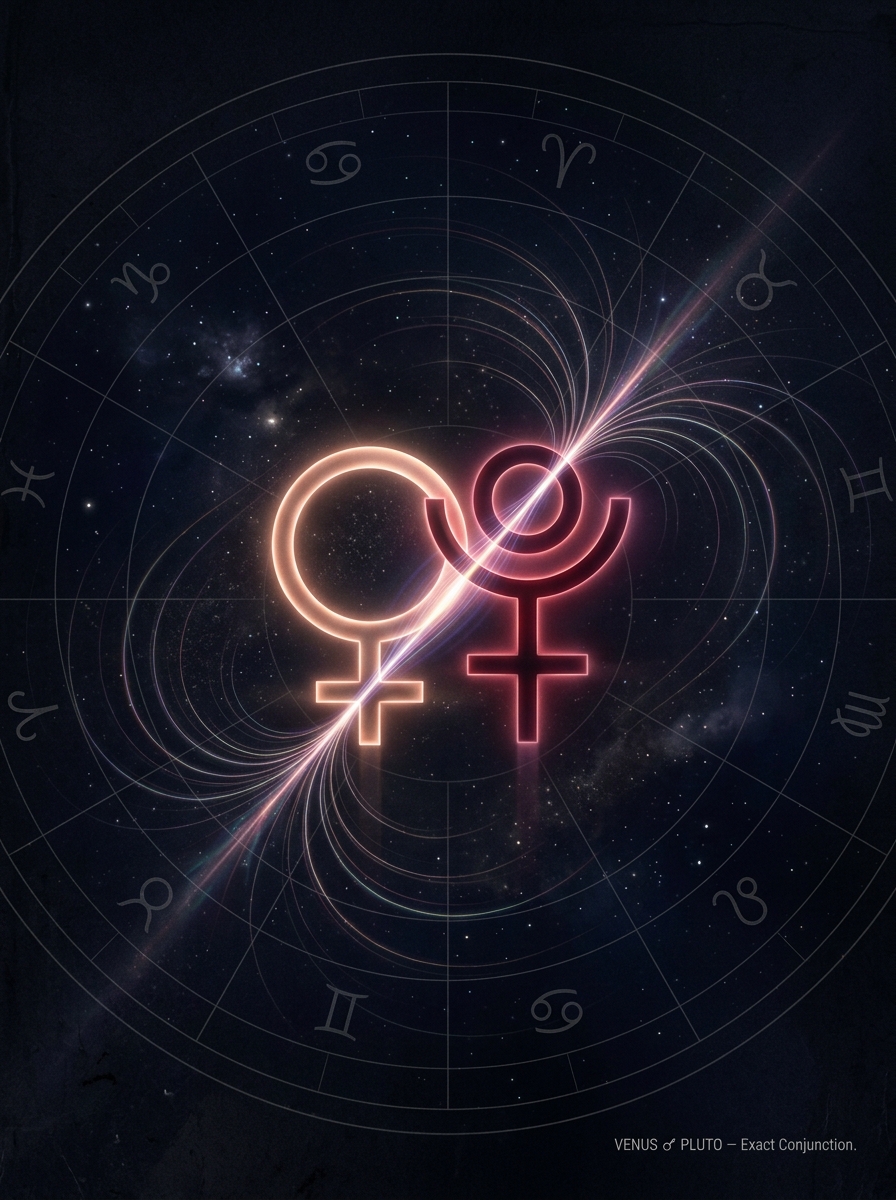
Venus conjunct Pluto makes love feel like a force field. In the birth chart, Venus wants beauty, pleasure, value, and attachment; Pluto wants truth, depth, power, and irreversible change. When they meet by conjunction, affection is rarely casual. Attraction tends to arrive with obsession, psychic x-ray vision, and a kind of emotional gravity that can make other people feel either irresistibly seen or uncomfortably exposed. The core thesis is simple: this aspect does not merely intensify desire — it turns desire into a crucible, where the native learns what love costs, what it reveals, and what must die before intimacy can become real.
The crucible of desire
A conjunction fuses functions before it differentiates them. With Venus conjunct Pluto, the heart and the underworld are in the same room. You are not dealing with love on the surface and power underneath; power is part of the way love is experienced, and love is part of the way power is exercised. This can create extraordinary loyalty and depth, but it can also create mistrust of anything bland, polite, or easily replaced. The psyche wants what is consequential.
What Venus wants once Pluto is in the room
Venus ordinarily seeks harmony, mutuality, and the pleasure of simple affirmation. Under Pluto’s pressure, those Venusian needs become psychologically charged. The native may not just want affection; they want evidence. They want to know whether they matter enough to alter another person’s life. They may test love without admitting they are testing it. They may also be highly sensitive to betrayal, half-truths, aesthetic falseness, or the social performance of intimacy. This is why the aspect often produces a person who can detect subtext quickly, especially in matters of desire, loyalty, and money.
The risk is that Venus starts to believe only what is intense. Calm may be misread as emptiness. Stability may feel suspiciously shallow. Yet the gift is unmistakable: the native often has rare emotional discernment and can recognize where a relationship has already begun to decay. In that sense, this aspect resembles the kind of deep seeing associated with Pluto in the Eighth House — except here the underworld work is routed through attachment, taste, attraction, and the exchange of value.
How Pluto alters the pattern of desire
Pluto does not do moderation. It strips away social lubrication until the core motive is visible. With Venus conjunct Pluto, attraction often feels fated, catalytic, or consuming. There can be an instinctive response to complexity, taboo, emotional danger, or people who carry some kind of wound or hidden power. The native may not be drawn to “good enough”; they may be magnetized by what asks to be transformed.
This does not always look dramatic. Sometimes it appears as a private, highly selective erotic life; sometimes as a public magnetism others can’t quite explain. Either way, the signature is unmistakable: Venus does not simply decorate Pluto here, and Pluto does not simply traumatize Venus. They collaborate to make desire into a revelation. The conjunction often resembles the lived psychology of Venus in Scorpio, but with the added note that the exact conjunction makes the process more immediate, concentrated, and personally decisive.
Gifts: magnetism, depth, and the courage to love fully
The most important gift of Venus conjunct Pluto is capacity. This aspect can hold more truth than many charts can tolerate. It can endure ambivalence, shadow, and the fact that every real attachment changes us. People with this placement often possess an almost alchemical loyalty: if they love, they love with the expectation that love will expose, refine, and remake them.
Emotional x-ray vision
The native often reads the emotional subtext of a room with uncanny accuracy. Venus notices what pleases; Pluto notices what is hidden. Together they produce a talent for sensing what people desire but cannot say, what they fear losing, what they are trying to buy with charm, and where beauty is being used as armor. This can make the person an excellent artist, counselor, negotiator, designer, or lover — anyone who must perceive the hidden architecture beneath appearances.
This is one reason the aspect can support work and visibility in domains touched by Pluto in the Tenth House: the native may know how power is dressed up as elegance, or how aesthetics can be used to convey authority. The same instinct can make them formidable in business, branding, or any setting where value and influence are negotiated.
Devotion with teeth
Unlike sentimental attachment, Venus-Pluto devotion is rarely passive. It tends to include fierce protectiveness, erotic intelligence, and a refusal to love in a half-present way. When healthy, that devotion becomes a major gift: the person can stay with what is difficult long enough to transform it. They are capable of holding grief, desire, and beauty in the same hand. They may even be the person others turn to when life has become too thin and something deeper is required.
In creative life, this can produce work that feels saturated with emotional charge. A song, a painting, a brand, or a performance may carry an almost confessional intensity. In some charts, this same current is amplified through Pluto in the Fifth House, where creativity itself becomes a site of erotic and psychological risk.
Friction: control, fear of loss, and the seduction of extremes
The shadow of Venus conjunct Pluto is not simply jealousy. It is the attempt to secure love by controlling its conditions. Because the aspect feels love as high-stakes, the native may unconsciously try to eliminate uncertainty through vigilance, testing, exclusivity, or emotional possession. The mind wants to prevent abandonment; the body wants to prevent humiliation; the heart wants to prevent dilution. All of that can be understandable and still destructive.
Possessiveness is often fear in disguise
When Venus is fused with Pluto, attachment can become a battlefield between longing and self-protection. The person may hold on too tightly because love feels existential, not optional. They may fear being replaceable, used, or fooled. In response, they can become controlling, secretive, or preemptively detached. Some become expert at reading the slightest shift in tone and then acting as though the relationship is already in danger.
This dynamic often echoes the more relational themes of Pluto in the Seventh House, but the conjunction puts the crisis inside the actual chemistry of attraction. The person may need to learn that trust cannot be forced by intensity. It has to be built through consistency, truth, and the willingness to survive ordinary disappointment without turning it into a referendum on worth.
The allure of pain
Another friction point is the unconscious attraction to emotionally unavailable, destructive, or power-laden situations. Pluto can eroticize what hurts because pain proves depth. That can lead to triangles, secrecy, manipulative bonding, or relationships that are compelling precisely because they are unstable. In severe cases, the native may repeat patterns of testing, breaking, and reconciling, confusing upheaval with intimacy.
This does not mean the aspect condemns the person to drama. It means their growth depends on distinguishing intensity from intimacy. A relationship can be quiet and still profound. A person can love without becoming consumed. The work is especially important when the chart also emphasizes private shadow material, as it does with Pluto in the Twelfth House, where unconscious fear can leak into attachment choices.
Where it shows up in real life
Venus conjunct Pluto does not only play out in romance. It marks the native’s entire economy of value. What they cherish, they do not cherish lightly. They may have strong instincts about money, art, sex, social hierarchy, and the invisible bargains that shape a life. Their taste is rarely casual; their commitments rarely shallow.
Love, sex, and the problem of transparency
In relationships, this aspect often seeks complete emotional disclosure — not because the person is nosy, but because Venus-Pluto cannot thrive on decorative language. They want to know what is real, what is hidden, and what the other person would rather not admit. Sex may function as a truth serum. Affection may feel inseparable from merging, revelation, and vulnerability. If the relationship cannot metabolize honesty, it begins to rot from the inside.
The healthiest expression is not constant confession. It is the capacity to remain present when the fantasy of perfection collapses. That may require the relational skills associated with Venus in the Seventh House, where partnership itself becomes a discipline of mutual regard, and with Moon-Venus synastry, which can remind the native what tenderness feels like when it is unforced and safe.
Money, self-worth, and the invisible exchange
Because Venus also rules value, the conjunction often implicates finances, pricing, ownership, and self-esteem. The native may oscillate between underpricing themselves and demanding total investment. They may be highly sensitive to whether something feels worth it. A cheap arrangement may feel insulting; an extravagant one may feel strangely natural if it carries symbolic weight. The deeper issue is usually self-worth: if love must be earned through intensity, then money and affection can become entangled with worthiness.
That is why the placement often benefits from deliberate grounding around resources and boundaries. It may resemble, in spirit, the concentrated material seriousness of Venus in Capricorn or the value-driven intensity of Pluto in the Second House, though the conjunction internalizes the whole issue: What am I worth if no one is testing me? What is love worth if it cannot survive reality?
Crisis as initiation
The native often undergoes one or more major relationship, artistic, or financial ruptures that function as initiations. A betrayal may wake them up. A loss may free them from an illusion. A powerful attraction may reveal where they have been hiding from themselves. These events are not “meant” as punishment; they are the conjunction’s way of insisting that value become conscious. Pluto does not permit sentimental evasions for long.
When that alchemy is working, the person emerges with better instincts, cleaner boundaries, and a more honest relationship to desire. When it is not, they may simply keep reenacting the same crisis in different costumes.
How the aspect matures
The mature expression of Venus conjunct Pluto is neither cold detachment nor emotional flooding. It is erotic truth with boundaries. It is the ability to love deeply without making another person the container for one’s survival. It is aesthetic discernment that can bear shadow, and devotion that does not require possession.
From fusion to depth
Early in life, the conjunction may confuse merging with love. Over time, it learns that real intimacy includes separation, privacy, and consent. That shift changes everything. The person becomes less interested in dominating the object of desire and more interested in knowing what is alive in the exchange. Love ceases to be a test and becomes a process of mutual revelation.
In this sense, the aspect is not unlike a long Pluto transit: it keeps asking what must be surrendered so that something truer can emerge. That is why its final gift is not seduction, but discernment. The native learns how to choose what can survive depth.
The signature of earned grace
When Venus conjunct Pluto is integrated, the person can be both tender and formidable. They know that beauty can coexist with grief, that pleasure can coexist with power, and that attachment becomes sacred only when it is willing to tell the truth. Their magnetism often increases with age, because they are no longer trying to appear harmless. They radiate the authority of someone who has looked directly at desire and lived.
If you want to understand the placement in a larger chart context, compare it with house emphasis such as Pluto in the Eighth House for intimacy, Pluto in the Fourth House for inherited emotional patterning, or Venus in the Eighth House for love shaped by depth and psychological exchange. But the conjunction itself remains singular: it binds attraction to transformation so tightly that neither can be fully understood without the other.
Related
- Venus Opposite Pluto: Love Under Pressure, Desire Under the Veil
- Venus Trine Pluto: Magnetic Love, Depth, and the Will to Transform
- Venus Square Pluto: Love at the Edge of Power
- Venus in the Eighth House: Love, Value, and the Alchemy of Shared Depth
- Venus Conjunct Saturn: Love Under Pressure, Love Made Real
Comments
Loading comments…