Venus Opposite Pluto: Love Under Pressure, Desire Under the Veil
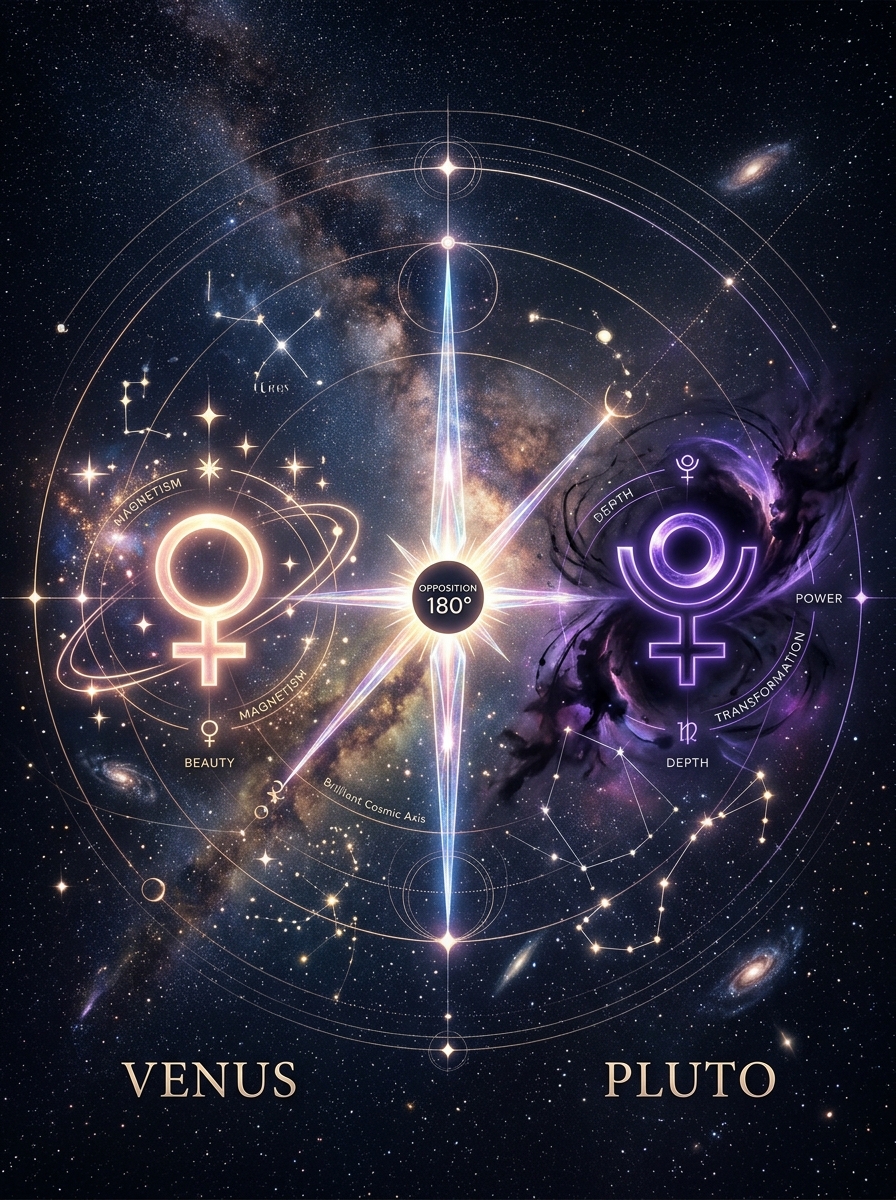
Venus opposite Pluto is the signature of a love that cannot stay polite. The aspect places the planet of harmony and pleasure in direct tension with the planet of psychological excavation and control. Where Venus reaches for ease, reciprocity, and shared beauty, Pluto demands the unvarnished truth, even when that truth burns. The opposition means neither planet overpowers the other; they stare across the chart, each refusing the other’s terms. The result is a relationship with bond itself: every embrace carries the question of possession, every tenderness is tested for subtext, and the hunger for closeness is laced with the fear of dissolution.
This is not a placement that allows casual relationships. The native feels love as a force that rearranges the self — and that is exactly what makes the aspect both enthralling and exhausting. The core thesis is simple: you cannot love superficially once the Venus-Pluto axis has been activated. But learning to love without becoming captive to intensity is the lifelong task.
The architecture of desire: projection and the mirror
The opposition creates a psychic split. One part of the self, governed by Venus, wants to be liked, to receive, to make peace through charm and aesthetic grace. The other, governed by Pluto, scans for hidden motives, power imbalances, and the places where affection might become a trap. Because the opposition is a mirror aspect — two points face each other across the chart — much of the tension plays out through projection. The native often meets their own disowned intensity in a partner. They may fall for someone magnetic, secretive, or emotionally unavailable, only to discover that the relationship has become a theater for their own unclaimed hunger.
This dynamic is not abstract. It shows up in a recurring pattern: you are drawn to people who seem to hold a key to something you cannot name. The bond feels fated, but the fatefulness often masks a refusal to own your own power. The partner becomes the carrier of your shadow — your need, your rage, your erotic depth — while you inhabit the Venus role of seeking harmony. As long as that projection remains unconscious, relationships oscillate between idealization and disillusionment. The healing begins when you recognize that the person you want is a symbol of the part of you that is most alive but least integrated. For a deeper look at how oppositions function as mirrors of the psyche, see the treatment of the astrological opposition (180°) in natal charts.
The two faces: gift and shadow
The gift: erotic truth and psychological courage
The high expression of Venus opposite Pluto is an uncanny ability to see through social masks. You notice the unsaid thing — the embarrassed pause, the power imbalance behind a compliment, the way someone’s generosity can also be a form of control. This discernment, when matured, becomes a form of psychological courage. You are not here to be naive; you are here to know love without sentimentality. In the best case, this makes you an extraordinary confidant, artist, therapist, or lover. You can guide others toward the places they would rather not look, and in your own relationships, you insist on a level of honesty that most people find uncomfortable but necessary.
There is also a distinctive aesthetic to this aspect: an attraction to what has been tested by fire. You may prefer art that carries emotional weight over mere prettiness, or love stories that include ruin and redemption. This is not a taste for darkness for its own sake; it is a capacity to create beauty from what has been metabolized — love that has seen the underworld and still returns with flowers. That is the gift: the ability to love without denial, to trust that honesty is the only foundation that can hold the weight of real desire.
The shadow: manipulation, possessiveness, and compulsive attachment
The same energy that creates depth can also create damage when it remains unconscious. The shadow of Venus-Pluto is not simply “being intense”; it is the misuse of intensity to control outcomes. When the heart is afraid, it may reach for power instead of tenderness. This can manifest as relational bargaining — withholding affection to provoke a response, treating emotional disclosure as currency, or using sex to secure attachment. The native may not think of themselves as manipulative; they experience such maneuvers as self-defense. But defense can still wound.
Possessiveness often signals a deeper wound in the sense of self-worth: a fear that if you are not extraordinary or indispensable, you will be discarded. Venus wants to be cherished; Pluto fears annihilation through rejection. Together, they can create attachment styles that swing between craving fusion and punishing distance. Jealousy here is not always crude; it can be metaphysical — a terror that love is fragile, that desire is competitive, that what matters most can be taken away. That terror leads to tests, ultimatums, and a refusal to let affection flow freely. The pattern is familiar to anyone with this aspect: you demand total honesty and then punish the person who gives it. The integration requires learning that safety does not come from control, but from the willingness to risk vulnerability. For more on the transformative potential of Pluto’s energy in intimate bonds, see Pluto in the Eighth House.
How the aspect shapes a life
Because this is not a per-facet placement but a whole-chord tension, its effects ripple through every domain governed by Venus — love, money, aesthetics, self-worth — and every domain governed by Pluto — power, secrecy, transformation, the underworld of the psyche. In love, the signature is a stark oscillation between craving and vigilance. You want profound merging, yet you remain acutely sensitive to signs of abandonment or manipulation. Affection may carry subtext; admiration may conceal possession. The relationship becomes the place where the psyche asks: do I matter enough to be chosen completely? That question is the engine of devotion and the trap of obsession.
In money and value, Venus rules resources and taste, but Pluto brings suspicion of hidden costs. There can be dramatic fluctuations in finances — sudden windfalls followed by losses — or a deep unease around generosity that feels transactional. You may have a nose for bargains that conceal liabilities, or for beautiful things with a dark provenance. The theme is always the same: nothing is ever simply what it appears to be. Aesthetic decisions carry psychological weight; spending money can feel like a referendum on self-worth.
In career or public life, this aspect can manifest as a drive to create something that matters — work that has been forged in crisis or that honestly addresses human depth. You may be drawn to professions that involve psychological exposure: therapy, investigative journalism, transformative art, or any field where you help others confront what is hidden. The caveat is a tendency toward power struggles with authority or with collaborators; the opposition can turn the workplace into a psychological theater of control and release. If this tension lands across the 10th house, public image and desire become entangled, and the native may attract intense scrutiny. In the 5th house, romance and creativity burn with a dangerous, transformative radiance.
Integration: learning to let intensity serve intimacy
Integration does not mean becoming less intense. It means learning to let the Pluto-driven demand for truth coexist with Venus's equally valid need for grace. The answer is not detachment — that would be a betrayal of the soul’s hunger — but conscious attachment: clearer values, cleaner boundaries, and a refusal to confuse fear with fate.
Build relationships that can survive truth. Venus opposite Pluto thrives where honesty is non-negotiable and emotional complexity is welcome. You do best with partners who can tolerate directness, who do not require you to remain pretty or agreeable at all times. You need relationships that make room for conflict without converting conflict into humiliation. The integrated Venus is not passive niceness; it is calibrated grace. The integrated Pluto is not coercion; it is the courage to enter what is hidden and return changed. Together, they ask for a relationship culture where repair matters more than image.
Because this aspect stores so much charge, it needs a container. Creative work, therapy, ritual, disciplined body practices, and honest erotic expression can all help channel the current. The point is not to purge desire but to give it form. Pluto without form becomes compulsion; Venus without depth becomes veneer. Put them together in music, poetry, design, or serious relational work, and the aspect becomes generative. For a wider context on Pluto’s methods of transformation across the chart, the discussion of Pluto transits is instructive. And if the theme is less overtly erotic and more about self-worth, the dynamics of Pluto in the Second House often run parallel.
Ultimately, this opposition is the chart signature of someone who cannot love superficially once they have tasted what love is. That is a burden, yes. But it is also a vocation. The aspect asks for an adult beauty — not innocence, not domination, but the rare equilibrium where desire tells the truth and truth does not kill desire. When that equilibrium is found, the love that emerges is not safe. It is alive.
Related
- Venus Conjunct Pluto: Love That Fuses, Wants, and Transforms
- Venus Square Pluto: Love at the Edge of Power
- Venus Trine Pluto: Magnetic Love, Depth, and the Will to Transform
- Sun Opposition Pluto: The Will Under Pressure, and the Power That Refuses to Stay Hidden
- Neptune Opposition Pluto: The Dream and the Abyss
Comments
Loading comments…