Venus Square Pluto: Love at the Edge of Power
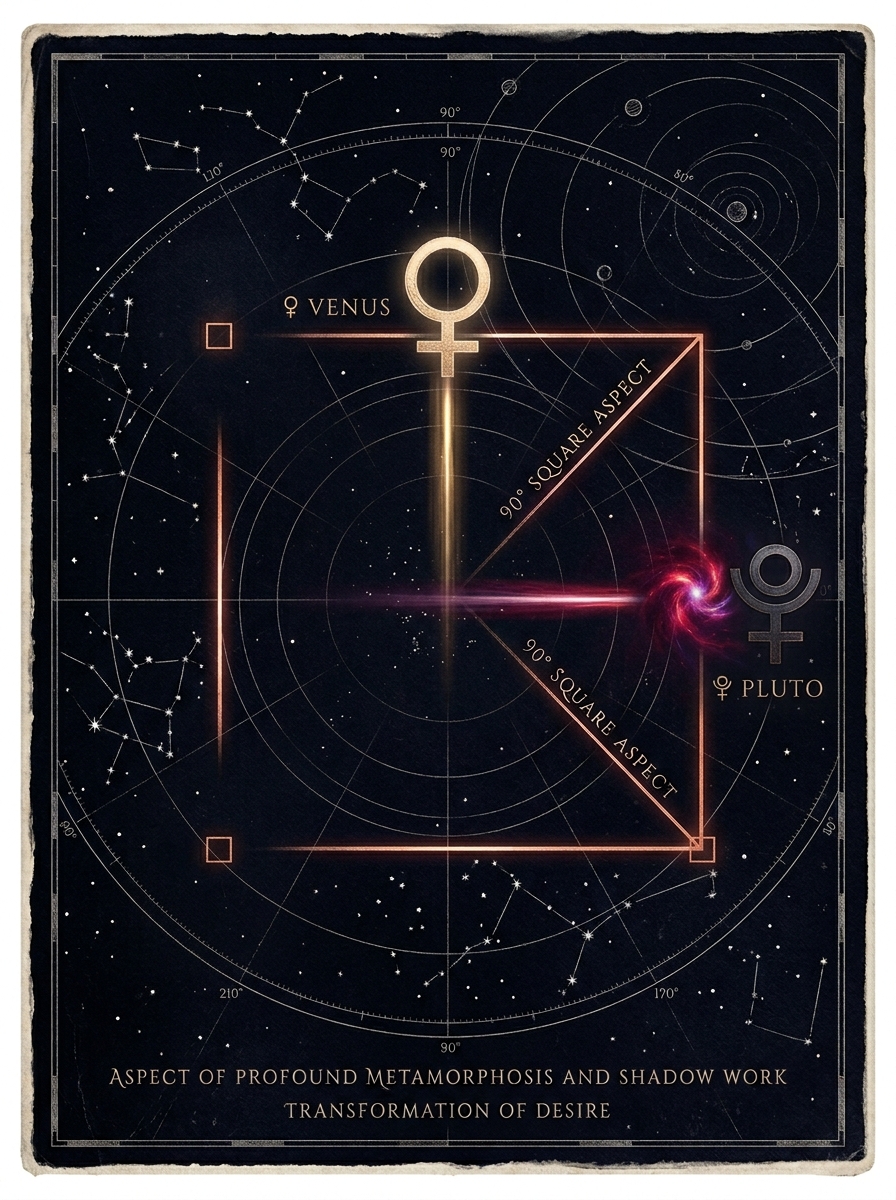
The pressure chamber of desire
The natal Venus square Pluto creates a friction most people never have to name: the need for harmony rubbing against the compulsion to unearth every hidden motive. Venus wants sweetness, mutual pleasure, and the kind of beauty that decorates life; Pluto wants the truth that lives underneath the decor—the power currents, the eros, the thing nobody says. When these two meet in a square, love is never light. It is a probe.
The square is a catalyst, not a flaw. As with any square aspect, the tension forces growth, but here the stakes feel personal. The native does not just want a partner; they want a soul excavation. They cannot accept a relationship that stays on the surface because they sense—correctly—that the surface hides more than it reveals. This radar for subtext is a gift, but it also makes trust a high-wire act. Every affection is tested for sincerity, every compliment scanned for leverage.
The pressure does not go away. It compels the person to develop a kind of erotic intelligence: an awareness that desire is never innocent, that attraction carries history, and that beauty, if it is not bought with some truth, is just decoration.
How the wound gets wired
Children who grow up with this aspect often learn that love is conditional on performance. A parent’s mood might shift without warning. Affection comes when the child is charming, pleasing, or useful, and disappears when they are not. The result is an adult who monitors attachment like weather, who feels the temperature change in a room before anyone speaks. The Pluto in their chart drives them to control the emotional climate because the alternative—not knowing when love will withdraw—felt impossible.
This early training produces two survival strategies. One is to become magnetic, to wield Venus like a weapon: dress impeccably, say the perfect thing, be the one everyone wants. But the magnetism comes with a knot because the person does not trust the desire they generate. They wonder if they are loved for the show or for the self behind it. The other strategy is to avoid dependence altogether—to keep relationships at a safe distance, to leave before being left, to value autonomy above all.
The core wound is a belief in scarcity: that love, pleasure, and worth are finite, and that you have to fight or seduce to secure your share. This not only affects romance but also money, as Venus rules resources. The native may hoard, overspend, or misuse wealth to soothe a sense of deprivation, or they may refuse to receive anything at all because accepting feels like being in debt. For deeper exploration of how Pluto conditions the psyche around value, the Pluto retrograde process—when that energy turns inward—deepens the same excavation.
The split between shadow and integration
The dark expression of Venus square Pluto is control dressed as love. The native may test a partner’s loyalty: provoke jealousy to watch the reaction, withdraw warmth to see if the other pursues, keep a score of favors given and not returned. They may not even know they are doing it—Pluto runs underground, and the behavior feels like self-protection, not manipulation. But the result is the same: relationships become war games where intimacy competes with the need to never be vulnerable.
When the square is integrated, the energy transforms into something far more potent. The person stops testing others and starts telling the truth about what they want and fear. They learn that real power in love is not the ability to control the beloved but the willingness to risk being seen. This is where Venus and Pluto stop fighting and start cooperating. The native can love with full awareness of the shadow yet choose to trust anyway. That trust is hard-won, which makes it rare and valuable.
In mature form, the square produces a loyalty that can survive disclosure. The native does not flee when a partner reveals their own darkness; they recognize it. They can hold space for complexity because they already live inside it. For those with a T-square in the birth chart that includes this square, the pressure is amplified—but so is the capacity for breakthrough, because the whole chart demands the same evolution.
Where the current shows up
In love, the native is drawn to fated encounters. They may fall for people who are emotionally unavailable, already entangled, or psychologically wounded—not out of masochism, but because Pluto reads depth through damage. The healthy version is an attraction to partners who are willing to do their own work, so the relationship becomes a joint excavation rather than a rescue mission.
In career and creativity, this aspect produces artists who refuse the cosmetic. Whether they work in design, music, therapy, or writing, they bring an instinct for the raw, the taboo, the thing that polite culture avoids. They make work that feels necessary rather than decorative. Compare the drive with a more straightforward Venus placement like Venus in Libra, where harmony is the goal—here, harmony is a byproduct of truth-telling, never the primary objective.
The same instinct applies to money and value. The native may have a nose for investments or collectibles that carry hidden worth, or they may struggle with the psychology of debt and gift. The path of integration is to treat resources as symbols of exchange, not as substitutes for love. For a parallel in how Pluto conditions partnership itself, see the Pluto in the 7th House dynamic, where the mirror of relationship becomes the stage for the same power-and-intimacy drama.
The work of making desire honest
Integration is not about becoming less intense. It is about letting the intensity become conscious so it can be directed rather than acted out. That means naming the fear of deprivation when it surfaces. It means asking for reassurance instead of testing for it. It means letting pleasure feel good without scanning for the cost.
The native’s gift is the ability to love without naivety. They know that every bond has a shadow, and they are not shocked when it appears. In time, they learn that the deepest intimacy is not the merging of two people but the shared willingness to keep showing the real self—the part that hungers, the part that hides, the part that believes it is not enough. That exposure is terrifying for anyone with Venus square Pluto, but it is also the only door out of the power struggle.
When Pluto transits hit this square—whether from a Pluto transit to Venus or from the slow-motion activation of the natal pattern—the work becomes non-negotiable. The native is asked to release a version of love that was built on control or performance and to discover what remains. What remains is usually leaner, more honest, and more alive than what was guarded. That is the payoff the square always promised: the love you cannot possess is the love that actually belongs to you.
Comments
Loading comments…