Venus Opposition Mars: Desire at War, Desire Made Visible
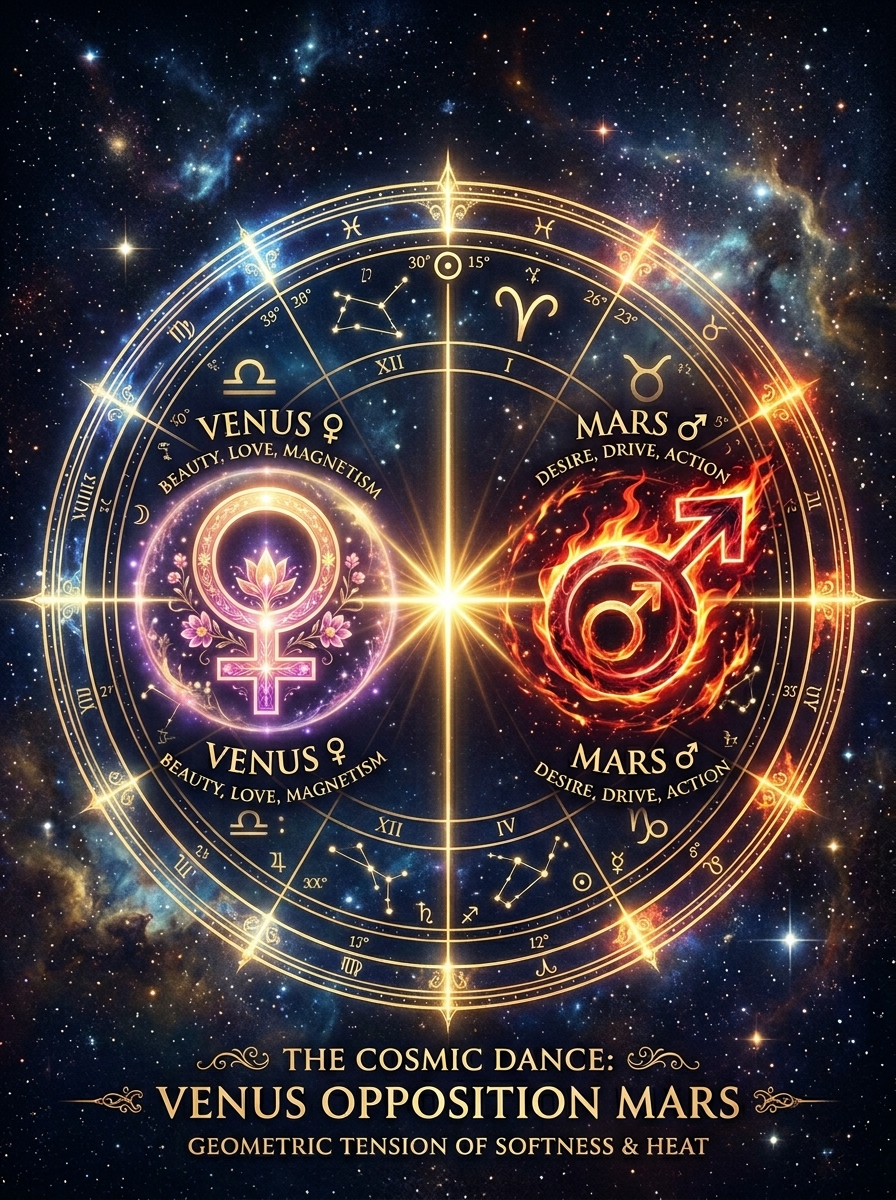
The Core Dynamic: Desire as Face-to-Face Encounter
Venus opposition Mars is the natal signature of a desire that refuses to separate into affection and appetite. The two planets stand opposite each other in the birth chart, not as enemies but as a charged face-to-face encounter. What the native wants—the objects of love and the objects of pursuit—live in different rooms of the psyche, and the door between them is thin. The result is not simply tension; it is a permanent reciprocity. Each pole becomes most itself when the other is fully acknowledged.
In the language of the opposition aspect, this configuration forces a meeting between two imperatives that the culture often tries to keep apart. Venus governs attraction, harmony, taste, and the wish to bind. Mars governs assertion, appetite, separation, and the will to claim. When they oppose, the native does not experience a choice between the two. They experience both at once, and the psyche must learn to move the current between them rather than choose a side.
This is not a planetary feud. It is a structural polarity. The person feels affection and impatience, charm and bluntness, aesthetic pleasure and raw need—often in the same relationship, the same hour, the same body. The opposition makes desire conspicuous. It cannot stay politely invisible.
Psychological Roots: The Split Between Loving and Wanting
The opposition often originates in early experience. A child may have received tenderness from one parent and discipline or drive from another, and learned that love and will do not coexist in the same room. Or they may have been praised for being agreeable and punished for being assertive, internalizing a split: the Venus side gets acceptance, the Mars side gets shame.
That split reappears in adult relationships as projection. The native attracts partners who embody the half they have disowned. A person who overidentifies with Venus—sweet, accommodating, eager to please—may find themselves drawn to someone blunt, decisive, or demanding. The Mars-dominant type, in turn, may pursue partners who are softer or more passive, then feel contempt for the lack of edge. Neither pattern satisfies because the missing pole is not the partner’s responsibility; it is the native’s own exiled energy.
The Body as Arena
The opposition rarely stays in the mind. It surfaces in the body as a literal field of tension. Restlessness, muscular tightness, sudden appetite swings, or a low-grade sexual agitation often accompany the aspect. Some natives need physical exertion to discharge Mars heat before they can receive Venus calm. Others need beauty, music, or touch to soften an overactive will. The body becomes the stage where the argument between attraction and assertion plays out, and ignoring it only deepens the split.
The Problem of Timing
Mars wants now. Venus wants the right moment. The opposition creates a chronic rhythm mismatch: acting too soon and regretting the rupture, or waiting too long and growing bitter. This is not a superficial scheduling issue; it is a psychological reflex. The native may unconsciously test partners: “Will you still want me if I demand?” “Will I be lovable if I refuse?” The tests are attempts to measure whether affection and assertion can survive in the same room. Integration requires learning to trust that desire can be both immediate and patient—that the timing that honors both poles is a felt sense, not a rule.
Maturity and Shadow: From Alternation to Integration
The shadow of Venus opposite Mars is alternation. The person swings between chasing and being chased, yielding and resisting, charm and combat. They may be admired but not pursued, pursued but not respected, desired but not chosen. The cycle feels fated, but it is driven by the internal split.
The Trap of Performative Harmony
Overidentifying with Venus leads to a life of accommodation that looks graceful on the outside and feels hollow within. The person becomes the polite, attractive, flexible partner—until resentment leaks out through passive aggression, sexual ambivalence, or an attraction to people who provoke conflict. The same dynamic appears in work: a person who is everyone’s favorite collaborator but privately furious at not being taken seriously.
The Mars-Trap of Blunt Force
The reverse error is more obvious. The native identifies with Mars—direct, sexually assertive, impatient with politeness—and then feels starved for tenderness, reciprocity, or appreciation. They may dominate rooms but not be able to rest in them. The Venus side, left unintegrated, returns as a craving for beauty, touch, or simple affection that the person cannot ask for without feeling weak.
The Mature Expression: Cleaner Desire
Maturity does not mean less desire; it means cleaner desire. The integrated native no longer needs love to prove appetite or appetite to prove worth. They can want someone without making that person the custodian of their identity. They can assert a need without turning every exchange into a contest. The hallmark of integration is presence that contains both invitation and edge—a person who can attract and initiate, soothe and disturb, beautify and defend.
This is the alchemy of the opposition: Venus teaches Mars that force becomes more potent when it knows what it values. Mars teaches Venus that value becomes real only when it moves. When they cooperate, desire gains dignity. For a deeper look at how this polarity appears in relationship dynamics, see Venus and Mars synastry.
Expression Across a Life: Love, Work, and Presence
Because the opposition is a structural dynamic, it touches every arena the native enters—but each arena reveals a different facet. The key is to avoid re-explaining the core; instead, see how the same polarity expresses differently.
In Love and Intimacy
Relationships become the main theater for the opposition. The native often needs a partner who can hold both Venus and Mars—tender yet forceful, elegant yet decisive, affectionate yet sexually direct. If the partner is too passive, desire cools; too aggressive, the Venus side feels violated. That double bind can create a lifelong search for the exact temperature of intimacy. Many natives unconsciously stage the split: they choose a lover who embodies the missing half, then resent the very quality that drew them. The lesson is not to settle for less chemistry but to recognize that chemistry alone is not integration—it is projection waiting to be reclaimed.
In Career and Creative Work
The same friction that makes relationships dramatic can fuel powerful work. Venus-Mars natives often excel in fields that blend charm with drive: design, diplomacy, sales, performance, negotiation, activism. Their instincts are quick, their taste clear, and their body knows before the mind whether a situation is alive or dead. When the opposition is poorly managed, the native may alternate between pleasing superiors and fighting for credit. When integrated, they become advocates who can push with grace and charm without losing spine. The aspect is especially potent when linked to the fifth house—see Venus in the fifth house or Mars in the fifth house for how creativity becomes an arena for this voltage.
In Personal Presence
People with this aspect often have conspicuous magnetism. They are noticed not because they try to dominate a room but because their field contains both invitation and edge. That blend can make them compelling in any setting where human chemistry matters—but it also makes them easy to misread. Others may see the Mars side and miss the Venus side, or vice versa. The work is to become readable: to let the two drives speak in the same voice so that one never cancels the other.
The Signs and Houses Shape the Argument
The broad meaning of Venus opposite Mars stays constant, but its texture shifts with sign and house. Signs determine style; houses determine the life arena where the split becomes most visible.
A Venus in Libra opposite Mars in Aries produces a classic push-pull between partnership and autonomy. The native may feel they must choose between being loved and being free. The Mars-in-Aries side wants to initiate; the Venus-in-Libra side wants fairness and reciprocity. The conflict is sharp but clear. For a deeper look at the Mars-in-Aries pole, see Mars in Aries; for the Venus-in-Libra pole, Venus in Libra.
A Venus in Scorpio opposite Mars in Taurus makes desire primal, possessive, and hard to separate from trust and survival. The native may swing between intense emotional bonding and stubborn withdrawal. The body and resources become the battlefield. Mars in Taurus shows the fixed, patient side of the Mars pole; Venus in Scorpio reveals the depth of the Venus side.
House placement tells where the contradiction lands. A 1st/7th house axis makes self-definition and committed partnership the main theater. A 10th/4th axis pits public grace against private drive. A 6th/12th axis ties the split to work, service, and hidden resentment. For examples, compare Mars in the 7th house with Mars in the 12th house.
No two charts are identical. The opposition is a door, not a prison. The lifelong invitation is to stop treating love and will as strangers. When they begin to cooperate, desire gains dignity. You become less divided, more readable, and capable of intimacy that does not require self-betrayal. That is the hidden promise of the opposition: not peace at any cost, but a living truce between attraction and action.
Related
- Venus Opposite Mars in Synastry: Desire at the Edge of Friction
- Synastry Mars Opposite Mars: Desire, Collision, and the Chemistry of Equal Fire
- Moon Opposition Venus: The Heart Torn Between Need and Grace
- Synastry Venus Opposition Venus: The Beauty of Mismatch, the Friction of Want
- Mars Opposition Saturn: The Friction That Builds a Life
Comments
Loading comments…