Mercury Opposite Mercury in Synastry: The Electric Rift of Two Minds
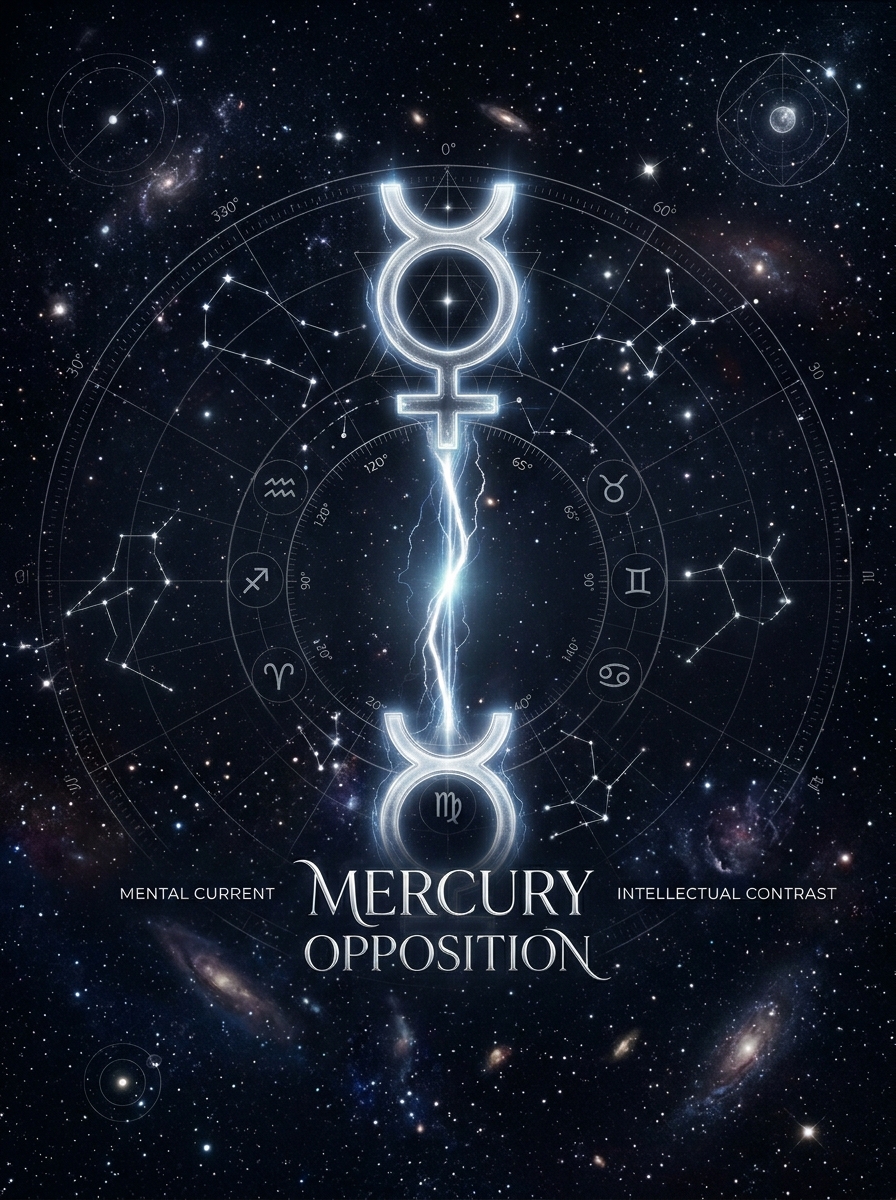
The Architecture of Cognitive Polarity
Mercury opposite Mercury in synastry is not a meeting of like minds; it is the meeting of two interpretations of reality that cannot sit in the same chair. The attraction comes from contrast: each person senses that the other carries a missing angle—a faster argument, a cleaner vocabulary, a more daring theory. The friction comes from the same source. Mercury governs how thought forms, sorts, names, and negotiates, and in an opposition each mind keeps encountering its own reflection at a distance—recognizable, irritating, illuminating. For the structural logic of this aspect, see the opposition aspect and its relational mechanism of mirroring and integration.
This is the core thesis: the aspect does not primarily describe agreement or disagreement. It describes a charged cognitive polarity. The relationship lives in translation. What one means, the other rephrases. What one assumes is obvious, the other interrogates. If handled consciously, that pressure produces wit, breadth, and intellectual eroticism. If handled unconsciously, it hardens into correction, interruption, and the tired sensation of never being accurately heard. Within astrological synastry, it is one of the clearest signatures of a bond that stays mentally awake because it cannot afford complacency.
The specific Mercury style of each person sharpens the dynamic. One partner may speak in facts, sequences, and precision; the other in pattern, context, or implication. Even when both are articulate, they are editing different layers of reality. That difference is not a flaw in the aspect. It is the aspect. The mind enjoys being met by a worthy opponent—and the opposition ensures the opponent never fully dissolves into agreement.
The Projection Loop: Why You Cannot Stop Correcting Each Other
Opposition aspects are famous for projection because they create an unmistakable otherness. In this case, each person tends to encounter the other as a thinker with a different method, not merely different opinions. That distinction matters. The relationship is not simply “we disagree”; it is “you process reality in a way that exposes my blind spot.” In Jungian terms, the opposition often stages shadow cognition—the part of your own mind that has been split off and assigned to them. The partner who seems “too literal” or “too abstract” is carrying an unowned function: decisiveness, detachment, nuance, or breadth.
The temptation to teach
There is a specific temptation here: to teach, improve, refine, or fact-check the other into symmetry with yourself. Sometimes that is useful. Often it is just disguised anxiety. Mercury wants coherence, and under opposition, coherence can become compulsion. Each person may feel that if the other would only say it “right,” the relationship would settle. But the relationship is not asking for sameness. It is asking for a shared bilingualism.
The key distinction is between correction and translation. Correction implies one version is superior. Translation assumes both versions contain truth, but in different forms. That shift is everything. When the couple defaults to correction, every conversation becomes a hidden contest for epistemic superiority. When they learn to translate, the same friction becomes a workshop for mental flexibility.
The love of argument as a decoy
The visible subject of a fight is often a decoy. The argument about dinner plans, timing, wording, or a text message is usually carrying a deeper issue: “Do you understand my logic?” “Do you respect my mind?” “Do I have to become you in order to be safe here?” Oppositions externalize a tension that wants integration. In synastry aspects, this is one of the clearest examples of desire taking the form of mental recognition and resistance at once.
Maturation: From Duel to Dialogue
The immature version of Mercury opposite Mercury insists on victory. The mature version knows that both minds are partial instruments. Over time, the relationship can become less about winning an argument and more about refining perception. Experienced astrologers often value oppositions more than clients expect: they reveal where a bond can become smarter than either person alone. In the language of synastry step-by-step, this is a contact that must be read for function, not fantasy.
The role of natal awareness
A Mercury opposition never speaks in isolation. Two people with strong mutable signatures may turn the aspect into lively debate; two fixed Mercuries dig in and refuse to yield; cardinal Mercuries use the tension to initiate action, then argue about the plan while moving. The more both people understand their own natal Mercury function—whether grounded in the Mercury in Virgo precision or the Mercury in Sagittarius horizon-scanning—the less likely they are to personalize every difference as hostility. A foundational resource for understanding the archetype is Mercury in astrology.
When the same pair also has soft Moon-Venus synastry or strong Sun-Moon synastry, the emotional field can cushion the argumentative edge, creating warmth that keeps the mind from becoming a battlefield. Such supportive contacts allow the opposition to feel like stimulating difference rather than existential mismatch.
Translation as practice
Maturity turns opposition into dialogue through deliberate practice. The couple learns to pause before replying, to ask “What do you mean by that?” instead of “You’re wrong.” They develop a shared vocabulary for their diverging mental paths. Over months and years, the relationship becomes a laboratory where thought is allowed to revise itself in public. This is the deeper promise of the aspect: not harmony, but cognitive reciprocity.
The Daily Voltage: Conversation, Timing, and the Microphysics of Misunderstanding
A Mercury opposite Mercury does not only announce itself in grand arguments. It lives in the smallest units of communication. The text that lands flat. The joke that is taken as criticism. The story that gets summarized too early. The practical plan that collapses because one person needs specifics while the other is still thinking aloud. If the relationship has strong house overlays, the plot thickens; Mercury contact can feel very different depending on where the planets land by house. A useful companion for that layer is synastry house overlays.
Speaking before the thought is finished
One person may regularly speak while still discovering what they mean; the other may insist on finished meaning before speech should begin. That mismatch creates friction around timing, not just content. In the best version, the couple becomes strangely productive—one voice generates, the other sharpens. But this only works if both can tolerate unfinishedness. A pair with this aspect may need to consciously slow down conversations about money, commitments, and emotional triggers. Otherwise, the mind outruns comprehension and the partners end up fighting over sentences that were never fully born.
When silence becomes loaded
Oppositions are not always loud. Sometimes the tension appears as strategic silence, intellectual withholding, or passive-aggressive refusal to clarify. If one person expects verbal processing and the other needs internal time, each can misread the other as evasive or domineering. This is especially important if either person’s natal Mercury is tied to private or subterranean placements such as Mercury in the 12th House or Mercury in the 8th House. What looks like avoidance may actually be a different relationship to mental disclosure.
Love, work, and the same dynamic
In a romantic partnership, the opposition can feel intellectually erotic—the constant spark of difference that keeps the bond alive. In a professional collaboration, it can produce sharp, complementary problem-solving as long as each person respects the other’s native logic. The core dynamic remains the same: two minds that refuse to fold into one, but can learn to translate. The application changes only the context, not the psychology.
The Long Arc: When Difference Becomes Shared Intelligence
A Mercury opposite Mercury connection rarely feels bland, and that is its gift. It can produce the kind of partnership in which ideas are always under revision, assumptions are always being tested, and conversation stays alive long after romance settles into routine. If the couple learns to distinguish misunderstanding from difference, they gain something rare: a relationship that thinks.
The deepest potential of this aspect is not harmony in the sentimental sense. It is cognitive reciprocity. Each person gradually learns the grammar of the other’s soul-mind, and that learning changes the self. The partnership becomes a workshop for translation, humility, and precision. This is the larger mystery of Mercury in synastry: not just communication, but consciousness in motion. When it works, the relationship does not erase difference. It makes difference intelligent.
Related
- Synastry: Sun Opposition Mercury and the Electric Argument
- Synastry Mars Opposition Mercury: The Spark That Argues, Seduces, and Reveals
- Synastry Mercury Square Mercury: The Spark, the Snag, and the Mind Games of Love
- Synastry Mercury Conjunct Mercury: The Shared Language of the Mind
- Synastry Venus Opposite Mercury: The Electric Tension Between Affection and Language
Comments
Loading comments…