Synastry Mars Square Mercury: When Desire Argues With the Mind
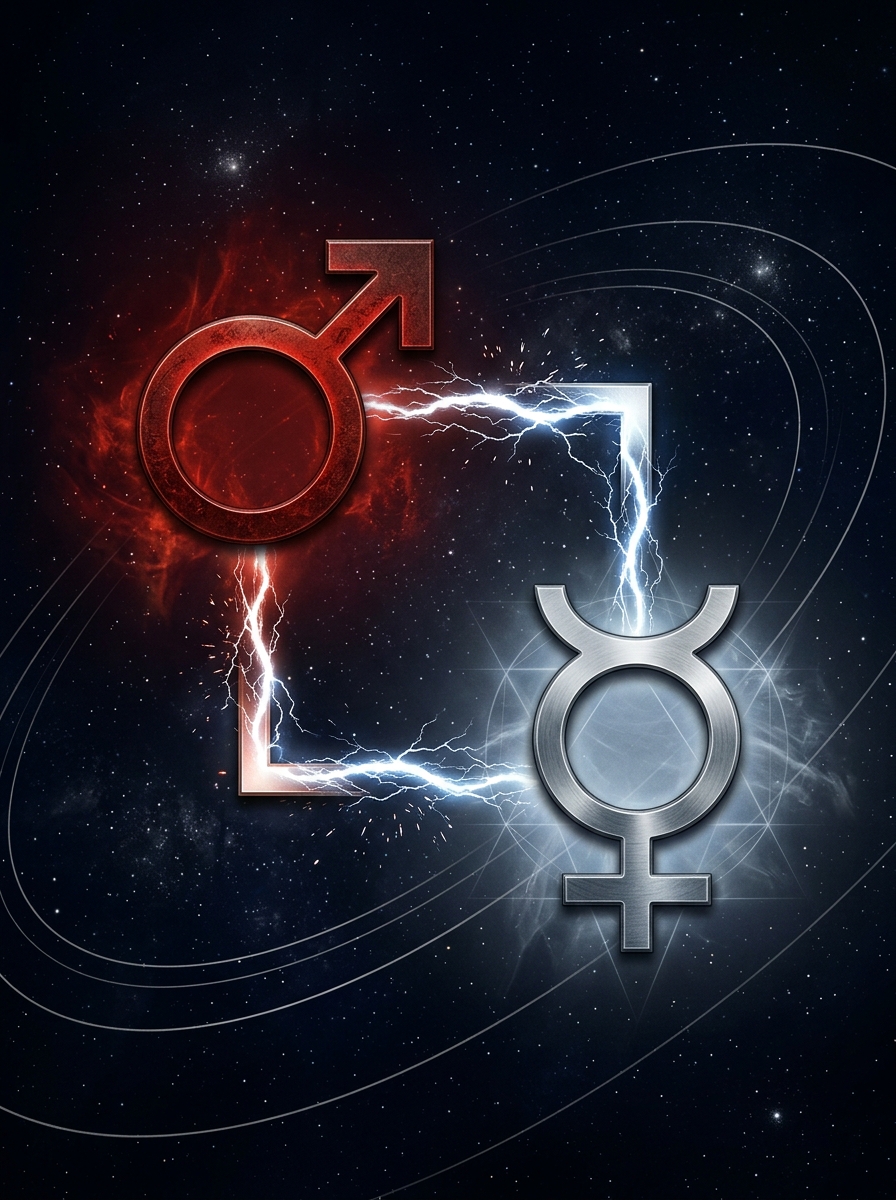
Mars square Mercury in synastry is the signature of conversation that never stays neutral. One person’s drive, impatience, or raw assertion presses against the other person’s way of thinking, speaking, and processing. The result is often unmistakable: quick attraction, quicker irritation, and a relationship that can feel mentally charged even when the topic is trivial. This aspect does not merely “cause arguments.” It creates a live wire between will and word—between the body that wants to act and the mind that wants to explain, revise, or define.
The Core Dynamic: When Will and Word Refuse Alignment
A square is not a wall; it is a demand for orientation. In the astrology of the square aspect, two principles refuse easy fusion, so each one becomes more itself under strain. With Mars square Mercury, that strain shows up in the exchange between decision and interpretation. One person feels the other talks too much, circles too long, intellectualizes, or delays. The other feels pushed, corrected, rushed, or verbally attacked. Neither side is imagining the friction. The square makes contact feel consequential.
Mars is directness, appetite, nerve, and the instinct to move first and think later. Mercury is perception, language, discrimination, and the act of naming reality. Put them in hard aspect and the relationship often develops a rhythm of “say it” versus “wait,” “do it” versus “let me think.” Even when the couple is affectionate, there can be a sense that one person’s words land like a spark on dry grass. The conversation becomes kinetic.
That kinetic quality can be thrilling. It can also make the relationship feel as though every sentence has stakes. The Mars person may experience Mercury as slippery, overly clever, evasive, or nitpicking. Mercury may experience Mars as brash, combative, or allergic to nuance. The synastry is not asking them to agree more quickly; it is asking them to learn how thought and action can tolerate each other without domination. If you want the broader context of relationship contacts, synastry aspects shows how different pairings build a composite atmosphere.
This is not a “bad” aspect. It is often one of the most stimulating. Mars square Mercury can produce fast banter, debate that wakes both people up, and a feeling that the relationship sharpens the mind. The pair may invent together under pressure, solve problems quickly, or say the thing everyone else avoids. In healthy form, the square makes both people more articulate and more decisive. It is less “calm compatibility” than “catalyzing contact.”
That is why it often appears in bonds where friction and fascination are tangled together. There may be immediate teasing, verbal sparring, competitive joking, or the sense that the other person is impossible to ignore. If the relationship also has tender signatures such as Moon-Venus synastry or Sun-Moon synastry, the couple may have enough softness to absorb the heat. Without those, the square can feel more like a constant editorial meeting with no end.
The Psychological Roots: Projection and the Body Beneath the Argument
Every synastry square has a shadow, and this one is especially prone to projection. The Mercury person may project recklessness onto Mars, while the Mars person projects insincerity or weakness onto Mercury. Underneath those judgments is often a simpler wound: each person feels that the other threatens their preferred way of meeting reality. One defends action, the other defends interpretation. That split is not arbitrary; it is wired into the archetypes themselves. Mercury is the messenger who analyzes before moving; Mars is the warrior who moves before analyzing. When they lock into a square, each becomes a mirror for the other’s disowned half.
Sometimes Mercury uses analysis to avoid acting. Sometimes Mars uses force to avoid thinking. The square exposes both evasions. In that sense, the aspect can function like a relational irritant that reveals where each person hides. Mercury may speak brilliantly and still avoid commitment. Mars may act boldly and still avoid reflection. The relationship keeps catching them in the gap. For the foundational archetype of Mercury, see Mercury in astrology; for Mars, the dynamic is always about assertive will, but the square forces a reckoning with consequence.
The nervous system is part of the story. Mercury governs mental processing; Mars governs muscular response. So the argument is rarely “just verbal.” It is often embodied: tight jaw, faster pulse, restless hands, a need to walk out of the room, a compulsion to text back immediately, a headache after a discussion that should have been ordinary. The square can make the relationship feel physically noisy. That somatic dimension is what makes the contact so difficult to fake. Polite language may say “I’m fine,” but Mars knows the body is mobilized, and Mercury knows the mind is still spinning. When the pair acknowledges that the conversation has a bodily component, they gain leverage. They can pause, move, write, or cool the temperature before speech becomes shrapnel.
When the square sits inside a larger pattern—for example, a T-square in the birth chart—the relationship may be activating old defenses rather than creating them. In that case, the argument is not only about the partner in front of you. It is about the inner figure each person brings into the room: the fighter who distrusts nuance, the analyst who distrusts impulse. Recognising that layer transforms a petty quarrel into a developmental crossroads.
Maturation vs. Shadow: The Forge and the Loop
The question is not whether Mars square Mercury is “good” or “bad.” It is whether the couple can turn friction into method. This aspect thrives when there are rules of engagement—spoken or unspoken—that protect both speed and precision. Without those boundaries, the pair may keep reenacting the same argument with different costumes. With them, the square becomes a source of invention.
The healthiest expression is often more procedural than sentimental. Let Mars know that interruption is not the same as clarity. Let Mercury know that endless qualification can feel like evasion. Give the relationship spaces where debate is welcome and spaces where nobody has to perform. A couple with this aspect often does well when they collaborate on tasks that require quick thinking, editing, troubleshooting, or strategic problem-solving. The square becomes a forge for mutual competence when each person respects the other’s intelligence—one kinetic, one verbal.
When the aspect goes shadow, it hardens into a chronic hierarchy. The Mars person may “win” by force of interruption, the Mercury person by verbal precision that leaves the other feeling stupid. That dynamic can corrode trust fast. The edge between stimulation and disrespect is thin. There is a difference between “you make me think” and “you make me brace myself.” The relationship becomes viable when the pair can enjoy the heat without making battle their default intimacy.
In many relationships, this aspect creates a distinctly erotic charge because language itself becomes charged with pursuit. Teasing, challenge, double entendre, and intellectual sparring can become the couple’s form of flirtation. The mind is provoked; the body responds. A sharp exchange can feel like an opening move rather than a rupture. That edge works best when both people know the difference between provocation and contempt. If the bond lacks that kind of balm, the pair may need more conscious repair after conflict, because the square tends to leave residue. Venus-Mars synastry can provide the softening that prevents the square from turning cruel.
How It Lives: Love, Work, and Everyday Contact
The same dynamic that sparks romantic friction also shapes professional collaboration, friendship, and domestic life. In love, Mars square Mercury often produces the couple that cannot stop talking and cannot stop quarreling. They finish each other’s sentences but also correct each other mid-syllable. The erotic charge is intellectual as much as physical; they are turned on by the other’s quickness and frustrated by the other’s resistance. When the relationship has a foundation of trust, this becomes a game of mental catch that never gets old. When trust is absent, every disagreement feels like a power struggle.
In the workplace, this synastry can generate extraordinary productivity if the pair respects each other’s domain. A Mars person who is a project leader and a Mercury person who is a strategist may clash over timing but also produce ideas faster than either could alone. The key is role clarity: let Mars set the pace and Mercury check the logic. Without that division, the meeting room becomes a boxing ring.
In friendship, the aspect often appears between people who love to argue—about politics, movies, philosophy—and feel sharper afterward. They may drain others but energise each other. The danger is that the friendship becomes a constant tournament; the gift is that both friends become more articulate and less afraid of conflict.
This aspect also interacts with the rest of the synastry chart. If a supportive Moon-Venus synastry is present, tenderness can absorb the heat. If not, the couple may need intentional rituals of repair—a walk, a pause, a written note—to reset the nervous system after a verbal clash.
Ultimately, Mars square Mercury is a lesson in how to let heat inform intelligence instead of humiliating it. It gives a relationship edge, speed, and friction, then asks whether those qualities will become cruelty or craft. If the couple can hear the difference between provocation and contempt, the aspect becomes a forge. If not, it becomes a loop of missed meanings and unnecessary wounds. The square does not promise ease. It promises contact that cannot remain shallow.
Related
- Mars Conjunct Mercury in Synastry: The Spark, the Argument, the Us
- Synastry Mercury Square Mercury: The Spark, the Snag, and the Mind Games of Love
- Synastry Mars Opposition Mercury: The Spark That Argues, Seduces, and Reveals
- Mercury Square Mars: The Mind Under Pressure, the Tongue as a Blade
- Synastry Mars Sextile Mercury: The Spark of Quick Minds and Clean Friction
Comments
Loading comments…