Planetary Domicile: The Astrology of Cosmic Sovereignty and Essential Dignity
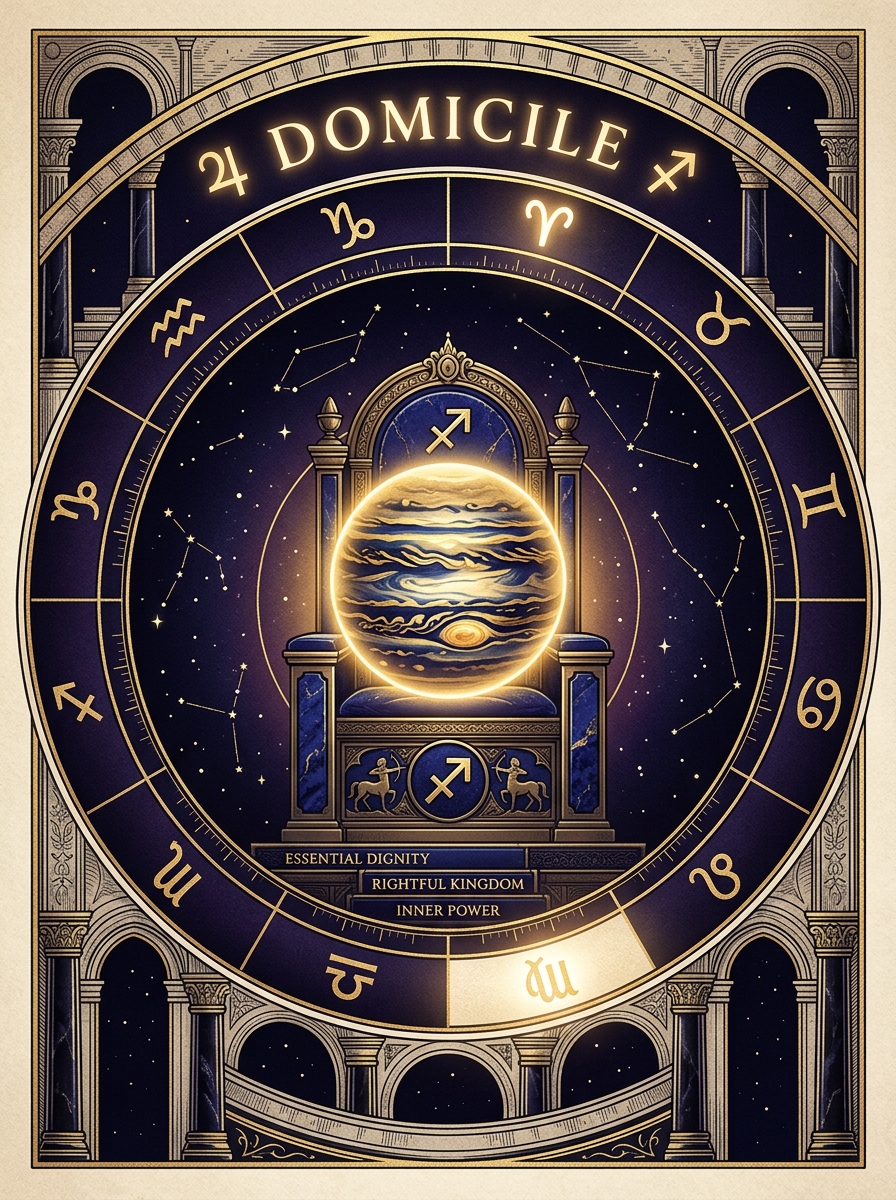
The Architecture of Astrological Dignity: Historical and Structural Foundations
Astrology, at its core, is a symbolic language of relationship, geometry, and placement. Among the various tools developed by the ancient observers of the sky to measure the relative strength, quality, and efficacy of a planet in a birth chart, the system of essential dignities stands as the most sophisticated and enduring framework. Essential dignity measures the inherent strength or weakness of a planet based solely on its position in the zodiac. It asks a fundamental question: how comfortable is the planet in the sign it currently occupies? In this grand celestial structure, planetary domicile is the supreme state of alignment, representing the absolute peak of essential dignity.
Historically, this system was not conceived overnight; it was the product of centuries of observation, philosophical synthesis, and mathematical design, largely crystallized during the Hellenistic period in the Mediterranean basin. Early astrologers sought to categorize planetary influence not as arbitrary influences, but as a dynamic interplay between the planetary actor and the zodiacal landscape. To understand domicile, one must view it within the complete matrix of the classical essential dignities: domicile, exaltation, detriment, and fall. Each of these states describes a specific relational dynamic between a planetary archetype and the seasonal, elemental, and modal qualities of the zodiac signs.
The Hellenistic Roots of Planetary Strength
In the Hellenistic tradition, which flourished from the 2nd century BCE to the early centuries of the Common Era, the concept of planetary strength was deeply intertwined with the prevailing philosophical systems of the time, including Stoicism, Platonism, and Hermeticism. The early practitioners, such as Vettius Valens, Ptolemy, and Dorotheus of Sidon, approached the cosmos as a living, rational organism where every part was intimately connected to the whole. The zodiac was seen as a template of cosmic order, and the planets were the active agents that distributed the divine intelligence throughout the sublunary realm.
Within this framework, the concept of a planet's sign placement was understood through the lens of governance and stewardship. The term "essential dignity" itself suggests a moral and social hierarchy, a reflection of the highly structured societies in which these techniques were forged. The Hellenistic authors did not view planets in signs as mere psychological tendencies; they viewed them as concrete entities with legal and domestic rights within specific sectors of the sky. The alignment of a planet with its natural sign was seen as a restoration of cosmic order, a moment when the micro-cosmos and the macro-cosmos achieved perfect resonance.
Domicile, Exaltation, Detriment, and Fall: The Four Pillars
To appreciate the absolute sovereignty of domicile, it must be contrasted with the other three primary states of the classical dignities system. Exaltation (hypsoma) represents a state of high honor and amplification. If domicile is a ruler in their own palace, exaltation is an esteemed guest of honor at a royal banquet. The exalted planet is treated with great respect, its voice is amplified, and its positive qualities are magnified, yet it lacks the long-term systemic control and foundational resources of the domicile ruler. The exalted planet performs brilliantly under specific, heightened conditions, but it is ultimately dependent on the host of the house to sustain its work.
Conversely, the states of debility represent conditions of systemic friction. Detriment (enantiosis) occurs when a planet is placed in the sign directly opposite its domicile. Here, the planet is in exile, operating in an environment whose elemental nature, seasonal quality, and psychological objectives are completely alien to its own. A planet in detriment must work twice as hard to achieve its basic functions, often having to translate its natural impulses into a foreign symbolic vocabulary. Fall (tapeinoma), which occurs in the sign opposite the planet's exaltation, represents a state of devaluation, vulnerability, and systemic disadvantage. In fall, the planet’s natural authority is stripped away, forcing it to operate from an underdog position, often leading to internal overcompensation or a feeling of being misunderstood by the surrounding environment.
The Concept of Domicile: Understanding Cosmic Sovereignty and Oikodespotes
When a planet resides in the sign it rules, it is said to be in its domicile (from the Latin domus, meaning house). In the original Greek texts, the term used for the ruler of a sign was oikodespotes, which translates literally as "the lord of the house" or the "master of the household." This Greek term carries a profound structural implication that goes far beyond the modern English word "ruler." The oikodespotes was the head of an ancient household, the individual who held ultimate legal responsibility, controlled the domestic economy, distributed resources to the inhabitants, and defended the estate from external threats.
When a planet is in its own domicile, it is the master of its own estate. It does not have to ask another planet for permission to express itself, nor does it have to adapt its agenda to suit the needs of a host. If Mars is in Aries, or the Moon is in Cancer, these planets are operating within their own territory. They have direct, unhindered access to the tools, resources, and elemental qualities of that sign. The planet can act cleanly, directly, and with absolute self-determination.
The Lord of the House
To understand the metaphor of the oikodespotes, imagine a homeowner. In your own home, you know where everything is kept, you set the house rules, you decide who is allowed to enter, and you can decorate the space to perfectly suit your personal comfort and functional needs. You do not need to compromise your lifestyle to accommodate a landlord's restrictions. In the same way, a planet in domicile operates with total autonomy.
If a planet in a birth chart is in its domicile, it possesses an inherent self-sufficiency. It does not rely on the condition of another planet to validate or support its planetary expression. For example, if Mercury is in Gemini, its intellectual, communicative, and analytical faculties are self-generating and self-contained. It doesn't need to check in with a dispositor to figure out how to think, write, or connect dots; it simply performs these tasks with natural authority and systemic alignment.
The Natural Flow of Planetary Expression
The alignment of a planet with its domicile sign represents a state of elemental and symbolic harmony. Every sign of the zodiac is composed of a specific combination of element (fire, earth, air, water) and modality (cardinal, fixed, mutable). The planets themselves possess archetypal temperaments: Mars is hot and dry; the Moon is cold and moist; Saturn is cold and dry. Domicile occurs when the planetary temperament aligns harmoniously with the seasonal and elemental qualities of the zodiacal environment.
When this alignment is present, the psychic function represented by the planet flows outwards without internal friction or external resistance. The planet is speaking its native language in its home country. This produces an expression that is exceptionally clean, pure, and true to the planet’s core archetype. There is no need for translation, no awkward modification of the planet's primary drives, and no energetic wastage. The planetary function manifests with a smooth, unforced elegance that can look like natural talent or effortless mastery to the outside observer.
The Astrological Ledger: Traditional and Modern Domicile Rulerships
The distribution of planetary domiciles across the zodiac is one of the most beautiful examples of symmetry in the Western esoteric tradition. Originally structured around the seven classical visible planets, this system was visualized through the Thema Mundi—a mythical birth chart of the universe used in Hellenistic astrology to teach the foundational relationships between the signs and the planets. The Thema Mundi established a symmetrical layout based on the dual lights of the cosmos: the Sun and the Moon.
In this classical layout, the two luminaries were assigned to the two brightest, hottest signs of the midsummer in the Northern Hemisphere: the Moon was given Cancer, and the Sun was given Leo. From this central axis, the remaining planets were assigned outward in order of their astronomical speed and distance from the Sun, moving symmetrically through both the solar half (from Leo to Aquarius) and the lunar half (from Cancer to Capricorn) of the zodiac.
| Planet | Traditional Domicile(s) | Modern Domicile(s) | Archetypal Principle |
|---|---|---|---|
| Sun | Leo | Leo | Creative self-expression, vital force, central identity |
| Moon | Cancer | Cancer | Emotional security, instinctual habits, nurturing care |
| Mercury | Gemini & Virgo | Gemini & Virgo | Cognition, communication, analysis, processing |
| Venus | Taurus & Libra | Taurus & Libra | Relational harmony, aesthetic value, pleasure, attraction |
| Mars | Aries & Scorpio | Aries (co-rules Scorpio) | Action, drive, separation, assertion, physical energy |
| Jupiter | Sagittarius & Pisces | Sagittarius (co-rules Pisces) | Expansion, wisdom, belief systems, integration |
| Saturn | Capricorn & Aquarius | Capricorn (co-rules Aquarius) | Structure, boundary, time, responsibility, crystallization |
| Uranus | N/A | Aquarius | Individuation, revolution, systemic disruption, insight |
| Neptune | N/A | Pisces | Mystical union, dissolution, imagination, transcendence |
| Pluto | N/A | Scorpio | Metamorphosis, deep psychological power, regeneration |
The Symmetrical Classical Rulerships
Under the classical scheme, the five non-luminary planets each ruled two signs—one daytime (diurnal) sign and one nighttime (nocturnal) sign, representing the active and receptive poles of their respective archetypes.
- Mercury was assigned Gemini (diurnal/air) and Virgo (nocturnal/earth). In Gemini, Mercury expresses its active, intellectual, and communicative side, networking and gathering information. In Virgo, it expresses its receptive, analytical, and practical side, processing, sorting, and refining data for utility.
- Venus was assigned Taurus (nocturnal/earth) and Libra (diurnal/air). In Taurus, Venus is sensory, material, and grounded, finding value in physical comfort, nature, and tangible resources. In Libra, Venus is relational, social, and aesthetic, seeking intellectual harmony, justice, and balanced partnerships.
- Mars was assigned Aries (diurnal/fire) and Scorpio (nocturnal/water). In Aries, Mars is the outward-directed warrior, initiating action, taking risks, and asserting the ego. In Scorpio, Mars is the inward-directed strategist, navigating emotional depths, managing vulnerability, and sustaining intense focus.
- Jupiter was assigned Sagittarius (diurnal/fire) and Pisces (nocturnal/water). In Sagittarius, Jupiter is the explorer, seeking wisdom, meaning, and broad philosophical horizons. In Pisces, Jupiter is the mystic, seeking spiritual connection, universal compassion, and dissolution of boundaries.
- Saturn was assigned Capricorn (diurnal/earth) and Aquarius (nocturnal/air). In Capricorn, Saturn builds concrete structures, establishes social authority, and honors historical tradition. In Aquarius, Saturn organizes collective groups, establishes ideological boundaries, and builds systems for societal progress.
The Modern Shift: Outer Planets and Co-Rulership
With the discovery of Uranus (1781), Neptune (1846), and Pluto (1930), modern Western astrologers sought to integrate these outer planets into the traditional domicile scheme. The outer planets represent transpersonal, collective forces that operate beyond the boundaries of individual consciousness (represented by Saturn). As a result, modern astrology reassigned these new discoveries to the signs that seemed to share their deep psychological and symbolic signatures, creating a shift from the classical dual-rulership model to a singular modern rulership model.
Uranus was assigned to Aquarius, replacing or co-ruling with Saturn, reflecting its association with sudden disruption, technological progress, and collective evolution. Neptune was assigned to Pisces, replacing or co-ruling with Jupiter, reflecting its association with transpersonal love, psychic sensitivity, and the oceanic consciousness. Pluto was assigned to Scorpio, replacing or co-ruling with Mars, reflecting its association with psychological death and rebirth, hidden power dynamics, and biological metamorphosis. Today, many professional astrologers utilize a co-rulership system, acknowledging the traditional rulers as the practical "gatekeepers" of the signs, while treating the modern outer rulers as the deeper, transpersonal dimensions operating behind the scenes.
The Psychological Archetype of the Home Sign: Innate and Unconditioned Expression
In the mid-20th century, astrologers like Liz Greene, Dane Rudhyar, and Steven Forrest transformed the language of astrology by blending classical celestial mechanics with the depth psychology of Carl Gustav Jung. In this modern light, the planets are no longer viewed as external forces influencing human destiny, but as internal psychic drives or archetypal functions within the human psyche. The signs of the zodiac represent the psychological styles, behavioral patterns, and developmental paths through which these psychic drives express themselves.
From a psychological perspective, a planet in its domicile represents a psychic function that is completely unconditioned, highly integrated, and operating with innate authority. When a planet is in its home sign, the individual does not need to learn how to access this part of their psyche through painful trial and error. The drive is born fully formed, speaking its own language, possessing a natural confidence, and operating as a primary, instinctual talent.
Jungian Perspectives and the Path of Least Resistance
According to Jungian theory, the psyche is composed of various archetypal patterns that reside in the collective unconscious. These archetypes seek expression in the conscious life of the individual. When a planet is in its domicile, it has a direct line of communication to the conscious ego. It represents a psychic function that is exceptionally well-aligned with the individual's natural disposition, creating a state of flow that feels authentic and unforced.
This produce what Steven Forrest refers to as a path of least resistance. For instance, an individual with Venus in Libra has an innate psychological grasp of relational dynamics, social etiquette, and aesthetic harmony. They do not have to struggle to understand how to compromise or how to create beauty; these behaviors are deeply wired into their psychological operating system. The archetype of the lover and mediator operates with absolute ease, showing up as a natural charm, an artistic eye, or an intuitive ability to diffuse conflict in interpersonal relationships.
Innate Sovereignty and Self-Validation
Because the domicile planet is self-sufficient, it does not seek validation from other parts of the chart or from the external world. It operates from a position of quiet confidence. Consider Saturn in Capricorn: here, the psychological drive for structure, boundaries, and mastery is grounded in its own element. The individual does not need to be constantly reassured of their authority or capability; they possess an internal compass that knows how to build, endure, and succeed.
This internal sovereignty allows the planet to withstand external pressures. A person with Mars in Aries does not need to be taught how to stand up for themselves or how to initiate action; the warrior archetype is fully integrated and functional. When faced with opposition, they do not hesitate or look around for permission to fight; they simply act. This immediate, unconditioned access to a psychic function is the true psychological gift of planetary domicile.
The Paradox of Ease: Complacency, Frictionless Action, and the Shadow of Domicile
While classical astrology views planetary domicile as an unmitigated blessing, modern psychological astrology recognizes that every astrological placement carries a shadow side. The very ease and lack of friction that make a domicile planet so powerful can also become its greatest psychological liability. In the human psyche, growth is almost always the result of friction, challenge, and the need to overcome obstacles. Without resistance, the psychological muscles associated with a planet can become weak, complacent, or lazy.
This is the psychological paradox of domicile: because the planet operates so naturally and effortlessly, the individual may take its gifts completely for granted. They may fail to develop conscious awareness around this function, leading to significant blind spots, behavioral rigidity, or a refusal to do the hard psychological work of integration.
The Shadow of Harmony
When a psychic function operates without resistance, it can become an unchecked, dominant force in the personality, leading to a state of psychological inflation. Because the individual has never had to fight for this function, they may lack the humility and self-awareness that comes from having to work through planetary debility.
- Mercury in Gemini can possess an incredibly agile, rapid mind that gathers information effortlessly. However, because thinking comes so easily, the individual may struggle with deep concentration, intellectual discipline, or emotional vulnerability. They may become a superficial dilettante, skimming the surface of many subjects without ever committing to the depth of a single path, scattering their mental energy into endless, fragmented chatter.
- Venus in Taurus has a natural talent for enjoying the physical pleasures of life, maintaining stability, and cultivating comfort. Yet, the shadow of this placement is profound inertia, stubbornness, and a resistance to necessary psychological crisis. The individual may tolerate dead relationships or stagnant careers simply because they dread the discomfort of change, choosing familiar security over developmental growth.
- Mars in Aries is exceptionally good at initiating action and expressing healthy aggression. However, because the impulse to act is so unhindered, the individual can easily fall prey to chronic impulsivity, impatience, and an inability to cooperate with others. They may leave a trail of half-finished projects and damaged relationships in their wake because they never learned the value of patience, restraint, or diplomatic compromise.
The Lack of Evolutionary Friction
In the evolutionary astrology model, the soul grows by resolving the tensions and conflicts presented in the natal chart. Planets in detriment or fall, by their very nature, generate immense friction. They force the individual to ask hard questions, to adapt, to fail, and to rebuild their relationship to that planetary archetype. This struggle often produces a highly conscious, resilient, and uniquely creative expression of the planet.
A planet in domicile, however, experiences no such developmental pressure. It is content to stay exactly as it is, sitting comfortably in its own palace. As Liz Greene has noted, planets in domicile can represent areas of the personality where the individual is most resistant to change, most self-righteous, and most likely to fall into habitual patterns of behavior that hold them back from full integration. The ease of the placement becomes a golden cage, keeping the individual locked in a cycle of effortless but ultimately unproductive repetition.
Essential vs. Accidental Dignity: The Difference Between Potential and Execution
To fully understand how a planet in domicile will express itself in a specific life, we must look beyond its sign placement and examine its overall condition in the natal chart. Astrologers draw a sharp distinction between Essential Dignity (what a planet is capable of doing based on its sign) and Accidental Dignity (how a planet is actually situated to perform its duties based on its house placement, aspects, speed, and relationship to the horizon).
If essential dignity represents a planet’s character, talent, and potential resources, accidental dignity represents its physical circumstances, opportunities, and ability to act in the concrete world. A planet can have incredibly high essential dignity, yet be severely restricted by its accidental placement, resulting in a psychological gift that the individual struggles to manifest in their outer life.
Sign Placement vs. House and Aspect Dynamics
To illustrate the difference, let us use a classical political metaphor. A queen may be highly educated, noble, and deeply caring (high essential dignity), but if she is locked in a dungeon or cut off from her advisors (poor accidental dignity), she cannot govern her kingdom effectively. Her noble character remains intact, but her ability to execute her will is paralyzed.
- House Placement: The houses of the chart represent the specific arenas of life where the planetary energy is directed. A planet in its domicile placed in an active, angular house (the 1st, 4th, 7th, or 10th) has high accidental dignity. It is sitting on a stage with a microphone, ready to act. However, if that same domicile planet is placed in a cadent, hidden house (such as the 12th or 8th), its ability to express its power in the external world is compromised. For example, Jupiter in Sagittarius in the 12th house possesses immense spiritual wisdom and philosophical depth (essential dignity), but this wisdom may remain entirely private, internal, or hidden from the public eye, manifesting as a rich dream life or a quiet, solitary search for meaning rather than a public career as a teacher or explorer.
- Aspects: Aspects represent the lines of communication between planets. A planet in domicile that is unafflicted or supported by easy aspects (trines and sextiles) will manifest its gifts with absolute ease. However, if a domicile planet is locked in a tight square or opposition with a heavy outer planet or a malefic, it will face significant blockages. Consider the Moon in Cancer: essentially dignified, nurturing, and emotionally open. If this Moon is in a tight conjunction with Pluto, the emotional life becomes a battlefield of power struggles, intense shadow work, and fear of abandonment. The natural, gentle flow of Cancer is colored by the deep, transformative crises of Pluto, forcing the individual to work through significant emotional trauma before they can access the peaceful sanctuary of their lunar domicile.
- Dynamic Strength: Other factors like planetary speed, stationing, retrogradation, and combustion (being too close to the Sun) affect accidental dignity. A planet in its domicile that is retrograde (such as Saturn retrograde in Capricorn) will turn its structuring, authoritative energy inward, resulting in an intense self-criticism and a need to rebuild the internal structures of the psyche before taking on authority in the outer world.
By synthesizing essential and accidental dignity, the astrologer gains a nuanced understanding of the chart. We avoid the trap of simplistic interpretations, recognizing that a "good" placement on paper is always part of a complex, living system of psychological dynamics.
Frequently Asked Questions
What is the difference between planetary domicile and exaltation?
Planetary domicile and exaltation are both states of high essential dignity, but they function with very different psychological and structural dynamics. Domicile represents a state of permanent sovereignty and self-sufficiency. A planet in its domicile is the "owner" of the sign; it controls the resources, sets the rules, and operates with long-term autonomy. It represents a steady, natural, and fully integrated talent that requires no external validation.
Exaltation, on the other hand, represents a state of temporary elevation, amplification, and honor. An exalted planet is treated like a highly respected guest. Its voice is amplified, and its expression is exceptionally clean and idealistic. However, because it does not own the sign, it lacks the systemic control and resources of the domicile ruler. Exaltation is often more dramatic, visible, and focused than domicile, but it is less self-sufficient and more dependent on the general health of the dispositor to sustain its activities over the long term.
Can a planet in domicile still manifest negatively in a birth chart?
Yes, a planet in domicile can manifest destructively or block personal growth in several ways. Psychologically, the absolute ease of a domicile placement can breed complacency, laziness, or a path of least resistance that keeps the individual stuck in infantile behaviors. Because the planetary function operates without friction, the individual may take its gifts for granted, failing to develop conscious awareness or humility around its expression.
Furthermore, if a planet in domicile receives harsh aspects from outer planets (like Uranus, Neptune, or Pluto) or traditional malefics (like Mars and Saturn), its natural expression will be interrupted by crisis, trauma, or structural blockages. A planet's high essential dignity does not make it immune to the struggles of life; rather, it indicates that the individual has a rich, native reservoir of resources to draw upon when facing those struggles.
How do modern astrologers view traditional planetary domiciles versus modern rulers?
Modern astrologers generally take one of three approaches. Some adhere strictly to the traditional seven-planet system, using the classical dual-rulerships (such as Mars for Aries and Scorpio, Saturn for Capricorn and Aquarius) because they value the mathematical and philosophical symmetry of the Thema Mundi.
Others adopt the modern system completely, replacing the traditional rulers of Scorpio, Pisces, and Aquarius with Pluto, Neptune, and Uranus respectively, arguing that the discovery of these outer planets reflected a necessary evolution in human consciousness.
The third, and perhaps most common approach in contemporary psychological astrology, is co-rulership. This approach honors the traditional ruler as the practical, structural governor of the sign, while treating the modern outer planet as a deeper, transpersonal influence operating beneath the surface. For example, in Scorpio, Mars represents the active, tactical drive to navigate crisis, while Pluto represents the deep, evolutionary necessity for psychological transformation and rebirth.
How does a planet in detriment differ dynamically from one in domicile?
A planet in domicile operates with absolute ease, autonomy, and elemental harmony. It is in its home sign, speaking its native language, and has direct access to all its resources.
A planet in detriment, being in the sign opposite its domicile, operates in an environment that is elementally and archetypally alien to its nature. It is in exile. A planet in detriment cannot achieve its goals through direct, conventional means. It must work harder, adapt, and often find unconventional, creative ways to express its energy.
While domicile represents natural, unconditioned talent, detriment often represents a hard-won, highly conscious skill. The struggle and friction associated with detriment force the individual to develop self-awareness, making the planet a source of deep, unique creativity and resilience, whereas the domicile planet can remain asleep in its own comfort zone.
What is the significance of the ruler of the chart (the Ascendant ruler) being in its domicile?
The Ascendant represents the physical body, the personality persona, and the primary lens through which an individual views and navigates the world. The planet that rules the sign on the Ascendant is considered the "chart ruler" or the captain of the ship.
When the chart ruler is placed in its own domicile (for example, a Taurus Ascendant with Venus in Libra, or a Scorpio Ascendant with Mars in Aries), the individual’s core life direction and vital energy are supported by a state of high essential dignity. The "captain" is operating with full resources and sovereignty. This placement often gives the individual a strong sense of identity, a clear path in life, and an innate resilience. They have direct, unhindered access to the tools they need to navigate their destiny, allowing them to project their personality into the world with confidence and authentic authority.
Comments
Loading comments…