Planetary Fall in Astrology: The Psychological Descent and Reconstruction
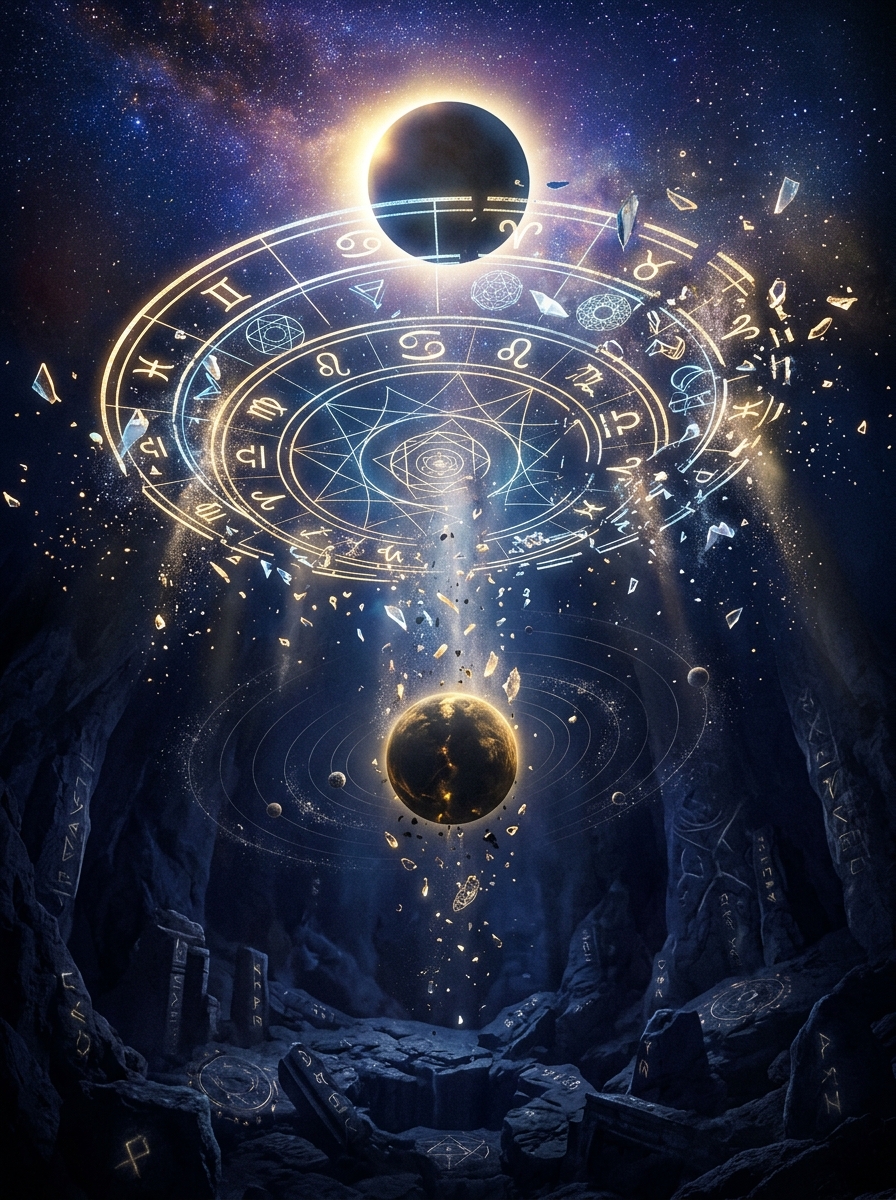
Understanding Planetary Fall: Definition and Mechanics
In the grand architecture of traditional astrology, planets are described as having varying states of dignity and debility. These states reflect how easily a planet's core archetypal energy can express itself through the filter of a specific zodiac sign. Among these conditions, planetary fall represents a profound state of traditional astrological debility. It occurs when a planet is positioned in the zodiac sign directly opposite its sign of exaltation.
To map this mechanically, we must look at the zodiacal grid as a series of polarities. Every planet has a domicile—a sign where it is at home—and a detriment, which is the opposite sign. Similarly, every planet has a sign of exaltation, where its energy is amplified, elevated, and expressed with a certain idealized, effortless purity. The sign directly opposite this point of exaltation is the sign of the planet’s fall. Here, the planet is stripped of its immediate, instinctual ease. The environment of the sign of fall does not naturally support the direct, uninhibited output of the planet's agenda. Instead, the planetary drive must operate under significant friction, forcing its expression to undergo a process of psychological descent, ego-stripping, and conscious reconstruction.
What is Planetary Fall?
When a planet is in its sign of fall, it functions like a traveler navigating a terrain that does not speak its language or value its customs. In the traditional view, this was often interpreted fatalistically as a weakness, a lack of power, or a point of misfortune in the natal chart. However, modern evolutionary and Jungian astrology reframes this debility entirely. A planet in fall is not broken; rather, it is denied the easy, superficial pathways of expression.
This denial forces the individual to engage with the planet's functions at a much deeper, more conscious level. Because the energy does not flow automatically or receive immediate external validation, the individual must work actively to understand the mechanics of this planetary function. It demands a descent into the underworld of the psyche to reclaim the raw, unadorned core of the planet's meaning, free from the socialized armor that usually protects it. This process represents a necessary friction that prevents the soul from remaining stagnant.
Fall vs. Exaltation
To understand fall, we must contrast it with exaltation. Exaltation is an honoring of the planet. When a planet is exalted, it is treated like an esteemed guest in a palace. Its qualities are praised, magnified, and given free rein. For instance, the Sun is exalted in Aries, where the solar drive for identity, vitality, and individual expression aligns perfectly with Aries' pioneering, self-assertive, and courageous spirit. The solar ego shines brightly, unimpeded by doubt or the necessity of compromise.
In contrast, when the Sun is in Libra—the sign of its fall—the solar drive for self-oriented identity is placed in the sign of relationship, compromise, and social equilibrium. The effortless self-assertion of Aries is replaced by the necessity of considering the other. The solar ego cannot simply project itself outward; it must negotiate, balance, and compromise. This creates friction. The immediate ease of self-expression is stripped away, forcing a conscious re-evaluation of how identity is constructed in relation to the world.
Fall vs. Exile and Detriment
It is also critical to distinguish planetary fall from detriment (sometimes called exile). Detriment occurs when a planet is in the sign opposite its domicile. Domicile is where a planet is "at home," meaning its resources are fully available and under its direct control. When a planet is in detriment, it is "away from home," feeling like a stranger in a foreign land. Its expression is unconventional, out of step with the local environment, and must find alternative, non-traditional routes to achieve its goals.
Fall, however, is a different kind of challenge. Exaltation is not about being at home; it is about being elevated, idealized, and placed on a pedestal. Therefore, fall is the fall from that pedestal. It is a psychological descent. While detriment is about a lack of familiar resources and feeling out of place, fall is about the dismantling of the planet's egoic structures. It is a process of humiliation in the original sense of the word—being brought close to the humus, the earth. It demands vulnerability, stripping away the idealized expectations of the planet so that a more authentic, grounded, and resilient mastery can be built.
The Luminaries and Inner Planets in Fall
To appreciate how planetary fall manifests in the human experience, we must examine the specific planetary placements where this debility occurs. By dividing these placements, we can look at the personal drives and how they undergo this evolutionary descent.
Sun in Libra: The Crucible of Selfhood
The Sun represents our central core of vitality, purpose, and the conscious ego. It is exalted in Aries, where the path of the hero is clear, self-directed, and direct. The Sun finds its fall in Libra, the sign of partnerships, aesthetics, and social harmony.
When the Sun is in Libra, the individual's drive to shine and assert their unique identity is filtered through a deep sensitivity to others. The challenge here is that the Sun's natural job is to project its own light, yet Libra demands that it balance its light with the light of the partner. This often leads to a pattern of people-pleasing, self-effacement, or defining one's worth entirely through the eyes of others. The individual feels an intense internal friction between the desire to stand out and the fear of disrupting social equilibrium. The psychological task of Sun in Libra is to descend beneath the surface of social pleasantries and superficial harmony to discover a genuine, internal sense of self that does not require constant external validation to exist.
Moon in Scorpio: The Depth of Emotional Instincts
The Moon governs our emotional landscape, instinctual reactions, and our need for safety and nurture. It is exalted in Taurus, where emotional stability is anchored in the physical world, sensory comfort, and predictable routines. The Moon finds its fall in Scorpio, a sign of intense crisis, psychological depth, and energetic transformation.
In Scorpio, the Moon is denied the peaceful, stable waters of Taurus. Instead, the emotional life is plunged into a turbulent, evolutionary crucible. Individuals with the Moon in Scorpio feel things with extreme intensity, often leading to unconscious defense mechanisms such as hyper-vigilance, emotional control, secrecy, and paranoia. The Moon in Scorpio cannot rely on simple comfort. Its path requires navigating the shadow, confronting the reality of loss and betrayal, and learning that true emotional security comes not from controlling the external environment, but from developing the capacity to survive emotional death and rebirth.
Mercury in Pisces: The Dissolution of the Rational Mind
Mercury is the planet of cognition, logical analysis, language, and everyday communication. It is exalted in Virgo, where it operates with precision, classification, and analytical clarity. Mercury finds its fall in Pisces, the sign of boundless imagination, spiritual dissolution, and mystical unity.
In Pisces, the structured, rational tools of Mercury are dissolved in an ocean of intuitive, psychic, and emotional data. The linear mind struggles to categorize or define experiences that are inherently non-linear and symbolic. The individual may feel overwhelmed by the sheer volume of unstructured information flowing into their awareness, leading to difficulties in organizing thoughts or articulating ideas clearly. The evolutionary invitation for Mercury in Pisces is to stop trying to force the infinite into analytical boxes and instead become a channel for poetic, symbolic, and intuitive wisdom, learning to trust the intelligence of the unconscious.
Venus in Virgo: The Sacredness of Imperfection
Venus rules our capacity for relationship, our aesthetic values, and how we attract harmony and abundance. It is exalted in Pisces, where love is experienced as a boundless, unconditional, and mystical union that transcends all flaws. Venus finds its fall in Virgo, the sign of analysis, critique, purification, and daily service.
When Venus is in Virgo, the romantic, idealized vision of Pisces is confronted with the practical realities and imperfections of daily life. The individual may struggle with hyper-criticism, holding themselves and their partners to impossible standards of purity and correctness, which can lead to feelings of unworthiness and relational isolation. They may try to analyze love rather than feel it, dissecting their relationships under a microscope. The path of integration for Venus in Virgo lies in finding the sacred within the flawed. It is the realization that love is not an idealized fantasy, but a daily practice of devotion, care, and practical support, discovering the beauty in the messy reality of human connection.
Social and Outer Planets in Fall
As we move from the personal to the social and outer planets, the archetype of the fall shifts from personal psychological mechanisms to how we assert ourselves, build societal structures, and construct our broader philosophy of life.
Mars in Cancer: The Warrior Guided by Sanctuary
Mars represents the drive for action, assertion, anger, and the pursuit of individual desires. It is exalted in Capricorn, where its energy is disciplined, focused, strategic, and directed toward tangible, long-term achievements. Mars finds its fall in Cancer, the sign of subjectivity, emotional vulnerability, and domestic security.
In Cancer, the direct, outward thrust of Mars is diverted into the shifting tides of the emotional body. The warrior is forced to fight from within a shell, often leading to passive-aggressive behavior, emotional outbursts, or defensive retreat when confronted. The direct path to a goal is replaced by a sideways, protective approach. The individual may feel that direct self-assertion is dangerous, associating anger with the destruction of safety. To integrate Mars in Cancer, the individual must learn to honor their emotional rhythms, using their assertiveness not for egoic dominance, but to protect their inner sanctuary and act as a courageous guardian for the vulnerable aspects of themselves and others.
Jupiter in Capricorn: The Architecture of Faith
Jupiter is the planet of expansion, philosophy, faith, and cosmic trust. It is exalted in Cancer, where growth is nurtured through emotional connection, intuition, and an innate sense of belonging to a supportive universe. Jupiter finds its fall in Capricorn, the sign of boundaries, structure, duty, and material reality.
When Jupiter is in Capricorn, the effortless optimism of the planet is constrained by the cold realities of Saturn's realm. Faith cannot be built on blind hope or emotional reassurance; it must be forged through effort, discipline, and concrete results. The individual may experience a deep skepticism or a fear of scarcity, believing that they must work exhaustively for every scrap of progress. They may struggle to trust anything that cannot be measured or built block by block. The integration of Jupiter in Capricorn involves building a realistic, structured philosophy of life, finding meaning in endurance, and realizing that true expansion is not about escaping reality, but about building lasting structures that support the growth of the collective.
Saturn in Aries: The Discipline of the Pioneer
Saturn governs boundaries, structure, maturity, and the lessons of time. It is exalted in Libra, where rules, justice, and social structures are balanced through negotiation, objective law, and relationship dynamics. Saturn finds its fall in Aries, the sign of raw impulse, individual initiation, and direct action.
In Aries, the slow, cautious, and structured approach of Saturn is forced into a sign that demands immediate action and self-assertion. The individual may swing between impulsive outbursts of will and paralyzing self-doubt, fearing that any attempt to assert themselves will result in punishment or failure. The structural authority of Saturn is internalized as a harsh inner critic that blocks spontaneous action. They may struggle with authority figures, seeing them as direct threats to their personal freedom. The evolutionary lesson of Saturn in Aries is to build an internal framework of self-discipline that supports, rather than stifles, the pioneering spirit, learning to take calculated, responsible risks without needing external permission.
The Psychological Alchemy of Katabasis
To truly comprehend planetary fall, we must step away from the traditional terminology of "malefic" and "benefic" and enter the realm of psychological alchemy. A planet in fall invites us into the ancient archetype of katabasis—the mythic descent into the underworld.
In mythology, characters like Inanna, Orpheus, and Psyche do not descend to the underworld to remain there forever, nor do they go there as a punishment. They descend because the underworld holds the treasures, the lost aspects of the self, and the raw material required for complete psychological integration. Liz Greene, a seminal figure in psychological astrology, often notes that planetary debilities are rich areas of psychological complexity precisely because they force the ego to confront what it has rejected or split off. The descent is a necessary spiritual trial, stripping away the outer garments of status, pride, and illusion.
When a planet is in fall, it represents a part of the psyche that cannot remain on the surface of the ego. The ego cannot easily use this planet to gain social approval or navigate life with superficial ease. Instead, the planet's energy is pulled downward into the oceanic depths of the unconscious. This descent is felt as a stripping of the ego's defenses, a dissolution of what we thought we knew about ourselves. It is a process where the false assumptions of the planet are burned away. For instance, the Sun in Libra must lose its reliance on pleasing others to find its true light. The Moon in Scorpio must let go of its attempts to control the emotional environment to discover true intimacy.
This psychological stripping is painful, but it is the raw material of the alchemist’s crucible. It is the nigredo phase—the blackening—where the substance of the self is broken down so that it can be rebuilt in a purer form. Without this descent, our understanding of the planet remains superficial. We would only know the planet in its idealized, exalted state, which is fragile because it has never been tested by the dark, heavy realities of the underworld. The descent of the fall ensures that the planetary function is tested, purified, and grounded in the deep soil of the psyche, yielding a mature, centered wisdom that cannot be shattered by external disruption.
Confronting the Shadow: The Crucible of Debility
In Jungian psychology, the shadow consists of those aspects of the self that the conscious ego finds unacceptable and therefore represses or projects onto others. Planets in fall are intimately connected to the shadow, as their natural expression is often suppressed or distorted by the conscious mind due to the friction they experience in the external world. When we cannot express a planet's energy with ease, we often hide it, deny it, or overcompensate for it.
Because a planet in fall does not function with instinctual ease, the individual often feels self-conscious about its expression. To protect themselves, they construct unconscious defense mechanisms. A person with Venus in Virgo might project their shadow onto partners, accusing them of being messy, disorganized, or morally compromised, while ignoring their own deep-seated fear of intimacy and vulnerability. A person with Mars in Cancer might repress their anger entirely, projecting it outward and perceiving the world as a hostile place, only to experience sudden, uncontrolled outbursts of rage when the emotional pressure becomes too great.
Confronting the shadow of a planet in fall requires looking directly at these defense mechanisms. It demands that we ask: What is this planet trying to protect? The friction of the fall is not a sign of failure; it is a catalyst designed to wake us up. As Steven Forrest emphasizes in evolutionary astrology, the chart is not a static blueprint of our limitations, but a dynamic map of our spiritual evolution. The friction of a debility is the friction of growth. Without this resistance, the ego remains lazy, relying on the easy expressions of exalted or well-placed planets.
The planet in fall forces us to pay attention, to do the hard psychological work of understanding our own motives, and to reclaim the repressed energy of the shadow. In doing so, we prevent the shadow from running our lives from the dark. We bring the light of consciousness to the debility, transforming it from a blind spot into a source of profound self-awareness. This conscious integration is what allows the individual to stop being a victim of their chart and instead become a co-creator of their destiny, turning the crucible of debility into a forge of personal sovereignty.
Rebuilding Spiritual Mastery Out of Vulnerability
The ultimate goal of navigating a planet in fall is the reconstruction of the planetary function from a place of conscious mastery rather than unconscious defense. This is the stage of albedo (whitening) and rubedo (reddening) in the alchemical process, where the purified energy is integrated back into the conscious life.
When we stop resisting the descent and accept the vulnerability of our fallen planets, a profound transformation occurs. Because we have had to rebuild the planetary function step-by-step, our mastery of that function becomes conscious, deliberate, and unshakeable. A person with an exalted planet may express that energy beautifully, but they often do so unconsciously; they cannot explain how they do it, and they may fall apart when that energy is challenged. A person with a planet in fall, however, has had to study the anatomy of that planet's expression. They know every bone, muscle, and nerve of that energy because they have had to repair and rebuild it themselves.
Arthur Edward Waite, in his writings on Western mysticism, often alluded to the idea that the path of initiation involves a voluntary surrender of power. The planet in fall is a natal initiation. It demands that we lay down our arms, accept our vulnerability, and allow ourselves to be taught by the sign. In doing so, we move from the fatalistic view of traditional astrology—which saw these placements as permanent marks of weakness—to an empowering, evolutionary perspective. The vulnerability of the fall becomes the source of our greatest spiritual strength.
This is the true meaning of spiritual mastery. It is not the absence of struggle, but the capacity to hold tension, to remain conscious in the face of limitation, and to build something beautiful out of the fragments of our broken illusions. The fallen planet, once reconstructed, becomes a lighthouse. It stands as a testament to the fact that we have descended into the dark, faced our deepest fears, and returned with a light that cannot be extinguished by the storms of life. Through this work, we realize that the universe does not place planets in fall to punish us, but to provide us with the raw material for our most profound spiritual achievements.
Integrating Natal Planets in Fall: Practical Evolutionary Steps
How do we apply these concepts to our own charts or when working with clients? The integration of a planet in fall requires moving from unconscious, defensive reactions to conscious, empowered expressions. This is a deliberate, lifelong evolutionary practice.
Transitioning from Defense to Empowerment
Each planet in fall has a characteristic defense mechanism that must be recognized and transformed. By identifying these patterns, we can take practical steps to shift our relationship with these placements:
- Sun in Libra: The defense mechanism is self-effacement and the avoidance of conflict at all costs to maintain connection. The evolutionary step is to practice self-assertion, recognizing that authentic relationship is only possible when two complete, distinct individuals are present. Conflict is not the end of love, but a necessary tool for clarifying boundaries. You must learn to say "I am" before you can say "we are."
- Moon in Scorpio: The defense mechanism is emotional control, secrecy, and hyper-vigilance. The evolutionary step is to practice vulnerability. This means choosing safe, trusted individuals with whom to share the raw, unpolished depths of one's emotional life, learning that true safety is found in the capacity to feel, not in the attempt to control. You must allow the emotional armor to be dismantled to experience true connection.
- Mercury in Pisces: The defense mechanism is mental overwhelm, escapism, or a refusal to define boundaries of thought. The evolutionary step is to bridge the rational and the intuitive. The individual can use creative writing, art, or meditation as structured outlets for their vast intuitive input, while practicing grounding techniques to maintain clarity in everyday affairs. Do not fight the ocean; learn to paint the waves.
- Venus in Virgo: The defense mechanism is hyper-criticism of self and others, leading to relational isolation or a transactional view of love. The evolutionary step is to practice self-compassion and acceptance. The individual must learn to quiet the inner critic, recognizing that love is found in the acceptance of human imperfection, and that service to others must be balanced with self-care. True intimacy begins when we allow ourselves to be seen in our imperfection.
- Mars in Cancer: The defense mechanism is passive-aggression, moodiness, and defensive withdrawal. The evolutionary step is to learn to assert anger directly and constructively. The individual must connect with their emotional body, identifying their anger before it turns into resentment, and use their energy to build and protect their emotional security. Action must be aligned with emotional truth, not egoic pride.
- Jupiter in Capricorn: The defense mechanism is cynicism, workaholism, and a fear of scarcity that blocks expansion. The evolutionary step is to build realistic optimism. The individual must set concrete, achievable goals, realizing that their efforts are supported by the natural laws of growth and time, and finding faith in their own capacity to endure and build. Faith is not a feeling; it is a commitment to the work.
- Saturn in Aries: The defense mechanism is a paralysis of will, fear of taking action, or sudden, explosive outbursts of rebellion. The evolutionary step is to build conscious, self-directed discipline. The individual must learn to take responsibility for their own path, setting boundaries for themselves without waiting for external authority to impose them, and taking steady, courageous steps toward their goals. True authority is authored from within.
Frequently Asked Questions
What does it mean when a planet is "in fall" in astrology?
Planetary fall is a state of traditional astrological debility. It occurs when a planet is placed in the sign opposite its sign of exaltation. In this position, the planet's energy does not flow easily or instinctively. Instead, it encounters friction and obstacles in the external environment, forcing the individual to undergo a psychological process of descent, vulnerability, and conscious reconstruction of that planet's function in their life. It represents a turning point in the chart where the soul has chosen to work for its mastery rather than receive it as a passive gift.
Is having a planet in fall a bad thing in a natal chart?
No. While traditional astrology often viewed planets in fall as fatalistic weaknesses or indicators of bad luck, modern psychological and evolutionary astrology views them as areas of profound growth and complexity. A planet in fall forces you to become highly conscious of its energy. Because you cannot rely on easy, instinctual expression, you must learn the mechanics of this planetary function deeply, ultimately developing a resilient, conscious mastery that is often stronger, more authentic, and more enduring than the effortless expression of exalted planets.
How does fall differ from detriment or exile?
A planet is in detriment (or exile) when it is in the sign opposite its domicile (the sign it rules). Detriment feels like being a stranger in a foreign land; the planet's resources are unfamiliar, and it must find unconventional ways to express itself. A planet is in fall when it is opposite its sign of exaltation. Fall is a descent from an idealized pedestal. It is less about a lack of resources and more about the stripping of the ego's defenses, demanding vulnerability and the rebuilding of the planet's expression from the ground up.
Can a planet in fall be healed or integrated?
Yes. Integration is the core goal of evolutionary astrology. It begins by identifying the unconscious defense mechanisms associated with the placement (such as people-pleasing for Sun in Libra or emotional control for Moon in Scorpio). By confronting these patterns, doing shadow work, and embracing the vulnerability of the placement, you can consciously reconstruct the planet's energy. This transforms the debility from a source of friction and insecurity into a reservoir of unique, hard-won spiritual mastery and psychological resilience.
Why do some astrological systems place so much emphasis on debilities like fall?
Traditional astrological systems emphasize essential dignities and debilities because they are focused on predicting concrete, external events and assessing the ease with which a planet can produce favorable outcomes in the physical world. In contrast, psychological and evolutionary systems reframe these debilities as soul contracts. They represent the areas of life where the soul has chosen to do the deepest, most challenging work, utilizing the friction of the debility as a necessary catalyst for spiritual awakening, ego transcendence, and the reclamation of the shadow.
How does Jungian psychology help us understand planets in fall?
Jungian psychology provides the concept of the shadow and the archetype of the descent (katabasis) to help us understand planets in fall. Because a planet in fall experiences friction, its natural expression is often suppressed by the conscious ego, pushing it into the shadow. Jungian shadow work allows us to identify the defense mechanisms we have built around the fallen planet, look past our projections, and integrate the repressed energy. This process allows us to rebuild the planetary function consciously, leading to greater psychological wholeness and individuation.
Comments
Loading comments…