The Lunar Calendar: Tracking Cosmic Cycles, Evolutionary Astrology, and Psychological Integration
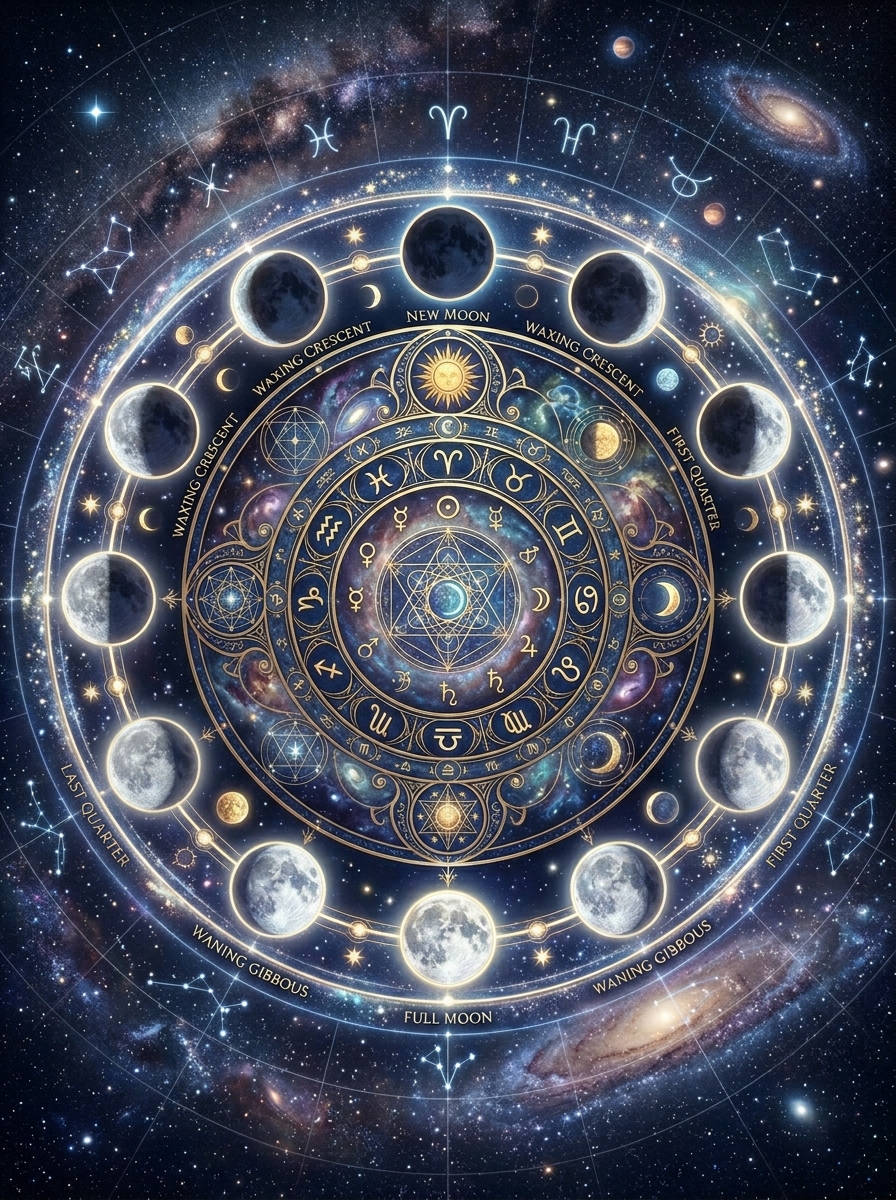
Introduction to the Lunar Cycle and Evolutionary Astrology
The human relationship with the Moon is as old as consciousness itself. Before the sun-centered solar calendars of agricultural empires regulated civil time, the shifting silver crescent of the Moon was humanity's primary clock. In modern evolutionary astrology and depth psychology, the lunar calendar is far more than a tool for tracking physical time or predicting coastal tides. It is a precise symbolic matrix, a map of the cyclic rhythm of the human psyche. The Moon, representing the unconscious, the instinctual self, and the reservoir of memory, acts as a cosmic mirror. As it waxes and wanes across the sky, it reflects the cyclical process of psychological individuation, mirroring the soul's journey through states of darkness, growth, culmination, and release.
Carl Gustav Jung observed that the celestial bodies in astrology represent the projection of the collective unconscious onto the starry sky. In this light, the Moon represents the anima—the inner feminine archetype that bridges the ego and the deep waters of the personal and collective unconscious. To track the Moon is to track the movement of the anima, observing how emotional states, somatic responses, and symbolic dreams shift in harmony with the lunar orbit. Legendary astrologer Liz Greene expanded on this, describing the Moon as the symbol of our deepest emotional needs, our ancestral inheritance, and the protective, instinctual responses we construct to feel safe in an unpredictable world.
When we observe the lunar calendar, we observe the ongoing dialogue between light and shadow. The Moon has no light of its own; it merely reflects the solar fire. Symbolically, the Sun represents the conscious ego, the heroic self-directed drive, and the waking mind, while the Moon represents the reflective, receptive, and subjective unconscious. The relationship between these two luminaries defines the lunar phases, describing a perpetual cycle of integration, conflict, and synthesis. By aligning our personal development with the lunar cycle, we transition from linear, achievement-oriented time to a deeper, spiral understanding of growth. We learn that periods of darkness are not failures of light, but essential phases of incubation and healing.
The Psychology of the Cosmic Mirror
The lunar calendar functions as a psychological diagnostic tool. In evolutionary astrology, as championed by thinkers like Steven Forrest, the Moon represents the emotional landscape, the instinctual self, and the karmic habits of the past. It describes how we react when we are startled, how we nurture ourselves and others, and what kind of environment we require to feel emotionally secure. When we track the Moon's transit through the twelve zodiac signs, we witness the shifting emotional lens of the collective psyche. A Moon transiting through Scorpio plunges the emotional body into deep, regenerative waters, demanding shadow work and emotional honesty, while a transit through Sagittarius shifts the lens toward the search for meaning, exploration, and philosophical expansion.
Understanding this cosmic mirror requires us to examine our instinctual patterns. When we ignore the cyclic nature of the Moon, we find ourselves trapped in the rigid demands of solar consciousness, which demands constant productivity, visibility, and linear progress. The lunar cycle reminds us that we are part of nature, and like the tides, we must experience periods of withdrawal and internalization. Jungian psychology emphasizes that the refusal to honor these cyclical retreats leads to the buildup of the shadow—the unacknowledged aspects of ourselves that we repress in our drive for solar perfection. Tracking the lunar calendar allows us to consciously allocate time for shadow work, emotional release, and somatic integration.
Syzygy and the Alignment of Body and Soul
At the core of the lunar cycle is the astronomical and symbolic concept of syzygy. Syzygy refers to the straight-line alignment of three celestial bodies in a gravitational system—specifically, the Sun, the Earth, and the Moon. This alignment occurs during the New Moon and the Full Moon. Astronomically, syzygy creates the maximum gravitational pull on Earth, resulting in spring tides, where the difference between high and low tide is at its peak. Symbolically, syzygy represents the alignment of the conscious ego (Sun), the somatic vehicle (Earth), and the instinctual unconscious (Moon).
During these moments of alignment, the boundary between the conscious and unconscious mind becomes porous. In the Western esoteric tradition, syzygy is associated with the coniunctio—the sacred marriage of opposites. It is a time when the masculine and feminine polarities of the psyche are brought into direct relationship. For the practitioner, syzygy represents a portal of heightened awareness. During the New Moon syzygy, the Moon stands between the Earth and the Sun, turning its dark side toward us and inviting us to plant seeds in the fertile soil of the unconscious. During the Full Moon syzygy, the Earth stands between the Sun and the Moon, allowing the full light of consciousness to illuminate the hidden recesses of the emotional body.
The Four Primary Phases of the Lunar Cycle
The cycle of the Moon is divided into four primary phases, each representing a critical transition point in both astronomy and psychological development. These phases—the New Moon, the First Quarter, the Full Moon, and the Last Quarter—mark the quadrants of the lunar cycle, establishing a rhythm of initiation, struggle, realization, and release.
graph TD
    New[New Moon: Initiation & The Seed] --> |Waxing Cycle| First[First Quarter: Action & Crisis]
    First --> |Waxing Cycle| Full[Full Moon: Culmination & Illumination]
    Full --> |Waning Cycle| Last[Last Quarter: Integration & Release]
    Last --> |Waning Cycle| New
The New Moon: Initiation, Darkness, and the Seed of the Unconscious
Astronomically, the New Moon occurs when the Moon is conjunct the Sun, occupying the same degree of the zodiac. From our perspective on Earth, the Moon is invisible, its illuminated hemisphere facing entirely away from us. This is the dark of the Moon, a time of sensory deprivation and quietude.
Psychologically, the New Moon represents the archetype of initiation and the raw potential of the unconscious. In Jungian terms, it is the starting point of the individuation process, where the ego is dissolved into the primal waters of the self. This phase corresponds to the alchemical stage of nigredo, or blackness, where the old structures are broken down to make way for new life. It is a time for quiet introspection, journaling, and setting intentions. The intentions set during a New Moon are not active demands made by the ego; rather, they are seeds planted in the fertile darkness of the unconscious, allowed to germinate in their own time.
In the evolutionary astrology of Steven Forrest, the New Moon is a time of instinctual clarity. Without the distracting light of solar consciousness, we can hear the quiet whisperings of the soul. It is a period where we must trust the dark, understanding that the lack of external visibility allows for internal restructuring. In the Western esoteric tradition, A.E. Waite associated the deep darkness of this phase with the potential energy of the Fool card in the Tarot—a state of pure readiness, unbound by the limitations of past forms, poised to take a leap into the unknown.
The First Quarter Moon: Crisis, Action, and the Solar Impulse
Approximately seven and a half days after the New Moon, the Moon reaches a position ninety degrees ahead of the Sun, forming a square aspect. Astronomically, the Moon appears half-illuminated, its light growing larger each night. This is the waxing half-moon, a period of active growth and development.
Psychologically, the First Quarter Moon represents a "crisis in action." The initial impulse or intention planted at the New Moon encounters the resistance of the material world. The square aspect is inherently tense, representing a friction between the past (the comfortable darkness of the New Moon) and the future (the demands of the emerging cycle). The ego must mobilize its solar energy to overcome obstacles, make difficult choices, and build the structures necessary to support the growing seed.
In depth psychology, this phase corresponds to the emergence of the hero archetype. The individual must step out of the protective womb of the unconscious and confront the challenges of the external environment. Liz Greene notes that during the First Quarter, we often experience external conflicts that mirror our internal doubts. If we set an intention to establish healthier boundaries during the New Moon, the First Quarter will inevitably bring situations where those boundaries are tested. This is not a sign of failure; it is the necessary friction required to build emotional muscle and psychological resilience. It is a time for decisive action, courage, and commitment to the path of growth.
The Full Moon: Culmination, Illumination, and the Archetype of the Anima
The culmination of the waxing cycle occurs fourteen to fifteen days after the New Moon, when the Moon stands directly opposite the Sun. Astronomically, the Moon is fully illuminated by the Sun's light, rising at sunset and setting at sunrise. This is the peak of the lunar cycle, a time of maximum visibility and high tide.
Psychologically, the Full Moon is the phase of realization and illumination. The light of consciousness (the Sun) shines directly onto the landscape of the unconscious (the Moon), bringing hidden desires, fears, and emotional patterns into clear view. In Jungian psychology, the Full Moon represents the peak of the coniunctio, the sacred marriage where the ego and the anima confront each other face-to-face. This confrontation often manifests as a powerful projection. We project our inner light or shadow onto external partners, experiences, or events, experiencing our internal reality as an external encounter.
The Full Moon is a time of emotional intensity and psychological integration. What was hidden in the dark of the New Moon has now grown, matured, and revealed its true nature. It is a time to celebrate what has been achieved, but also to release the illusions that have served their purpose. In the tarot system of A.E. Waite, the Moon card represents the bewilderment, psychic sensitivity, and potential distortion of this phase, warning us not to mistake the shifting shadows of the night for objective reality. It requires us to cultivate the capacity to contain emotional intensity without reacting impulsively, using the light of awareness to integrate the shadow material that has risen to the surface.
The Last Quarter Moon: Release, Integration, and the Wisdom of Hecate
Seven and a half days after the Full Moon, the Moon reaches a position ninety degrees behind the Sun, forming another square aspect. This is the waning half-moon, its light steadily diminishing as it journeys back toward the darkness of the New Moon.
Psychologically, the Last Quarter Moon represents a "crisis in consciousness." Unlike the active, external struggle of the First Quarter, this phase demands internal restructuring and the release of outdated beliefs, habits, and attachments. We must look back at the cycle's culmination and decide what is worth keeping and what must be let go. It is a time for pruning the garden of the mind, clearing away the dead wood to prepare the soil for the next cycle.
In evolutionary astrology, this phase is associated with the archetype of the Crone, or the wise elder, represented in Greek mythology by Hecate, the goddess of the crossroads. Hecate stands at the threshold between the conscious world and the underworld, holding a torch to guide the soul through transitions. Steven Forrest emphasizes that the Last Quarter requires us to develop a sense of detachment. We must learn to let go of the results of our actions, trusting that the essence of our experience has been integrated into our character. It is a time for forgiveness, internal clearing, and deep reflection, transitioning from active doing to a state of receptive being.
The Sacred Geometry of Eclipses: Portals of the Shadow
Eclipses are the most dramatic events in the lunar calendar, representing profound disruptions in the cosmic order. Astronomically, eclipses occur when the Sun, Earth, and Moon align with absolute precision during the New Moon (solar eclipse) or Full Moon (lunar eclipse) near the points where the Moon’s orbit crosses the ecliptic plane—the lunar nodes.
| Eclipse Type | Moon Phase | Astrological Meaning | Jungian Archetype |
|---|---|---|---|
| Solar Eclipse | New Moon | Ego dissolution, sudden change, external shifts | The Black Sun, Nigredo |
| Lunar Eclipse | Full Moon | Emotional breakthroughs, shadow release, relationship shifts | Confrontation with the Anima |
Solar Eclipses: The Black Sun and the Process of Nigredo
A solar eclipse occurs during a New Moon when the Moon passes directly between the Earth and the Sun, temporarily blocking the Sun's light. For a brief moment, day turns to night, and the solar disk is replaced by a black circle surrounded by a shimmering corona.
Symbolically, a solar eclipse represents the temporary death of the ego. The Sun, the source of conscious identity, vitality, and willpower, is obscured by the Moon, the force of the unconscious and the instinctual self. This creates a powerful confrontation with the personal shadow. In the alchemical work of Carl Jung, this alignment corresponds to the Sol Niger, or the Black Sun—a symbol of the primary matter, the state of depression, disorientation, and psychic darkness that must precede any true spiritual rebirth. The structures of the ego are dismantled, revealing the deeper instinctual drives that lie beneath.
In evolutionary astrology, solar eclipses are viewed as powerful destiny portals. They disrupt the linear flow of life, bringing sudden endings, unexpected beginnings, and shifts in direction. Steven Forrest notes that a solar eclipse force-starts a new chapter of development, often by removing external attachments that no longer serve the soul's evolution. It is a time of profound vulnerability, where we are called to surrender our control and trust the deeper intelligence of the self. During a solar eclipse, the veil between worlds is thin, and the intentions we plant are infused with a collective, evolutionary gravity that far exceeds a standard New Moon.
Lunar Eclipses: Confronting the Collective Anima and the Projection of Shadow
A lunar eclipse occurs during a Full Moon when the Earth passes directly between the Sun and the Moon, casting its shadow across the lunar surface. Instead of disappearing, the Moon often turns a deep, coppery red—a phenomenon known as a blood moon, caused by the bending of solar light through the Earth's atmosphere.
Symbolically, a lunar eclipse represents a profound disturbance in the emotional body and the projection of the collective shadow. The Moon, representing the emotional landscape, memory, and the anima, is obscured by the shadow of the Earth—the physical, material reality in which we dwell. This alignment forces us to confront the emotional baggage, unhealed wounds, and ancestral conditioning we have accumulated. The blood moon serves as a vivid reminder of the instinctual, wild nature of the feminine archetype, which cannot be domesticated or controlled by the solar ego.
During a lunar eclipse, the projections we place on others are shattered. The illusion of security we construct through external relationships, family dynamics, and social conditioning is put to the test. Jungian astrologer Liz Greene points out that lunar eclipses often bring relationship crises, as the shadow material we have projected onto our partners is returned to us, demanding integration. It is a highly sensitive time, where emotional reactions can run wild, and buried resentments can erupt. The task during a lunar eclipse is not to react to these emotional storms, but to stand still, observe the red light of the shadow, and allow the alchemical process of purification to take place.
The Lunar Nodal Axis: Rahu, Ketu, and the Weaver of Destiny
To fully comprehend the lunar calendar's evolutionary significance, we must examine the lunar nodes. The nodes are not physical bodies but mathematical points in space: the intersections where the Moon's orbit crosses the ecliptic (the Earth's orbital path around the Sun). This axis—consisting of the North Node (Rahu) and the South Node (Ketu)—is the weaver of destiny in the birth chart and the transiting calendar.
graph LR
    Ketu[South Node: Ketu <br/> Past Karma & Familiar Patterns] --> |Evolutionary Path| Rahu[North Node: Rahu <br/> Soul Purpose & Growth]
Ketu: The South Node and the Gravity of Past Karma
The South Node, traditionally known in Vedic astrology as Ketu or the Dragon's Tail, represents the point of ancestral inheritance, past-life conditioning, and instinctual habits. It is the place of comfort, where we possess innate talents and automatic behavioral patterns. However, it is also a place of evolutionary stagnation.
Psychologically, Ketu represents the personal and collective unconscious patterns that we fall back on when we are under stress. It is the path of least resistance, the familiar rut that feels safe but ultimately restricts our development. Liz Greene describes the South Node as the gravitational pull of the past, containing the emotional memories and defense mechanisms that we developed in childhood or carried over from ancestral lineages. While we must honor the gifts of the South Node, we cannot remain there. Over-identification with Ketu leads to regression, psychological decay, and the repetition of destructive life patterns.
In the tarot system, the South Node is associated with the archetypal energy of the Devil card—the chains of habit, materialism, and instinctual bondage that keep the soul trapped in a repetitive loop. To work with Ketu is to acknowledge its gifts while consciously refusing to let it dictate our future, releasing the karmic attachments that bind us to the past.
Rahu: The North Node and the Pull of the Evolutionary Edge
The North Node, known as Rahu or the Dragon's Head, represents the path of future growth, the soul's evolutionary purpose, and the territory we must explore to achieve integration. Unlike the comfortable South Node, the North Node represents unfamiliar, challenging, and often intimidating psychological territory.
Psychologically, Rahu represents the developmental edge. It is the archetype of the pioneer, the seeker, and the hunger for growth. When we align with the North Node, we step out of our comfort zone and embrace the qualities of the opposite zodiac sign and house. Steven Forrest describes the North Node as the compass pointing toward our highest potential. It is not an easy path; it requires conscious effort, risk, and the willingness to make mistakes. The North Node represents the qualities we need to cultivate to bring balance to our lives, integrating the unconscious gifts of the South Node with the conscious aspirations of the North.
The pull of Rahu is often experienced as an insatiable desire, an obsession, or a calling that we cannot ignore. It is the evolutionary catalyst that forces us to break free from linear time and ancestral conditioning, aligning ourselves with the path of the soul. By tracking the transits of the North and South Nodes through the zodiac signs, we can identify the collective evolutionary lessons that humanity is called to integrate over an eighteen-year cycle.
The Architecture of Orbit: Lunar Apogee, Perigee, and the Supermoon
The Moon does not orbit the Earth in a perfect circle; its path is an ellipse. This elliptical geometry creates a constant variation in the Moon's distance from the Earth, resulting in two distinct orbital extremes: perigee, when the Moon is closest to Earth, and apogee, when it is farthest away.
Perigee and the Supermoon: Amplification of the Instinctual Self
Perigee occurs when the Moon reaches its closest point to Earth in its elliptical orbit. When a Full Moon or New Moon coincides with perigee, it is popularly called a Supermoon. Astronomically, a Supermoon appears up to fourteen percent larger and thirty percent brighter than a micro-moon (a Full Moon at apogee).
The physical effects of perigee are well-documented, with increased gravitational pull creating larger tides. Symbolically and psychologically, perigee represents an amplification of the instinctual self. The barrier between the conscious mind and the physical, somatic body is reduced. We feel the lunar influence directly in our nervous systems, experiencing heightened sensitivity, vivid dreams, and intense emotional reactivity.
Jungian psychology emphasizes that during a Supermoon, the instinctual drives of the anima are brought close to the surface. It is a time when the somatic body speaks loudly, demanding attention through physical symptoms, emotional outbursts, or deep fatigue. For the practitioner, perigee is a time to ground the energy, connecting with the Earth and the physical body. It is an opportunity to perform somatic shadow work, listening to the wisdom of the body and releasing the physical tension that stores repressed emotional trauma.
Apogee: Lilith and the Solitude of the Farthest Point
Apogee occurs when the Moon is at its farthest point from Earth. Astronomically, the Moon appears smaller and dimmer, its gravitational influence on the Earth's tides at its weakest.
In the Western esoteric tradition, the point of lunar apogee is associated with the Black Moon Lilith. Lilith represents the untamable, wild feminine archetype that refuses to submit to the demands of the patriarchal ego. When the Moon is at apogee, it is in a state of solitude, detached from the immediate gravitational pull of the Earth.
Psychologically, apogee represents a state of emotional detachment, alienation, and the search for absolute sovereignty. It is a space where we feel disconnected from the comfort of family, society, and traditional emotional support systems. This distance allows us to see our emotional patterns with objective clarity, free from the subjective distortions of close proximity. However, it can also bring feelings of loneliness, rejection, and exile. The lesson of apogee is to find emotional security within the self, embracing our unique individuality and refusing to compromise our truth for the sake of social acceptance.
Synthesizing the Lunar Rhythms in Personal Practice
To work effectively with the lunar calendar, we must synthesize these astronomical and psychological principles into a structured personal practice. This practice is not about controlling the future or performing superstitious rituals; it is about cultivating a conscious relationship with the cyclical patterns of the psyche.
- Track the Daily Transit: Observe the sign the transiting Moon is occupying. Note how your emotional tone, physical energy, and dream patterns shift as the Moon moves through the elements of Fire, Earth, Air, and Water.
- Work with the Moon Phases: Align your activities with the lunar breath. Waxing Moon: build, expand, network, and take action. Waning Moon: consolidate, prune, rest, and reflect.
- Commit to Shadow Integration: Use the portals of the New Moon, Full Moon, and Eclipses to perform deep shadow work. Journal about the projections that arise, the emotional triggers you experience, and the somatic messages of the body.
- Align with the Nodal Compass: Study the placement of the transits of Rahu and Ketu in your birth chart. Identify the areas of life where you are being called to step out of your comfort zone (North Node) and release the past (South Node).
By aligning our lives with the lunar calendar, we cultivate a deep, psychological resilience. We learn to navigate the dark nights of the soul with the understanding that the light will inevitably return. We learn to contain the brilliant illumination of our achievements without losing our grounding. In doing so, we participate in the ancient, sacred dance of the Sun, Earth, and Moon, weaving the thread of our individual destiny into the rich tapestry of the cosmos.
Frequently Asked Questions
What is the psychological difference between a New Moon and a Full Moon?
The New Moon is a period of internal focus, representing the seed phase of the unconscious where the ego dissolves into darkness. It is a time for setting quiet, introspective intentions. The Full Moon is a phase of maximum illumination and projection, where the light of consciousness shines directly onto the unconscious, bringing hidden dynamics, emotions, and shadows into clear view.
How do eclipses differ from regular New and Full Moons in astrology?
Eclipses occur when the Sun, Moon, and Earth align precisely near the lunar nodes. This alignment creates a powerful evolutionary catalyst that disrupts normal life patterns. While regular Moon phases represent personal, cyclical shifts, eclipses act as major life portals, bringing sudden endings, new beginnings, and a confrontation with the personal and collective shadow that forces alignment with the soul's path.
What are Rahu and Ketu, and why are they important in the lunar calendar?
Rahu (the North Node) and Ketu (the South Node) are mathematical points where the Moon's orbit intersects the ecliptic plane. In evolutionary astrology, they represent the axis of destiny. Ketu represents past-life karma, instinctual habits, and ancestral conditioning, while Rahu represents the developmental edge, the soul's evolutionary purpose, and the unfamiliar qualities we must integrate to grow.
What is a Supermoon, and how does it affect our psychological state?
A Supermoon occurs when a Full or New Moon coincides with perigee—the Moon's closest orbital approach to Earth. Physically, this amplifies gravitational pull and tides. Psychologically, it brings the unconscious and instinctual self closer to the surface, magnifying somatic sensitivity, dreams, and emotional reactivity, making it an ideal time for grounding practices and somatic shadow work.
How does Jungian psychology relate to the phases of the Moon?
Jungian psychology views the Moon as a symbol of the anima—the inner feminine archetype that connects the conscious ego with the unconscious mind. The changing phases of the Moon mirror the process of individuation, depicting the cyclical journey of the ego as it integrates shadow material, projects its inner state onto the world, and undergoes the symbolic death and rebirth of the coniunctio.
Comments
Loading comments…