Astrological Detriment: Transforming Exile into Evolutionary Wisdom
Understanding Detriment: The Metaphor of the Sovereign vs. the Foreigner
In the study of astrological dynamics, the concept of essential dignity serves as a foundational system for evaluating how comfortably a planet can express its archetypal nature. To comprehend this system, one can employ the metaphor of land and citizenship. At the heart of essential dignity is the relationship between a planetary body and its domicile, or home sign. When a planet resides in its domicile, it operates as a sovereign ruler within its own territory. It is fully aligned with the customs of the land, understands the local laws, holds direct access to all necessary resources, and is supported by a culture that naturally values its objectives. For example, Mars in Aries functions as the unhindered warrior, direct, active, and immediate, while the Moon in Cancer is the natural nurturer, fluidly expressing emotional sensitivity.
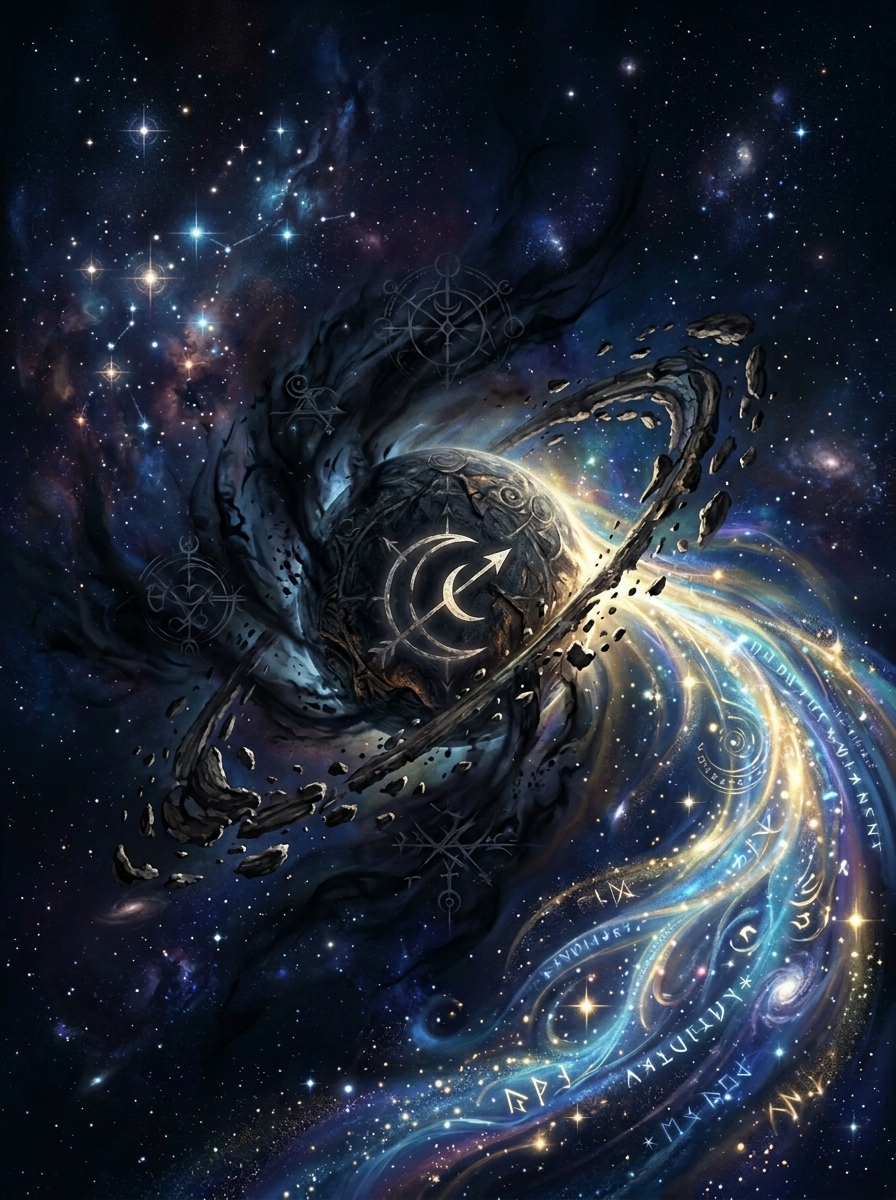
Conversely, when a planet is situated in the sign directly opposite its domicile, it is said to be in its detriment, historically termed "exile." In this state, the planet is no longer a sovereign; it is a traveler in a foreign land. It must navigate an environment whose core values, language, and behavioral expectations are entirely antithetical to its own instinctual expression. The planet's fundamental drive is forced to operate through a filter that feels uncooperative, counter-intuitive, and often hostile to its primary goals. The planet cannot rely on automatic pathways or familiar resources to achieve its ends; instead, it must learn to adapt to a foreign landscape.
The Mechanics of Essential Dignity
To understand the structural mechanics of astrological detriment, we must examine the binary polarity of the zodiac wheel. Every sign exists in a state of dynamic tension with its opposite sign. These oppositions represent complementary yet contrasting approaches to the same axis of human experience. Domicile represents the path of least resistance, where the planetary energy flows smoothly and without friction. Detriment, on the other hand, represents the path of greatest resistance. It is the celestial equivalent of trying to write with your non-dominant hand or translating a complex philosophical concept into a language you have only recently begun to study. The natural impulses of the planet are constantly interrupted and challenged by the sign's temperament.
The Historic View vs. Modern Evolutionary Astrology
Traditional, classical astrology took a relatively fatalistic and moralistic view of planets in detriment, labeling them as "weak," "damaged," or "debilitated." In these older systems, a planet in detriment was often seen as a permanent source of misfortune, indicating that the native would struggle to express the corresponding psychological function throughout their life. This interpretation generated a sense of determinism, leading individuals to view their charts with anxiety.
However, modern psychological and evolutionary astrology—informed by depth psychologists like Carl Jung and esoteric writers like Liz Greene and Steven Forrest—reframes this challenge entirely. Rather than a cosmic curse, a planet in detriment is seen as an invitation to conscious self-development. Because the planetary energy cannot express itself automatically or unconsciously, the individual is forced to pay close attention to it. While a person with a planet in domicile may express that function effortlessly and therefore remain unconscious of its inner workings, the person with a planet in detriment must navigate it with deliberate intent, eventually developing a deeply personalized, conscious, and resilient form of mastery.
The Psychological Dimension: Detriment as a Catalyst for Shadow Work and Consciousness
From the perspective of depth psychology, a planet in detriment represents a primary site for the formation of the psychological shadow. In early childhood, the natural, instinctual impulses of a planet in detriment are often met with confusion or disapproval by the immediate environment. Because the planet's drive is expressed in a manner that is alien to the dominant temperament of the sign, the child's attempts to express this energy may be judged as inappropriate, awkward, or socially unacceptable. Over time, the individual learns to suppress these impulses, pushing them down into the unconscious.
This suppression creates what Carl Jung defined as the shadow—the unintegrated parts of the self that we reject to maintain our conscious ego ideal. A planet in detriment becomes an active complex, highly sensitive and shielded by defensive psychological mechanisms. Because the ego cannot find a straightforward way to express this energy, it often projects it onto others. The individual may repeatedly encounter people who embody the raw, unintegrated expression of that planet, leading to interpersonal conflict or feelings of resentment, until they begin the conscious work of reclaiming this projected material.
Repression and the Birth of the Shadow
The psychological tension of a planet in detriment is not static; it acts as a constant, underlying friction. If a planet is in domicile, its expression is so natural that it is rarely questioned. It operates like a well-lubricated machine, requiring no maintenance and yielding little self-reflection. In contrast, the planet in detriment is like a squeaky wheel. It demands attention because it constantly encounters resistance. The native is forced to ask: "Why does this area of my life feel so complicated? Why do I struggle to express my drive, my feelings, or my mind in a simple way?" This questioning is the very beginning of psychological consciousness.
The Alchemical Process of Integration
To transform a planet in detriment from a source of conflict into an evolutionary asset, we must engage in active integration and shadow work. This requires dismantling the traditional binary of "good" and "bad" planetary placements. We must recognize that the struggle itself is the catalyst for growth. The individual must become an expert in the foreign customs of the sign, learning to translate their core planetary needs into the sign's medium.
This alchemical process refines the planetary expression. The initial awkwardness, defensiveness, and frustration associated with the detriment gradually give way to a highly sophisticated and mature integration. Because the individual has had to fight for the expression of this planet, they do not take it for granted. They develop a conscious relationship with it, learning when, how, and why to channel its energy. The foreigner in a strange land eventually becomes a skilled diplomat, capable of building bridges that a native resident could never build.
The Individual vs. The Collective: Sun in Aquarius
The Sun is the central organizing principle of the natal chart, representing the core identity, the hero's journey, the conscious ego, and the creative spirit. Its domicile is Leo, the fire sign of individual expression, personal sovereignty, and creative warmth. In Leo, the Sun is comfortable being the center of attention, expecting the environment to validate its presence and celebrate its unique identity. When the Sun is placed in Aquarius, the air sign opposite Leo, it is in its detriment. Aquarius is ruled by Saturn (the lord of structures and boundaries) and Uranus (the agent of collective reform), placing the solar urge to stand out and shine in a territory that values the group, the system, and egalitarian cooperation.
The fundamental tension for the Aquarius Sun is the conflict between the individual ego and the collective mind. The solar urge to be unique is constantly filtered through a deep-seated awareness of the social group. While a Leo Sun shines outward to express its personal drama, the Aquarius Sun is acutely conscious of how its expression affects the wider community. This creates a psychological paradox: the individual wants to express their unique identity, yet they feel a strong pressure to conform to the group or to serve a larger social cause, leading to a sense of isolation.
The Tension of the Solar Hero in the Group Mind
This tension often manifests as the archetype of the outsider or the rebel. Early in life, the Aquarius Sun individual may feel that their natural self-expression is alien to their peers. They may experience a deep fear of exclusion, which leads them to repress their personal desires in favor of collective alignment. Alternatively, they may adopt a stance of reactive rebellion, defining themselves solely by how different they are from others, which is still a form of dependency on the collective's reaction. They may intellectualize their identity, presenting a detached, rational persona while keeping their true creative fire hidden.
Reclaiming Personal Sovereignty within the Collective
Integrating the Sun in Aquarius requires a profound shift in perspective. The individual must realize that true collective contribution is impossible if the individual self is suppressed or diluted. A group composed of identical, conforming parts lacks vitality and adaptability. The Aquarius Sun must learn to embrace their unique, eccentric, and non-conformist qualities not as barriers to connection, but as their most valuable offering to the community.
When this integration is achieved, the Aquarius Sun becomes the conscious visionary. They no longer seek validation from the crowd, nor do they rebel simply to provoke. Instead, they stand firmly in their unique identity while placing their solar light at the service of human evolution. They are able to lead groups and inspire social change precisely because they have mastered the art of being both fully themselves and fully dedicated to the common good, proving that true individuality and collective responsibility are two sides of the same coin.
Emotional Resilience and Structure: Moon in Capricorn
The Moon governs the emotional body, the instinctual reactions, the subjective feelings, and our definition of comfort, safety, and nurturing. Its domicile is Cancer, the water sign of deep sensitivity, emotional fluidity, and instinctual protection. In Cancer, the Moon is free to feel, cry, and seek comfort from others without reservation. When the Moon is placed in Capricorn, the earth sign opposite Cancer, it is in its detriment. Capricorn is ruled by Saturn, the planet of structure, duty, boundaries, and pragmatism. In this placement, the receptive, watery quality of the Moon is forced to operate in a structured and demanding environment.
This positioning creates a psychological landscape where emotional vulnerability is often perceived as a weakness or a threat to survival. Individuals with this placement often grow up in environments where they are expected to be strong, self-reliant, and responsible at an early age. They may have felt that their emotional needs were a burden to their family, or that they were only valued for their achievements and utility rather than their internal feelings.
Saturn's Citadel: The Defense Mechanism of Emotional Self-Reliance
In response to these early experiences, the Capricorn Moon builds an inner fortress—a Saturnian citadel designed to protect their sensitive emotional core. Rather than expressing their feelings openly and seeking comfort, they learn to contain, compartmentalize, and intellectualize their emotions. When they feel overwhelmed, their instinct is not to reach out, but to work harder, organize their external environment, or take control of the situation. This can lead to a state of emotional isolation, where they support everyone else but refuse to allow anyone to support them.
Softening the Fortress: The Path to Maturity and Authority
The evolutionary path for the Moon in Capricorn is to transform this rigid emotional containment into true emotional resilience. This placement is not cold or unfeeling; rather, it possesses deep feelings that require a structured, safe framework to be processed. The native must learn to treat their emotional vulnerability not as a structural flaw in their fortress, but as a crucial component of their human experience.
To integrate this placement, the individual must develop self-compassion and learn to lower their defensive walls. By allowing themselves to feel their emotions without judgment and sharing their vulnerability with trusted others, they soften the Saturnian armor. When integrated, the Capricorn Moon becomes a beacon of emotional maturity. They offer a grounded, reliable, and deeply supportive presence to others, demonstrating that true strength lies not in the denial of feeling, but in the capacity to hold and guide one's emotions with patience and wisdom.
This integrated Capricorn Moon no longer fears the changing tides of emotion because they have constructed a solid inner foundation. They know how to self-soothe and how to take practical responsibility for their emotional well-being, transforming early experiences of deprivation into a rich reservoir of emotional wisdom that can hold space for the struggles of others.
The Dilemma of Scale and Detail: Mercury in Sagittarius
Mercury represents the cognitive faculties, communication styles, logical reasoning, and how we gather, organize, and transmit information. Its domiciles are Gemini (which focuses on immediate details, diverse connections, and local environment) and Virgo (which focuses on analytical precision, sorting, and systematic organization). When Mercury is placed in Sagittarius, the fire sign opposite Gemini, it is in its detriment. Sagittarius is ruled by Jupiter, the planet of expansion, belief, philosophy, and the search for ultimate truth. Here, the analytical, detail-oriented function of Mercury is placed in a territory that values the big picture and broad generalizations.
This creates a fundamental conflict of scale. Mercury wants to zoom in with a microscope to examine the small details and build a logical argument step-by-step. Sagittarius, however, wants to use a telescope to scan the horizon, looking for grand connections, overarching narratives, and philosophical meaning. When Mercury is forced to think through the lens of Sagittarius, the mind struggles with linear, logical precision. The individual is drawn to broad concepts, spiritual ideas, and grand visions, but may find it difficult to anchor these ideas in concrete facts.
The Conflict of the Microscope and the Telescope
In daily life, this tension can manifest as a struggle with communication and cognitive focus. The Mercury in Sagittarius individual may speak with great enthusiasm and conviction, but their arguments may lack evidence or logical structure. They may overlook crucial details, make promises they cannot keep, or generalize from a single experience. They may find administrative tasks, proofreading, or following detailed instructions to be tedious and exhausting, preferring instead to discuss philosophy, travel, or big ideas.
Grounding the Visionary: Practical Logic and Facts
To integrate Mercury in Sagittarius, the individual must learn to bridge the gap between Gemini details and Jupiterian vision. They must recognize that a grand philosophy is only as strong as the facts that support it, and that ignoring the details can lead to dogmatism or intellectual laziness. They must learn to slow down, verify their assumptions, and respect the steps required to manifest their ideas.
When integrated, Mercury in Sagittarius becomes the inspired communicator. They no longer ignore details; instead, they use their expansive vision to give meaning to those details, showing how small pieces of information fit into a larger, purposeful picture. They become teachers, writers, and philosophers who can articulate complex ideas with clarity, enthusiasm, and wisdom, using their intellect to inspire and expand the minds of others rather than simply presenting dry data.
By learning to value the precision of the opposite sign, Gemini, the native can ground their fiery, intuitive leaps of mind. This integration allows them to translate their vast philosophical insights into practical, everyday language, ensuring their voice carries both the weight of truth and the clarity of logical coherence.
The Infinite Dream: Mercury in Pisces
Mercury finds its second detriment in Pisces, the water sign opposite Virgo. Pisces is ruled by Neptune, governing the realms of the collective unconscious, dreams, intuition, and the dissolution of all boundaries. In this environment, the logical, analytical, and separating functions of Mercury are submerged in a vast, ocean-like consciousness. While Virgo uses Mercury to analyze, categorize, and separate things to understand them, Pisces seeks to merge, unify, and feel the underlying connection of all things.
For the individual with Mercury in Pisces, the mind does not operate in a linear, logical sequence. Instead, it processes information holistically, through images, feelings, symbols, and intuitive impressions. They do not just hear words; they feel the emotional frequency behind them. They do not just think about a problem; they dream about it, allowing the solution to emerge from the unconscious. This makes them highly creative and intuitive, but it can also make navigating a world that demands logical precision and boundaries extremely challenging.
Drowning in the Ocean of Intuitive Impressions
In its unintegrated state, Mercury in Pisces can lead to mental confusion, lack of focus, and difficulty maintaining boundaries. Because their mind is so receptive, they may absorb the thoughts, moods, and mental states of the people around them, making it difficult to distinguish their own ideas from the collective noise. They may struggle to express their thoughts in words, feeling that language is too rigid, cold, and limited to capture the fluid complexity of their inner experience. They may also be prone to escapism, daydreams, or self-delusion, choosing fantasy over difficult realities.
The Voice of the Soul: Translating the Symbolic Mind
The evolutionary task for Mercury in Pisces is to develop a conscious relationship with this intuitive, symbolic mind. The native must learn to navigate the Neptunian waters without drowning in them. This requires building mental boundaries and learning to value their intuitive insights while still practicing discrimination and grounding.
Creative practices—such as writing poetry, painting, music, or keeping a dream journal—are essential tools for integrating this placement. They allow the individual to translate the language of the unconscious into tangible forms. When integrated, Mercury in Pisces becomes the voice of the soul. They possess a profound capacity for empathy and artistic expression, communicating not just information, but deep emotional and spiritual truths that touch the hearts of others and heal the divisions created by purely analytical thinking.
This integration allows the individual to act as a bridge between the physical and metaphysical worlds. By learning to anchor their vast, non-linear insights in clear, structured communication, they can offer profound spiritual guidance, showing that the intuitive heart and the rational mind can work in harmony to understand the mysteries of existence.
Passion and Authenticity: Venus in Aries
Venus is the planet of relationship, harmony, values, attraction, and aesthetic taste. Its domiciles are Taurus (representing security, stability, and sensory comfort) and Libra (representing relational cooperation, balance, and diplomatic compromise). When Venus is placed in Aries, the fire sign opposite Libra, it is in its detriment. Aries is ruled by Mars, the planet of assertion, independence, passion, and direct action. As occultist Aleister Crowley noted, the Martian energy represents raw, unfiltered will. In this placement, the relational, peace-seeking energy of Venus is forced to operate in a territory that values the self, competition, and conflict.
This creates a dynamic tension between the urge to connect and the urge to maintain independence. Venus wants to create harmony, compromise, and build cooperative partnerships. Aries, however, wants to assert its own will, take immediate action, and win. For the individual with Venus in Aries, this manifests as a relational style that is passionate, direct, and highly focused on personal authenticity, but often prone to conflict and instability.
The Battlefield of the Heart: Autonomy vs. Connection
In relationships, this tension can lead to a cycle of intense passion and sudden conflict. The individual may equate peace with boredom, consciously or unconsciously creating drama to spark excitement and feel alive in their connections. They may struggle with impulsiveness in love, falling in love quickly and intensely, only to lose interest when the initial chase is over. They may prioritize their own immediate needs and desires over the feelings of their partner, leading to power struggles and relational distress.
Loving Fiercely: Reclaiming Courageous Intimacy
The integration of Venus in Aries requires learning that true relationship harmony does not mean the erasure of the self, nor does it require constant battle. The native must bring conscious awareness to their relational patterns, realizing that their need for excitement can be channeled into constructive, shared adventures rather than destructive conflict.
To integrate this placement, the individual must develop the capacity to advocate for their own needs while simultaneously respecting the autonomy and boundaries of their partner. They must learn to tolerate peace, recognizing that stability is not the death of passion but the foundation for it. When integrated, Venus in Aries represents a courageous and authentic approach to love. They love fiercely, honestly, and without pretense, standing up for their relationships and inspiring their partners to be their most authentic selves.
Furthermore, this integrated placement understands that vulnerability is a form of courage. Instead of treating love as a conquest or a battlefield, they use their Martian drive to fight for growth, healing, and mutual respect within the relationship, transforming their initial impulsiveness into a lifelong passion for genuine, courageous connection. Their aesthetic and artistic choices also reflect this bold, raw authenticity, rejecting polite conventions in favor of expressions that are vibrant, alive, and deeply honest.
Practical Integration: Embracing Astrological Exile as an Evolutionary Path
Working with a planet in detriment is ultimately an alchemical process of transformation. Instead of trying to force the planet to act like it is in its domicile—which will only lead to frustration, self-judgment, and failure—we must learn to honor its unique, foreign expression. The goal is not to eliminate the tension between the planet and the sign, but to hold that tension consciously until it yields its evolutionary treasure.
To integrate a planet in detriment, we can follow several practical steps. First, we must stop comparing its expression to traditional standards of success. A planet in detriment will never express itself in the smooth, socially conventional way of a planet in domicile, and it should not try to. We must give ourselves permission to express this planetary function in a non-traditional, unique, and personalized manner.
The Alchemy of the Exile: Step-by-Step Integration
Second, we must study the sign opposite the planet's placement—its domicile—to understand the energy we need to consciously integrate. For example, if Venus is in Aries (detriment), we can look to Libra (its domicile) to understand what healthy, diplomatic compromise looks like, and then find ways to express that compromise within the passionate, active framework of Aries. If the Moon is in Capricorn (detriment), we look to Cancer (its domicile) to understand what self-nurturing and vulnerability mean, integrating these qualities into our structured Capricorn routines.
By balancing the polarity, we prevent the planet from swinging between extreme repression and explosive reaction. We create a dialogue between the opposites, allowing the planet in detriment to find a healthy, integrated expression that honors both the planetary drive and the sign's environment.
Honoring the Gift of the Foreigner
By embracing the role of the foreigner, we can unlock the unique gifts of our detriment placements. Because we have had to work consciously to express these planetary functions, they often become our greatest strengths and sources of wisdom. A person who speaks their native language naturally rarely thinks about grammar or syntax; a foreigner who has had to study the language consciously understands its structure, nuances, and beauty on a much deeper level.
In the same way, the individual who has integrated a planet in detriment possesses a level of self-mastery and psychological insight that others rarely achieve. They have turned their greatest struggles into their most profound wisdom, demonstrating that the path of greatest resistance can lead to the highest form of evolutionary growth.
As we embrace these exiles within our own birth charts, we realize that they are not defects, but specialized callings. They demand that we step out of default modes of being and engage in the deliberate creation of character. Ultimately, the planet in detriment is a gift of consciousness, a cosmic prompt to move beyond easy, automatic living and enter the realm of conscious, self-directed evolution.
Frequently Asked Questions
What does it mean when a planet is in detriment?
A planet is in detriment when it is located in the zodiac sign directly opposite the sign it rules (its domicile). In this position, the planet's energy must operate in an environment that is foreign and uncooperative to its natural expression, requiring conscious awareness and integration to transform initial struggles into evolutionary wisdom.
Is a planet in detriment always bad?
No. While traditional astrology labeled detriment as a weakness or debilitation, modern psychological and evolutionary astrology views it as a powerful catalyst for growth. The challenge of a detriment forces the individual to develop a highly conscious, unique mastery of that planet's energy rather than relying on automatic, unconscious expression.
How can I integrate a planet in detriment in my chart?
Integration involves recognizing the tension, practicing shadow work, and studying the opposite sign (the planet's domicile) to find balance. Instead of forcing the planet to behave conventionally, you should honor its unique, non-traditional way of expressing its energy and balance it with the qualities of its opposite sign.
Comments
Loading comments…