Mars Conjunct Saturn: The Tempered Blade of Will
What the conjunction actually is
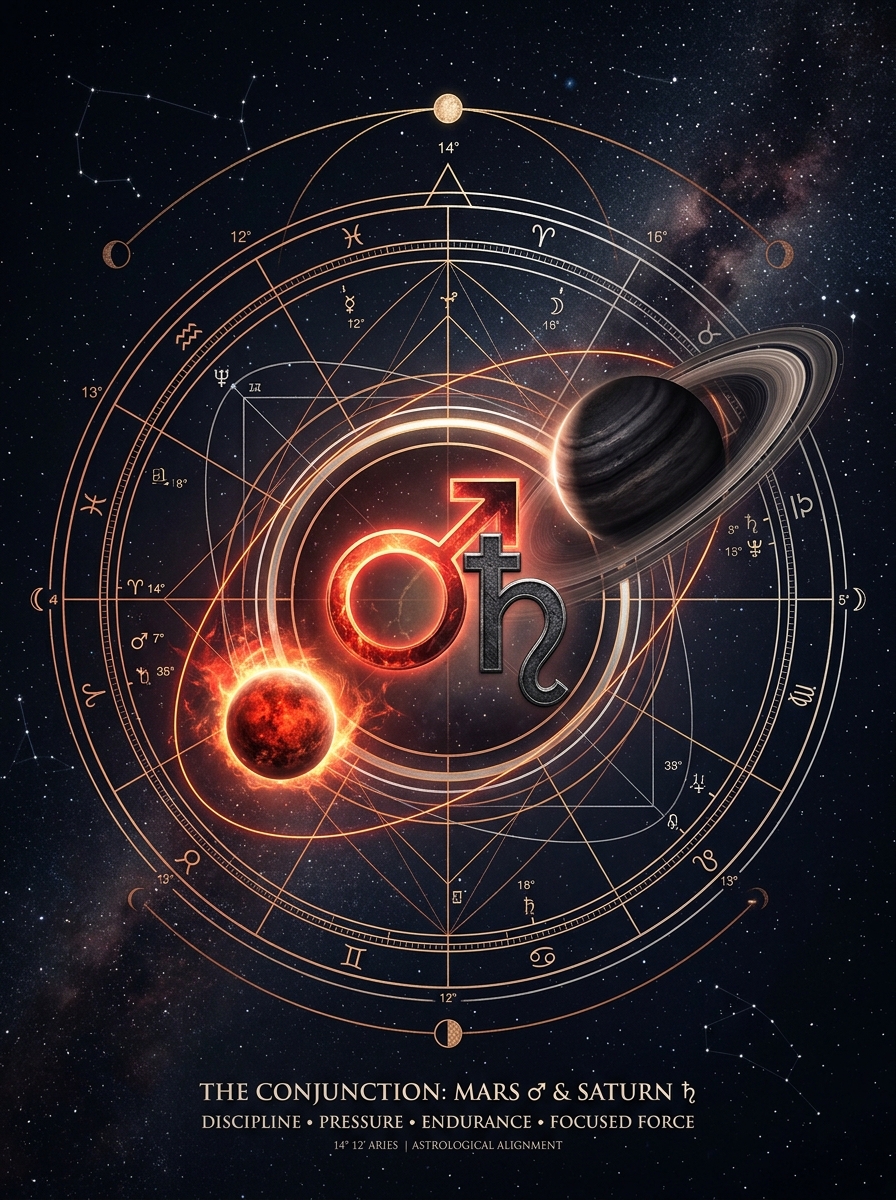
Mars conjunct Saturn does not merely combine drive with discipline. It creates a condition where desire meets an internal gatekeeper before it may move. The impulse to act does not flow; it must present credentials. Mars demands immediacy, heat, risk; Saturn answers with time, consequence, structure, and the memory of every prior failure. Between them, there is no negotiation from equal ground.
The result is a psyche that experiences wanting as something tested, delayed, or morally weighted before it earns the right to exist. That pressure can calcify into frustration or self-censorship, but it can also forge one of the most formidable signatures of endurance in the chart. The person becomes someone who does not waste action on anything that cannot survive contact with reality. This is not the pure thrust of Mars in Aries nor the tactical reserve of Mars in Capricorn, though it shares DNA with both. It is something more intimate: the fire learning the shape of the blade that contains it.
To understand this conjunction, hold two facts together. Mars acts first and thinks later; Saturn thinks in terms of survival and cost. When they occupy the same degree, the body may hesitate even when the mind is ready. The psyche imposes an invisible requirement: demonstrate competence, prepare thoroughly, endure discomfort, then act. That is not cowardice. It is a different order of will — one that knows what things cost before it buys them.
The inner architecture: how the fusion forms
The conjunction does not simply "tone down" Mars. More precisely, Saturn gives Mars a container. But a container can feel like a cage before it feels like a forge. In childhood, the person often internalizes the message that initiative leads to punishment, that wanting something creates trouble, or that anger is dangerous. Saturn becomes the inner law; Mars becomes the outlaw. The result is a chronic self-monitoring that can look like composure but feel like pressure.
The fear beneath this is not rejection. It is failure understood as a verdict on worth. The psyche behaves as if every action is a test of value, so the person may freeze at the threshold, overprepare to avoid exposure, or substitute duty for desire because duty feels safer. Anger, when it arises, rarely explodes. It goes inward first — compressing into sarcasm, numbness, or a punishing internal standard. This is why the conjunction can correlate with a powerful but complicated relationship to authority. If early training taught the person that assertion invites consequence, then Saturn becomes the guard and Mars the prisoner who schemes silently.
But the prison is not the whole story. Saturn's containment also concentrates energy. The same force that withholds can later focus. The person learns that not every delay is a verdict; some delays are preparation. The key is recognizing when the inner gatekeeper is protecting something legitimate — a genuine lack of readiness — and when it has become a reflex that no longer serves. For that discernment, it helps to understand how Mars operates when it moves through the hidden, solitary regions of the chart, as with Mars in the 12th House, or how it confronts shared power in Mars in the 8th House. These placements echo the same theme: will that must earn its visibility.
The maturation arc: from inhibition to integrity
The shadow of Mars conjunct Saturn is not repressed rage that eventually erupts. It is pressure without release — a dry, structural tension that the person may not even recognize as suffering. They carry themselves tightly, brace before acting, and confuse endurance with self-abandonment. The shadow says: you are only safe when you are working, only valuable when you are achieving, only lovable when you are useful. That is a misery that looks like strength.
The integrated form looks different. The person learns that discipline is not the opposite of desire but its vehicle. They become people who can keep going when inspiration has evaporated, when the applause has stopped, when the terrain is dull or humiliating. This is not raw courage; it is staying power. Where others are seduced by momentum, this aspect asks: will it last? Can it bear weight? That orientation makes the native excellent at managing projects, crises, and delayed gratification. They may not move quickly, but when they commit, they become nearly impossible to dislodge.
The maturation happens when the person stops treating hesitation as a defect and starts asking what it is protecting. Saturn does not grant mastery cheaply. Mars makes the person want to act now. Their conjunction teaches that real confidence is forged through repeated encounters with limitation, not before them. The same force that once said "no" to premature action can mature into a fierce inner yes that does not waste itself. That is vitality made trustworthy.
In mature form, this conjunction resembles the self-command of Saturn in Capricorn combined with the combat readiness of Mars in Scorpio. But it is more personal than either placement alone, because the conflict lives at the level of motive. The person is not merely organized; they are forged. And what emerges from the forge is not a warrior who fights everything — but one who knows which battles belong to them.
How it lives in a life
In work, this aspect produces reliability under strain. The person prefers tasks with clear standards and measurable results; ambiguity drains them because it deprives Saturn of structure and leaves Mars without a target. They rise slowly, wanting proof before claiming space, and they are often at their best when there is an obstacle to overcome and a standard to meet. The shadow is overwork — the belief that rest must be earned by pain. The gift is craftsmanship: the ability to refine, edit, repair, and persist long after others have stopped. For those whose conjunction falls in the career sphere, the dynamic echoes the earned authority of Saturn in the 10th House or the worker's discipline of Mars in the 6th House.
In relationships, the conjunction creates guardedness around desire. The person may fear being too much, too needy, or too exposed. They test loyalty through endurance, or attract partners who mirror the same themes of restraint and responsibility. Erotically, this aspect is slower than it looks. Desire needs time to trust itself. Once engaged, it can be deeply loyal and physically persistent. The challenge is not lack of feeling but inhibition around expression. The person needs relationships that can hold intensity without punishing it. Where that is absent, the result is withdrawal, control struggles, or a chilly duty that passes for intimacy.
In the body, the story becomes legible as chronic tightness — jaw clenching, shallow breathing, a tendency to run on adrenaline and restraint. Mars wants discharge; Saturn wants containment. If no conscious outlet exists, the organism improvises with tension. Physical discipline helps, but only if it is not merely another way to dominate the body. Strength training, martial arts, or structured labor can release pressure when they are used to free energy rather than accumulate it.
The apprenticeship in time
The adult expression of Mars conjunct Saturn is not endless struggle. It is the ability to act without being owned by either impulse or fear. That means learning the difference between discipline and self-punishment, between patience and paralysis, between prudence and avoidance. The aspect grows more elegant when the person stops romanticizing hardship and starts using constraint as intelligence.
A useful lens is to see this conjunction as an apprenticeship in time. Mars wants the body to move now; Saturn insists that movement mean something. Over years, the native can become astonishingly capable if they do not mistake every delay for a verdict. Many people with this aspect do their best work late enough in life to understand the value of what was once experienced as blockage. The same force that once said "not yet" can become the force that says "now, and for good reason."
That is the final paradox. What first feels like inhibition can become integrity. This is not a chart signature of denied vitality. It is the signature of vitality that has learned to survive itself. The tempered blade is not weaker for having been forged; it is sharper, harder, and less likely to break when it meets resistance.
Comments
Loading comments…