Sun Conjunct Saturn: The Crown of Weight, Duty, and Endurance
The Core Dynamic: Will Encounters Its Own Limit
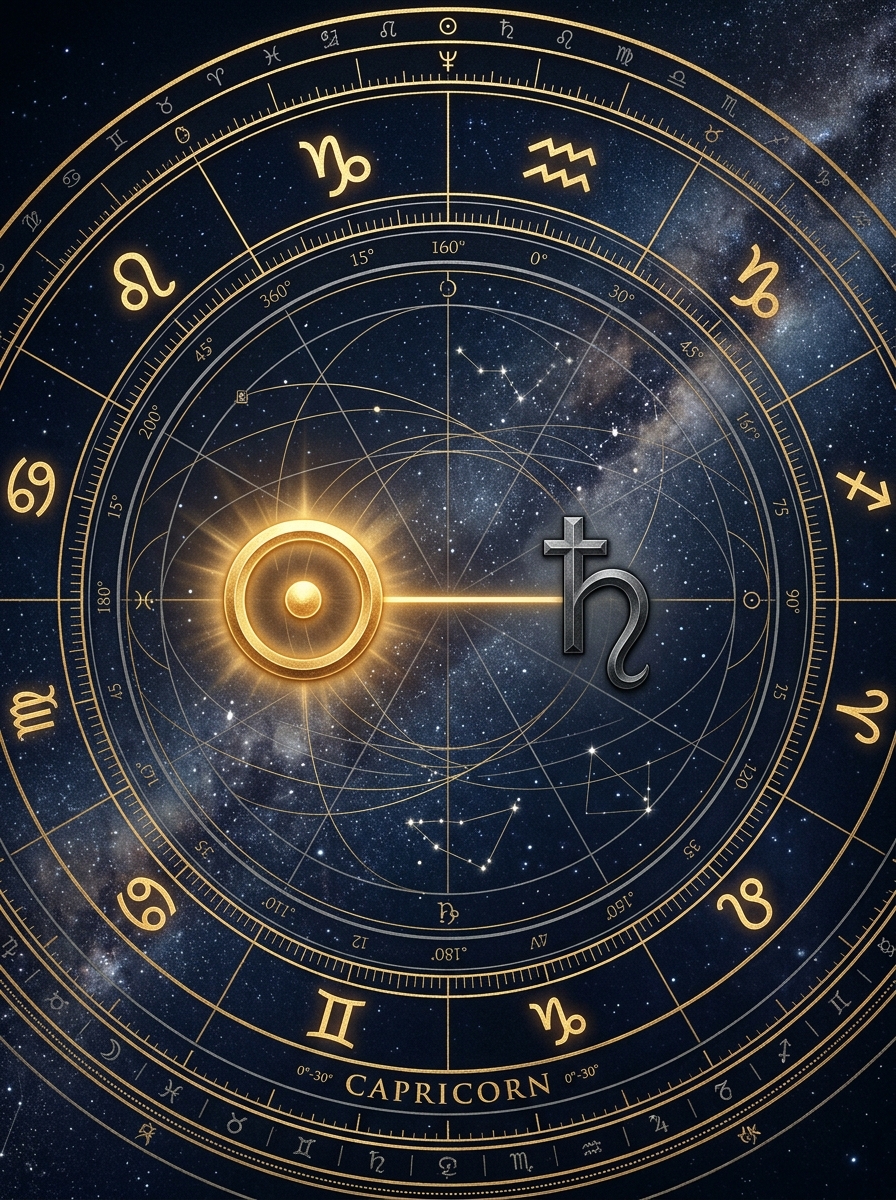
Sun conjunct Saturn is not a debate between two urges—it is a fusion. The Sun wants to radiate, to assert, to be seen; Saturn demands containment, measurement, and proof. In conjunction these drives occupy the same psychic space. The result is a personality that experiences identity itself as a responsibility, not a given. These people rarely feel entitled to shine; they must earn the right to take up space.
This is not a “difficult” aspect in the way a square or opposition is. Those create visible tension between planets in different houses or signs. A conjunction is intimate: the Sun and Saturn co-author the same sentence. The native may not experience self-doubt as an occasional visitor but as the architecture of the psyche. Before speaking, creating, or loving, they often ask: Is this worthy? Have I done enough? That internal question can be a forge for excellence or a cage, depending on how the person learns to distinguish a standard that refines from a standard that shames.
The aspect compresses the solar urge to become into Saturnian time. Early bloomers are rare; what ripens tends to last. Readers who want the larger symbolic frame for Saturn itself can see Saturn in astrology, but here Saturn is not an abstract teacher—it is stitched into the fabric of identity.
How It Forms: The Architecture of the Self
The psychological roots of Sun conjunct Saturn lie in early encounters with structure, criticism, or premature responsibility. The chart often shows a childhood where authority felt like pressure rather than support—a parent who demanded performance, a family situation that required the child to become a small adult, or an environment where love seemed conditional on achievement. The native internalized the message that they must be useful to be allowed to exist.
This produces a powerful inner editor. Before they act, they imagine consequences. They can be acutely aware of failure, embarrassment, or inadequacy, often before there is evidence. Many carry a strong memory of early evaluation—a grade, a critique, a comparison—that still echoes. The body often reflects the tension: tight jaw, raised shoulders, a spine that braces against the world. The person may carry themselves carefully, conserving energy as if visibility itself is risky. Saturn in the first house explores a related theme of embodied self-definition, but the conjunction is more fused—the self is the structure.
The inner judge can be mistaken for conscience. It is not always conscience. Sometimes it is fear wearing a moral costume. The native may say, “I should be more accomplished by now,” when what is really happening is an unrealistic measure of worth. They may confuse delay with failure, humility with self-erasure. Yet the judge is not purely pathological. In its best form, it gives a monastic relationship to excellence—a refusal to cheapen one’s own gifts. The work of this aspect is to separate the standard that refines from the one that shames.
The Long Forge: Maturation vs. Shadow
The mature expression of Sun conjunct Saturn is authority that does not need to announce itself. These people become load-bearing beams in their communities—steady, reliable, and quietly formidable. They do not panic when consequences arrive. They have learned, through repetition, that they can survive discomfort, that their judgment improves with experience, and that they are not as fragile as they once believed. This is a profoundly Saturnian kind of self-esteem: not bright and spontaneous, but durable. Confidence accumulates like compound interest.
In work, they often gravitate toward fields where mistakes matter—medicine, law, engineering, craft, public service, scholarship, or any domain that rewards competence over charisma. They may struggle early, then become formidable later. Their leadership is based on trust, not charm. When they speak from lived experience, others listen. If the chart also emphasizes Saturn in the 10th house, career authority can become a central pillar of identity, a reputation earned through years of integrity.
Yet the shadow is real. When the Sun feels overmanaged by Saturn, the life-force itself seems licensed only under conditions of performance. The person may overwork, underplay their talents, become allergic to celebration. They can attract authority figures—bosses, partners, institutions—who mirror the internal critic. The unconscious bargain: If I am useful enough, correct enough, I will be allowed to exist without criticism. That bargain rarely delivers what it promises. The result can be exhaustion, resentment, or a private sense of barrenness behind a composed facade.
The remedy is not to reject Saturn. It is to rehabilitate the Sun—to give it permission to shine imperfectly. This requires ritual, play, creative permission, and the simple experience of being seen without being graded. Saturn in the 5th house shows how joy itself can become a disciplined art, a structure that liberates rather than confines.
How It Lives in Relationships, Work, and Time
Because the native’s identity is bound to Saturn, every domain of life is filtered through the same lens—but the lens itself does not change. The dynamic is single. So we can describe its expression across domains without re-explaining the core.
In relationships: Trust is slow and deliberate. The native does not hand over affection easily; they need to believe that love will not turn punitive. Once committed, they are exceptionally steady—less interested in romance as spectacle than in love as a structure that holds. This aspect has affinities with Saturn in the 7th house, where commitment becomes a serious test of mutual respect rather than a romantic abstraction. The danger is confusing loyalty with self-abandonment, staying in bonds that drain.
In work: The native respects competence more than charisma. They often do best in environments that reward follow-through and penalize shortcuts. They may avoid self-promotion, yet become the person everyone turns to when pressure rises. Their career arc tends to favor delayed but lasting achievement. If Saturn also connects to the 6th house or Capricorn, they may build a reputation as the person who can be trusted with the long game.
In timing: Early life often feels restricted. The person may appear older than peers but less free. They absorb responsibility young, and that weight can feel unfair. But the same traits become assets in the second half of life. They age well psychologically because they were forced to meet time honestly. The Saturn return is often a turning point where the structure they built either crystallizes or collapses—and they rebuild, wiser.
The life lesson of Sun conjunct Saturn is not “be more disciplined.” It is far subtler: learn to let the Sun exist inside Saturn without mistaking structure for condemnation. The mature version of this conjunction is not a hardened person. It is a person who can be realistic without becoming bleak, responsible without becoming self-punishing, and ambitious without needing to prove worth through suffering.
The same force that once made the person feel blocked becomes the shape of their authority. What first felt like a sentence becomes a signature. The life does not merely overcome gravity—it learns to stand in it.
Comments
Loading comments…