Mars Opposition Saturn: The Friction That Builds a Life
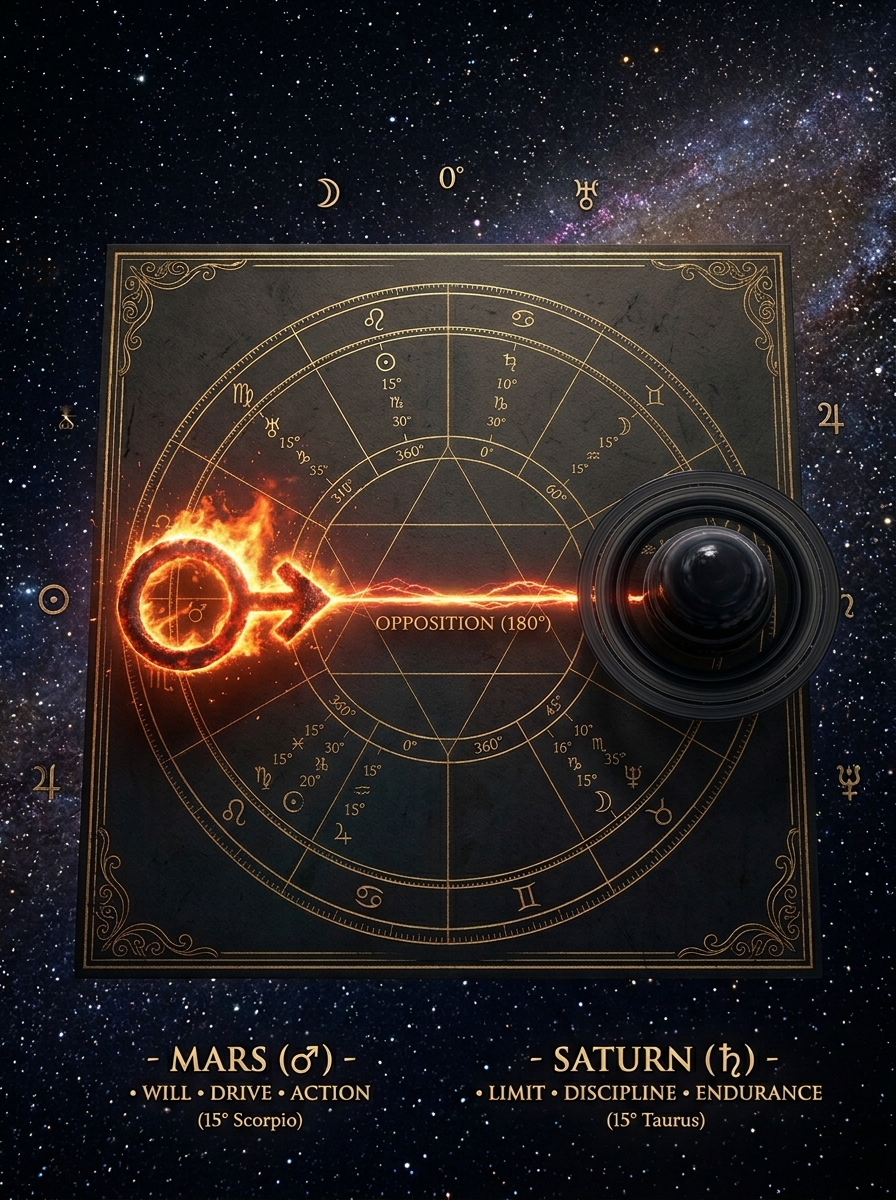
The Core Tension: Will Meets Its Gatekeeper
Mars opposition Saturn is the aspect of force encountering refusal. One side wants to act now—strike, pursue, assert—while the other measures cost, demands proof, or withholds permission until conditions are safer or more legitimate. The core meaning is simple and severe: will is not absent, but it is edited by fear, duty, time, and consequence. This is the inner warrior who keeps meeting the inner magistrate.
Because an opposition is a tension across a line of awareness, the psyche tends to project one planet outward. You may experience Mars as “my impatience, my anger, my hunger,” while Saturn appears as other people’s rules, criticism, delay, bureaucracy, or coldness. Yet the real drama is internal. The more one pole is disowned, the more life recruits it through circumstance. For a broader frame on the geometry itself, the astrological opposition is never just conflict—it is a mirror that insists on consciousness.
The lived sensation is frustration with timing. You start, then stop. You commit, then second-guess. You want to act, but something in you asks whether you are qualified, allowed, prepared, or safe. The result can look like hesitation, inhibition, or delayed momentum, but that is only the surface. Underneath, Saturn is trying to shape Mars into something that survives contact with reality. This can create a person who knows the weight of action before they know its pleasure.
A specific emotional flavor appears: anger that arrives late—not because you lack feeling, but because feeling has been rationed. By the time Mars breaks through, it may come out as compression, resentment, or an explosion that surprises even you. The gift, if developed, is astonishing staying power. Few aspects can endure as long as this one once its energy is consciously organized. For the larger symbolic language of Mars itself, see Mars in astrology.
The Inner Architecture: How This Dynamic Forms
The mistake is to think of this aspect as “bad luck” or simple self-sabotage. Two principles with incompatible tempos are welded together. Mars is impulsive, initiatory, heat-seeking. Saturn is compressive, structural, consequence-oriented. When they oppose each other in the natal chart, the psyche must learn to generate motion without reckless leakage, and discipline without deadness.
The most common psychic wound is the sense that action must first earn permission. People with this aspect may grow up feeling that initiative draws punishment, that wanting too much is dangerous, or that anger is unacceptable unless it has already become justified by failure. Sometimes the message came from authority figures; sometimes it was absorbed from the household atmosphere. Either way, the body learns to hesitate.
This can show up as chronic self-editing, fear of starting, or an exhausting habit of rehearsing before acting. It can also produce a perfectionistic delay loop: if the work cannot be done impeccably, it must not be done yet. That pattern looks responsible from the outside but internally conceals a frightened Mars and an overburdened Saturn. The cure is not encouragement alone; it is the gradual building of trust that action can be imperfect and still lawful.
Mars retrograde in the natal chart often deepens this dynamic, as the drive turns inward and struggles to find direct release. When the opposition involves a retrograde Mars, the tension between will and restraint becomes even more internalized, demanding a conscious reclamation of desire.
The Two Paths: Inhibition Versus Authority
The mistake is to treat the opposition as a problem to solve. It is not a defect; it is a forge. At its best, Mars opposition Saturn produces executive force: endurance, strategic patience, toughness under pressure, and a realistic relationship to effort. These people often become formidable precisely because they cannot rely on blind enthusiasm. They learn how much force is enough. They learn timing, pacing, and the difference between a gesture and a commitment. Where others burn brightly and vanish, this aspect can build a bridge, a business, a body of work, a reputation, a marriage that survives weather.
This is especially visible when the native stops asking either planet to “win.” Mars is not there to demolish structure, and Saturn is not there to kill desire. The real task is to make desire accountable and responsibility alive. In mythic terms, this is the forging of a blade: the metal is not made softer by fire, but stronger. When this aspect matures, action becomes deliberate rather than frantic, and restraint becomes intelligent rather than punitive.
The unresolved version is a life organized around fear of failure: too much waiting, too much self-surveillance, too much fatigue. The integrated version knows that Mars needs a worthy wall to push against, and Saturn needs a living will to organize. Neither planet is the enemy. The enemy is their estrangement.
That is the deep promise here: not freedom from constraint, but the discovery that constraint can shape power instead of denying it. This opposition is one of astrology’s great apprenticeship aspects. It does not give the native an easy path—it gives them a serious one. And when lived consciously, seriousness becomes strength, not burden.
Where the Friction Manifests: Work, Body, and Relationship
The life themes of Mars opposition Saturn become unmistakable when you watch where pressure accumulates. This aspect tends to create arenas where effort feels costly, where progress arrives by attrition rather than luck. It is not soft, yet it is often the aspect of people who do difficult things well because difficulty is not new to them.
In work and ambition
In career life, the pattern can be a battle with authority, deadlines, or the fear of being exposed as insufficient. Sometimes the person works under harsh bosses, rigid systems, or environments that demand more than they give. At other times, the “boss” is internal: a severe standard that makes every accomplishment feel late, small, or provisional. Yet this is also the aspect of someone who can carry real responsibility. The same force that makes initiation hard can make follow-through exceptional. When the opposition involves the 10th house, the negotiation with public authority becomes central—see Mars in the 10th house and Saturn in the 10th house for how drive and limitation play out in status and legacy.
In anger, conflict, and the body
This aspect often stores anger in the musculature, jaw, back, or breath. The person may not look volatile, but the body is braced. When anger is chronically inhibited, it becomes density: tightness, chronic overcontrol, fatigue, or the strange exhaustion of always being ready for resistance. When Mars finally erupts, it may do so through accidents, injuries, inflammatory flare-ups, or situations that force confrontation after too much delay.
The body becomes the battlefield where the argument between wanting and withholding is enacted. Learning to discharge tension earlier, more cleanly, and less catastrophically is part of the medicine. This is not about “getting angry more”; it is about allowing pressure to become information before it becomes damage. For those with Mars in the 12th house opposite Saturn, the struggle goes underground, and anger hides in dreams or unconscious patterns—see Mars in the 12th house.
In intimacy and closeness
In relationships, the opposition can create a pattern of wanting connection but fearing dependence, or wanting desire but mistrusting its consequences. Mars seeks contact; Saturn seeks boundaries. Together they can produce a person who tests love through endurance, restraint, loyalty, or silence. There may be a delay before trust is granted, or a reflex to expect criticism where passion is offered. Sometimes one partner embodies the Saturn function too rigidly, while the other is assigned the Mars role of “the difficult one.”
The relationship may seem contained, yet beneath the surface there is longing, defensiveness, and a need to know whether love can tolerate resistance. When the opposition lands in the 7th house, the dynamic becomes overt in partnerships—Mars in the 7th house and Saturn in the 7th house illuminate how the tension between assertion and commitment plays out in one-on-one bonds.
The shape the struggle takes: sign and house context
The exact expression of Mars opposition Saturn depends on the signs and houses involved. The aspect supplies the tension; the placement supplies the costume. With fire signs, the conflict often centers on courage and the fear of acting too soon. With earth signs, the question becomes labor, efficiency, and material endurance. Air placements can turn the opposition into argument or mental overprocessing. Water signs tend to internalize the struggle, making desire and inhibition feel entwined with memory or emotional protectiveness.
For example, Mars in Aries opposite Saturn in Libra dramatizes the pull between raw self-assertion and relational fairness. Mars in Capricorn opposite Saturn in Cancer makes ambition inseparable from family loyalty, duty, or emotional defensiveness. The houses tell you where the opposition is repeatedly staged: in the 4th and 10th, home versus ambition; in the 5th and 11th, creative self-expression clashes with social duty; in the 8th and 12th, the struggle becomes subterranean—control, fear, surrender, grief. The exact field matters because Saturn does not merely say “no”; it says, “Here is the arena where maturity must be forged.”
Comments
Loading comments…