Mars Trine Saturn: The Art of Force That Knows Its Shape
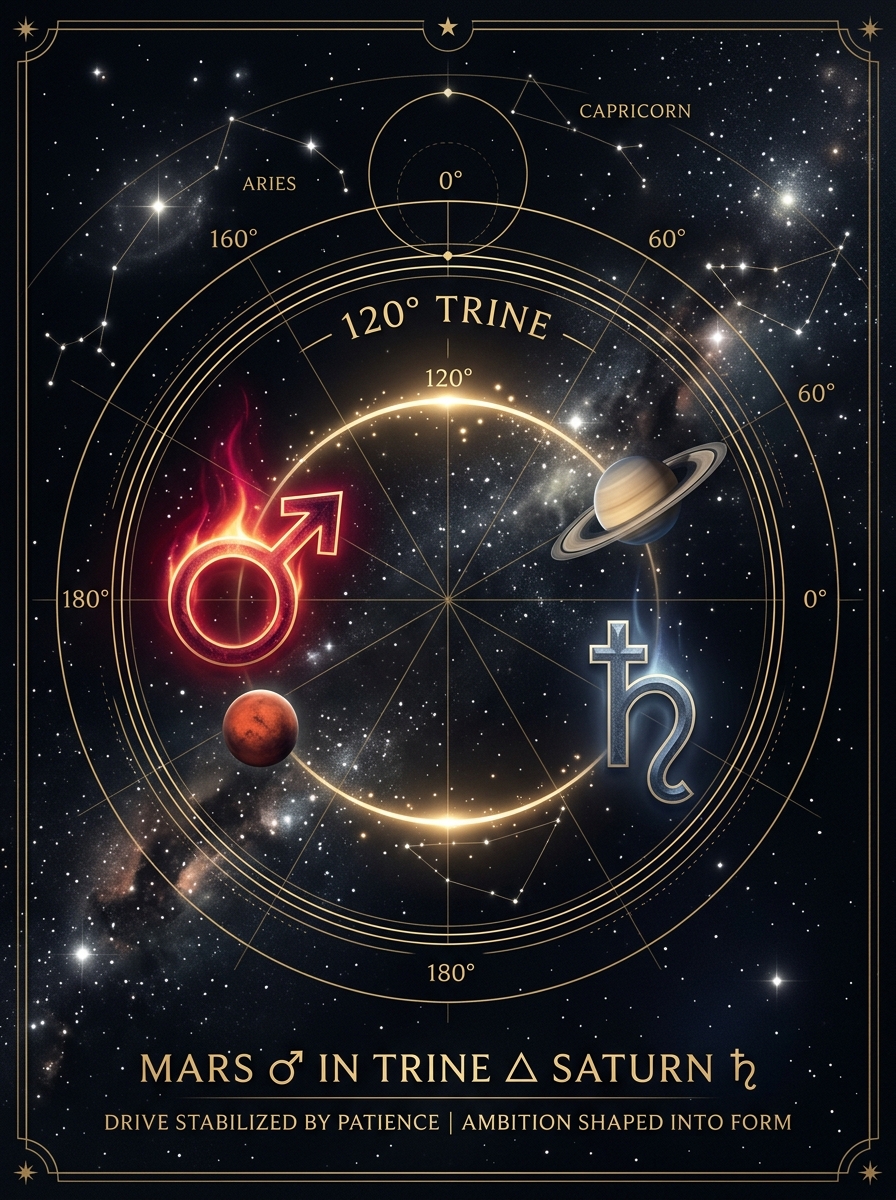
In a natal chart, Mars trine Saturn is the cleanest signature of usable force: desire that has found its container. Mars supplies heat, initiative, the urge to act; Saturn brings timing, structure, the instinct for consequence. In trine, they do not merely tolerate each other—they recognize a shared language. The result is not flashy power but reliable power: the kind that can carry a project from impulse to architecture, from intention to result.
Unlike hard Mars-Saturn contacts, where drive feels blocked or shamed, the trine offers cooperation. The inner warrior has a supervisor, and the supervisor is not a tyrant. But every trine carries its own subtle inertia: when energies flow too easily, the psyche may assume they will always flow. That assumption is the aspect’s hidden trap. Understanding why requires a closer look at the geometry itself—the trine aspect is a structure of fluid talent rather than passive luck, a gift that can become a script if never questioned.
The Inner Architecture: Willpower Without Melodrama
The core psychological pattern of Mars trine Saturn is a temperament that does not need to prove itself through noise. Mars here is not a berserker; Saturn does not freeze the action. Together they favor proportion, patience, and a stoic relationship to effort. These natives often work best when they can define a standard, then meet it repeatedly. They may not be the fastest in the room, but they are frequently the ones still standing after everyone else has burned out.
The inward experience is often: “I can bear this.” That sentence is the private muscle of the aspect. Saturn confers stamina; Mars supplies the willingness to meet resistance. Together they make a personality unrattled by delay, discipline, or the long haul. When healthy, life feels buildable.
The Shadow of Competence as Camouflage
Because the aspect works so smoothly, it can hide its own needs. A person may become identified with being capable, controlled, and uncomplaining, then quietly starve the impulsive, erotic, or angry parts of the self. Mars trine Saturn can produce a very adult surface that conceals a younger hunger underneath. If that hunger is never named, it may leak out as chronic tension, dryness, perfectionism, or a habit of only acting when success is practically guaranteed. The psyche mistakes caution for wisdom.
There is another shadow too: overidentification with endurance. A native may keep carrying what should be put down. Since the aspect supports patience, it can normalize overextension. The lesson is not to throw discipline away, but to distinguish between mature persistence and habit-bound obligation. When the trine becomes a script—I am the one who holds everything together—the warrior becomes a prisoner of his own reliability.
How It Matures and Where It Stumbles
Mars trine Saturn tends to ripen over time. Early life may be defined by learning restraint; adulthood reveals the aspect’s true eloquence: durable skill, earned confidence, and a low tolerance for empty motion. Many of these natives improve with age because they are not trying to win the first moment—they are trying to master the whole game.
Yet a trine is not a guarantee of emotional ease. Because Saturn moderates Mars, anger may be delayed, compressed, or converted into efficiency. The native might not explode, but they may hold. That holding can become a problem if it turns into silent resentment or an unconscious belief that feeling anger is immature. Mars needs directness; Saturn needs integrity. When both are respected, anger becomes boundary-setting. When distorted, anger becomes a tax on the body.
The most common friction is that the person becomes so identified with self-control that spontaneity feels suspect. The instinctive life then has to petition the executive before it can move. This is not always obvious from the outside; the native may look adventurous while privately calculating every risk. The antidote is not chaos for its own sake. It is conscious permission to act before certainty is complete, to make room for experiments, to let desire be a little ugly sometimes. Mars trine Saturn does best when its structure serves life rather than replacing it.
The Physical Signature
This aspect often shows up somatically. Mars rules muscle tone and immediate response; Saturn governs compression and conservation. Together they can create physical self-command: disciplined training, efficient movement, a serious relationship to practice. Many natives are not dramatic about fitness or skill-building; they simply do it until the body obeys. The same applies to mental habits—slow to commit, but once committed, hard to dislodge. There is a non-neurotic seriousness here: not gloom, but seriousness as a functional virtue. For a deeper look at the warrior principle in the chart, see the full portrait of Mars in astrology.
The Concrete Expression: Love, Work, and the Line Between
Because the trine defines a stable relationship between planets, its expression in life follows the same curve: effort shaped by patience. That curve shows up entirely differently depending on the domain, but the underlying dynamic does not need to be re-explained for each area. Instead, we can look at how Mars trine Saturn inflects the major theaters of life without re-deriving the core.
In Career and Public Work
The gift of this aspect is practical timing. Mars wants movement; Saturn wants form. That combination often produces a builder’s instinct: an eye for sequence, systems, and standards. It can show up in carpentry, surgery, law, athletics, management, engineering, writing—any field where controlled force matters more than spectacle. The person may not love chaos, but can be astonishingly effective when chaos appears. When the aspect connects to the 10th house or its ruler, ambition becomes visibly vocational. A native with Mars in the 10th House or Saturn in the 10th House channeled through a trine rarely needs theatrics to prove drive; they demonstrate it through results.
In Relationships
In love, Mars trine Saturn offers constancy, patience, and follow-through. The native does not chase drama; they build trust slowly and protect what they have built. This can look like loyalty that is almost boring to the thrill-seeking partner, but it is the kind of loyalty that survives crises. If the chart also emphasizes commitment themes, Saturn in the 7th House illuminates how responsibility becomes a relational ethic rather than a burden. The shadow here is emotional withholding—the partner may feel the person is always in control, never letting spontaneity breathe. The trine can be so smooth that the native forgets to show the messy parts of desire.
In Physical and Creative Expression
The body learns what the mind decides. A Mars trine Saturn native may have a serious relationship to craft, whether that is a sport, an instrument, or a physical trade. They are not flashy; they are precise. The aspect ages well because the body adapts to discipline without breaking down. In creative work, the person may be slow to start but relentless once they find form. The discipline of the trine can be seen in the patient revisions of a writer, the repeated practice of a musician, the methodical training of an athlete. It is force that has learned the shape of consequence.
The Matured Warrior: Force That Knows Its Shape
At its best, Mars trine Saturn produces a person who does not waste force. That phrase is the essence of the aspect. Mars supplies the courage to engage; Saturn supplies the wisdom to aim, pace, and persist. The person becomes a kind of artisan of will: not merely energetic, but exacting about where energy goes. This is the signature of someone who can make something real out of effort, and then keep protecting it once built.
The mature version of this aspect is not rigid. It is calibrated. It knows when to press and when to wait, when to fight and when to conserve. In a culture that often worships speed or dramatizes burnout, Mars trine Saturn offers another model: force with memory, discipline with blood in it, action that has learned the shape of consequence. That is why the aspect can age beautifully. It does not just win tasks; it becomes character.
When the native trusts that their own desire is worthy of structure, the trine fulfills its promise. The warrior is no longer improvising against the world. The warrior is building a life—one deliberate, enduring step at a time.
Comments
Loading comments…