Mars Sextile Saturn: The Warrior Who Can Wait
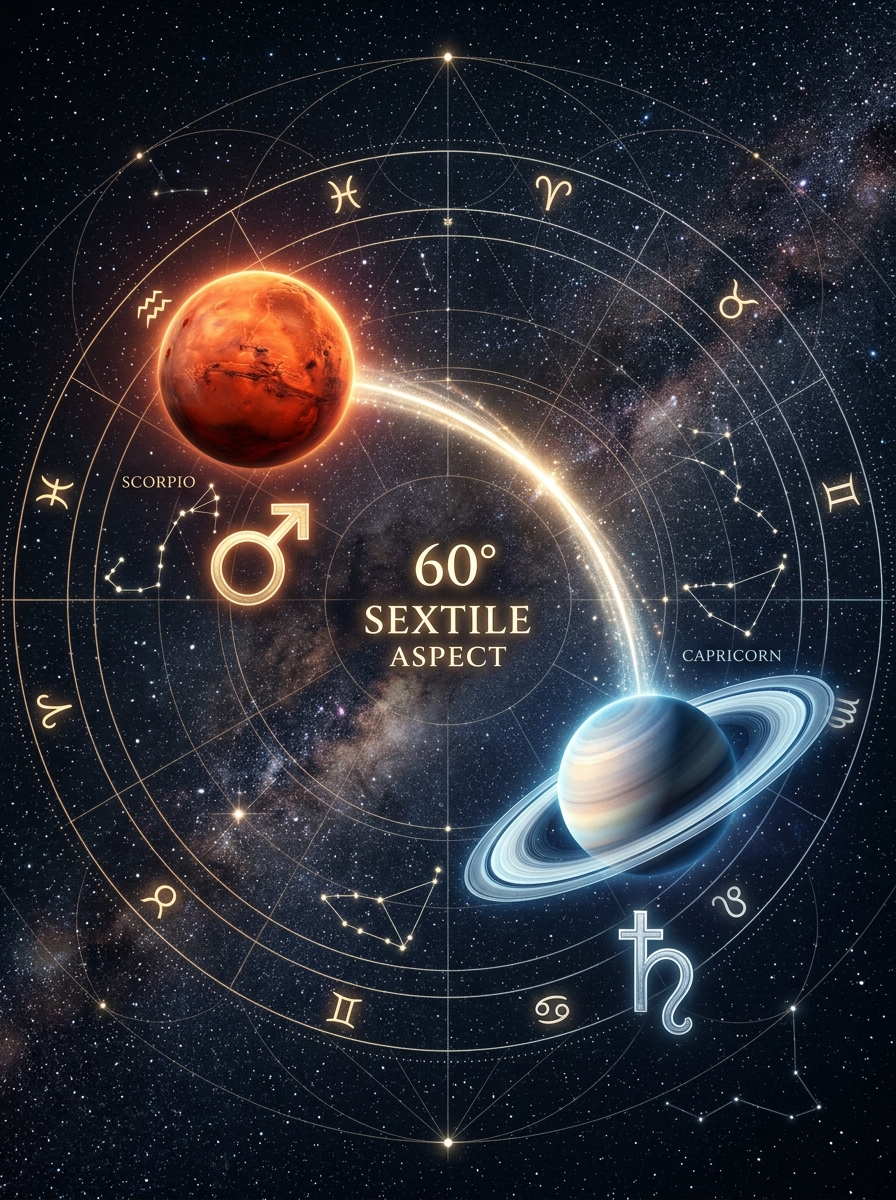
The Architecture of Deliberate Force
Mars sextile Saturn is not a truce between impulse and caution; it is impulse educated by structure. In the natal chart, this 60° bond allows the two planets to cooperate without producing the brittle split that appears in square or opposition. Mars wants to move; Saturn wants to make movement count. The sextile builds a temperament that understands delay, sequence, and consequence as natural components of effective action — not as obstacles to it.
The core thesis is disciplined efficacy. This is not a signature of raw speed; it is a signature of stamina, containment, and tactical will. Where Mars alone can scatter energy and Saturn alone can stall it, the sextile shapes action by endurance and purpose. The psyche learns that restraint is not refusal, and ambition is not chaos. People with this aspect often become the ones others count on when conditions are difficult — not because they move fastest, but because their timing is better and their tools are sharper. For the broader geometry of opportunity that makes this possible, the astrological sextile provides the essential backdrop: an active, opportunity-bearing bond that rewards deliberate use.
How the Internal Alliance Works
At the psychological level, Mars carries the raw sensation of wanting — hunger, anger, libido, initiative — while Saturn supplies the bone structure around that wanting: inhibition, discernment, responsibility, time. In a sextile, these principles remain distinct enough to be useful. The person can feel urgency without becoming reckless and can accept limits without collapsing into passivity.
Timing, Not Repression
The most important distinction here is between Saturn as repression and Saturn as timing. With this aspect, the nervous system often learns to delay gratification without feeling deprived by it. That is rare. It means the person can tolerate apprenticeship, repetition, and incremental progress. They can keep a goal in view while moving through inconvenience. In practical life, this is the aspect of someone who builds a career, repairs a relationship, or trains a body over years rather than weeks.
This does not mean the person is always patient; it means patience becomes strategic rather than moralized. Irritation tends to be metabolized into planning or endurance. When well expressed, it resembles the Mars in Capricorn principle — action organized by realism and a long horizon — without requiring that sign placement. The Saturn side may echo Saturn in Capricorn in its gravitation toward competence, yet the sextile keeps the atmosphere less austere and more mobile. A related subtle integration — the semi-sextile — speaks to even finer adjustments, but this 60° bond is overtly functional: it asks to be used.
The Dignity of Controlled Force
There is something quietly honorable about this configuration. Mars wants to prove itself; Saturn wants to deserve what it builds. Together, they create a person who often respects earned authority more than charisma. Shortcuts, empty confidence, and theatrical rebellion feel hollow. The best work comes from compression: a lot of energy concentrated into a disciplined shape.
That can show up as remarkable physical control — but it is not limited to the body. It can be verbal: choosing the right moment, saying less but meaning more, refusing to leak power through complaint. This habit of conserved force is why the aspect often appears in charts of people who seem less dramatic than their peers but are more durable. They may not launch first, yet they arrive with better timing.
The Shadow of Self-Control
The danger in Mars sextile Saturn is not chaos; it is overcontrol. The same discipline that makes the person effective can harden into self-surveillance, emotional compression, or an unconscious belief that only what is difficult is worthy. A life organized too tightly around duty can forget how to play. A person can become admirable in quietly expensive ways.
The shadow often takes the form of delayed action that has become habitual rather than strategic. The person may keep preparing long after preparation has stopped being useful. They feel they need to be “ready” before they begin — a Saturnian disguise for Mars anxiety. In some cases, anger is so well contained that it never fully registers as anger; it appears instead as fatigue, stiffness, cynicism, or moral superiority. This can generate a life of competence without joy, especially if other chart factors reinforce seriousness — as Saturn in the 5th House intensifies the question of whether one is allowed to enjoy creation at all.
Growth with this aspect requires chosen friction. Not reckless upheaval, but conditions that prevent perfectionism from becoming paralysis. The person benefits from projects with real deadlines, real stakes, and imperfect outcomes. They need to discover that effectiveness does not require emotional numbness.
Where It Shows Up in Life
Because the core dynamic is conserved, strategic force, its life expression is concrete before it is dramatic. This section applies the already established dynamic to three domains — work, conflict, and intimacy — without re-deriving it.
Work and Mastery
This aspect excels at craft. It favors people who can tolerate beginnerhood long enough to become competent. They may start self-conscious or wary of failure, but they improve through repetition rather than inspiration. The confidence that emerges is sober, not inflated; it comes from evidence. In the best cases, the person becomes a builder of systems — not just a performer inside them. They understand what sustains effort over time: routines, boundaries, checkpoints, realistic standards. This makes them especially strong in fields where errors are costly, because they are less likely to rush past details in the name of momentum. For a house-specific look at where that operational drive might land, compare the tone of Mars in the 6th House with that of Saturn in the 10th House; the sextile between them often behaves like a bridge.
Conflict Without Combustion
Anger, under this sextile, is more controlled than explosive. The person may not be confrontational by nature, yet when they do oppose something, the resistance can be formidable precisely because it is measured. They may not shout; they simply hold the line. This makes them excellent in negotiations, management, and any situation where firmness needs to coexist with restraint. At their best, they do not confuse aggression with power. A well-placed boundary can accomplish what a burst of force cannot. To see a more direct and visible Mars expression, consider Mars in the 1st House; the sextile is more strategic, less immediate, and often more effective over time.
Desire That Survives Reality
In intimacy, this aspect makes desire more dependable than volatile. It may not be the most improvisational signature, but it is often among the most loyal. The person can be serious about commitment without becoming sexless, and sensual without becoming careless. There can be a preference for trust earned through experience rather than instant chemistry. That quality stabilizes relationships, though it can also make the person cautious about letting desire disrupt order. For a comparison of how martial energy behaves when filtered through relationship itself, Mars in the 7th House offers a useful reference; there the battlefield is interpersonal by definition. In the sextile, the person may not seek conflict with the partner, but they often bring a strong sense of reliability to shared effort.
What Strengthens This Aspect
Mars sextile Saturn becomes especially potent when life supports repetition, responsibility, and measured ambition. It thrives on a concrete aim, a tolerable amount of pressure, and a field where effort compounds. It weakens when life becomes too vague, too chaotic, or too divorced from consequence. The aspect does not enjoy drift.
The Role of House and Sign
Where the aspect lands by house determines what gets organized. In the 4th or 12th houses, the discipline may be inward, ancestral, or emotionally contained. In the 8th, it can handle crisis and intimacy with grim competence — much like Mars in the 8th House deepens the will’s encounter with risk and transformation. In the 9th, it may apply to study, belief, and ideological endurance. In the 11th, the person may become a steady architect of group efforts rather than a flashy activist. The same aspect in the 10th often manifests as hard-won public authority.
Sign placements color the expression without changing the essence. Mars in Virgo makes the sextile more exacting and procedural; Mars in Aries makes it brisker and more self-starting; Saturn in Aquarius turns it toward systems and social architecture. The dynamic taught by a Mars retrograde — internalized action — can still find a way to incarnate intent through the sextile. The deeper point: the aspect offers method, not content. It teaches the psyche how to persist.
The Mature Expression
The highest form of Mars sextile Saturn is not hardness; it is integrity. The person learns that real power does not need to advertise itself. It shows up in what can be sustained, repaired, protected, and brought to completion. This is the aspect of the long game, the competent hand, the will that does not waste itself trying to look forceful. For a broader philosophical frame on how the sextile awakens latent potential, the astrology of the sextile aspect clarifies why this geometry is so responsive when deliberately engaged.
If Mars is the spark and Saturn is the kiln, Mars sextile Saturn is the art of making something that will not shatter.
Comments
Loading comments…