Malachite Meaning & Healing Properties: The Stone of Necessary Change
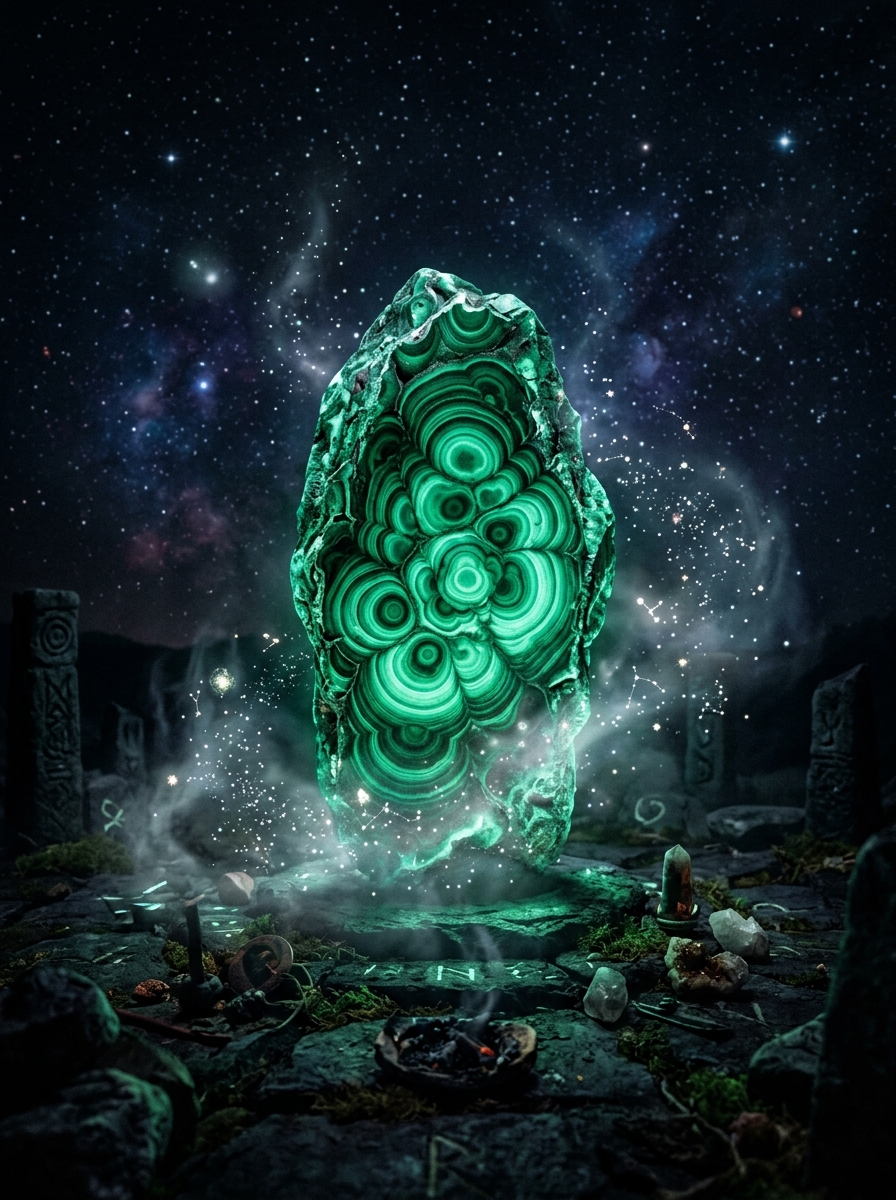
Malachite is the stone of change that does not ask permission. Its green banding carries the feel of growth under pressure: protection, truth-telling, emotional excavation, and the hard-won beauty that follows when something false in your life finally cracks. If emerald is refinement, malachite is alchemy. It does not soothe by pretending the wound is not there; it helps you name the pattern, absorb the lesson, and move.
The Core Dynamic: Malachite as the Stone of Necessary Change
The core meaning of malachite is radical transformation through honest contact with reality. In metaphysical work, it is often treated as a guardian stone, but not in the soft, decorative sense. Its protection is active. It is the kind that exposes what has been hidden, then strengthens your field so you can face it without collapsing into it. That is why malachite has a reputation for being “strong” or even “intense”: it tends to amplify what is already present, especially emotional residue, unspoken resentment, and attachment to stale identities.
That makes malachite especially resonant for people standing at a threshold. It does not support stagnation. It belongs to the psychological moment when a person senses, perhaps dimly, that the old shape of the self is no longer livable. In Jungian terms, malachite behaves like a catalyst for shadow integration: it draws attention to the disowned material that shapes behavior from beneath the surface. For a broader symbolic map of how such thresholds appear in the birth chart, see the zodiac's underlying logic.
Part of malachite’s potency comes from its visual language. The stone’s concentric bands resemble growth rings, river currents, or a cross-section of lived experience. It looks as if time has been compressed into mineral form. That image matters: malachite is associated with layered change, not cosmetic improvement. It asks what has accumulated, where your energy is trapped, and what you keep performing instead of feeling. This is also why malachite is often linked with boundaries — not rigid walls, but intelligent separations: where you end and another person begins, where obligation stops and self-betrayal starts, where care becomes enmeshment. The stone is less about “good vibes” than about moral clarity. It can feel uncomfortable because it makes avoidance harder to maintain.
Psychological Action: Heart and Solar Plexus in Tandem
Malachite’s primary energetic home is the heart chakra, but not as a sentimental organ. The heart here is the place where love, grief, discernment, and self-respect meet. In chakra work, malachite supports emotional release while strengthening the capacity to hold feeling without fusing with it. That dual function is what makes it a stone of emotional detoxification in the literal metaphysical sense: it clears old psychic residue that weighs on the nervous system and shapes instinctive reactions.
However, the heart alone is not enough. Malachite also bridges to the solar plexus chakra because the issues it surfaces require will to act on them. The heart tells the truth of attachment and loss; the solar plexus decides whether that truth will govern behavior. Malachite becomes especially potent when those two centers have been split apart — when someone knows something is wrong but cannot yet move, or when they move impulsively without fully feeling the cost. The stone does a kind of inner reconciling work, forcing the two centers into dialogue.
That is why malachite feels so uncompromising. It is not for pushing emotion down; it is for moving it through. People drawn to malachite often need to metabolize anger, grief, or fear that has become dense and defensive. The stone is said to support release without numbness — you do not become empty, you become lighter. For deeper work on how life direction emerges from such clearing, see the North Node's guidance on purpose.
The Emotional Signature: No More Self-Deception
The most useful way to understand malachite meaning is as a stone that refuses repression. It does not let you pretend the wound is not there. Instead, it helps you name the pattern, absorb the lesson, and move — but not before you have felt what needs to be felt. This is why malachite is often used during shadow work, dream journaling, breakup recovery, and transitions where the old self-image is being dismantled. If you want a stone that mirrors your current life honestly, malachite is that mirror. It does not care about comfort; it cares about clarity.
Maturation vs. Shadow: The Two Faces of Malachite in a Life
When malachite is integrated consciously, it becomes a tool for discernment. A person working well with malachite learns to recognize their own patterns faster, to set boundaries before resentment builds, and to speak truth without cruelty. They become less porous to other people’s expectations and less trapped in repeating dramas. The stone’s energy, when metabolized, fosters a kind of emotional sobriety — the ability to see one’s own motivations clearly and to act from self-respect rather than reaction.
The shadow side of malachite is equally real. Because the stone amplifies whatever is already present, it can intensify emotional upheaval if the user is not grounded. Some people misuse malachite by treating it as a license to ventilate feelings without integration, or by using its intensity as a form of self-dramatization. The stone can also overexpose a fragile psyche if introduced too quickly. In that sense, malachite’s shadow is verification without compassion — the raw truth without the container to hold it.
How the Dynamic Plays Out in Love, Work, and Self
In love, malachite tends to surface the places where a person has given too much, absorbed too much, or confused caretaking with devotion. It does not soften the admission; it reveals the pattern. In work, malachite is useful for career cross-roads where the self-image must shift — leaving a role that no longer fits, or stepping into leadership that requires harder boundaries. In self-understanding, malachite supports the dismantling of persona and the integration of what was previously suppressed. It works especially well when paired with intention-setting around a specific life arena, such as those described in the astrological houses, which map the sectors of experience where change actually lands.
Because malachite is an intense stone, it is often paired with gentler allies rather than used as a lone remedy for tender states. In practice, some people alternate it with softer greens or calmer grounding stones so the system can integrate what malachite surfaces. If your work involves concentrated energy patterns in one area of life, consider how a stellium in the birth chart might align with malachite’s focus — both call for conscious integration of density.
Practical Alignment: Placement, Care, and When to Reach for Malachite
The most effective way to use malachite is with clarity about purpose. Place it where you want energetic honesty, emotional release, or boundary repair. Many people keep it on a desk during decision-heavy periods, near a journal during shadow work, or on a bedside table when dreams are carrying useful material. Because malachite is responsive and amplifying, it works best when your intention is specific rather than vague.
As jewelry, malachite is often worn close to the heart or as a statement ring when the goal is self-possession. But it is not always the best stone for constant contact if you are already emotionally raw. Its intensity can feel clarifying one day and overexposing the next. Think of it as a teacher stone: valuable, precise, sometimes blunt. If you are in a fragile state, introduce it gradually and notice your response. For ritual use, you can hold malachite while stating a boundary, naming a pattern you are ready to break, or writing the truth of a situation without softening it for appearance’s sake.
Cleansing and care deserve practical respect. Malachite is a softer, reactive mineral — a copper carbonate — and should not be placed in water for long periods. Cleanse it with smoke, sound, dry moonlight, or a brief energetic reset. Physically, keep it away from harsh chemicals and treat it gently. The care you give the stone is part of the work: malachite asks for boundaries, and its maintenance mirrors that ethic.
When Malachite Is Most Useful
Malachite is especially useful during breakup recovery, identity shedding, therapy-informed shadow work, and any period when your life is asking for cleaner boundaries and fewer self-deceptions. It is not the stone of easy reassurance. It is the stone of the brave sentence, the admitted grief, the finally-seen pattern. In that way, it functions like the psyche’s own corrective force — unsettling at first, then liberating. For those working with the astrological sextile aspect — a configuration of opportunity that demands participation — malachite mirrors that same call: the opening is there, but you must step into it. Learn more about the sextile's active consciousness.
Astrological Signature: Scorpio, Capricorn, Taurus, and the Shape of Transformation
Malachite is most closely tied to Scorpio, and the fit is obvious once you understand the stone’s temperament. Scorpio rules depth, death-and-rebirth processes, hidden motives, intimacy, secrecy, and psychological transformation. Malachite does not preserve the surface; it reveals what is under it. It belongs to the part of life where old skins are shed and the psyche is forced into greater honesty. The stone’s affinity with Scorpio is not merely symbolic — it activates the same instinct for intensity and truth.
Secondary ties exist with Capricorn and Taurus. Capricorn gives malachite its seriousness, discipline, and respect for consequences. Taurus gives it material presence, patience, and an earthy connection to value, security, and embodiment. In a birth chart, malachite may resonate most strongly where these signs or their houses are activated, especially if the native is in a period of structural change. The stone tends to support the kind of transformation that is grounded — not flighty inspiration, but real work on real things. For more on how the Sun sign shapes identity through such work, see the individuation path of the solar core.
Malachite’s astrological feel is closer to a sextile than a trine in spirit: it does not relax you into passive ease; it creates an opening that asks for participation. The stone’s medicine works best when you are willing to engage the work it presents. That is why it is useful to think of malachite in terms of activation rather than comfort. It supports latent potential by making avoidance less attractive and truth more available.
Related
- Moldavite Meaning & Healing Properties: Green Fire from the Stars
- Black Tourmaline Meaning & Healing Properties: The Stone of Boundaries and Deep Earth
- Moonstone Meaning and Healing Properties: The Lunar Stone of Inner Tides
- Peridot Meaning: The Green Fire of Renewal
- Labradorite Meaning: The Stone of Hidden Fire and Clear Sight
Comments
Loading comments…