Moldavite Meaning & Healing Properties: Green Fire from the Stars
The core dynamic: catalyst, not comfort
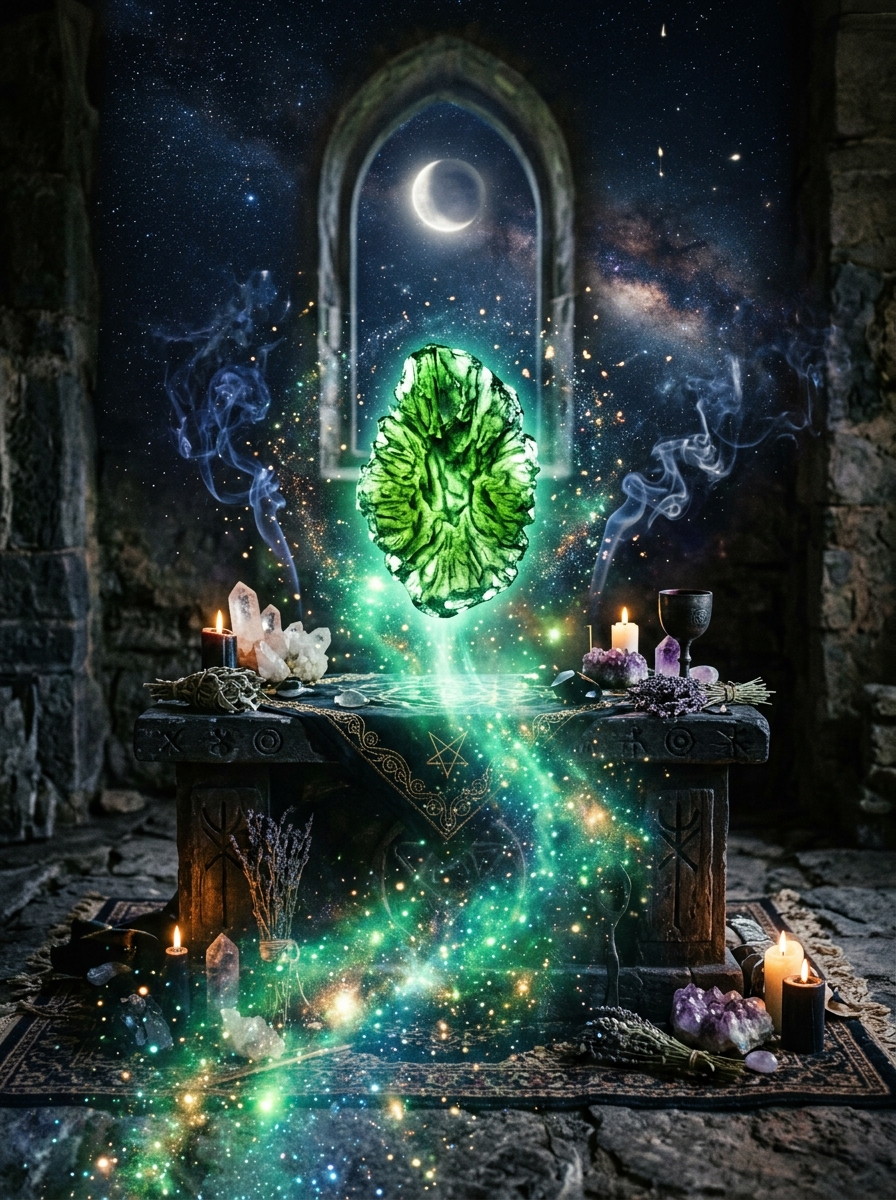
Moldavite is the stone of collision. Forged when a meteor struck the Earth and fused local sand into green glass, it carries a double signature—terrestrial and extraterrestrial—that makes it unlike any other crystal. Its meaning in metaphysical practice is not gentle reassurance but initiated upheaval. Where most stones soothe, moldavite accelerates. Where others anchor, it summons. It does not ask permission to surface what has been buried, nor does it wait until the ego feels ready. That is why it earns the reputation of a “transformation stone,” though transformation implies a gradual unfolding, while moldavite behaves more like a summons: a green fire that burns through the ornamental parts of a life until only the essential remains.
In Jungian terms, moldavite often appears as an ally to individuation—not to comfort the persona but to expose where the persona has outlived its usefulness. It favors the future that requires courage over the past that offers familiarity. This is why the stone is so frequently linked with the North Node. The North Node in astrology describes the direction of growth that feels necessary, unfamiliar, and consequential. Moldavite operates in the same register: it does not reward clinging. It strips away the identity that no longer fits, often before the conscious mind has fully agreed to let it go.
Psychological roots: shadow, individuation, and evolutionary pressure
The healing mechanism of moldavite is not sedative; it is catalytic. It increases contact with what is already active in the psyche—especially the material that has been held below awareness. People who work with it often report a sudden sharpening of perception, intensified dreams, and a surge of synchronicities. But they also report the return of grief they thought was processed, the surfacing of inherited fears, and the unmasking of relational patterns that had become invisible through habit. These are not flaws in the stone’s reputation; they are its intended effect. Moldavite makes denial inconvenient.
Psychologically, this means it acts on the shadow—the parts of the self that have been exiled because they threaten the constructed identity. The stone’s energy tends to bring shadow material to the surface quickly, often in the form of a crisis or a visceral emotional reaction. That can feel disruptive, but it is the necessary first stage of any genuine transformation. The key is not to avoid the disruption but to hold it with enough structure that the psyche can reorganize around a larger truth.
The stone’s affinity for the psychic pressure of the North Node is not accidental. Both represent a pull toward the future self that cannot be reached without dismantling some of the old self. This is why moldavite is especially resonant for people whose birth charts carry strong Uranian signatures or a concentrated stellium—a cluster of planets in one house or sign that intensifies a life theme until it demands conscious integration. A stellium often creates a psychological complex that feels unignorable; moldavite can serve as the catalyst that forces the complex into view. It does not tell you who to become. It strips away what you are not.
Mature expression and the shadow path
Like any concentrated force, moldavite can be used toward integration or toward destabilization. The difference lies in the container. When the stone is approached with humility, pacing, and a grounded body, it can open the heart chakra to a less possessive kind of love—love as truth, not attachment. It can then move the energy upward through the third eye and crown chakras, making intuitive knowing feel less theoretical and more immediate. In this mature expression, the stone becomes a tool for discernment: it clarifies what is already true but has been postponed.
But the same energy that can liberate can also unhinge. If the lower chakras are depleted—if the person is sleep-deprived, emotionally raw, or desperate for certainty—moldavite can amplify confusion before it clarifies. The stone’s Uranian quality (disruption, lightning, liberation) can tip into nervous-system overload if there is no grounding practice to channel it. This is the shadow path: a high-frequency experience that leaves the person more ungrounded than before, mistaking intensity for depth.
Astrologically, moldavite is most often linked with Scorpio and Aquarius—two signs that handle transformation in very different but equally relevant ways. Scorpio understands death, rebirth, and the necessity of surrendering what is psychically toxic. Aquarius understands the future, rupture, and the willingness to separate from obsolete structures. The zodiac framework provides a language for where the stone’s pressure will land: in a Scorpio person it may deepen emotional excavation; in an Aquarian it may accelerate a life pivot. But the stone does not respect sign boundaries. It works wherever the psyche is ready to release.
Moldavite in the life field: love, work, and spirit
Because moldavite behaves like a concentrated astrological event, its effects show up in specific arenas depending on timing and intention. A single stone can produce very different outcomes for the same person in different phases of life.
In love, moldavite does not attract a partner; it reveals the relational patterns that no longer serve. It tends to surface the difference between genuine connection and sentimental attachment. People sometimes report that existing relationships either deepen or dissolve after working with the stone. The dissolution is not a failure of the stone; it is the stone honoring a truth that had been undernegotiated. If you are using moldavite in the context of love, pair it with conversation and reflection rather than expecting it to deliver a specific outcome.
In work, the stone clarifies vocational fit. It is not a stone for smoothing over career dissatisfaction but for cutting through the stories you tell yourself about why you cannot leave or why you must stay. It can accelerate a bold move—a resignation, a pivot, a creative reinvention—but it will not sustain the effort unless the underlying desire is authentic. For this reason, it is often used during threshold moments: the last month of a job, the first weeks of a new direction, or the crisis that forces a change of course.
In spiritual practice, moldavite is most effective as a ritual tool for focused intention rather than as a permanent companion. Placed on an altar during meditation or held during divination, it can sharpen symbolic perception and make inner guidance feel less abstract. It works best when the question is clean and specific. Vague intentions attract chaotic experiences; this stone responds to exactitude. The sextile aspect in astrology describes a channel through which latent potential can be activated—moldavite provides the voltage, but the sextile provides the usable current. Pairing the stone with steadying practices—breath, journaling, time in nature—keeps the channel open and the energy directed.
Working with the stone: timing, pairing, and discernment
Using moldavite well means respecting its velocity. It is not a stone to wear continuously without attention to the body’s response. For most people, short sessions are more effective than all-day wear. A few minutes of focused meditation with the stone can produce clearer insight than carrying it for a week while the psyche adjusts. It can be held during dreamwork or placed under the pillow for heightened symbolism, but sleep quality should be monitored; the stone’s crown chakra resonance can make the mind hyperactive if used too close to bedtime.
Pairing moldavite with grounding stones—black tourmaline, hematite, or smoky quartz—is a common practice, though the pairing should be tested individually. Not every body chemistry responds the same way. The real pairing is not just with other stones but with embodied routines: hydration, rest, honest conversation, and time offline. The stone asks for embodiment as much as inspiration.
When not to use moldavite? During periods of acute grief, panic, or physical exhaustion, the stone can amplify vulnerability before it strengthens it. Its medicine is best applied when the psyche already has some capacity to hold intensity. If you are in a phase of raw survival, choose a softer ally first. Moldavite will wait. It does not judge the timing; it only responds to the moment you finally turn toward your own becoming.
For readers who want to understand the broader symbolic architecture that surrounds it, the language of the astrological houses can be instructive—the same stone behaves differently in the 10th house (career upheaval) than in the 7th (relationship reckoning) or the 12th (private psychic work). A Sun sign describes what must be integrated to become fully oneself; moldavite can serve as the pressure that makes that integration unavoidable. It is not the identity. It is the green fire that reveals the identity already trying to emerge.
Related
- Labradorite Meaning: The Stone of Hidden Fire and Clear Sight
- Malachite Meaning & Healing Properties: The Stone of Necessary Change
- Shungite Meaning: The Stone of Deep Cleansing and Energetic Armor
- Moonstone Meaning and Healing Properties: The Lunar Stone of Inner Tides
- Topaz Meaning & Healing Properties: Clarity, Fire, and Steady Power
Comments
Loading comments…