Dream About Being Trapped: When the Psyche Sees No Door
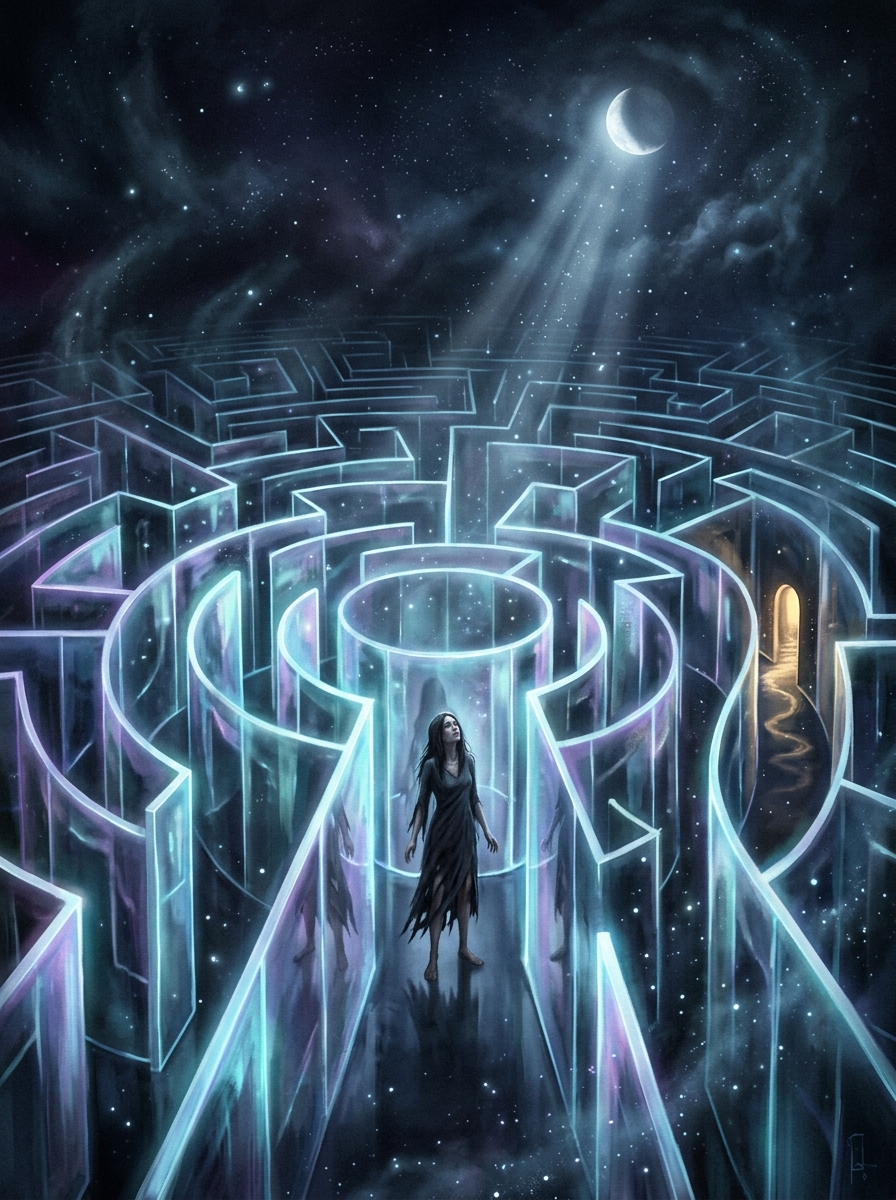
A dream about being trapped seldom means you are literally stuck. It means your psyche has located a situation where choice feels narrowed or denied. The image is a diagnostic frame: the kind of trap, the emotional temperature, and the body’s response together specify how your stuckness is organized. Panic suggests urgency; numbness suggests chronic pressure; resignation suggests a life pattern so familiar it no longer shocks the nervous system. In Jungian terms, the dream often stages a confrontation with an enclosure the conscious mind has normalized—one that may be external, internal, or both at once.
The Core Dynamic: What the Dream Actually Signals
Not all traps mean the same thing, and the dream is not merely saying “you feel stuck.” It is specifying the texture of the constraint. An architectural trap—a locked room, a basement, an attic, a cage—usually concerns a boundary you cannot cross in waking life. That boundary may be external (debt, caregiving, a job that has become a container) or internal (a rule, a fear, an identity you keep reinforcing). The house in dream language often represents the self, so being trapped inside a house can signal being trapped inside an old version of yourself.
A vehicle trap points differently. Cars, trains, and planes suggest momentum and life-path choices already in motion. When you cannot get out, the dream may be showing a commitment that is carrying you farther than you intended—movement without control, not mere confinement. Meanwhile, an organic trap—webs, mud, quicksand, vines—involves entanglement. Something has become psychologically adhesive: an obligation, a relationship, a habit, a grief that will not release you cleanly. The symbolism is less “I am in prison” than “I am being held by what has grown around me.”
The feeling-tone sharpens the reading further. Panic appears when the waking self knows—even reluctantly—that the situation has become untenable. Paralysis indicates a conflict between opposing loyalties: you want freedom, but another part fears the consequences of taking it. Quiet resignation can be the most telling sign. If the dreamer remains oddly calm, the psyche may be describing a pattern so habitual that the body no longer protests. This is why dream interpretation must stay close to the dreamer’s actual experience, not just the symbol. Two people can dream of the same elevator and mean opposite things: one is overwhelmed by external pressure; the other is finally facing the emotional limit of a relationship they have outgrown. For a deeper look at how symbolism works in this practice, our approach to tarot and astrology treats images as living patterns rather than fixed codes.
Psychological Roots: Where the Enclosure Comes From
The most common reading is that being trapped expresses a felt loss of agency. But that phrase is too broad unless sharpened. The dream may respond to one of several distinct pressures: repression, conflict between loyalties, or avoidance hardened into architecture.
Repression occurs when you have buried anger, grief, desire, or ambition so thoroughly that the psyche renders that suppression as confinement. In this sense, the dream says less “your life is blocked” than “your life force is being routed around an excluded truth.” Jung emphasized that dreams often compensate for the conscious attitude. If you pride yourself on composure, the dream may show claustrophobia. If you claim unlimited flexibility, it may show locked doors. The psyche corrects self-descriptions too polished to be true.
Conflict between loyalties arises when you are split between incompatible goods—family and separation, stability and transformation, duty and desire. The dream trap becomes the visible shape of that double bind. People often report being trapped while trying to reach someone else or escape a crowd. The enclosure is social as much as spatial, produced by relationships, not walls.
Avoidance that has become a room is the dream’s merciless literalism. A door you keep failing to open in waking life becomes a locked room in sleep. A conversation delayed for months becomes a hallway with no exit. The unconscious gives physical form to what you keep postponing. This is why these dreams often intensify during periods of chronic overextension—the psyche is turning a physiological reality into a story you can remember.
Variations That Change the Meaning
The specific setting of the dream narrows the reading with precision. A trap in water is not a trap on land; a trap in public is not a trap in private. The details tell you where the pressure lives.
Enclosure Types
Trapped underground often concerns material that has been buried: family history, old grief, inherited fears, or a self-image built long ago and never updated. Underground spaces can also suggest depression in the literal sense—heaviness, low energy, a sensation of having descended into a place with no daylight. Trapped underwater points to overwhelm. Water in dreams carries feeling and memory; being beneath it suggests emotions too large to process cleanly while awake. The issue may be saturation, not repression—you are in too much feeling, with too little air. Darkness changes the emphasis to uncertainty. A dark trap speaks to a constraint the mind cannot name, which makes the dream especially unsettling—a good clue when waking life feels vague but wrong.
A room defines a psychological container: too small means a shrinking role; a visible but unusable door points to inhibition, not absence of escape. A crowd trap reflects social pressure, public expectation, or fear of exposure—losing individuality in an environment that rewards conformity. Trapped in a relationship is one of the most direct forms: the dream may depict a person, a marriage, a family structure, or an attachment rooted in obligation, guilt, or dependence. The other person is often less important than the emotional logic. The dream asks whether what you call love has quietly become containment.
Escape Dynamics
If you almost escape, the dream is about threshold pressure. Change is imminent but not yet chosen. You are close to a decision, a breakup, a move, a no. The old structure still has authority but no longer has legitimacy. When escape works, note what made it possible—a hidden key, a broken window, help, sudden strength. These details are clues to your available resources: insight, rupture, assistance, or courage.
How to Read the Dream Without Flattening It
A dream about being trapped should not be interpreted as a generic warning. It is a diagnostic image with multiple possible sources. The best reading asks what in waking life has become too tight, too repetitive, too silent, or too inevitable.
Ask What Is Closed, and What Is Protected
Not every enclosure is purely negative. Some traps are shelters that have outlived their usefulness. A family system, perfectionism, a job, or a relationship once protected you from chaos; later it became a cage. The dream may mark the moment when protection and imprisonment become indistinguishable. If the dream is about danger, you may need boundary-setting or practical exit planning. If it is about protection turned stale, you may need grief, not just action. Sometimes the door is locked because part of you believes the world outside is worse than confinement.
The Body Tells the Truth
The body in the dream often speaks before the symbol does. Tight chest, shallow breathing, weak legs, frozen hands, inability to speak—these all point to embodied stress. Dreams translate nervous system states into narrative. The trap may be the dream’s way of staging what your body has been holding all day. This is one reason the dream can touch multiple areas of life—love, work, relationships—without needing separate sections. The same dynamic of narrowed choice and conflicting loyalty can show up in a partnership (a relationship that feels like a room), a job (a vehicle with no brakes), or a long-held identity (an underground shelter). Each is a concrete expression of the same psychic pattern. The symbolic architecture beneath the image is explored further in About Aurora Arcana, where we blend tarot, astrology, and pattern reading without pretending symbols are one-size-fits-all.
The Final Question: What Wants Release?
The deepest meaning of dreams about being trapped is rarely “you are doomed.” More often it is “something in your life has exceeded its container.” That something could be anger, desire, obligation, grief, or identity itself. The dream compresses everything into a single unbearable image because it wants a response, not a theory. When read carefully, the trap dream is not a bad omen—it is an announcement that a boundary has become visible. Once you can see the walls, you can ask whether they are real, historical, chosen, or merely inherited. That question is where interpretation becomes freedom. In the symbolic framework we use at Aurora Arcana, such moments are thresholds, not dead ends—they invite you to recognize the shape of your confinement so you can decide what to do with it.
Related
- Dream About Running But Not Moving: The Meaning of Stalled Motion
- Dream About Drowning: What the Water Is Trying to Say
- Dream About a Cave: Hidden Fear, Inner Depth, and the Return to the Self
- Dream About Driving Off a Cliff: When Control Ends at the Edge
- Dream About a Flooded House: What Rising Water Means in the Rooms of the Psyche
Comments
Loading comments…