Dream About a Train: Momentum, Fate, and the Life You're Boarding
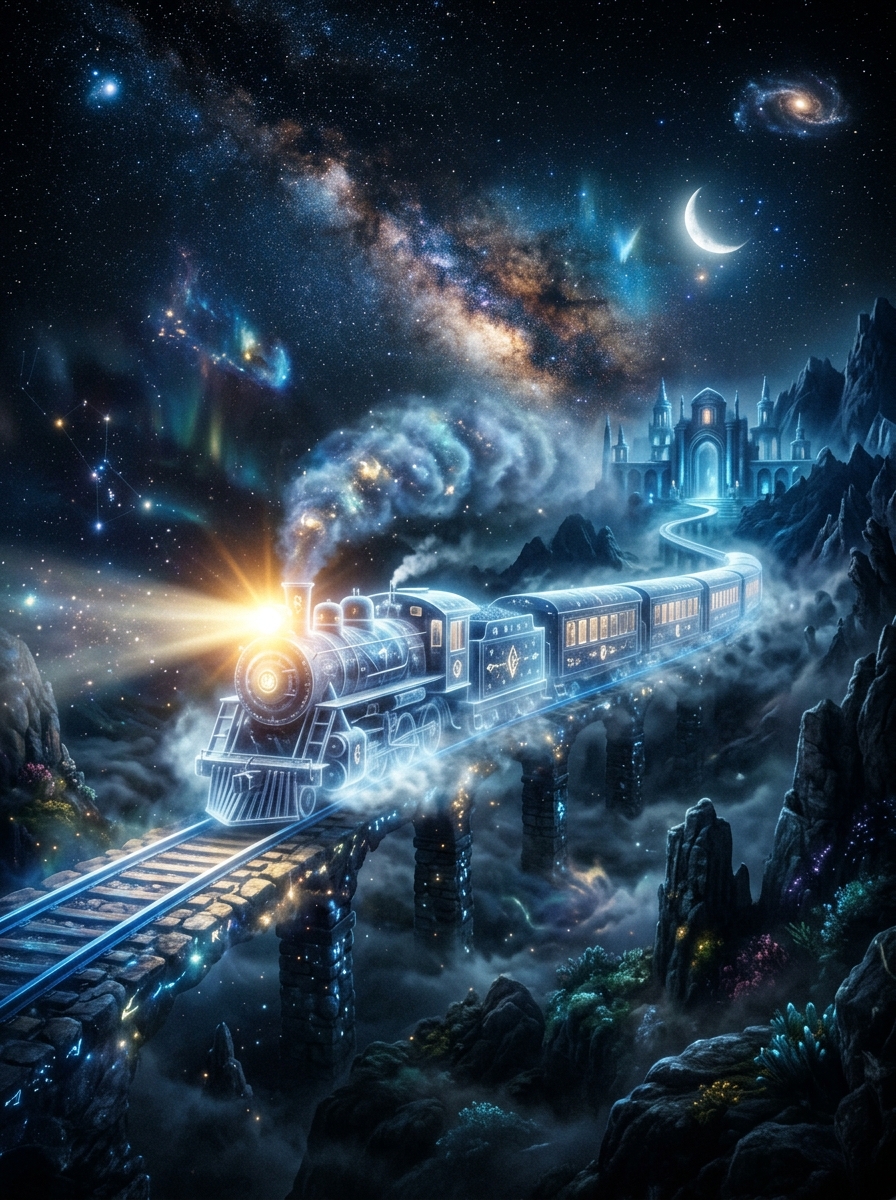
A train dream is not really about speed. It is about direction that was decided before you arrived. The track is already laid, the timetable already printed. Your only question is whether you are on board—and if so, whether you know where the line ends. That tension between individual will and engineered momentum is what makes the train one of the psyche's most precise symbols for how modern life actually moves.
Direction You Did Not Choose
The core dynamic of a train dream is committed motion on a pre-existing route. Unlike a car, which goes where you steer it, or a path through a field, which you cut yourself, a train travels infrastructure that someone else built and that cannot be improvised in the moment. When this image appears in a dream, the psyche is usually pointing at some sector of your life that has crossed the threshold from possibility into process. The decision, consciously or not, has already been made. The line has been laid.
These dreams tend to arrive during transitions that feel more significant from the inside than they look from the outside: a relationship deepening past the point of casual retraction, a career move absorbing its own momentum, a family obligation gradually becoming structural. The dream is not telling you that something will happen. It is telling you that something is already happening, and that your relationship to it matters more than your control of it.
Station versus moving car
A platform dream and a moving-train dream are related but do different psychological work. Standing on a platform, watching departure boards, checking a ticket—these images belong to threshold and choice. The emotional register is anticipation, readiness anxiety, or the grief of the path not taken. Once you are aboard and the landscape is sliding past the window, the dream has moved past threshold into participation. The question is no longer whether but how: how you ride, where you sit, whether you can breathe in the company you're in.
Missing the train is the most common anxiety variant. The shallow read is "missed opportunity," but that rarely captures what the dream is doing. More precisely, the psyche is dramatizing the belief that timing is harsh and that life will not wait for you to feel ready. Sometimes the message is practical—make the call, submit the application, stop deliberating. More often it is developmental: the discomfort belongs to the maturing recognition that the world runs on its own schedule, and that readiness is something you construct in motion rather than in advance.
The Scene Changes the Message
A train is a narrative machine, which means its symbolic content shifts with the action. The vehicle itself is the constant; the drama tells you which aspect of that dynamic the psyche is foregrounding.
Riding calmly
Calm transit—watching the scenery, settled in your seat—typically signals acceptance of a process larger than your immediate preferences. This can be quietly restorative, especially for people who tend to over-manage. The psyche compensates for driven waking behavior by staging a world where progress is carried rather than forced. If the landscape outside the window is vivid and changing, the dream may be underlining that your life is in orderly transformation: not a crisis, but a crossing. The difference matters. Crisis scrambles meaning; transit gives it a timetable.
Searching for your place
Not finding your seat or car concentrates the dream's meaning on belonging within a structure. The train is moving; you are on it; but you cannot locate your assigned role. This configuration tends to appear when someone is entering a new social hierarchy—a workplace, a family system, a professional tier—and quietly suspects they have not earned their position. A mis-numbered seat, the wrong class of car, a ticket in a language you cannot read: these details are the psyche's precise shorthand for status anxiety and impostor feeling. The social grammar of your current phase is the subject.
Derailment and disaster
A derailed train or collision compresses into one image the fear that a system you trusted is unstable. These dreams rarely function as literal warnings. They are emotional weather reports: two life-tracks becoming incompatible (duty and desire, ambition and intimacy, an old identity and a new one), or the mounting suspicion that a plan you committed to has structural flaws. A wrecked or burning train can mark the psyche's announcement that an old mode of movement is finished—that what looks like catastrophe is actually clearance.
Psychological Ground: Ego, System, and Schedule
From a Jungian perspective, the train is one of the few modern images that directly encodes the ego's encounter with collective life. You are not the only passenger. Your private story is being carried by public systems—institutions, inherited expectations, deadlines, the financial rhythms of other people's decisions. The dream exposes, without sentimentality, how much of any individual life is governed by structure rather than desire.
That exposure is not automatically ominous. Some lives need rails. Without them, energy disperses into drift. The train can symbolize both entrapment by structure and protection through it, and the difference is almost always emotional tone. Does the dream feel purposeful—as if the route goes somewhere worth going? Or does it feel merely repetitive, a loop disguised as a trajectory? The psyche rarely confuses the two, even when the waking mind does.
There is also a somatic register. Rails suggest linearity, spinal alignment, the body being carried from one state to another. A smooth train can reflect a regulated nervous system: forward motion without excessive friction. A train that jerks, brakes hard, or shakes in the dark tends to surface in dreams during periods of burnout—when the body is registering stress that the waking mind has rationalized as normal pace. Efficiency, sustained long enough, starts to feel like fate. The dream notices.
Tunnels, Bridges, Crowds
The tunnel is the train dream's initiatory image. The track continues through total darkness; direction is preserved even when visibility is not. This is psychologically exact for periods of depression, grief, intensive therapy, or any passage where meaning is temporarily inaccessible but not destroyed. The train does not stop at the tunnel entrance. Neither, the dream suggests, should you.
Crossing a bridge by train implies a transition that has already been engineered for you. You are not leaping across a gap; you are being transported over it along a structure someone else built. Whether that feels like grace or like surrender depends entirely on your relationship to trust. The dream does not judge the feeling; it presents the structure.
Crowded cars shift the symbol toward collective influence. You may be carrying not only your personal expectations but other people's projections, timelines, and unfinished business—what some depth psychologists would call family inheritance, the relay of pattern across generations. If strangers in the dream feel intrusive, the image speaks to social overwhelm. If they feel anonymous but harmless, the dream may simply be noting the ordinary entanglement: your private story is not fully separable from the stories of the people around you, and has never been.
How to Read Your Own Train Dream
The most useful question is not "What does a train mean?" but "What kind of movement is the psyche staging, and what is my relationship to it?" The answer usually falls into one of three positions: forward motion you are resisting; forward motion you trust but cannot steer; or forward motion that feels imposed, with the dream asking whether you actually consent to the route.
Emotional atmosphere is the key. Relief and ease suggest alignment with the direction the dream is showing you. Panic compresses fear of timing and failure into a single somatic signal. Grief, especially the quiet kind, often means a phase is ending and some part of you is not ready to name it over. Flat detachment deserves the most scrutiny: it can indicate hard-won maturity, or it can indicate dissociation—the numbness that settles in when a person has stopped expecting the situation to be negotiable.
For dreamers who return to transit imagery repeatedly, the Aurora Arcana approach to symbolic language may be useful context: we treat recurring images as patterns of psyche rather than prophecies, which means the train is less a prediction than a portrait of the movement you are already inside. The real work is learning to tell the difference between a route worth riding and a habit that has mistaken itself for destiny.
Related
- Dream About Running But Not Moving: The Meaning of Stalled Motion
- Dream About Driving Off a Cliff: When Control Ends at the Edge
- Dream About Missing a Flight: Meaning, Psychology, and Hidden Timing
- Dream About a Car Crash: What Your Psyche Is Trying to Say
- Dream About an Airplane Crash: What the Fall Means
Comments
Loading comments…