Dream About an Elevator: Rising, Falling, and the Inner Architecture of Change
The core dynamic: motion without agency
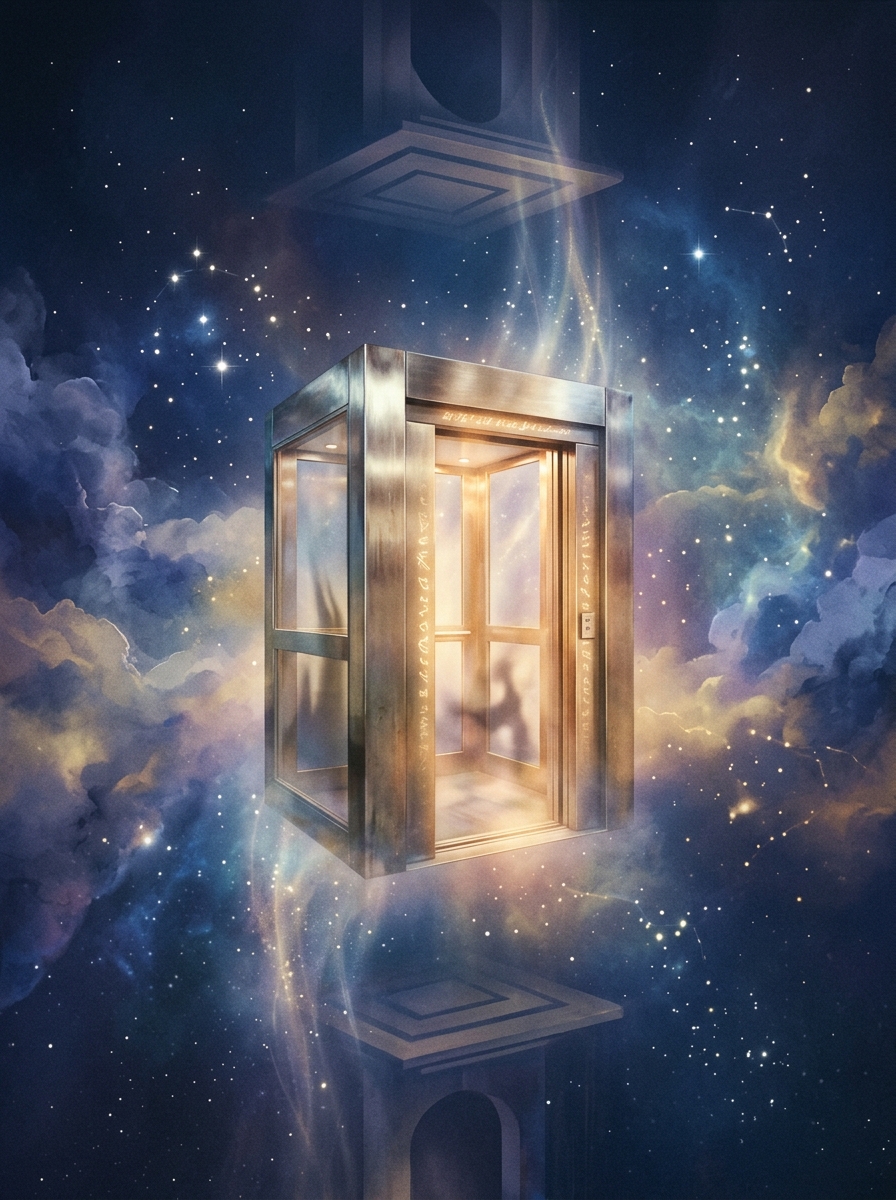
A dream about an elevator always reports the same basic tension: you are moving between levels of consciousness, status, emotion, or identity, but you are not fully steering the process. That compression—change under pressure—is the heart of the symbol. Unlike stairs, which demand effort and sequence, elevators lift or drop you in a single sealed passage. The psyche deploys this image when life feels accelerated, externally managed, or emotionally abrupt. The dream rarely arrives during calm, gradual evolution. It comes during promotions, breakups, relocations, therapy breakthroughs, spiritual openings, or the kind of slow internal crisis that suddenly breaks into daylight.
The emotional tone of the ride tells you more than the direction. An upward ascent laced with panic may betray impostor syndrome or fear of exposure. A descent that feels calm can signal readiness to face what has been buried. A smooth, controlled ride differs from one with flashing lights, broken doors, or missing floors. The dream asks not only where you are going, but how you relate to being moved.
Psychological roots: why the elevator appears now
Elevators belong to the architecture of vertical hierarchy—office towers, hotels, hospitals, high-rise apartments. In waking life they are tied to access, rank, and the gates between public and private. That is why dream elevators so often carry the charge of status anxiety. They dramatize your relationship to mobility: the shame of visible success, the terror of falling from a hard-won floor, the exhaustion of always climbing in a system that never stops measuring.
But the psychological root goes deeper than social standing. The elevator is a compressed image of the psyche itself—layers, thresholds, sudden passages between levels. In Jungian terms, a building with many floors resembles a personality organized by different strata of awareness: the lobby as social presentation, mid-level floors as practical identity, upper floors as aspiration or abstraction, basements as the repressed, forgotten, or merely unintegrated. The dream elevator travels straight through these zones without asking permission.
The vertical psyche
The elevator’s vertical movement naturally speaks the language of hierarchy—but the dream often questions that hierarchy rather than endorsing it. A gilded car in a luxury tower may reveal a life organized around appearances and approval. A freight elevator suggests raw labor, hidden work, the machinery beneath the polished self. The setting of the building matters too. A hotel signals temporary identity, a office building status and labor, a hospital healing or crisis, a home the architecture of intimacy and family patterning. When the building is unfamiliar, the psyche is showing you an uncharted layer of life—something you have not yet named.
For readers who want a broader framework on how dream symbols operate, Aurora Arcana’s interpretive approach treats images as dynamic rather than one-to-one. The same elevator can mean ascent in one dream and descent into shame in another—context is everything.
How the dream matures vs. how it goes shadow
The elevator dream is not inherently good or bad. Its quality depends on whether the movement serves integration or resistance. A healthy iteration of the dream allows you to witness yourself in transition without panic. You may not control the mechanism, but you can observe the floors passing, notice the feelings that arise, and accept that you are being moved. That capacity for witness is a sign of psychological maturity: the ego can tolerate not being in charge.
The shadow version of the dream is the stuck elevator. Suspended between floors, unable to press a working button, doors sealed, silence pressing in. This image often appears during real-life limbo that has become psychically costly—waiting for a decision, a diagnosis, a divorce, a job offer that never comes. The dream does not pretend this state is growth. It is honest report: you are in a holding pattern that is eroding something. The stuck elevator demands action, even if that action is simply acknowledging the cost of remaining still.
The healthy passage vs. the stuck dream
A dream of falling in an elevator can feel catastrophic, but survival in dream logic is telling. If the dream ends before impact, or you survive the fall, it often means the psyche believes adaptation is possible even if the old structure collapses. The fall externalizes a loss of footing—fear of failure, sudden bad news, the terror that whatever you built may not hold. Yet the survival suggests you are not destroyed by the change; you are being reorganized.
Conversely, a dream of rising too fast, skipping floors, or overshooting the intended floor can indicate missing stages—moving too quickly through a process that needs time. This is common when people try to outpace grief, rush a career shift, or force clarity before it is ripe. The psyche’s message is not “fail” but “incomplete.” The missing floors are the steps you have not taken.
Malfunction—doors that won’t close, buttons that do nothing, a car that free-falls without warning—appears when ordinary explanations no longer suffice. These images are not predictive of disaster; they reveal nervous system strain, the fear of losing control, or the sense that your life has exceeded your current structure. If you have been forcing certainty, the broken mechanism is the dream’s most honest report.
Consolidated life applications: love, work, and the unbuilt floor
Because the elevator dream is about transition under pressure, it shows up across every major life domain without needing separate symbolic treatments. The core dynamic—moved without full agency—simply wears different costumes.
In work and ambition, an elevator dream often stages the tension between genuine advancement and hollow visibility. A glass elevator can reflect performance pressure: your rise is on display, and you feel exposed. A freight elevator might appear when you are doing the unglamorous labor that supports a public success. If the car stops at a floor you did not intend, the dream may be exposing a mismatch between the goal you thought you wanted and the destination your deeper self has chosen.
In love and relationships, the elevator can become a container for relational dynamics. A packed elevator with strangers may reflect social competition or the sense that your personal life is proceeding in a shared but uneasy space. If familiar people are inside, the dream may be staging family patterns or the emotional architecture of a partnership—who rises, who falls, who is left on a different floor. The question shifts from “Where am I going?” to “Who is witnessing my movement, and who is not allowed to come along?”
In personal identity and spiritual growth, the elevator dream often marks a threshold between old and new selves. A descent that feels calm can indicate readiness to meet what you have repressed—grief, desire, memory. An ascent that feels weightless may signal authentic expansion, or it may be dissociation, a flight from embodiment. The body appears in the dream through breathlessness, vertigo, or a sense of lightness, and these sensations are not random. They reflect whether the transition is integrated or merely abstract.
What to do with the dream
A dream about an elevator asks for an honest inventory, not a quick interpretation. The most useful question is not “What does the elevator mean?” but “Where in my life am I being moved by forces larger than my preference?” That could be a job change, a family obligation, a health condition, a tightening relationship—or the slow, internal pressure of becoming someone different.
Next, ask about the floor. Not the dream building’s floor, but your own. Where are you in the transition—above your old life, beneath your old certainty, or trapped between identities? A repeating elevator dream often points to a transition that refuses to stay in the background. If the car keeps skipping floors, consider what steps you are rushing. If the doors never open, ask what door you are afraid to walk through.
Finally, attend to the mechanism. The buttons, the control panel, the responsiveness of the car—these details tell you whether the dream is about agency, helplessness, or something in between. A dream with working buttons suggests you still believe in choice, even if you have not yet pressed. A dream with no buttons at all may be a sobering report that your current phase offers little room for control—and that survival, for now, is about riding the passage.
As with all dream work, the goal is not a fixed decoding but an ongoing dialogue. The elevator symbol, understood correctly, stops being a weird nocturnal event and becomes a map of pressure, timing, and becoming. That perspective—treating symbols as living rather than fixed—is central to how Aurora Arcana approaches tarot, astrology, and the interior life. The dream does not give you the answer; it gives you the question you are living inside.
Related
- Dream About a Train: Momentum, Fate, and the Life You're Boarding
- Dream About Driving Off a Cliff: When Control Ends at the Edge
- Dream About a Car Crash: What Your Psyche Is Trying to Say
- Dream About Being Unable to Move: The Meaning of Psychic Paralysis
- Dream About Running But Not Moving: The Meaning of Stalled Motion
Comments
Loading comments…