Dream About a Locked Door: What Your Psyche Is Keeping Closed
The Boundary Is the Message
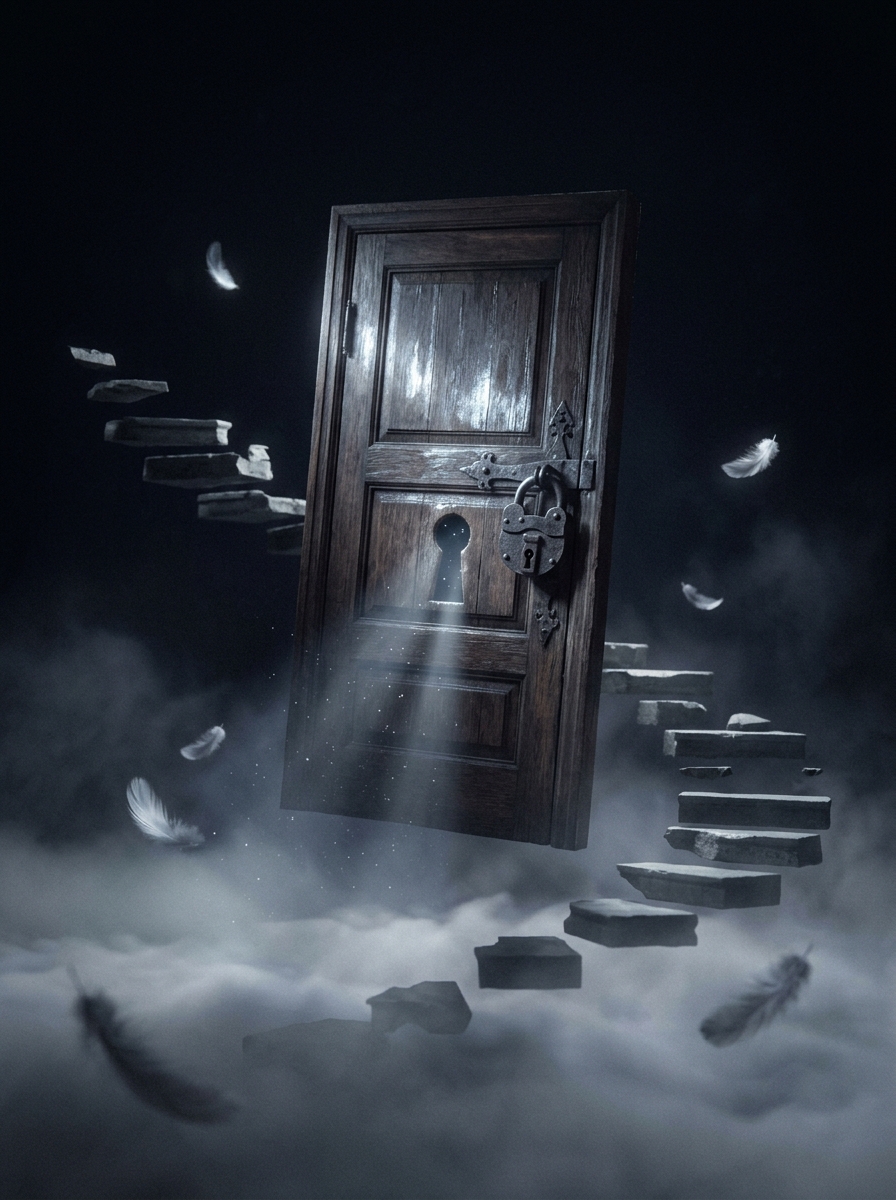
A locked door in a dream does not simply mean “something is blocked.” It means the psyche has drawn a boundary with intention. Where there is a door, there is a threshold; where there is a lock, there is a decision—one that may belong to the dreamer, to another figure, or to the unconscious itself. The emotional charge of the dream—frustration, relief, curiosity, fear—tells you whether the boundary is a protective holding or a denial of access.
In the symbolic language of dreams, which Aurora Arcana treats as living signals rather than fixed omens, a locked door asks one question above all others: Is this door meant to stay closed, or is it waiting for something? The answer shifts the entire meaning. A door that must remain shut may guard trauma too raw for waking integration; a door that merely waits holds a secret the dreamer is nearly ready to receive. The same image can be a repository or a tease. The dream is the body’s way of checking in on which one you need right now.
This is not the same as a broken door or a missing door. A lock implies agency—someone or something turned the key. Even if the dreamer feels powerless, the lock itself is an act of will. That makes the locked door a remarkably precise symbol: it registers where your psyche has drawn a line between what is available and what is not yet yours to handle.
What the Door Conceals (and Why)
The psychological engine behind the locked door is ambivalence—a split within the dreamer. One part reaches for the knob; another part has turned the deadbolt. This internal division often appears when the dreamer is approaching a truth they have outgrown but not yet integrated. In Jungian terms, the door marks the edge of the conscious personality’s territory; on the far side lies the shadow, the anima or animus, or material too potent for the current ego structure to hold without fracture.
Yet not every locked door conceals something dangerous. The psyche also uses the lock as a containment strategy. Trauma survivors, for example, may dream of inaccessible rooms not as a sign of repression but as a protective mechanism—the unconscious knows that forced excavation during a period of instability can do more harm than good. In that case the locked door is not an accusation; it is a pacemaker. The dreamer is being asked to respect timing.
This distinction is central to the framework of Aurora Arcana, where dream symbols are read in the context of the dreamer’s whole life. A locked door that appears after a major loss, during a period of grief, or when the dreamer is already overwhelmed is far more likely to be a wise containment than a neurotic blockage. The question is not simply “What is behind the door?” but “Why is the door locked now?”
The Key and the Keeper
The details of the dream shift the interpretation from abstract to personal. Three variables matter most: who has the key, who locked the door, and where the door is located.
If the dreamer holds the key but cannot find the lock—or cannot make the key turn—the issue is readiness without clarity. The tools, authority, or permission exist, but the confidence to use them does not. The dream may be asking the dreamer to examine what “using the key” actually means in waking life: speaking a truth, making a choice, crossing a threshold. If the key fits and the door opens, the dream is registering a transition—a secret revealed, a capacity coming online, a relationship changing state.
If someone else locks the door, the dream dramatizes a relational dynamic. That other figure may represent a literal person (partner, parent, boss) or an internalized authority—shame, religion, an old rule that no longer applies. The emotional residue matters. Anger points to a power struggle. Resignation points to learned helplessness. Curiosity about who locked it points to a growing awareness of the hidden architecture of one’s own defenses.
The setting of the door further narrows the meaning. A front door concerns public life, career, and social access. A bedroom door touches intimacy, secrecy, and vulnerability. A basement door implies buried material—family inheritance, instinct, old pain. An attic door suggests memory, perspective, or outdated beliefs. Each room in the house is a different region of the self, and the locked door tells you where the psyche is holding a boundary most tightly.
How the Dream Moves Through Life
The dynamic of the locked door—desire meeting restriction—unfolds differently in different domains, but the core pattern remains the same. In love, a dream of a locked bedroom door may reflect a relationship where intimacy has become guarded, or a part of the dreamer that resists full vulnerability. The dream is not about the partner; it is about the dreamer’s own threshold around emotional exposure. In work, a locked office door can indicate stalled ambition or a fear of claiming authority. The lock is the hesitation dressed as circumstance.
In self-esteem and identity, a locked door often appears when the dreamer is refusing to acknowledge a talent, a desire, or a grief that would require them to reorganize how they see themselves. The psyche has sealed the room precisely because entering it would change the story they tell about their life. The cost of delay shows up in the dream’s mood—frustration, loneliness, a sense of being excluded from one’s own potential.
This is where the dream becomes a practical tool. Instead of asking “What does a locked door mean?” the dreamer can ask: Where in my life am I hesitating? What am I protecting by not opening that door? The answer is rarely generic. A person who dreamed of a locked basement door during a divorce discovered she had been avoiding rage she considered unacceptable. A man who dreamed of a locked front door while job-hunting realized he was terrified of the failure that might come with a new role. The dream did not predict the outcome; it illuminated the shape of the internal barrier.
Reading the Dream Without Forcing the Lock
The most useful dream interpretation does not arrive at a single meaning; it arrives at a better question. For a locked door, the cleanest reading comes from matching three elements: what the dreamer wanted from the door (desire), what kept it closed (structure), and what emotion colored the encounter (feeling). Desire reveals what the psyche is reaching for. Structure reveals the form of the resistance—internal prohibition, external circumstance, or wise pacing. Feeling reveals whether the dreamer is aligned with the boundary or fighting it.
If the desire is strong and the feeling is frustration, the dream may be urging the dreamer to examine a situation they have been postponing out of fear. If the desire is weak and the feeling is relief, the dream may be confirming that a closed chapter should stay closed. If the desire is present but the emotion is curiosity rather than panic, the dream may be a sign that the threshold is about to open—provided the dreamer does not force it.
In the tradition of Aurora Arcana, dream symbols are not fixed dictionary entries. They are relational events between the conscious mind and the deeper self. A locked door is not a verdict; it is a conversation. The dreamer who listens to what the lock is protecting—rather than obsessing over what lies behind it—has already begun the crossing. The door may open later, or it may remain shut, but the relationship to the boundary will have become conscious. That is the real work of the dream.
Related
- Dream About Being Trapped: When the Psyche Sees No Door
- Dream About an Elevator: Rising, Falling, and the Inner Architecture of Change
- Dream About Being Unable to Move: The Meaning of Psychic Paralysis
- Dream About a Mirror: Self-Recognition, Distortion, and the Face Beneath the Face
- Dream About Running But Not Moving: The Meaning of Stalled Motion
Comments
Loading comments…