The Waxing Crescent and First Quarter Moon: Sacred Geometry, Individuation, and the Archetypes of Growth
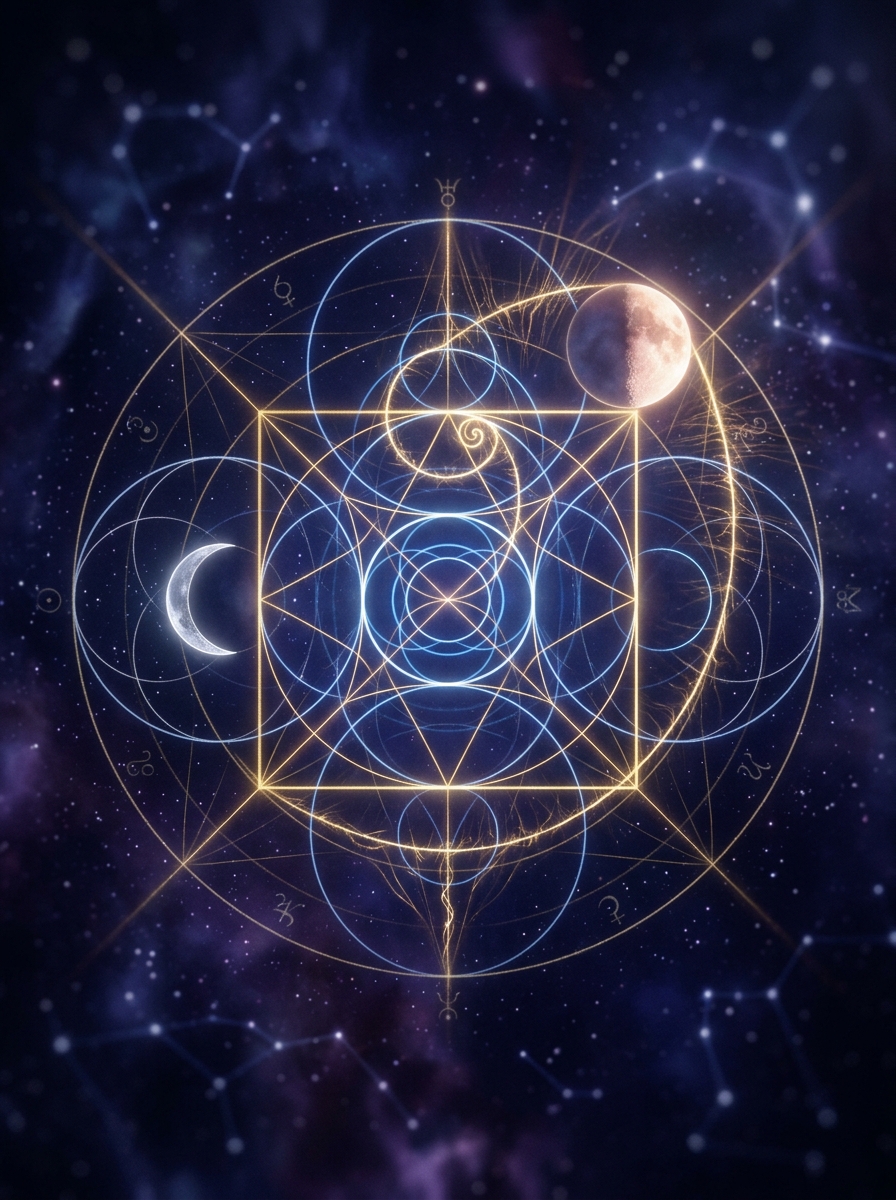
Astronomical Foundations: The Mechanics of the Waxing Cycle
To understand the metaphysical potency of the waxing lunar cycle, one must first ground their awareness in the elegant celestial mechanics that govern the Earth-Moon-Sun system. The lunar cycle begins at the New Moon, a moment of astronomical conjunction where the Moon resides directly between the Earth and the Sun. From our terrestrial perspective, the Moon’s illuminated hemisphere is turned entirely away from us, rendering it invisible against the glare of the solar disk. As the Moon continues its counterclockwise orbit around the Earth at an average speed of approximately 2,288 miles per hour, it moves away from this conjunction. This movement initiates the waxing phase, a term derived from the Old English weaxan, meaning to grow, increase, or multiply.
As the angular separation—or elongation—between the Moon and the Sun increases from 0 degrees toward 90 degrees, the Waxing Crescent phase emerges. Astronomically, the Waxing Crescent spans the range of elongation from 45 degrees to 90 degrees. During this time, a sliver of direct sunlight illuminates the eastern limb of the Moon. This crescent is not merely a flat curve on a two-dimensional sky; it is the visual manifestation of a spherical body catching the light of its parent star.
The Terminator Line and Three-Dimensional Lunar Topography
The boundary dividing the illuminated day side of the Moon from the dark night side is known as the terminator line. In the Waxing Crescent and First Quarter phases, the terminator line acts as an extraordinary astronomical lens. Because the Sun’s rays strike the lunar surface at a highly oblique angle along this boundary, they cast long, dramatic shadows across the lunar landscape. Through even modest telescopes, this low-angle illumination reveals the three-dimensional texture of the Moon with astonishing clarity. The jagged rims of craters like Tycho and Copernicus, the towering heights of the Lunar Apennines, and the vast basaltic plains of the maria are thrown into sharp relief. The terminator line exposes the physical reality of the Moon’s rugged topography, transforming what appears to be a flat disk into a sphere of deep valleys and towering peaks.
As the Moon reaches an elongation of exactly 90 degrees east of the Sun, it arrives at the First Quarter phase. This is the moment of quadrature. The term "First Quarter" does not refer to the amount of the Moon we see illuminated—which is exactly 50 percent—but rather to the fact that the Moon has completed the first quarter of its synodic orbit, which averages 29.53 days. At the First Quarter, the terminator line appears as a perfectly straight line bisecting the lunar disk. This geometric division represents a critical tipping point. The light is now equal to the dark, and from this moment onward, the Moon enters the Waxing Gibbous phase (from the Latin gibbosus, meaning humpbacked), where the illuminated portion swells from 50 percent to 99 percent, culminating in the brilliant opposition of the Full Moon.
Astrological Symbolism of Growth: Cultivating the Seed of Intent
In the symbolic language of evolutionary and depth astrology, the waxing cycle is the cosmic archetype of active cultivation, sustained effort, and the systematic building of momentum. If the New Moon represents the absolute subjective dark—a state of pure potential where the seed of intention is planted in the fertile ground of the unconscious—the Waxing Crescent is the first visible green shoot breaking through the soil. This phase demands a profound transition from the receptive, reflective state of "planting" to the deliberate, active "watering" of those intentions.
During the Waxing Crescent, the astrological energy shifts from internal conception to externalized effort. The initial impulse of the New Moon, which is often experienced as a vague feeling, a sudden dream, or a subtle pull toward a new direction, must now be sustained by conscious will. In his seminal works on evolutionary astrology, Dane Rudhyar characterized the Waxing Crescent as a time of "instinctive struggle," where the emerging form must fight against the inertia of the past. The old structures, represented by the decaying matter of the previous lunation cycle, still linger in the soil. To grow, the new life-form must actively push against this resistance.
Cultivation and the Kinetic Shift from Intention to Action
Cultivation is not a passive event; it is a kinetic engagement with reality. As the Moon waxes, the cosmic tide rises, bringing with it an influx of vital energy. This is the time to feed the emerging dream with concrete resources: time, attention, physical labor, and intellectual focus. The metaphor of watering the seed is highly instructive. If one waters too little, the emergent shoot withers under the heat of daily life; if one waters too much, the root system rots in over-idealization. The Waxing Crescent demands a balanced, rhythmic application of effort.
This phase symbolises the developmental stage of the young child who is beginning to explore the boundaries of their environment. There is a sense of wonder, but also an emerging realization that actions have consequences in the physical world. The planetary light is growing, and with it, our capacity to see the path ahead. Unlike the New Moon, where we must walk by faith, the Waxing Crescent provides just enough light to plan our steps. It is a call to align our daily habits with our highest aspirations, ensuring that the momentum we build is directed toward the structures we actually wish to inhabit.
Practical Application and Timing: Navigating the Rising Tide
Understanding the astronomical flow of the waxing cycle allows for the strategic application of lunar timing to contemporary life, career, and creative endeavors. In the realm of mundane astrology and electional practice, the period between the New Moon and the Full Moon is viewed as a natural incubator. The cosmic current during this fortnight is supportive of expansion, accumulation, absorption, and building. Consequently, this is the premier window for launching initiatives that require longevity, visibility, and substantial growth.
When the Moon is waxing, the energetic tide supports projects that are in their developmental infancy. This is the time to initiate professional networking campaigns, pitch new ideas to stakeholders, and actively create the primary materials of your craft. If you are a writer, the waxing cycle is the time to generate drafts and build the core narrative; if you are an entrepreneur, it is the time to build your client list, establish partnerships, and push marketing campaigns into the public sphere.
| Lunar Phase | Elongation Range | Core Practical Action | Esoteric Principle |
|---|---|---|---|
| New Moon | 0° – 45° | Intention setting, visualization, quiet reflection | Conjunction / Pure Potential |
| Waxing Crescent | 45° – 90° | Resource gathering, initial action, habit building | Emergence / Cultivation |
| First Quarter | 90° | Decision making, overcoming obstacles, restructuring | Quadrature / Productive Friction |
| Waxing Gibbous | 90° – 135° | Refinement, analysis, editing, preparation | Development / Analytical Growth |
Strategic Growth: Professional Networking and Building Momentum
To strategically utilize this waxing energy, one must cultivate a mindset of accumulation. It is highly favorable to:
- Establish new contacts: Reach out to mentors, colleagues, and potential collaborators. The social atmosphere during a waxing Moon is generally open and collaborative, as people are instinctively looking outward.
- Acquire resources: Purchase tools, invest in education, or hire support. The energy supports absorbing knowledge and gathering materials that will sustain the work ahead.
- Build momentum through consistency: Establish daily rituals and work schedules that reinforce your core goals. The habits formed during this phase tend to take root deeply.
Conversely, the waxing cycle is not a time for closures, liquidations, or premature endings. Attempts to wrap up complex business relationships, file for divorce, or terminate long-term projects during this period often meet with frustrating delays or unexpected complications. Because the natural flow of energy is expansive, trying to force an ending during the waxing phase is like swimming against a powerful rip current. The system wants to grow; forcing it to contract requires immense, often counterproductive effort. Save closures, audits, and final cuts for the waning cycle, when the cosmic breath is naturally exhaling and letting go.
The Sacred Geometry of the First Quarter: The Power of the Square
At the exact midpoint of the waxing half of the cycle lies the First Quarter Moon. Esoterically and geometrically, this is one of the most critical junctures of the entire month. In astrology, the 90-degree angle of quadrature is known as a square. In the Western esoteric tradition, particularly within the writings of A.E. Waite and the symbolic design of the Rider-Waite-Smith Tarot, the square represents the realm of physical manifestion, structure, and the testing of spirit against the density of matter.
The square is not an easy aspect; it is an angle of dynamic tension. In classical astrology, the square is of the nature of Mars—combust, sharp, and demanding action. While the trine (120 degrees) represents a harmonious flow of energy that can sometimes lead to complacency, the square creates productive friction. Without this friction, nothing in the physical universe could be built. Just as a carpenter requires the friction of the saw to shape wood, or an engineer requires the resistance of materials to build a bridge, the soul requires the friction of the astrological square to forge character and manifest destiny.
The Crisis of Action: The Esoteric Dynamics of the Square
Dane Rudhyar famously termed the First Quarter Moon a "crisis in action." This is distinct from the "crisis in consciousness" that occurs at the Third Quarter Moon. A crisis in action demands that we do something physical to resolve the tension. The straight line of the First Quarter terminator acts as a cosmic surveyor's level, forcing us to look honestly at the division between our inner vision and our outer reality.
At this 90-degree checkpoint, the universe tests the viability of the seed planted at the New Moon. It is a natural checkpoint for adjustments. The initial enthusiasm of the crescent phase has worn off, and the practical difficulties of manifestation begin to loom large. Here, the square demands that we make hard decisions. We must decide what to keep, what to modify, and what to discard. Esoterically, the First Quarter square is the moment where we must ground our ideals in practical reality, accepting that compromise with the laws of matter is necessary for any dream to take physical form.
Psychological Dimension: Carl Jung and the Individuation Process
When viewed through the lens of depth psychology, particularly the analytical psychology of Carl Gustav Jung, the transition from the Waxing Crescent to the First Quarter Moon corresponds beautifully with the arduous process of individuation. Individuation is the psychological journey wherein a person becomes their own unique self, integrating the various contents of the conscious and unconscious mind.
At the New Moon, the seed of intention resides entirely within the personal and collective unconscious. It is a state of undifferentiated potential, symbolized by the dark waters of the womb or the alchemical prima materia. As the Moon waxes into the Crescent phase, this unconscious content begins to break through the threshold of awareness, entering the territory of the conscious ego. The ego, however, is a conservative structure. It seeks to maintain its existing equilibrium and safety. The emergence of a new psychological demand—a new creative calling, a career change, or a deeper emotional need—threatens this equilibrium.
Confronting the Shadow of Doubt and Resistance
As the Moon reaches the First Quarter square, the psychological tension reaches its peak. This is the moment where the developing ego encounters the Shadow. In Jungian psychology, the Shadow consists of those hidden, repressed, or unacknowledged aspects of the self that the ego deems unacceptable or dangerous. When we attempt to make a significant change in our lives (symbolized by the waxing intent), we inevitably activate the Shadow.
       [ Unconscious Intention ] (New Moon)
                  │
                  ▼
       [ Emergence into Ego ] (Waxing Crescent)
                  │
                  ▼
  ┌───────────────────────────────┐
  │   FIRST QUARTER CHECKPOINT    │ <─── Encounter with Shadow
  │  (Productive Friction/Square)  │       (Fear, Self-Sabotage)
  └───────────────┬───────────────┘
                  │
                  ▼
       [ Integrated Action ] (Individuation Progresses)
The Shadow manifests during the First Quarter as internal resistance:
- Self-Sabotage: Sudden bouts of procrastination, illness, or distraction that prevent us from working on our goals.
- Fatigue: A deep, inexplicable tiredness that arises precisely when we need to take action.
- Projections: Perceiving external obstacles, critics, or opponents as insurmountable enemies, failing to see that they are reflections of our own inner doubt.
To successfully navigate the First Quarter phase, one must confront reality. Carl Jung wrote, "One does not become enlightened by imagining figures of light, but by making the darkness conscious." The First Quarter demands that we look directly at our fear of failure, our fear of success, and our fear of judgment. By acknowledging these shadow dynamics, we strip them of their unconscious power. We can then integrate the raw psychic energy locked within the Shadow, converting it into the determination needed to push through the developmental threshold.
Mythological Thresholds and Cosmological Friction: The Hero's Journey and Planetary Archetypes
To fully appreciate the narrative drama of the Waxing Crescent and First Quarter phases, we can turn to the structural insights of Joseph Campbell and the planetary archetypes of traditional cosmology. In Campbell's monomyth, the Hero’s Journey, the hero begins in the ordinary world, receives a call to adventure (the New Moon), and must eventually leave the safety of the known to cross the first threshold.
The transition from the Waxing Crescent to the First Quarter represents this precise moment of "Crossing the First Threshold." The threshold is not undefended; it is patrolled by the Threshold Guardian. The Guardian represents the boundary of our current level of consciousness and capability. To pass, the hero cannot simply wish themselves across; they must demonstrate their commitment, courage, and resourcefulness. The encounter with the Threshold Guardian is a mythological representation of the productive friction of the First Quarter square. It is a test of worthiness and resolve.
The Threshold Guardian and the Tension of Mars and Saturn
Cosmologically, this threshold encounter is characterized by the archetypal tension between Mars and Saturn. Mars represents the principle of local energy, personal will, impulse, and the drive to conquer obstacles. It is the raw, burning desire that pushes the sprout up through the earth. Saturn, on the other hand, represents the principle of structure, limitation, time, boundaries, and physical reality. Saturn is the heavy clay, the cold wind, and the gravity that the sprout must overcome.
When these two forces clash at the First Quarter square, a profound cosmological friction occurs:
- The Mars Impulse: Wants immediate gratification, rapid growth, and direct action. It is the hero charging forward with sword drawn.
- The Saturn Boundary: Demands patience, organization, respect for natural laws, and structural integrity. It is the stone wall that refuses to yield to raw passion.
If the Mars impulse dominates without Saturnian structure, the energy dissipates into chaotic, ineffective action, leading to burnout. If the Saturn boundary dominates without Martian drive, the project is crushed under the weight of fear, rules, and stagnation. The spiritual task of the First Quarter Moon is to synthesize these two archetypes. We must use the structural discipline of Saturn to channel the passionate force of Mars. We build a vessel (Saturn) capable of containing and directing our creative fire (Mars).
Lunar Transits Through the Zodiac: The Changing Tones of Waxing Energy
While the phase of the Moon determines the overall dynamic of the lunar energy, the zodiac sign through which the Moon is transiting colors its emotional tone, expression, and focus. As the Moon waxes from New to Full, it travels through approximately six different signs of the zodiac, spending about two and a half days in each. Understanding these transits allows for the fine-tuning of daily activities during the waxing cycle.
Aries (Cardinal Fire)
When the waxing Moon transits Aries, the Martian quality of the cycle is amplified. This is a highly competitive, self-starting energy. It is excellent for launching short-term projects that require courage and initiative. However, the temptation is to start many things without finishing them. Channel this transit into breaking through initial barriers, but beware of interpersonal impatience.
Taurus (Fixed Earth)
The waxing Moon in Taurus slows the pace, grounding the emergent energy in physical reality. This transit supports consolidation, financial planning, and tactile creation. It is a time to nourish the body and secure the physical assets needed for your projects. The focus here is on steady, deliberate progress and building lasting value.
Gemini (Mutable Air)
In Gemini, the waxing energy becomes intellectual, communicative, and multi-directional. This is the prime transit for writing, marketing, networking, and gathering information. The atmosphere is light and curious, though there is a risk of mental scattering. Use this time to brainstorm, conduct interviews, and distribute ideas.
Cancer (Cardinal Water)
When the Moon transits its home sign of Cancer, the focus of the waxing cycle shifts inward to the emotional foundations. This is a time to nurture the team, secure the home environment, and listen to intuitive guidance. The growth here is emotional and protective, ensuring that the roots of the project are strong enough to support the eventual outward display.
Leo (Fixed Fire)
The waxing Moon in Leo brings a desire for visibility, creative expression, and playfulness. This is a highly dramatic and expressive transit, making it excellent for presentations, performance, and sharing your work with the public. The energy is warm and encouraging, though one must guard against the ego's demand for constant approval.
Virgo (Mutable Earth)
Virgo brings analytical precision and a focus on detail to the waxing cycle. This transit is perfect for editing, organizing databases, refining systems, and attending to health and wellness. The energy is service-oriented, focusing on how to make the emergent work more efficient, practical, and useful to others.
Libra (Cardinal Air)
When the Moon transits Libra, the focus shifts to relationships, harmony, and aesthetic balance. This is a favorable time for negotiations, forming partnerships, and design work. The waxing energy is channeled into creating beauty and fostering cooperative dynamics. It reminds us that no project can succeed in complete isolation.
Scorpio (Fixed Water)
The waxing Moon in Scorpio deepens the emotional and psychological stakes. This is a time of intense focus, research, and transformation. The energy supports diving into complex problems, managing shared resources, and eliminating superficial elements. It can bring hidden dynamics to light, demanding psychological honesty.
Sagittarius (Mutable Fire)
Sagittarius brings optimism, philosophy, and a desire for expansion to the waxing Moon. This transit is ideal for long-range planning, publishing, teaching, and travel. The emotional tone is adventurous and hopeful, encouraging us to look at the big picture and align our efforts with our core values.
Capricorn (Cardinal Earth)
When the Moon transits Capricorn, the waxing energy is channeled into structured ambition, duty, and professional advancement. This is a sober, highly productive transit that supports organizing hierarchies, building long-term strategies, and executing difficult tasks. The focus is on duty, legacy, and building enduring monuments.
Aquarius (Fixed Air)
In Aquarius, the waxing Moon focuses on the collective, innovation, and humanitarian goals. This transit supports group projects, technological development, and community organizing. The energy is collaborative and forward-looking, urging us to consider how our personal growth can contribute to the evolution of the wider social network.
Pisces (Mutable Water)
The transit of the waxing Moon through Pisces wraps the cycle in a shroud of imagination, spirituality, and artistic sensitivity. This is a time for dreamwork, meditation, and creative visualization. While not ideal for hard practical execution, it is invaluable for allowing the unconscious mind to paint the poetic details of your vision.
Traditional Wisdom and Folk Beliefs: Planting and Grooming by the Moon
The principles of the waxing Moon are not merely theoretical constructs of modern psychology or esoteric philosophy; they have been practical guides for humanity for thousands of years. Folk traditions across the globe have long aligned their agricultural, domestic, and personal care practices with the waxing and waning of the light.
In traditional biodynamic agriculture and folklore, the waxing Moon is the time of ascending sap and outward growth. The gravitational pull of the Moon, combined with the increasing light, affects the moisture levels in the soil and the behavior of plants. The general rule of traditional gardening is to plant above-ground crops during the waxing phase. Leafy vegetables (such as spinach, lettuce, and cabbage), grains, and fruiting plants (like tomatoes, beans, and melons) thrive when sown as the light is increasing, as the rising sap promotes rapid leaf and stem development.
       WAXING MOON ACTIVITIES (Rising Sap)
 ┌─────────────────────────────────────────────┐
  │  - Plant above-ground crops (leafy greens)  │
  │  - Cut hair for rapid growth and thickness  │
  │  - Graft fruit trees, apply fertilizers     │
  │  - Gather herbs for immediate usage         │
  └─────────────────────────────────────────────┘

       WANING MOON ACTIVITIES (Descending Sap)
 ┌─────────────────────────────────────────────┐
  │  - Plant root crops (carrots, potatoes)     │
  │  - Cut hair to retain shape and slow growth │
  │  - Prune trees, weed the garden             │
  │  - Harvest crops for long-term storage      │
  └─────────────────────────────────────────────┘
Conversely, root crops (such as carrots, potatoes, and onions) are traditionally planted during the waning Moon, when the energy is retreating back into the earth, promoting strong root systems. Grafting fruit trees and applying liquid fertilizers are also waxing Moon activities, as the plant's vascular system is highly active and receptive to absorbing nutrients.
These same principles were historically applied to personal grooming, particularly hair care. Folk wisdom suggests that if you want your hair to grow back quickly, thick, and strong, you should cut it during the Waxing Crescent or First Quarter Moon. The logic is sympathetic: as the Moon increases in light and size, so too will the hair grow with greater vitality. Conversely, if you wish to maintain a specific short hairstyle or slow down hair growth, you should trim it during the waning phase. These traditions, though dismissed by modern mechanical science, remain powerful symbolic representations of external growth alignment, reminding us that our bodies and our fields are intimately woven into the larger rhythm of the cosmos.
Frequently Asked Questions
What is the primary difference between the Waxing Crescent and the First Quarter Moon?
The Waxing Crescent Moon covers the developmental phase where the Moon is between 1 and 49 percent illuminated, representing the emergence of an idea and the initial, consistent effort to nurture it. The First Quarter Moon occurs at the exact moment of 50 percent illumination, representing a geometric square (90 degrees) to the Sun. Symbolically, the Crescent is about cultivation, while the First Quarter is about decision-making and taking decisive action to overcome the first major obstacles.
Why does the First Quarter Moon feel so stressful or full of obstacles?
The First Quarter Moon is astrologically represented by a square, an aspect of friction and tension. Psychologically, this is when your new goals (the waxing intent) clash with your old habits, fears, and the inertia of your current life (the Shadow). This friction is not negative; it is a creative catalyst designed to test your commitment and force you to adjust your plans so they can survive in the physical world.
Can I perform releasing rituals during the waxing cycle?
Generally, the waxing cycle is not aligned with releasing, banishing, or ending rituals. Because the cosmic energy is expanding, performing a releasing ritual now can lead to struggle or incomplete closure. It is highly recommended to focus on attraction, building, and growth during the waxing phase, and save your releasing, cleansing, and banishing rituals for the waning phase (from the Full Moon to the New Moon).
How can I use the First Quarter Moon to overcome creative block?
A creative block during the First Quarter is often a manifestation of the "Threshold Guardian" or shadow resistance. To overcome it, you must shift from passive contemplation to physical action. Do not wait for inspiration. Instead, engage in the physical mechanics of your craft: write draft pages, organize your workspace, or sketch rough designs. The square demands action, and the block will typically dissolve once you begin the physical work.
How do traditional planting cycles relate to modern goal setting?
Traditional planting cycles teach us that everything has its proper season. Planting above-ground goals (projects that require high visibility, public engagement, and rapid growth) during the waxing cycle aligns your psychological focus with the natural expansion of the collective energy. It reminds us that sustainable success requires consistent cultivation (watering) rather than expecting immediate results from a newly planted seed.
Comments
Loading comments…