Cancer Horoscope: Reading the Tides of Your Lunar Nature
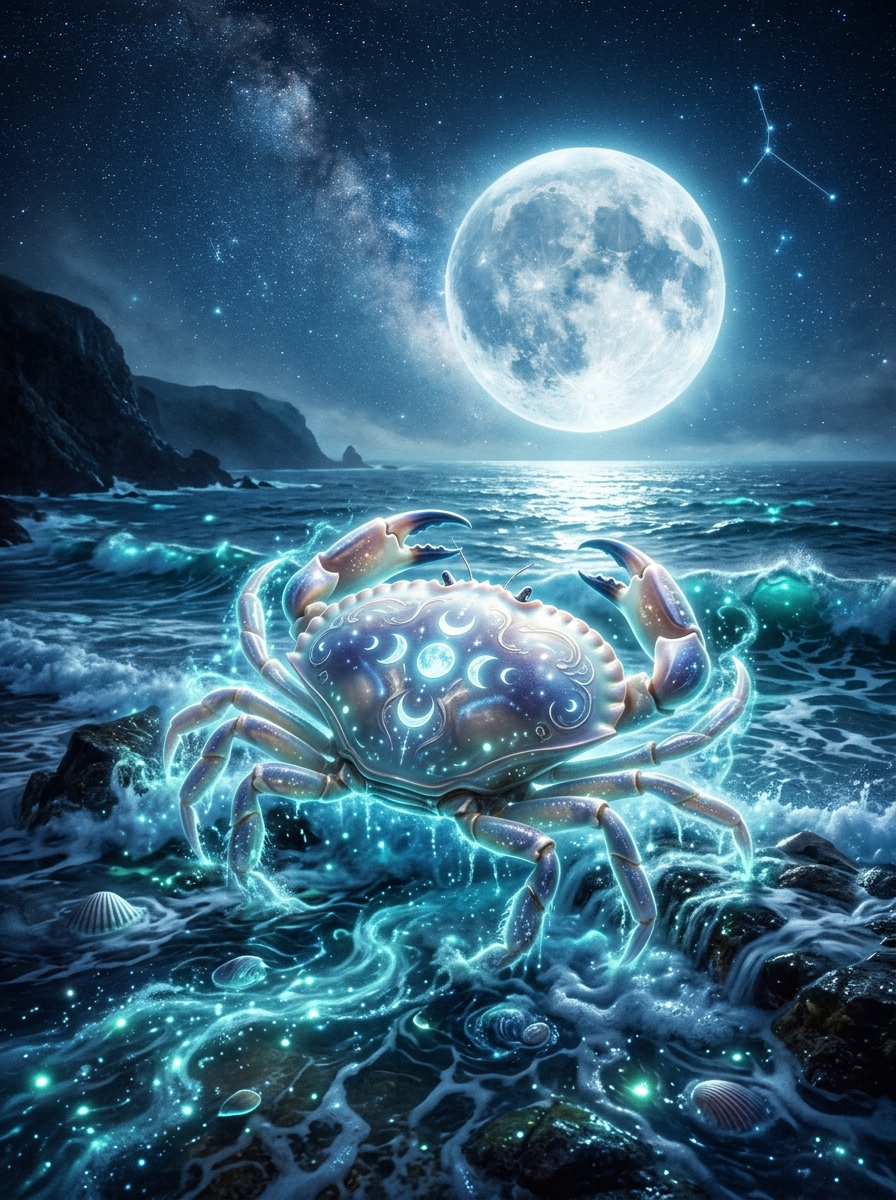
Cancer and the Rhythm of the Horoscope: Beyond Linear Time
Most people approach a horoscope the way they approach a weather forecast: a finite prediction for a fixed window, after which the reading expires and a new one begins. For Cancer, this model is too rigid, too mechanical — and ultimately too shallow to be useful. Cardinal water does not move in straight lines. It swells, retreats, pools in hidden places, and wells up again without warning. The horoscope, read through a Cancer lens, is less a forecast and more a tide chart.
Carl Jung spent decades mapping the inner landscape of the psyche, and his concept of the alchemical vessel — a sealed container in which raw, unprocessed material is slowly transformed into something refined — is one of the most illuminating metaphors for how Cancer actually experiences time and astrological influence. The sign does not simply receive transits and move on. It holds them. It marinated in a lunar square to Saturn for weeks after the aspect perfected, still feeling the residue of that restriction, that unease. It revisits a beautiful Venus trine from last month with a nostalgic ache that can seem disproportionate to outside observers. Nothing passes through Cancer quickly or cleanly; every astrological event is metabolized slowly, deeply, in the vessel of feeling.
The Cardinal Quality and Its Contradiction
There is a persistent misconception that Cancer's emotional depth makes it passive, reactive, or even stuck. In fact, Cancer is a cardinal sign — the initiatory water, the one that begins the season, that cracks open a door and steps through first. The contradiction this creates is real and worth sitting with: Cancer initiates from the inside out. It does not charge forward like Aries or strategize like Capricorn. It moves sideways, as the crab moves, sensing the contours of a situation through touch and intuition before committing. This oblique approach is not evasion. It is intelligence of a specific kind — the intelligence of the body, the gut, the instinct sharpened by long attention to emotional weather.
When you are reading a Cancer horoscope, you are not looking for events. You are looking for climate. The difference matters enormously. An event-based reading asks: "What will happen?" A climate-based reading asks: "What kind of emotional terrain will I be navigating, and how can I move through it with awareness?" This reframe — from prediction to preparation — is the single most useful shift a Cancer-identified reader can make.
The Symbol of the Crab: Shell, Claw, and the Art of Retreat
The crab's biology is the perfect symbol for Cancer's psychological architecture. At the center of the animal is something exquisitely soft — organs, vulnerability, life itself — wrapped in a carapace of calcium carbonate, one of the hardest substances in nature relative to the creature's size. Cancer is built the same way: profound tenderness armored by what can seem, from the outside, like guardedness, moodiness, or even coldness.
Steven Forrest, in his writing on evolutionary astrology, emphasizes that the Cancer archetype is not fundamentally about neediness or sentimentality, though pop astrology reduces it to both. The deeper drive is toward safety — not comfort in the passive sense, but the kind of sanctuary that makes genuine vulnerability possible. Cancer builds a shell not to avoid experience but to create the conditions under which real experience can be metabolized without annihilation.
The Claw: Tenacity Disguised as Attachment
The crab's claw is worth its own meditation. It is the instrument of the oblique approach — reaching around rather than through, grasping and holding rather than cutting or piercing. In psychological terms, this translates as tenacity that can tip into attachment. Cancer holds on. It holds on to people, to memories, to versions of the past that may no longer exist in the present. Liz Greene, whose Saturn: A New Look at an Old Devil and The Astrology of Fate map the psychological underworld of each sign with clinical precision, describes the Cancer grip as one that is ultimately oriented toward continuity — a desperate need to ensure that what was loved is not lost.
This is neither a flaw nor a virtue in isolation; it is a structural feature. When working with Cancer transits in your horoscope, pay attention to what you are holding and why. Jupiter moving through your fourth house might be an invitation to expand your sense of home — but Cancer can experience even beneficial expansions as threatening to existing attachments. The shell tightens before it loosens. Recognizing that reflex is the first step toward conscious navigation.
The Art of Strategic Withdrawal
Perhaps the most underrated Cancer skill is the retreat into the shell — not as defeat but as self-regulation. When the emotional temperature rises beyond a manageable threshold, Cancer instinctively withdraws. Therapists might call this a healthy limit on stimulation. Forrest frames it as the crab's biological wisdom: the only way to survive being caught in a tide pool is to pull in and wait for the wave to pass.
For practical horoscope reading, this means that during intense transits — a Pluto opposition to your natal Moon, a Solar Eclipse in your first house — the impulse to withdraw and be still may not be avoidance. It may be precisely the right response. The horoscope is not always telling you to act. Sometimes it is telling you to hold.
The Moon's Sovereignty: The 28-Day Cycle as Inner Calendar
No planet governs a sign more intimately than the Moon governs Cancer. This is not mere rulership in the technical sense — it is something closer to identity. The Moon is the fastest-moving body in astrology, cycling through all twelve signs every 28 days, spending roughly two and a half days in each. For most signs, the Moon's transit is ambient background music. For Cancer, it is the melody itself.
The Moon's 28-day orbit mirrors the human biological rhythms that govern sleep, digestion, hormonal cycles, and emotional regulation. Long before astrology codified this correspondence, ancient cultures organized their agriculture, their rituals, their wars, and their harvests around the Moon's cycle. The esoteric tradition — from the Hermetic texts of antiquity to Arthur Edward Waite's systematic organization of Western occultism — consistently treats the Moon as the mediator between the material world and the subtle world of feeling and imagination.
The Moon as a Mirror
What the Moon does, psychologically, is reflect. It has no light of its own; it borrows from the Sun and shows it back to us, distorted by distance and angle. This is an exact description of the Cancer function: to take in experience, hold it in the emotional body, and reflect it back — to oneself first, and then to others. When the Moon is well-aspected in a Cancer chart, this reflective capacity becomes an extraordinary gift for empathy, for reading a room, for knowing without being told what someone needs. When it is stressed — by a square to Neptune, by opposition to Saturn — the reflection becomes funhouse-mirror distortion, and the emotional body becomes a hall of echoes rather than a clear pool.
Reading your Cancer horoscope with awareness of where the Moon is in its 28-day cycle is the single most concrete tool you have for accurate self-assessment. The New Moon in your chart is not just an abstract point of potential. It is a physiological and psychological reset.
Navigating the Four Lunar Phases: A Practical and Psychological Map
The four primary phases of the Moon — New, Waxing, Full, and Waning — are not merely astronomical descriptions. For Cancer, they are experiential states, each with its own emotional tone, its own optimal activities, and its own particular traps.
New Moon: The Dark Interior
The New Moon occurs when the Sun and Moon conjoin in the same sign and degree. The sky is dark; the Moon is invisible. Psychologically, this corresponds to the most introverted phase of the lunar month — a moment of inception that happens below the threshold of consciousness. Cancer experiences New Moons with particular intensity, especially New Moons in Cancer (which occur once a year, usually in late June or July) and New Moons that aspect natal Cancer planets.
This is the phase for seeding intentions rather than executing plans. The alchemical vessel is sealed; the raw material is being placed inside. Practically: journal rather than announce. Feel rather than perform. Allow the next thing to form in the dark before bringing it into light. Forrest's evolutionary astrology emphasizes that the New Moon phase in the natal chart corresponds to a soul entering incarnation without a clear picture of what it came to do — purely receptive, purely instinctual. In transit, it echoes this quality.
Waxing Moon: The Rising Tide
As the Moon moves from New to Full, growing visibly each night, the emotional and energetic current builds. For Cancer, this is the phase of active nurturing — of taking the intention seeded at the New Moon and doing the practical work to grow it. This is when Cancer's formidable maternal instinct (regardless of gender) comes online: the capacity to tend, feed, protect, and coax things toward fullness.
The trap of the Waxing phase, for Cancer in particular, is over-attachment to the outcome. Because Cancer invests so deeply in what it nurtures, the growing thing can become a projection screen for all of Cancer's unmet emotional needs. Liz Greene's depth-psychological approach would recognize this as the Shadow Mother — the nurturer who cannot allow the thing she tends to mature beyond her control. Awareness of this dynamic during Waxing phases allows Cancer to invest generously without gripping.
Full Moon: The Illuminated Unconscious
Full Moons are the phase most people associate with emotional intensity, and Cancer feels this more acutely than almost any other sign. The Sun and Moon are in direct opposition — literally facing each other across the zodiac — and what was seeded two weeks ago is now visible, for better or worse. What was hidden in the dark of the New Moon is now fully lit.
Psychologically, the Full Moon activates the unconscious. Carl Jung's framework of the shadow — the parts of the psyche we have not yet integrated — tends to surface at Full Moons. For Cancer, whose unconscious is already unusually close to the surface, Full Moons can feel overwhelming: the tide comes in fast and high, emotions that seemed manageable at mid-month are suddenly oceanic. Old memories surface. The need for connection peaks. The need for solitude can spike paradoxically at the same moment.
The Full Moon is not, however, a crisis. It is an illumination. What you discover about yourself at a Full Moon is information that will help you navigate the next two weeks more consciously.
Waning Moon: Release, Cleansing, and the Grateful Goodbye
After the Full Moon, the light begins to decrease. The Waning phase moves from Full to New, from outer to inner, from manifestation back to potential. For Cancer, this is the hardest phase — and the most necessary. The crab's tenacity, its grip, its orientation toward preservation and continuity, makes release feel like annihilation. Letting go of what is no longer serving the growth of the vessel can register as loss rather than completion.
The Waning Moon is the phase for editorial work in the broadest sense: pruning relationships that have become draining, releasing resentments that have calcified into the shell, completing grief cycles that have gone on too long, cleaning and clearing the home (Cancer's sacred domain) in preparation for the next New Moon. The esoteric tradition associates the Waning phase with banishing work, with the crone aspect of the Triple Goddess — the wisdom of ending, of knowing when a thing is complete.
Practically, the Waning Moon is the best time to finish ongoing projects rather than start new ones, to have difficult closing conversations, and to rest more deliberately than usual. The tide is going out; swim with it, not against it.
Daily Transits and the Cancer-Capricorn Axis: Learning the Temperature
Beyond the monthly lunar cycle, Cancer feels every daily shift in the Moon's sign position. When the transiting Moon moves into Cancer, sensitivity peaks: emotional attunement sharpens, boundaries become more permeable, and the need for comfort and security is acute. This is the phase to be gentle with yourself and others, to cook rather than order in, to call the person you've been meaning to call, to create rather than consume.
When the Moon moves into Capricorn — the sign directly opposite Cancer on the zodiac wheel — the quality changes sharply. The Cancer-Capricorn axis is one of the most instructive polarities in Western astrology, representing the fundamental tension between private emotional life (Cancer) and public structural life (Capricorn), between the Mother and the Father, between the home and the institution, between vulnerability and boundaries.
Moon in Capricorn: The Opposition as Teacher
The Moon in Capricorn transit can feel, from a Cancer perspective, like the emotional heating system has been shut off. Capricorn's Moon is cool, strategic, oriented toward productivity and hierarchy rather than feeling and connection. For Cancer rising or Cancer Moon individuals especially, Moon in Capricorn days can feel alienating — as though the world suddenly speaks a language they don't.
The evolutionary invitation here is not to suffer through these transits but to learn from them. Capricorn's discipline, its boundary-setting, its capacity to function effectively regardless of emotional state — these are precisely the qualities that Cancer needs to develop in order to move beyond reactivity into maturity. Liz Greene identifies the Cancer-Capricorn axis as the axis of mother-father integration: the work is to carry both, to be capable of both tenderness and structure, both nurture and limit-setting.
The Eclipses: Threshold Moments on the Axis
When eclipses fall on the Cancer-Capricorn axis — Solar Eclipses at New Moons, Lunar Eclipses at Full Moons — the intensity is amplified significantly. Eclipse seasons create threshold moments: openings or closings that are more fated, more structurally significant, than regular lunations. For Cancer, a Solar Eclipse in Cancer marks the beginning of a new chapter in the domains of home, family, emotional identity, and private life. A Lunar Eclipse in Cancer (with the Sun in Capricorn) illuminates the tension between personal needs and professional demands, between what you need emotionally and what the world expects of you structurally.
Eclipse degrees remain sensitive for up to eighteen months after the eclipse itself. If a planet in your natal chart sits near an eclipse degree, transiting planets will activate that degree repeatedly, creating a sustained theme rather than a one-time event.
The Myth of Karkinos and the Great Mother: Deep Roots of the Crab
The constellation Cancer traces its mythological origins to Karkinos — a giant crab sent by the goddess Hera to distract Heracles during his battle with the Lernaean Hydra. The crab pinched the hero's foot; Heracles crushed it underfoot. Hera, in honor of the creature's loyalty and sacrifice, placed it among the stars.
The myth is deceptively simple, but its layers repay attention. Karkinos is not the hero of the story. It is the helper of the divine feminine, a small creature called to serve a purpose far larger than itself — and crushed for its trouble. This is the Cancer archetype in its mythological form: the willingness to sacrifice comfort for the protection of the beloved, the readiness to enter a battle in a supporting role rather than a starring one, and the melancholy of being overlooked, underestimated, or simply outmatched by Herculean force.
The Great Mother and the Past-Orientation
In the broader Western esoteric tradition, Cancer is associated with the Great Mother archetype — not a specific deity but a primordial organizing principle of nourishment, protection, and the cyclical return of all things. Jung's writing on the mother complex in Symbols of Transformation and later in the Collected Works maps both the gift and the wound of this archetype with extraordinary care: the gift is the capacity for unconditional care; the wound is the inability to release what must be released, to let the child grow into the world, to allow the thing held to leave the vessel.
Cancer's past-orientation — its memory, its tendency to look backward, to preserve, to memorialize — is the shadow side of this Great Mother energy. The past is not the enemy; it is the ground of identity. But when the orientation toward the past prevents engagement with the present, it becomes what Forrest calls the "evolutionary regression" — the soul choosing comfort over growth, the known over the necessary.
In practical horoscope terms, this means watching for cycles in which you are not reading the present transit accurately because you are overlaying a past experience onto it. A new partner is not your old partner. A new professional chapter is not a repetition of the one that ended badly. The vessel must be emptied before it can hold something new.
Karkinos and the Courage of the Small
There is a deeper courage in the Karkinos myth that often goes unrecognized. The crab did not survive its mission. It acted anyway. This is the Cancer courage that pop astrology rarely addresses: the willingness to be vulnerable without guarantee of safety, to open the shell in full knowledge that the world might not deserve it. The crab moves sideways not because it is afraid to go forward, but because that is how its body is built — and it goes anyway.
When your horoscope asks you to step into something new, something uncertain, something that requires the shell to open even a crack — this is the mythological inheritance you are drawing on. Karkinos lives in the sky, placed there by a goddess, because it acted from love rather than calculation.
Integrating Your Cancer Horoscope: A Framework for Conscious Reading
All of this — the alchemical vessel, the lunar phases, the Cancer-Capricorn axis, the myth of Karkinos — comes together in a practical framework for how to actually read a Cancer horoscope with depth and accuracy.
Start with the Moon. Before you read any forecast, check where the transiting Moon is. Its sign, its phase, and its aspects to your natal chart form the immediate emotional weather. Then move outward to the slower planets: where is Jupiter in relation to your Cancer placements? Saturn? Pluto? These slower transits set the structural context — the underlying terrain over which the Moon is moving.
The Emotional Body as Instrument
Cancer's greatest asset in astrological self-understanding is its body. Not the physical body in isolation, but the emotional body — the field of sensation, intuition, and felt knowing that processes information faster than the rational mind. When you read a horoscope, notice what it evokes in the chest, the stomach, the throat. A transit description that creates a subtle tightening in the solar plexus is telling you something the rational mind might overlook. A description that produces an inexplicable sense of relief is worth attention.
This is not magical thinking. It is somatic intelligence — the kind that Jungian analysts, somatic therapists, and mindfulness practitioners have been mapping for decades. For Cancer, this intelligence is native. The work is to trust it rather than second-guess it.
When to Act and When to Hold
One of the most practical questions for Cancer horoscope reading is: is this transit asking me to move or to wait? Cardinal signs have an initiatory drive, and Cancer is no exception — but cardinal water initiates from the inside out. The outer action follows an inner readiness that often takes longer to develop than the calendar would prefer.
A rough heuristic: New Moon and Waxing phases favor initiation. Full Moon and Waning phases favor assessment, integration, and release. Transits from Jupiter and Venus invite expansion. Transits from Saturn and Pluto invite depth work, structural change, and the kind of transformation that rarely feels good in the moment. Eclipse seasons are threshold moments — act on them deliberately, not reactively.
FAQ: Cancer and the Horoscope
What makes Cancer's experience of horoscopes different from other signs?
Cancer experiences astrological transits as emotional and psychological weather rather than external events. Because the Moon — the fastest-moving and most internally resonant planetary body — rules Cancer, every lunar transit is felt with unusual acuity. Cancer does not merely observe a transit; it metabolizes it, carries it, reflects on it long after it has moved on. This makes Cancer one of the most subjectively responsive signs in the zodiac, and it means that horoscope reading, for Cancer, is less about prediction and more about emotional preparation and self-regulation.
How should I use the lunar cycle if I have Cancer placements?
Think of the 28-day lunar cycle as your personal emotional calendar. The New Moon is the time to set internal intentions and turn inward. The Waxing phase (New to Full) is for active growth and nurturing of those intentions. The Full Moon illuminates what is ready to be seen — including unconscious material. The Waning phase (Full to New) is for release, completion, and rest. If you have your natal Moon, Sun, Rising, or multiple planets in Cancer, these phase shifts will be distinctly felt rather than vaguely sensed.
What is the Cancer-Capricorn axis and why does it matter for my horoscope?
The Cancer-Capricorn axis is the polarity between private emotional life (Cancer) and public structural life (Capricorn). When planets transit Capricorn — or when the Moon moves through Capricorn — Cancer individuals often feel a kind of emotional cooling or external pressure that can seem at odds with their inner life. This axis is where Cancer does its most important developmental work: learning to integrate the warmth of the personal sphere with the discipline and boundary-setting of the institutional sphere. Eclipses on this axis — which occur in cycles roughly every nine years — mark significant chapters of this integration work.
How do I avoid becoming fatalistic when reading my Cancer horoscope?
The antidote to fatalism is the distinction between climate and event. A horoscope describes the emotional and energetic terrain available during a given period; it does not dictate what you will do with that terrain. Liz Greene and Steven Forrest both emphasize the importance of treating astrology as a tool for self-awareness rather than a script handed down by fate. When a challenging transit is described — say, Saturn opposing your natal Moon — the question is not "what bad thing will happen?" but "where am I being asked to grow up, set limits, or take structural responsibility for my emotional life?" This reframe converts the transit from a threat into an invitation.
What is the myth of Karkinos and how does it relate to Cancer's psychology?
Karkinos was a giant crab sent by the goddess Hera to distract Heracles during the battle with the Hydra. It was crushed underfoot, and Hera placed it in the stars. The myth encodes Cancer's deepest psychological themes: loyal service to those we love, the willingness to act from love even without guarantee of safety, the bittersweet fate of the helper who is overlooked by history. It also connects Cancer to the Great Mother archetype and to the past-orientation that is simultaneously Cancer's greatest gift and its most significant evolutionary challenge. Understanding Karkinos is a way of understanding why Cancer holds on — and what it takes to let go.
How do eclipses affect Cancer placements specifically?
Eclipses are amplified New and Full Moons that fall near the lunar nodes, and they carry an elevated sense of fate or structural inevitability. For Cancer placements, eclipses in Cancer (Solar Eclipses) tend to open new chapters in home, family, emotional identity, and private life. Eclipses in Capricorn (Lunar Eclipses with the Sun in Cancer) tend to illuminate the tension between personal emotional needs and external structural demands. Eclipse degrees remain sensitive for up to eighteen months, meaning that subsequent planetary transits over those degrees will reactivate the themes initiated at the eclipse itself. Cancer individuals are advised to pay close attention to what occurs in the two weeks surrounding any eclipse that aspects their natal Cancer placements — these are often the moments of genuine turning points, not merely dramatic feelings.
Comments
Loading comments…