The New Moon: Archetypes of the Dark Moon and Lunar Renewal
What is a New Moon? Astronomical and Astrological Basics
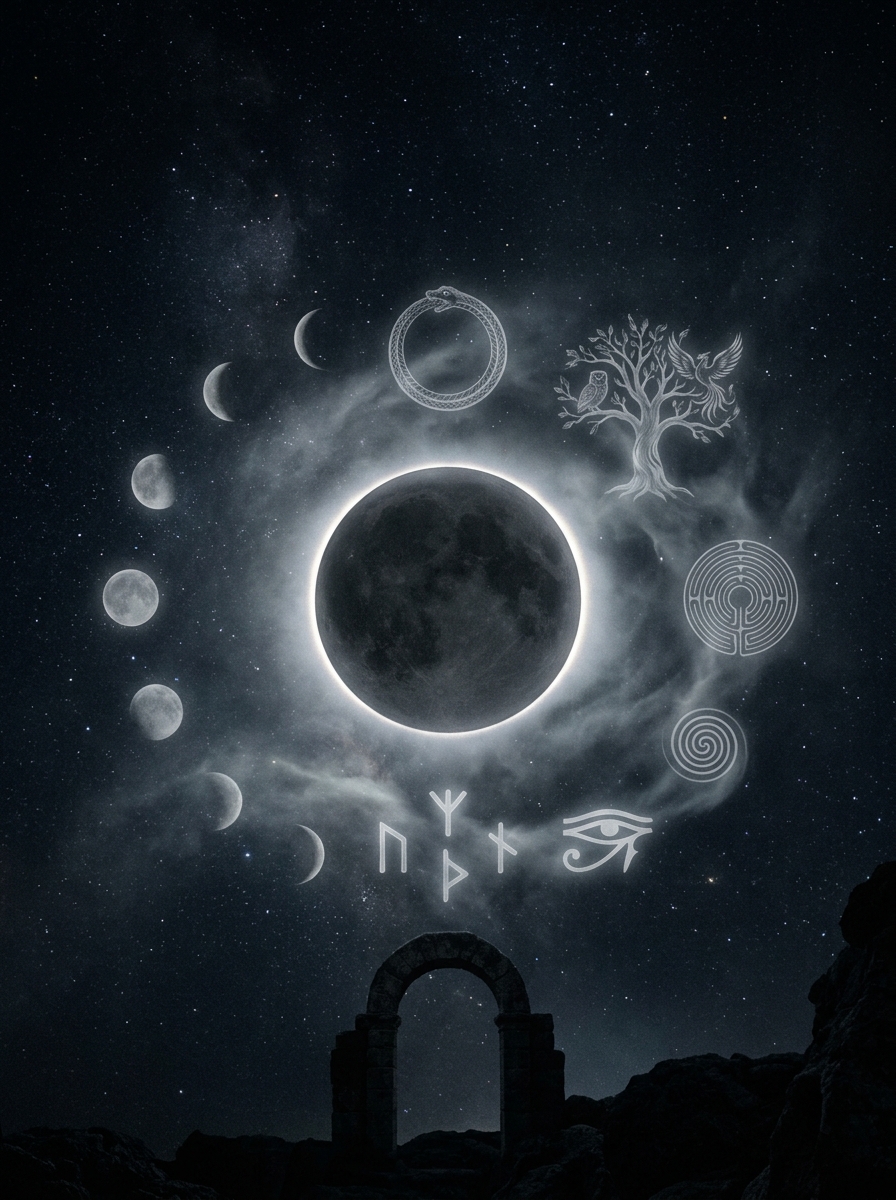
To understand the mystery of the new moon, we must first look to the sky. From a purely astronomical perspective, the new moon marks the beginning of the synodic cycle, which spans approximately 29.5 days. This celestial event occurs when the Sun and the Moon align at the exact same degree of the zodiac. In astronomical terms, this alignment is known as a conjunction. Because the Moon is positioned directly between the Earth and the Sun, its illuminated side faces away from us. Consequently, the moon becomes completely invisible to the naked eye. In the night sky, it leaves only a silent, dark void where its silvery glow usually rests.
Astrologically, the conjunction of the Sun and the Moon is one of the most potent alignments in the cosmos. The Sun represents the conscious ego, our vitality, and the active principle of light (logos). The Moon represents the unconscious mind, our emotions, and the receptive principle of darkness (eros). When these two luminaries meet, we witness a brief, sacred union of opposites. This conjunction is a cosmic reset button. Because the Moon's light is temporarily extinguished, the normal flow of emotional and psychic feedback is quieted. This silence creates a space where the conscious and unconscious can merge, permitting new seeds of awareness to plant themselves in the fertile soil of the psyche.
The Mechanics of Conjunction
In the tropical zodiac, the Sun and Moon move at different speeds. The Moon, being the swiftest of the celestial bodies, completes its orbit around the Earth in about 27.3 days, but because the Earth is also moving around the Sun, it takes the Moon slightly longer to catch up and align with the Sun again. When they meet, they form a zero-degree aspect. During this conjunction, the solar and lunar energies are concentrated in a single point of the zodiac.
This concentration of energy acts like a cosmic seed. In the words of astrologer Steven Forrest, the new moon is a time of instinctual action. We cannot see the path ahead, nor can we reflect on where we have been. Instead, we are driven by a subtle, internal nudge. The ego’s bright light is temporarily dimmed, allowing the deep, instinctual wisdom of the unconscious to guide our impulses. It is a moment of pure potentiality, where the past has been dissolved and the future has not yet taken shape.
The Invisible Phase: Rebirth in the Darkness
For several days surrounding the astronomical conjunction, the sky remains dark. In ancient times, this period was known as the "interlunium" or the dark moon. While modern astrology often uses the terms "new moon" and "dark moon" interchangeably, esoterically they represent two distinct phases of the same transition. The dark moon is the final phase of the old cycle, a time of release and dissolution. The new moon is the exact moment of conjunction and the subsequent appearance of the first silver crescent in the evening sky.
During this invisible phase, there is a natural turning inward. Without the external reflection of lunar light, our attention is drawn away from the outer world and directed toward our inner landscape. This invisibility is not a lack of energy, but rather energy in its most concentrated, potential form. It is the pause between the exhalation and the inhalation, the moment of absolute stillness before the heart beats again. By aligning ourselves with this darkness, we learn to trust the unseen processes of growth that occur beneath the surface of our conscious lives.
The Archetypal Dimension of the Dark Moon: Womb of Silence and Nigredo
To penetrate the deeper meaning of the new moon, we must look beyond the mechanics of the solar system and enter the realm of archetypal psychology. Carl Jung spent much of his later life studying the symbolism of alchemy, recognizing that the ancient alchemists were not merely trying to turn lead into gold, but were projecting the psychological process of individuation onto their chemical experiments. The new moon corresponds directly to the first phase of this alchemical transformation: the nigredo, or the blackening.
In the alchemical process, the nigredo represents a state of dissolution, decay, and darkness. It is the necessary breakdown of old structures before any new synthesis can occur. Psychologically, this corresponds to the encounter with the shadow. The shadow, as Jung defined it, consists of those parts of ourselves that we have rejected, repressed, or deemed unacceptable. During the new moon, when the sky is dark, our conscious ego-defenses are weakened, and the contents of the shadow are more likely to bubble up to the surface. Rather than fearing this darkness, the Jungian approach invites us to enter it, recognizing that the nigredo is the fertile ground from which the new self will emerge.
The Jungian Shadow and Lunar Invisibility
Liz Greene, a pioneer of psychological astrology, has written extensively about the relationship between the luminaries and the structure of the psyche. She notes that the Moon is closely linked to our emotional security patterns, our ancestral past, and the automatic behaviors we use to keep ourselves safe. When the Moon goes dark, these security blankets are temporarily stripped away. We may feel a sense of vulnerability, disorientation, or unexplained anxiety.
This vulnerability is actually an invitation to shadow integration. When our usual emotional defenses are offline, we are given a rare opportunity to see ourselves clearly. We can observe our projections, our fears, and our unhealed wounds without the ego’s need to justify or defend them. In the silence of the dark moon, we can ask ourselves: What am I holding onto that no longer serves my growth? What fears are preventing me from stepping into my authentic self? By facing these shadows, we reclaim the vital energy that was previously bound up in repression, transforming it into creative fuel for the cycle to come.
Mysterium Coniunctionis: The Sacred Marriage of Sol and Luna
One of Jung's most profound works is Mysterium Coniunctionis, an exploration of the separation and synthesis of psychic opposites. The conjunction of the Sun (Sol) and the Moon (Luna) at the new moon is the ultimate celestial symbol of this sacred marriage. Sol represents the active, ordering principle of consciousness, associated with the animus, while Luna represents the receptive, fluid principle of the unconscious, associated with the anima.
In our daily lives, these two principles are often in conflict. We struggle to balance our logical minds with our emotional needs, our career ambitions with our domestic desires, and our conscious will with our unconscious impulses. The new moon offers a brief window of integration. In the darkness of the conjunction, the division between these forces dissolves. The animus and anima meet in a quiet embrace, allowing us to align our conscious intentions with our deepest emotional truths. This is not a time for loud action, but for quiet alignment, ensuring that the seeds we plant are rooted in the authentic desires of the soul.
Alchemical Nigredo: Dissolution and Fertile Decay
In the alchemical text Rosarium Philosophorum, illustrated with woodcuts that Arthur Edward Waite and other esotericists studied deeply, the conjunction of Sol and Luna is depicted as a king and queen dissolving into a single body within a dark tomb. This stage of death and decay is essential. Without the decomposition of the old form, the spiritual essence cannot be freed.
The new moon is our personal return to the alchemical tomb. It is a time of fertile decay, where our old identities, outdated beliefs, and exhausted emotional habits are allowed to break down. This process can feel uncomfortable to the conscious mind, which clings to control and stability. However, esoterically, we understand that this decay is the primary condition for new life. Just as a seed must rot in the earth before it can sprout, our old patterns must dissolve before we can manifest a new level of consciousness. The new moon encourages us to surrender to this decomposition, trusting that the darkness is not an end, but a womb of silence.
Hecate and the Threshold: Mythology of the Lunar Crossroads
In the mythic imagination of Western esotericism, the dark moon belongs to Hecate. Unlike the bright goddesses of the crescent and full moon—such as Artemis and Selene—Hecate is the goddess of the night, the underworld, and the liminal spaces. She is the guardian of the crossroads, the places where three paths meet and decisions must be made. Her presence during the new moon reminds us that this phase is not merely a passive void, but an active threshold of transition.
Historically, Hecate was depicted as a triple-faced goddess, holding torches, keys, and daggers. Her torches illuminate the dark paths of the underworld, helping lost souls navigate the shadows. Her keys unlock the doors to hidden mysteries and deeper levels of consciousness. Her daggers cut away the cords of the past that keep us bound to obsolete patterns. When we work with the energy of the new moon, we are entering Hecate’s realm, standing at the crossroads of our own lives and choosing which path to take.
The Guardian of the Dark Moon
In classical Greek myth, Hecate was the only deity who witnessed the abduction of Persephone by Hades. When Demeter searched the earth for her missing daughter, it was Hecate who came to her with a torch, guiding her through the darkness to find the truth. This myth highlights Hecate's role as a guide through psychological crises and periods of profound transition.
When we experience our own personal dark moons—times of grief, confusion, or spiritual emptiness—Hecate stands beside us. She does not try to rescue us from the darkness or rush us back into the light. Instead, she holds her torch high, encouraging us to look closely at our surroundings. She teaches us that the darkness is not something to be feared, but a place of initiation. Under her guidance, the dark moon becomes a space of profound psychic sensitivity, where we can access intuitive insights that are hidden during the bright daylight of the full moon.
Navigating Transition and Liminality
The word "liminal" comes from the Latin limen, meaning threshold. A liminal space is a state of transition, where we are no longer what we were, but have not yet become what we will be. Standing at the crossroads is the ultimate liminal experience. It is a place of profound freedom, but also of intense anxiety, as we must take responsibility for the choices we make.
During the new moon, we find ourselves in this liminal state. The old lunar cycle has ended, and the new one has not yet fully begun. Hecate demands that we sit with this uncertainty. She warns us against making hasty decisions out of fear of the dark. Instead, she invites us to stand at the crossroads, look down each path, and listen to the quiet voice of our intuition. The keys she holds remind us that the solutions to our problems are already within us, waiting to be unlocked when we have the courage to face the unknown.
New Moon Modulation Through the Four Zodiac Elements
The general themes of the new moon—stillness, reflection, and initiation—are modulated and colored by the zodiac sign in which the conjunction occurs. Each sign belongs to one of the four classical elements: Fire, Earth, Air, and Water. Understanding how these elements shape the new moon allows us to tailor our intentions and rituals to the specific cosmic currents of the moment.
+--------------------------------------------------------------+
|                THE FOUR ELEMENTS OF THE NEW MOON             |
+--------------------------------------------------------------+
|  FIRE:   Aries, Leo, Sagittarius   -> Sparking Creative Will |
|  EARTH:  Taurus, Virgo, Capricorn -> Anchoring Seed in Form  |
|  AIR:    Gemini, Libra, Aquarius   -> Conceptualizing Vision  |
|  WATER:  Cancer, Scorpio, Pisces   -> Dissolving in the Abyss |
+--------------------------------------------------------------+
Fire Signs: Sparking the Creative Will
When the new moon falls in a fire sign (Aries, Leo, or Sagittarius), the darkness is charged with a static, electric potential. Fire is the element of spirit, passion, and creative drive. During a fiery new moon, the intention-setting process is focused on taking initiative, expressing individuality, and finding the courage to pursue our passions.
- Aries New Moon: This is the astrological new year, the ultimate cycle of initiation. It calls for bold action, independence, and the courage to pioneer new paths. The focus is on the self, raw desire, and breaking free from limitations.
- Leo New Moon: Here, the focus shifts to creative self-expression, playfulness, and the heart. The intentions set during a Leo new moon are about standing in our light, honoring our unique talents, and cultivating self-love and sovereignty.
- Sagittarius New Moon: This phase invites us to expand our horizons, both intellectually and spiritually. It is a time for setting intentions around education, travel, philosophy, and finding a deeper meaning in life.
During these moons, the challenge is to avoid impulsive starts. The darkness of the new moon requires us to internalize the fire, allowing it to warm our intentions from within rather than burning itself out in a sudden, external flash.
Earth Signs: Anchoring the Seed in Form
An earth sign new moon (Taurus, Virgo, or Capricorn) brings our focus back to the physical world, the body, and the structures of our lives. Earth is the element of manifestation, stability, and slow, deliberate growth. These phases are ideal for planting intentions that require patience, discipline, and practical planning.
- Taurus New Moon: This moon focuses on comfort, financial security, and our relationship with the natural world. It is a time for setting intentions around abundance, physical pleasure, and building self-worth.
- Virgo New Moon: Here, the focus is on refinement, health, and daily routines. The intentions set under a Virgo new moon are centered on healing the body, organizing our spaces, and being of service to others through practical acts of care.
- Capricorn New Moon: This is the moon of long-term ambition, career, and legacy. It calls us to set intentions regarding our professional goals, our public standing, and the structures of authority in our lives.
The earth elements remind us that a seed cannot grow unless it is planted in good soil and watered regularly. These moons ask us to create concrete, actionable steps to support the intentions we set.
Air Signs: Conceptualizing the Vision
Air sign new moons (Gemini, Libra, or Aquarius) stimulate the intellect, social connections, and communication. Air is the element of ideas, perspective, and mental clarity. During these phases, the darkness of the moon is filled with whispers, concepts, and new ways of thinking.
- Gemini New Moon: This moon highlights curiosity, learning, and local community. It is a time for setting intentions around writing, learning a new skill, improving communication, and embracing intellectual flexibility.
- Libra New Moon: The focus here is on relationships, beauty, and justice. Intentions set during a Libra new moon are centered on creating harmony in partnerships, resolving conflicts, and bringing art and balance into our lives.
- Aquarius New Moon: This moon calls us to look to the future, the collective, and our unique individuality. It is a time for setting intentions around community involvement, technological innovation, and liberating ourselves from societal expectations.
The challenge of an air moon is to avoid getting lost in the realm of theory. Ideas are plentiful, but without grounding, they drift away like autumn leaves. We must use these cycles to clarify our thoughts so that we can communicate them with precision.
Water Signs: Dissolving into the Emotional Abyss
When the new moon occurs in a water sign (Cancer, Scorpio, or Pisces), the boundary between the conscious mind and the collective unconscious is at its thinnest. Water is the element of emotion, intuition, and memory. These moons are deeply subjective, calling us to plunge into the depths of our feelings and listen to the whispers of our dreams.
- Cancer New Moon: This moon is focused on home, family, and emotional foundations. It is a time for setting intentions around nurturing ourselves and others, healing ancestral wounds, and creating a safe sanctuary.
- Scorpio New Moon: This is the most intense of the dark moons, focusing on transformation, power, and intimacy. Intentions set under Scorpio are about facing our shadows, releasing psychological blockages, and engaging in deep emotional regeneration.
- Pisces New Moon: This moon represents the end of the entire zodiac cycle, a time of complete surrender and spiritual dissolution. Intentions set here are focused on artistic inspiration, spiritual connection, compassion, and letting go of the ego.
During water moons, the emotional tides can be overwhelming. It is crucial to allow ourselves to feel without judgment, using the sensitive energy of the phase to heal old emotional wounds rather than drowning in them.
How to Work with New Moon Energy: Intentions, Rituals, and Solar Eclipses
Working with the new moon is an art of conscious alignment. It is not about forcing our will upon the universe or using magic to bypass the hard work of personal growth. Rather, it is a practice of co-creation, where we use the natural cycles of the cosmos to structure our internal work.
               NEW MOON INTENTION CYCLE

   +------------------+         +------------------+
   |   1. Dissolve    |  ---->  |    2. Align      |
   | (Release the past|         | (Listen in the   |
   |  in the darkness)|         |  silent womb)    |
   +------------------+         +------------------+
            ^                            |
            |                            v
   +------------------+         +------------------+
   |    4. Nourish    |  <----  |    3. Plant      |
   | (Daily practical |         | (Set concrete,   |
   |  action step)    |         |  clear goals)    |
   +------------------+         +------------------+
The Art of Non-Dogmatic Intention Setting
Many modern guides suggest that setting intentions is as simple as writing a wish list and burning it. However, from a psychologically-informed astrological perspective, intention setting is a deeper process. It requires us to align our conscious desires with our unconscious needs. If we set an intention based solely on ego-driven desires—such as wealth, fame, or control—we are likely to experience internal conflict, as the unconscious Moon will resist the conscious Sun's demands.
To set effective intentions:
- Cultivate Silence: Before writing your intentions, spend time in quiet meditation. Let the noise of the day settle so you can hear your deeper desires.
- Focus on Feelings: Rather than focusing on specific material outcomes, write down how you want to feel as your intentions manifest. For example, instead of writing "I want a promotion," try "I intend to feel confident, valued, and intellectually stimulated in my professional life."
- Keep it Present and Positive: Write your intentions as if they are already occurring, using active, positive language. Use phrases like "I am cultivating..." or "I open myself to..." rather than "I want to stop..." or "I will try to..."
- Align with the Element: Tailor your intentions to the element of the transiting sign, as outlined in the previous section.
Simple, Psychological Rituals
A ritual is a physical action performed with symbolic intent. It acts as a bridge between the conscious mind and the unconscious, communicating our desires in the language of the soul: imagery, symbol, and action. A new moon ritual does not need to be elaborate or dogmatic; it should be personally meaningful and grounded in self-reflection.
- Cleansing the Space: Start by physically cleaning your environment, then clear the air with incense, resin, or a simple bell. This acts as a sensory signal to your brain that you are entering a sacred, reflective space.
- Lighting the Flame: Light a single candle. In the darkness of the new moon, this small flame represents the seed of consciousness, the spark of light that will grow over the coming weeks.
- Journaling the Shadow: Write down the old habits, fears, or beliefs you are ready to let go of. Take a moment to acknowledge how they served you in the past, then burn the paper safely, symbolizing their return to the elemental fire.
- Planting the Seed: Write your intentions on a fresh piece of paper. You can place this paper under a crystal, keep it on your altar, or bury it in a small pot of soil to represent the planting of the seed.
Solar Eclipses: The Great Awakener and Intensified New Moons
Twice a year, a new moon occurs close to one of the lunar nodes, resulting in a solar eclipse. During a solar eclipse, the Moon passes directly between the Earth and the Sun, completely blocking the solar light. In ancient times, eclipses were viewed with terror, seen as portents of doom or the death of the king. Esoterically, we view a solar eclipse as an intensified, supercharged new moon.
       SOLAR ECLIPSE ALIGNMENT (Supercharged New Moon)

       [ Sun ] <======= [ Moon ] <======= [ Earth ]
                          (Blocks Light)
Astrologically, eclipses act as catalysts for major life transitions. They disrupt the normal flow of energy, shaking us out of our complacency and forcing us to confront realities we have ignored. While a normal new moon is excellent for conscious intention setting, an eclipse is a time for surrender. The cosmic currents are too strong to be directed by the ego.
Instead of trying to manifest specific goals during an eclipse, it is wiser to practice radical receptivity. Pay close attention to the events, emotions, and people entering your life at this time. Eclipses often bring sudden endings and unexpected beginnings, clearing away the obstacles that are blocking our evolutionary path. By surrendering to the eclipse energy, we allow the universe to realign our lives with our soul's true purpose.
Frequently Asked Questions about the New Moon Phase
How do I find which house the new moon is transiting in my birth chart?
To find where the new moon is transiting in your birth chart, you will need your birth date, time, and location to calculate your natal chart. Once you have your chart, find the current degree and sign of the new moon (this information is widely available in astrological calendars). Look for that sign in your natal chart and locate the house it corresponds to.
For example, if the new moon is at 15 degrees of Taurus, find Taurus on the outer wheel of your chart and see which house contains that degree. The themes of that house will show you where the new moon cycle will manifest in your life. If it transits your Second House, the focus will be on finance and self-worth; if it transits your Seventh House, the focus will be on close partnerships and relationships.
Is a new moon the same as a dark moon, or are they different phases?
While these terms are often used interchangeably in casual astrology, they are distinct esoterically and astronomically. The dark moon refers to the last three days of the old lunar cycle, when the moon is completely dark and invisible. This is a time of ending, dissolution, and releasing what was.
The new moon is the exact moment of the Sun-Moon conjunction and the subsequent return of the light. Psychologically, the dark moon is the preparation of the soil, while the new moon is the planting of the seed. Both phases are essential parts of the cycle of renewal, but the dark moon requires rest and release, while the new moon invites introspection and intention-setting.
Can I perform intention-setting rituals during a solar eclipse?
It is generally recommended to avoid active intention-setting during a solar eclipse. Eclipses carry highly volatile, unpredictable energy, and are closely aligned with the lunar nodes, which represent karmic destinies. Setting specific ego-driven intentions during an eclipse can lead to unexpected and chaotic results.
Instead of trying to direct the energy, use the period of a solar eclipse for meditation, introspection, and surrender. Let the eclipse reveal what needs to be changed in your life, rather than trying to force a change yourself. It is a time to listen, not to speak.
How long does the influence of a new moon last?
The immediate cycle of the new moon lasts for about 29.5 days, moving from conjunction, to the full moon peak, and back to darkness. This is the minor lunar cycle. However, there is also a longer cycle known as the Gestation Cycle, which tracks the relationship between the new moon and subsequent phases in the same sign over a 2.5-year period.
The intentions you set at a new moon in Taurus, for example, will reach a first turning point nine months later at the Taurus first-quarter moon, peak at the Taurus full moon nine months after that, and find final resolution at the last-quarter Taurus moon another nine months later. Thus, while the emotional cycle is monthly, the spiritual seeds we plant can take up to two and a half years to fully blossom.
Why do I feel extremely tired or emotionally sensitive during a new moon?
The new moon is a time of low light and deep introspection. Without the reflecting light of the Moon, our life-force energy (represented by the Sun) is directed entirely inward. This can manifest physically as fatigue, lethargy, or a need for extra sleep.
Emotionally, the conjunction of the conscious mind and the unconscious can bring hidden feelings, dreams, and memories to the surface, making us feel more sensitive or vulnerable. Rather than trying to fight this tiredness with caffeine or activity, honor your body's request for rest. Trust that this temporary withdrawal of energy is a necessary phase of replenishment, preparing you for the active growth of the waxing cycle.
Comments
Loading comments…