Venus Trine Neptune: Grace, Eros, and the Dreaming Heart
The core dynamic: beauty that reaches beyond itself
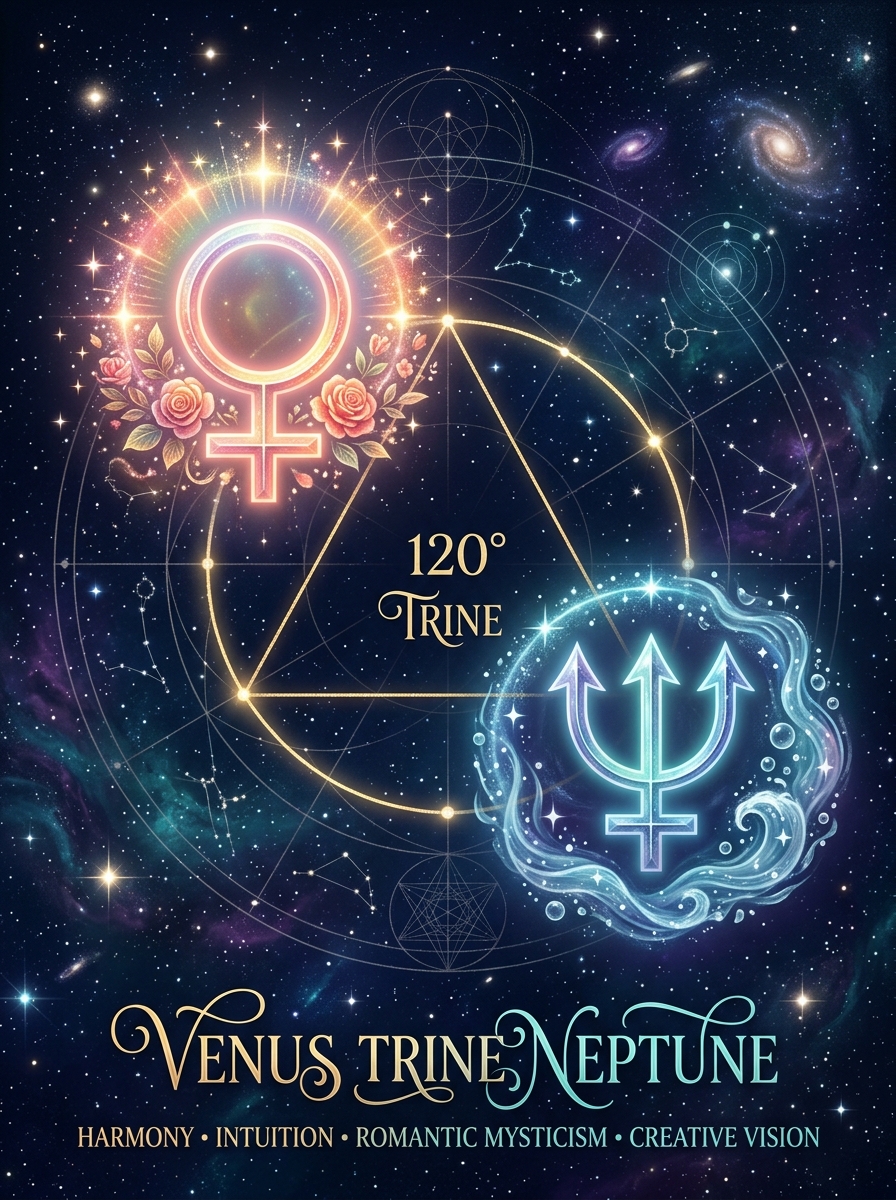
Venus trine Neptune in the birth chart describes an easy passage between desire and transcendence. Venus wants to attract, value, harmonize, and make form beautiful; Neptune wants to dissolve boundaries, idealize, merge, and reunite what seems separated. When they are in trine, those impulses do not fight for control. They collaborate. The result is a person whose love, taste, imagination, and sensual life are often touched by longing for something larger than the ordinary transaction of life.
This is not simply “being romantic.” It is a psyche attuned to atmosphere, symbol, tenderness, and the hidden music inside surfaces. Where a hard Venus-Neptune aspect can create confusion, disappointment, or misplaced devotion, the trine typically gives the native a smoother channel: compassion can feel natural, inspiration can arrive without strain, and aesthetic sensitivity often seems native rather than learned. The shadow is subtle precisely because the gift is real. Ease can become enchantment, and enchantment can become a habit of seeing the world through a veil of desired meaning.
How the trine works psychically
A trine is a flowing aspect, and it often behaves like a talent that does not need to defend itself. You can see the general logic in any discussion of the trine aspect or the broader pattern of a Grand Trine: energy moves, but it may move so gracefully that friction—the force that sharpens discernment—never fully enters the room. With Venus trine Neptune, the flow is between the relational heart and the imaginal ocean. The person may sense beauty before they can explain it, and may love what is wounded, evasive, artistic, spiritual, or longing to be redeemed.
In psychological terms, this aspect often softens the boundary between outer object and inner projection. That can be a blessing when it fuels empathy, art, and forgiveness. It becomes risky when the person falls in love with possibility rather than reality. Still, the trine is not inherently naive. Its best expression is not blindness but poetic realism: the ability to perceive beauty without reducing it to utility.
Where the permeability begins: the psychology of porous boundaries
The smooth flow of the trine makes Venus trine Neptune a natural generator of empathy and aesthetic receptivity, but it also creates a psychological architecture that can blur the line between self and other. The native's inner world is unusually porous: they may absorb the moods of those around them, sense unspoken emotions, and feel an almost instinctive pull toward art, music, or imagery that carries a melancholic charge. This is not a flaw; it is the root of their creative and relational gifts.
Yet permeability without discretion becomes a weakness. The person may project their own longing onto a partner, reading potential as destiny or tenderness as proof of soul recognition. This tendency is most explicit when Neptune is tied to the 7th house or 12th house—as in Neptune in the 7th House or Neptune in the 12th House—but the trine itself already softens the edge. The native may find it difficult to discern genuine compatibility from the intoxicating experience of being seen through a dream.
The remedy is not to become cynical. It is to build a conscious practice of checking inner perceptions against outer facts. The trine’s grace is real, but it requires a second function—call it Saturnian reality-testing—to keep it from drifting into self-deception. Without that check, the native may mistake emotional attunement for truth, and may stay too long in relationships that feel beautiful but lack substance.
Maturation and shadow: when grace hides a missing edge
The real shadow of Venus trine Neptune is not overt conflict but the quiet erosion of boundaries. The native may be generous past the point of self-erasure, trusting past the point of discernment, or aesthetically enchanted past the point of practicality. They may undercharge for their work, romanticize unavailable people, ignore financial realities, or keep relationships alive on feeling alone. The aspect is especially susceptible to the belief that if something is beautiful, it must also be good.
This is the classic Neptunian error, and the trine makes it easier to fall into because it rarely feels dramatic at the start. There may be no crisis, only a slow thinning of boundaries. The native may not even notice that their desires are being shaped by other people’s moods. They may absorb disappointment rather than confront it. Or they may become the dream-keeper in a relationship, carrying all the beauty while someone else handles the mechanics.
The shadow can also appear as saviorism. The person may feel most alive when loving someone broken, ambiguous, or artistically gifted but ungrounded. They may confuse compassion with rescue. Yet Neptune does not ask to fix others; it asks us to recognize the divine in what cannot be controlled. Without discrimination, compassion can become an excuse for tolerating what should have ended long ago.
The best stabilizer for this aspect is form. Routine, clear agreements, budgets, deadlines, and honest naming of needs give the dream somewhere to live. Without some Saturnian structure, the aspect can float. With structure, it can become art that lasts and love that survives contact with time. This is where the chart’s broader pattern matters: a Grand Trine may amplify the ease but also the risk of inertia; a strong earth signature can ground the imagination.
How it plays out in a life: love, art, vocation
Once the core dynamic is understood, its concrete expressions across life domains become clear rather than repeated. In love, the native gives and receives affection in a way that feels hushed, intuitive, and emotionally musical. They are drawn to people who carry some Neptunian charge—artists, healers, mystics, wounded souls, idealists, drifters—because those individuals seem to live partly in another world. When this works well, the relationship feels like mutual sanctification: both people feel seen not just for what they do, but for what they might become. When it fails, the native may idealize a partner into a symbol and then feel betrayed by the person’s ordinary humanity.
Erotically, Venus trine Neptune values mood, suggestion, and emotional attunement over overt conquest. Music, scent, imagery, and atmosphere become part of desire’s grammar. Many people with this aspect are turned on by tenderness itself: the feeling that someone is safe enough to dissolve into. Yet sexual idealization can become a problem if fantasy outruns mutual honesty. The native may prefer longing to disclosure, or may hesitate to name needs directly because doing so feels like a reduction of magic.
In creativity, this aspect is one of the most naturally artistic configurations, especially when supported by water signs or a strong 12th-house emphasis. The person has an instinct for beauty that is less about polish than atmosphere: the right color, the right song, the right phrase, the right silence. They may be drawn to photography, film, dance, poetry, fashion, perfume, music, or design. The creative gift here is not merely style; it is permeability. The native can receive impressions that other people miss, then translate them into form. That translation can feel almost alchemical: sorrow becomes song, fantasy becomes image, tenderness becomes a whole world. For further nuance on how this expresses through specific houses, see Neptune in the 5th House or Venus in the 5th House.
In career terms, the aspect supports work in the arts, counseling, spiritual care, photography, design, film, music, charity, hospitality, or any field where aesthetic intelligence and emotional intelligence overlap. It can also show up in people who do not consider themselves “creative” but who nonetheless curate mood with unusual skill. Their taste is often part vision, part mercy. A look at Neptune in the 10th House or Venus in the 10th House can refine how vocational expression takes shape.
The mature expression: refined receptivity
At its highest, Venus trine Neptune becomes a quiet form of consecration. The person learns that beauty is not an escape from reality but one of the ways reality reveals its soul. Love becomes less about projection and more about blessing what is. Art becomes less about impressing others and more about transmitting feeling with precision. Desire becomes less hungry, more attuned. The native no longer needs every person to be a poem; they can appreciate the poem without mistaking it for a contract.
That is the real gift: not fantasy, but refined receptivity. Venus offers proportion, grace, and affection; Neptune offers mystery, compassion, and dissolution of rigid borders. Together, they make a psyche capable of tenderness without coarseness and imagination without despair. When well lived, this aspect does not merely love beauty. It helps beauty do what it is secretly for—remind the soul that it belongs to something larger than appetite.
Related
- Venus Sextile Neptune: Grace, Longing, and the Beautiful Porosity of Love
- Venus Conjunct Neptune: The Beautiful Risk of Loving What Cannot Be Held
- Venus Opposition Neptune: The Dream That Loves Too Much
- Sun Trine Neptune: The Radiant Current of Inspired Identity
- Moon Trine Neptune: The Soft-Edged Soul and Its Hidden Weather
Comments
Loading comments…