Venus Opposition Neptune: The Dream That Loves Too Much
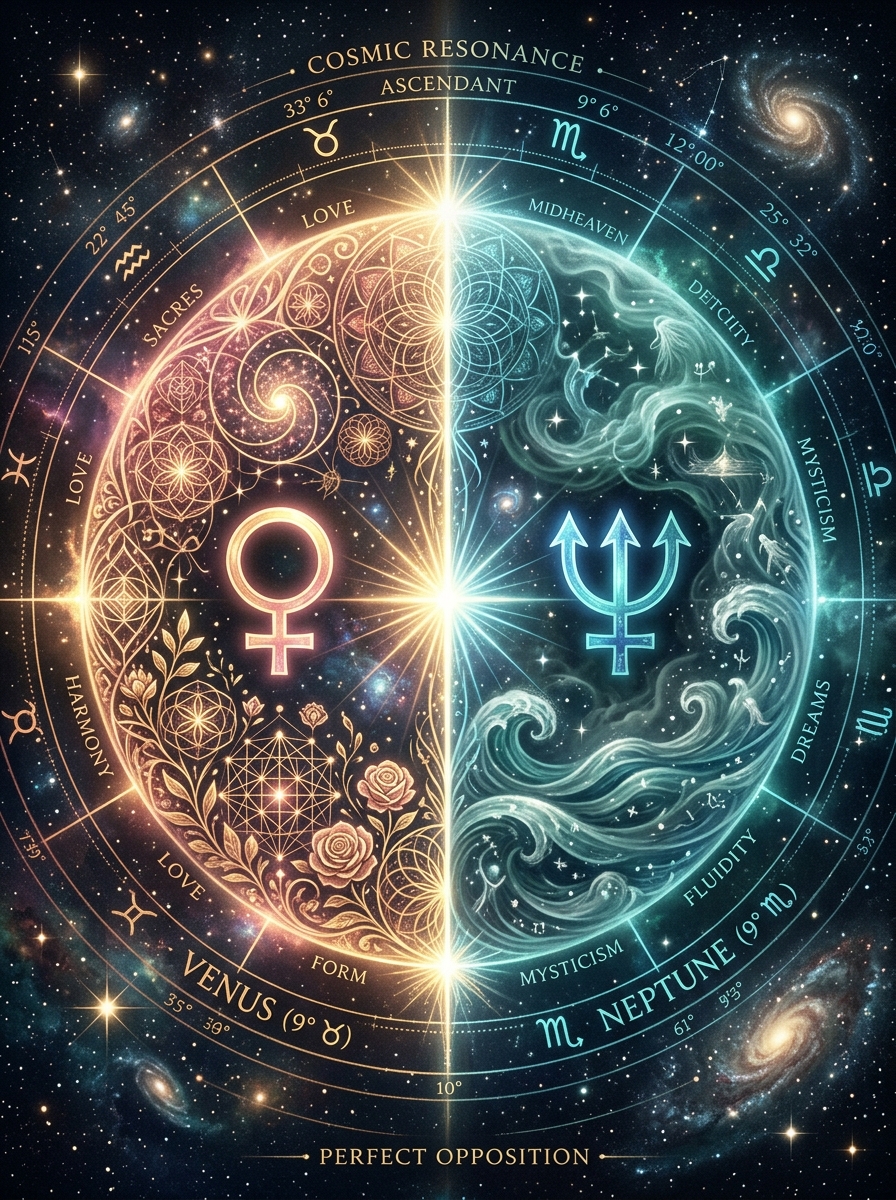
The core dynamic: desire at the edge of dissolution
A Venus opposition Neptune is not merely a romantic flaw. It is a geometry of longing in which the heart reaches for tenderness, beauty, and union—and finds itself facing an ocean that dissolves every boundary. Venus wants to name, value, and hold what is real. Neptune answers by erasing edges, blurring motive, and making the beloved larger than life. The two principles stand across from each other like shores separated by a luminous body of water. One side craves proportion, pleasure, mutuality; the other craves transcendence, surrender, the undivided dream. Neither can be abandoned because both are true.
This is not idealization in the shallow sense. The native does not merely overvalue another person; they perceive a soul-beauty that ordinary affection cannot contain. Neptune supplies a veil that makes a glance feel fated, a touch feel redemptive. For a moment, love becomes sacred. That moment is real—but it is also a projection. To understand this aspect you must hold both truths: the gift and the wound are born from the same porousness. For a fuller sense of the opposition as a structural mirror rather than a conflict, see the opposition aspect in astrology.
How the opposition lives
The psyche here is split between human sweetness and something beyond the human. Love is never only about compatibility, shared habits, or stable affection. It is also about devotion, meaning, salvation, aesthetic transport. The native may feel a genuine hunger for gentleness, but the nervous system is easily seduced by what feels ethereal, elusive, or redemptive. Attraction can be immediate and uncanny—not because of obvious chemistry alone, but because the other person seems to carry the music the native has been missing. The tension is that Venus demands clarity while Neptune resists being pinned down. The result is an oscillation between exquisite connection and quiet bewilderment.
Psychological roots: projection as first language
The deepest mechanism here is not naïveté but extraordinary receptivity to projection. In Jungian terms, projection is the first stage of relationship, not its final truth. With Venus opposition Neptune, that stage lasts longer and feels more charged than average because Neptune supplies a screen onto which fantasies, hopes, and unfinished grief can be cast. Venus then attaches value, tenderness, and desirability to the projected image. This is why the native may be drawn to people who are unavailable, ambiguous, wounded, artistically compelling, or simply hard to define—the opacity itself becomes part of the attraction.
The psychological cost is that the native’s own inner life gets outsourced. The “other” carries the missing piece—the luminosity, the redemption, the permission to feel worthy. When the projection breaks, the disappointment is rarely minor. It can feel like spiritual exile: a lover who turns out to be ordinary seems like a betrayal of beauty itself. For a broader understanding of this permeability, see Neptune in the birth chart, where the principle is rooted in the soul’s structure rather than a single aspect.
The shadow that hides in devotion
There is a subtler shadow: the refusal to acknowledge one’s own desire because the ideal has become too grand for any living person to meet. The native may perform sacrificial love, then resent the lack of reciprocity. Or they may accept too little because the drama of yearning feels more familiar than the steadiness of being genuinely loved. Venus here is not weak—it is overwhelmed by the magnitude of what Neptune whispers is possible. The tragic grace of this aspect is that it knows the ecstasy of devotion, but it must learn the ethics of discernment, a subject explored further in Neptune retrograde, where inward revision helps recover inner vision.
Maturation: from enchantment to durable tenderness
The most evolved expression of this opposition does not kill enchantment—it disciplines it. The person learns to let beauty remain mysterious without allowing mystery to become a license for self-erasure. They develop a felt sense of reality that does not require cynicism. They can love deeply and still ask direct questions. They can create atmosphere without living inside illusion. The test is simple and inexorable: can the native tolerate the beloved as human? Can they let the dream be refined rather than shattered by truth?
How it goes shadow first
Before maturation, the aspect often produces a pattern of emotional leakage. Because Venus also governs resources and self-worth, this can show up as blurred financial judgment—undercharging, overgiving, ignoring practical details because the emotional atmosphere seems more important than the ledger. The native may spend on beauty, art, rescue, or experiences that promise transcendence. At best, this is generous patronage; at worst, it is confusion about what is sustainable. The deeper issue is worthiness. If one’s value is organized around being luminous, selfless, or aesthetically pleasing, it becomes hard to ask for clean reciprocity. The psyche confuses being adored with being loved, being needed with being cherished. That distinction is central to the aspect’s growth.
The cultivated gifts
When the same permeability is channeled intentionally, it produces remarkable artistry and compassion. The imagination is tuned to nuance—tone of voice, subtext, emotional weather behind words. This can make for a powerful musician, photographer, poet, counselor, or any role that works by suggestion rather than blunt statement. Neptune loves atmosphere; Venus gives it form. Together they create work that feels emotionally precise, evocative, and hard to forget. The native may also have a gift for recognizing beauty in what is overlooked: the bruised, the fading, the unfinished. In its highest expression, Venus here does not seek prettiness; it sacralizes tenderness. That can make the person an elegant advocate for the vulnerable, especially in intimate or creative settings. For a parallel expression of devotional love, see Venus in the 12th house, where affection prefers the unseen and the sacrificial.
How it plays out in a life
Instead of separate sections for love, career, and money—each of which would re-derive the same dynamic—it is more useful to see how the same core polarity expresses across domains.
In relationships, the native may repeatedly find themselves in bonds that feel fated, redemptive, or spiritually charged. The beloved becomes a religious object, unconsciously asked to heal childhood loneliness or embody an impossible purity. The native presents themselves as endlessly understanding, only to discover they have abandoned their own needs. When the spell breaks, anger mixes with grief because the loss is not only of a person but of a myth. The alternative is to learn to love with eyes open—to let the mystery remain without requiring illusion. For a view of how this dynamic intensifies when Neptune lands in the house of partnership, read about Neptune in the 7th house.
In work and creativity, the same porousness can be a professional asset if channeled into art, healing, or design. The native can read a room, sense unspoken need, and produce work that resonates emotionally. The risk is mistaking atmosphere for accomplishment—finishing projects is harder when the dream already feels complete. The mature version learns to execute while keeping the vision alive.
In money and self-worth, the theme is leakage versus sacred investment. The native may need explicit structures—budgets, contracts, accountability—to protect against their own generous or escapist impulses. The goal is not to kill generosity but to make it sustainable. When the inner sense of value is no longer tethered to being adored, the capacity to give genuinely expands.
Integration: the cultivated soul
When integrated, Venus opposition Neptune produces someone who can love beautifully without losing themselves, create atmospheres that heal rather than seduce, and recognize that the real is not the enemy of the sacred. The heart no longer needs to be deceived in order to feel inspired. The person can stand in the tension between tenderness and truth and remain open. That may be the most important thing this aspect teaches: not how to stop dreaming, but how to dream with eyes open.
This capacity is kin to the broader opposition aspect pattern, where life insists that wholeness is not achieved by choosing one pole and exiling the other. With Venus and Neptune, the task is to let love become real enough to endure, and mysterious enough to remain alive. When that balance is struck, the native becomes a conduit for beauty that is both earthly and transcendent—a rare and durable grace.
Related
- Venus Conjunct Neptune: The Beautiful Risk of Loving What Cannot Be Held
- Sun Opposition Neptune: The Bright Self and the Vanishing Horizon
- Venus Sextile Neptune: Grace, Longing, and the Beautiful Porosity of Love
- Venus Square Neptune: Desire in a Hall of Mirrors
- Venus Trine Neptune: Grace, Eros, and the Dreaming Heart
Comments
Loading comments…