Moon Trine Neptune: The Soft-Edged Soul and Its Hidden Weather
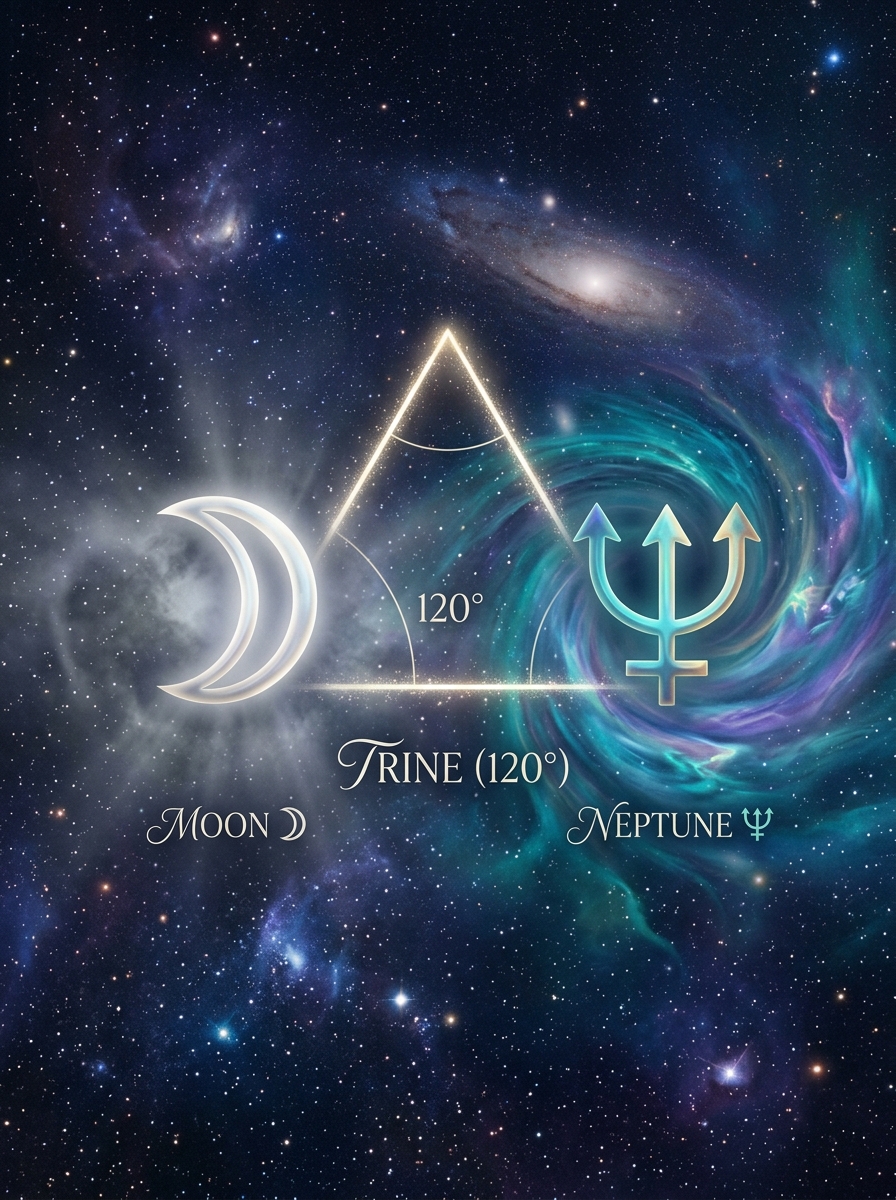
The liquid intelligence: what Moon trine Neptune actually is
Moon trine Neptune is not a battle between instinct and illusion. It is a marriage so natural that the native often does not realize other people experience emotional life differently. The Moon seeks safety, attachment, the body’s memory of warmth; Neptune dissolves edges, opening the psyche to symbol, longing, and the oceanic field beyond the ego. In this trine aspect, they do not oppose each other — they amplify each other without friction. The person feels by atmosphere before analysis, by resonance before proof, by an inward yes or no that arrives as a mood rather than a thought.
That seamlessness is the aspect’s defining fact and its subtle hazard. A trine is a flowing geometry, not a confrontational one. With Moon and Neptune, the flow can become so smooth that the native trusts impressions that were never checked against reality. They assume everyone absorbs the mood of a room, hears the silence between words, or dreams in Technicolor narratives. When the aspect is handled with maturity, it produces emotional perception that is imaginative without becoming sterile, compassionate without becoming sentimental, and receptive without losing all shape. When undeveloped, it produces a life lived in the haze of what feels true rather than what is true.
How it forms: the psyche as permeable membrane
The psychological ground of Moon trine Neptune is an early environment where emotional boundaries were either unusually thin or spiritually charged. The child learned to read the unspoken: a parent’s submerged grief, the family’s collective anxiety, the sacred in the ordinary. This is not a wound in the usual sense — the trine is harmony — but it is a kind of training. The emotional body becomes a finely tuned receiver, and the person grows up assuming that to feel another’s pain is to be responsible for it.
That training makes the psyche a permeable membrane. Sensations, moods, images, and intuitions move through it with little resistance. The native may have vivid dreams, synesthetic experiences, or an uncanny ability to know when someone is lying or hurting. The cost is that the self can become crowded by what it senses. The person may carry other people’s feelings all day and mistake that labor for their own emotional life. The boundary between self and world is not broken — it was never built thick in the first place.
This aspect often appears in charts with strong water emphasis, but even in a dry or angular chart, it is the one soft place where the soul leaks through the armor. A deeper look at Neptune in the birth chart clarifies that this planet is never merely “spiritual” in a vague sense — it is the principle of dissolved edges, and the trine lets that principle move through the emotions with minimal resistance (Neptune in the Birth Chart).
The two currents: devotion and drowning
The mature expression of Moon trine Neptune is devotion with discernment. The person remains tender, but no longer confuses tenderness with passivity. They can feel another person deeply without becoming responsible for that person’s emotional weather. This is the clean channel — compassion that flows without flooding.
The shadow expression is the open wound. The aspect’s gift for attunement can slip into idealization. The native may project soulfulness onto partners, friends, or family members and overlook what is actually being offered. They fall in love with potential, with vulnerability, with the story of rescue. Neptune does not like being cornered by reality, and the Moon does not like being flooded by disappointment, so the psyche learns to avoid hard facts by drifting into fantasy, spirituality, or reverie. The result is a life pattern of “almost” — almost named the feeling, almost set the boundary, almost left the illusion.
The critical distinction between these two currents is boundaries that are gentle but real. Without them, compassion becomes enmeshment. The native becomes a sponge for atmosphere, obligation, and other people’s projections. With them, the same permeability becomes a form of spiritual intelligence. The person can walk into a room and know whether it is grieving, exhausted, or hopeful — and then choose whether to absorb it. That choice is the difference between drowning and staying alive to serve.
This dynamic is especially vivid when Neptune is emphasized through house placement. For those with Neptune in the 12th House, the boundary between self and collective unconscious is already paper-thin, and the trine to the Moon can make the psyche feel like an open channel to the infinite (Neptune in the 12th House). But even in less extreme configurations, the same principle applies: the native must learn to ask, “What am I feeling, what am I sensing, and what am I imagining?” Those three are not the same thing, and naming the difference is the sacred work.
One life, many surfaces: love, work, home
The lived expression of Moon trine Neptune is not a set of separate compartments — it is a single sensitivity that flows into every area. Here is how it surfaces, without re-explaining the dynamic.
Love and the problem of projection
In relationships, the aspect craves soul recognition — to be known without being dissected, to merge without losing self. That longing is beautiful, but it inflates projection. The native may mistake emotional intensity for truth, mistaking a shared dream for a real bond. This is why the aspect can be both radiant and dangerous in romance. When the chart emphasizes the seventh house, the Neptunian mirror becomes especially powerful: the other person becomes a screen for the native’s own unacknowledged depths, as described in Neptune in the 7th House (Neptune in the 7th House). The lesson is not to stop dreaming, but to love what is actually present — not the idea of the beloved.
Work as symbolic translation
Professionally, the aspect favors work that involves empathy, imagination, or symbolic translation. Art, healing, counseling, music, film, spiritual care — any role that asks the person to read what is unsaid. The challenge is practical: vague purpose without structure becomes diffuse exhaustion. Moon-Neptune types need clearer containers than they think they do. Deadlines, contracts, and specific roles do not kill inspiration; they save it from dilution. For those with Neptune in the 10th House, the public path itself feels porous and mission-driven, and the trine to the Moon makes that calling feel personal and urgent (Neptune in the 10th House). The gift is to let inspiration take form, not float indefinitely.
Home as sanctuary or fog
Domestic life under this aspect is rarely merely practical. The Moon wants shelter; Neptune wants a sanctuary where the soul can dissolve into peace. The person may beautify the home, keep music playing, collect objects with emotional resonance, or drift toward spaces that feel enchanted or temporary. In harsher circumstances, home can become a place of escape — sleeping too much, withdrawing too deeply, turning private life into a fog bank. If the aspect ties to the fourth house, the ancestral current becomes especially emotionally available, as explored in Neptune in the 4th House (Neptune in the 4th House). The native may sense the family’s unspoken pain and hold it until it can be transformed.
The art of staying permeable without losing shape
The long-term beauty of Moon trine Neptune is that it teaches how to live with the invisible without surrendering to confusion. It makes the psyche hospitable to dream, grief, music, prayer, and the emotional lives of others. It asks for boundaries, but only so the soul can remain open without losing its name.
That balance is what protects the gift. A Moon-Neptune person who never grounds out becomes swamped. One who grounds but never listens becomes barren. The art is to stay permeable without becoming indistinct. Practical anchors help: sleep, meals, bodywork, time limits, written agreements, friendships that do not romanticize confusion. These are not a betrayal of the aspect’s poetry — they are what allow the poetry to remain true.
For readers exploring the broader architecture of ease in the chart, the trine’s talent is similar in spirit to the dynamics described in The Grand Trine — a harmonious flow that can either become a source of effortless grace or a trap of inertia (The Grand Trine). But here, the harmony is more intimate than architectural. It is a private radio tuned to the invisible frequencies of mood and meaning. The challenge is to keep the signal clean and the antennae strong, without mistaking every whisper for a command.
Comments
Loading comments…