Venus Conjunct Neptune: The Beautiful Risk of Loving What Cannot Be Held
The core dynamic: love meets the infinite
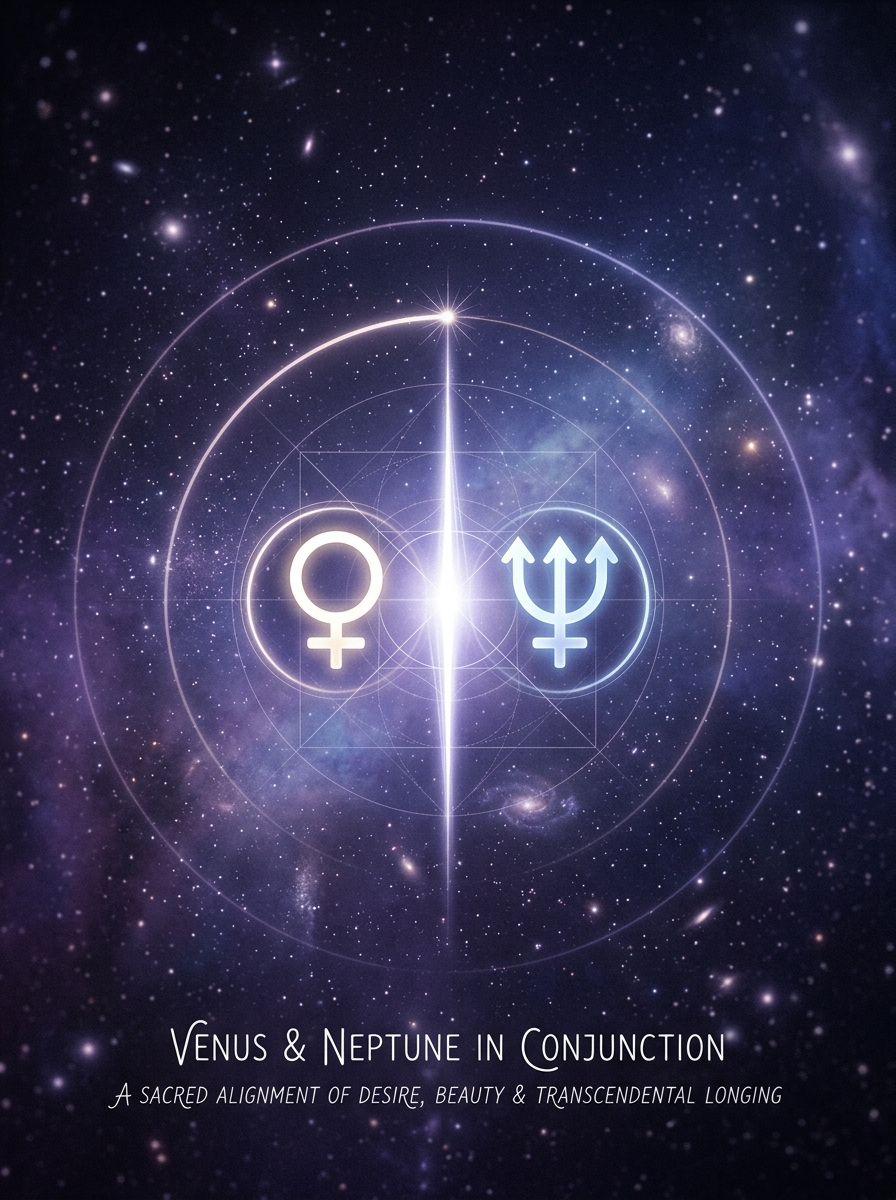
Venus conjunct Neptune is the chart signature of a heart that refuses to stop at pleasure. It wants beauty, yes, but also surrender; affection, but also dissolution; desire, but also transcendence. The conjunction fuses Venus’s instinct to value, bond, and attract with Neptune’s tendency to dissolve boundaries, idealize, and spiritualize experience. In practice, that means love is rarely “just” personal. It becomes atmosphere, fantasy, vocation, wound, altar.
This is not a mild aspect. It can make a person radiant, porous, empathic, and musically alive to nuance. It can also make them easy to misread, easy to disappoint, and sometimes easy to seduce into self-abandonment. The same opening that lets in grace lets in projection. The same tenderness that heals can blur discernment. If you want the wider skeleton of Neptune symbolism before narrowing to the conjunction, Neptune in the birth chart gives the larger archetypal frame.
The psyche of the conjunction: how it forms
The chemistry begins with Venus asking, “What is lovable? What is mine to cherish?” and Neptune answering, “What happens when the separateness between me and you softens?” Together they create a love nature that is less about possession than about merging states. People with this aspect do not merely want a partner; they want a vibration, a sacred field, a shared dream.
This porousness is not a choice. It is the baseline psychic architecture. The native feels emotional undercurrents in a room before they can explain them. They are impressionable in the original sense: life impresses itself upon them. A song, a face, a perfume, a gesture of mercy, or a half-finished conversation can move them into love. The aesthetic and the erotic become nearly indistinguishable. Attraction arises from softness, melancholy, artistry, or the suggestion of hidden depth.
The psychological roots lie in a deep longing for union that predates any particular relationship. Neptune carries the memory of the oceanic state—the pre-individuated oneness we left behind at birth. Venus gives that longing a face, a name, a body. So the conjunction often manifests as a chronic, barely articulated ache for a love that feels like homecoming, even if no actual person has ever provided it. That ache can be the source of the native’s greatest creativity and their most painful disillusionment.
The two arcs: gift and shadow
When integrated, Venus conjunct Neptune becomes a channel for beauty as transmission. The person carries a subtle glamour that has little to do with polish and everything to do with psychic permeability. Others feel safe, inspired, or enchanted in their presence, as though the ordinary world has become slightly more musical. This is why the aspect appears so often in artists, healers, designers, and performers—anyone whose work depends on atmosphere. Venus supplies form and taste; Neptune supplies image, dream, and emotional frequency. The result can be exquisite: a composition, a photograph, a fragrance, a styled room that speaks what cannot be said directly.
There is also a deep merciful streak here. Neptune dissolves judgment; Venus seeks harmony. Together they produce a person who instinctively softens cruelty, includes the excluded, and hears what is beautiful in what others dismiss. Their affection is often more humane than strategic. When this aspect matures, it becomes spiritual elegance—the ability to bless the world without hardening against it.
But the shadow is not lack of feeling; it is too much feeling poured into the wrong vessel. Because Neptune magnifies longing and erases contours, the native may fall in love with potential, symbolism, or rescue narratives. They do not merely see a beloved; they see what the beloved could redeem in them. That can feel holy until reality refuses the script. Projection enters: the native unconsciously assigns perfection, innocence, artistic genius, or spiritual status to others. Later, disillusionment can be dramatic, because the fall is not from love but from an ideal.
Boundary leakage is the other shadow. This aspect often confuses compassion with consent. The native may stay too long, lend too much, give away too much, or accept less than they deserve because they want to preserve the dream of harmony. This is not stupidity; it is over-identification with the emotional weather of others. The person may feel mean for naming limits, as though a boundary were a moral failure. Without discernment, Neptune turns generosity into leakage. Compare this with the relational structure of Neptune in the 7th House, where the idealizing mirror is placed onto partnership itself—here it is woven into the native’s own desire mechanism.
How it lives in a life: love, work, body
In romance, Venus conjunct Neptune enters through resonance, not caution. The native may feel they have met someone “familiar” after one conversation, or that desire arrived with a mystical authorization. This can create breathtaking experiences. It can also create heartbreak when the bond depended on atmosphere rather than compatibility. The healthiest relationships for this placement are those that can contain tenderness without requiring illusion. A strong match respects the native’s sensitivity without exploiting it, someone who can hold romance and ordinary life in the same hand. The native’s longing for union often resonates with the devotional quality of Venus in Pisces, but the conjunction adds an extra layer of psychic fusion that demands grounded reality checks over time.
In work and vocation, the native gravitates toward fields where beauty, healing, or inspiration are the product: music, film, photography, fragrance, fashion, counseling, spiritual work. They rarely thrive in purely mechanical environments. The danger here is vagueness; the blessing is vision. They may struggle to negotiate fees or tolerate hard-edged career logic. When maturity arrives, the work becomes a vessel for mercy—many with this aspect are drawn to making things that soothe, transport, or redeem. In corporate settings, they bring rare tact, visual intelligence, and the ability to sense the group’s mood before it is spoken. For the creative dimension, see Neptune in the 5th House, which amplifies the romantic and inspired currents in self-expression.
In the body and nervous system, this conjunction lives as sensitivity to environment, noise, chemicals, stress, and other people’s moods. Neptune dislikes hard edges; Venus likes equilibrium. Together they create a nervous system that is exquisitely responsive and easily overwhelmed. Sleep, hydration, artistic solitude, and clean emotional spacing are not luxuries—they are maintenance. Many natives need retreats from social saturation to hear their own desire again. If they do not take that space, they start mistaking exhaustion for destiny.
The developmental task: from enchantment to consecration
The central maturation of Venus conjunct Neptune is not to become cynical. It is to become accurate without losing wonder. Cynicism would kill the gift; blindness would waste it. The mature expression lives between these errors: able to feel awe, able to test reality.
This often means redefining love—not as merger, not as rescue, not as perfection, but as a sustained act of attention. The native learns that devotion without discernment becomes self-erasure, while discernment without devotion becomes dry and defensive. Venus needs form; Neptune needs mystery. Together they ask for a love that is both embodied and expansive.
At its highest octave, this conjunction functions like a sacrament. The person sees through appearances without becoming detached from them. They know that a face can be a symbol and a person can be a mystery without either being a fantasy. They can create, forgive, adore, and serve without dissolving the self that does the loving. That is the real promise of Venus conjunct Neptune: not endless romance, but refined perception. The world becomes more beautiful because the native has learned how to see it without gripping it. And that, in the end, is the rarest kind of love. For the deeper mystical waters, see Neptune in the 12th House, where the conjunction’s spiritual roots often lead.
Comments
Loading comments…