Temperance and The Devil: Alchemy Against Compulsion
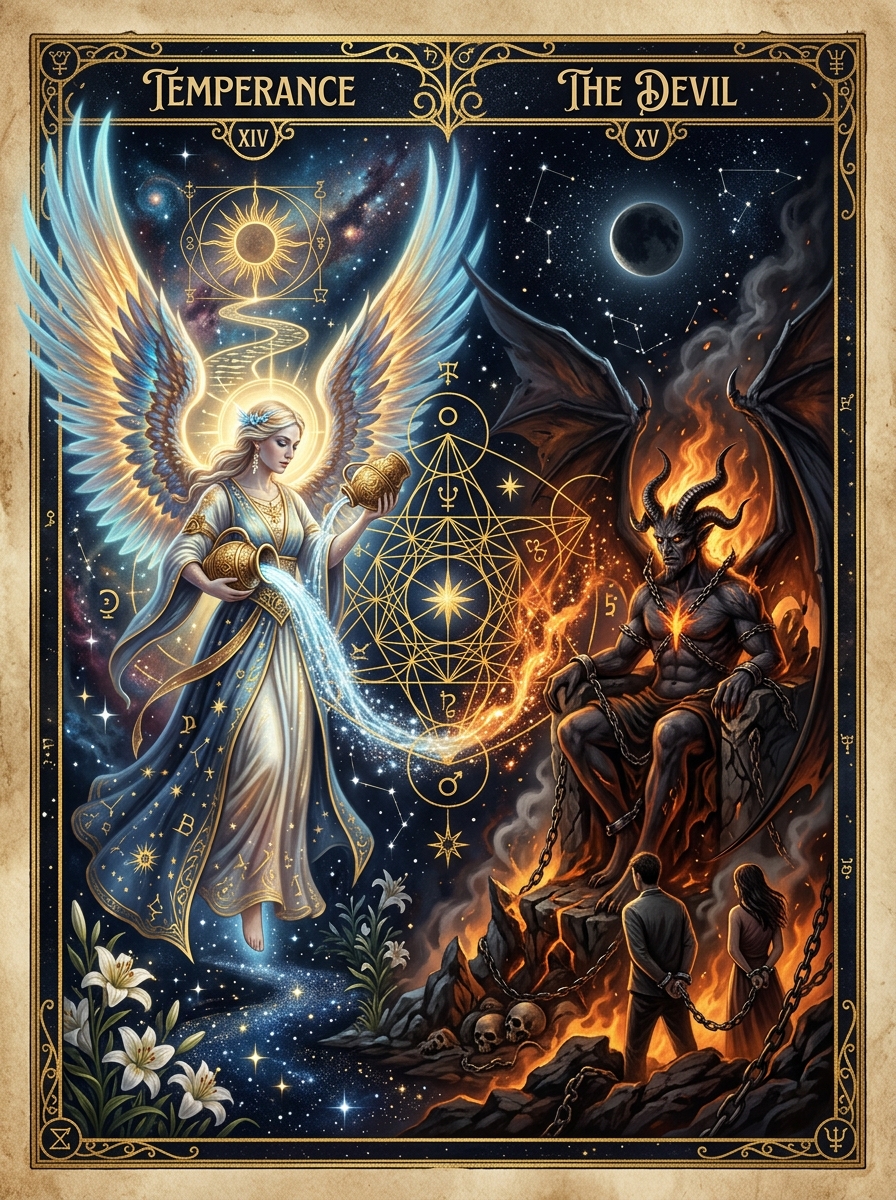
The pairing of Temperance and The Devil is not a morality play. It is a thermodynamic diagram of the psyche under the influence of two opposing forces: one that blends, measures, and circulates, and one that binds, fixates, and intensifies until pleasure becomes a cage. The core question this combination poses is not “Are you balanced or are you trapped?” — that is too simple. It is: “Is the part of you that knows how to heal strong enough to metabolize the part that prefers the chain?”
These two major arcana cards share a hidden intimacy. Temperance is the alchemist’s vessel, the art of holding two substances together until they become a third. The Devil is the archetype of delimited desire — the impulse that narrows a living need into a compulsive pattern, then calls that pattern identity. Together they describe a moment when transformation is possible but not guaranteed, because the same energy that feeds the fixation could also fuel the release.
The Core Dynamic: Chemistry That Is Neither Good Nor Evil
Temperance is Sagittarius in the major arcana, a figure of calibrated movement and spiritual chemistry. She does not demand purity; she demands adjustment. The Devil is Capricorn, earth hardened into compulsion: structure that has lost its flexibility, survival instinct mistaken for fate. When they appear together, the reading reveals a psyche that is actively negotiating with its own addiction — not only to substances or behaviors, but to emotional extremes, power dynamics, and familiar suffering.
What makes this combination so potent is that the two cards are not enemies. They are locked in a partnership that can produce either transmutation or stagnation. Temperance can stand in the presence of The Devil because she understands that shadow material cannot be bullied into surrender; it must be metabolized drop by drop. This is why the pair often shows up when someone has already tried fighting their compulsions with sheer will and lost. The old strategy — repression — only feeds the devil. Temperance offers a different method: slow integration, precise dosage, and the willingness to hold discomfort without acting on it.
The deep thesis here is that healing is not the opposite of the compulsion; healing is the process that re-routes the energy the compulsion was using. For a fuller study of how this works in a single card, the Temperance card page and The Devil card page provide the psychological foundations.
The Psychological Roots: How the Chain Forges Itself
Why does this pairing appear so often in readings about love, work, and identity? Because the chain The Devil represents is never forged from pure evil — it is forged from unmet needs that were once survival adaptations. A person who learned early that intensity equals safety will keep seeking intensity long after it stops being safe. A person who fused self-worth with output will keep overproducing even after burnout becomes chronic.
Temperance exposes the mechanism: the part of the psyche that tries to moderate is often the same part that secretly fears what would happen if the compulsion were truly released. The chain becomes comfortable, known, manageable. The devil whispers that the alternative — freedom — is shapeless and frightening. This is the moment when shadow work becomes essential: not to destroy the dark impulse, but to learn what it was protecting.
A useful adjacent pair is The Devil and The Moon, which deepens the theme of unconscious entanglement — see The Devil and The Moon for how fear and illusion feed compulsion. But Temperance adds the alchemical variable: the chain can be dissolved, not by force, but by the patient application of differentiated awareness.
Maturation vs. Stagnation: Two Paths Through the Same Gate
When this combination matures, the result is not a sterile purity but a dynamic equilibrium. The person learns to hold desire without being hijacked by it. They can experience craving without acting on it, passion without possession, ambition without burnout. This is what Strength and The Devil explores — the capacity to integrate the shadow without being mastered by it. The Strength and The Devil page shows how the lion’s gentleness can tame the goat’s frenzy.
When the combination stagnates, the person remains locked in a loop of relapse and self-flagellation. They know the language of recovery, but the underlying attachment has not been alchemized. The Devil keeps feeding on the secrecy, the shame, the thrill of transgression. Temperance becomes a hollow virtue — a performance of restraint that only postpones the next collapse.
The difference between these two outcomes often comes down to a single question: Is the person willing to feel the emptiness that the compulsion was filling? If yes, the chain begins to soften. If no, the reading becomes a warning that the current strategy — managing symptoms rather than touching the wound — will not hold. For those who need to face an ending first, Death and The Devil offers a companion diagnostic: sometimes the chain must break before it can be transformed. See Death and The Devil for that harder medicine.
How It Manifests in a Life: Love, Work, and Inner Guidance
Because the dynamic is already established, what follows is not a re-derivation but a series of concrete expressions. In love, the combination appears as magnetic chemistry that feels destined but is actually sticky. One person may feel like the antidote to the other’s loneliness while simultaneously triggering the very behaviors that create loneliness. The bond can heal, but only if both parties can name the pattern without dressing hunger up as destiny. A Heart-Shaped Love Tarot Spread can clarify whether the connection is based on genuine compatibility or shared attachment wounds.
In career, the same cards name the difference between disciplined ambition and compulsive productivity. The Devil in professional life is not a bad boss or a corrupt industry; it is the internalized voice that says there is never enough — never enough output, never enough success, never enough proof of worth. Temperance advises not a rebellion but a recalibration: slow the burn rate, separate identity from output, and let the work breathe. A Career Tarot Spread can help identify whether the issue is role fit, values conflict, or a shadow dynamic around power and validation.
In inner guidance, this pairing often signals that the seeker is trying to use spiritual practice to bypass a material or emotional addiction. Meditation becomes another way to avoid the body. Abstinence becomes another kind of performance. Temperance, however, demands embodiment: she is not an ascetic; she is a chemist. She insists that healing happen in the same room as the craving, not in a purified corner of the psyche. The Hanged Man and Temperance combination — explored at The Hanged Man and Temperance — models the exact surrender that this pairing requires.
Working the Combination: The Art of Disciplined Integration
The guidance of Temperance and The Devil is not to slay the shadow, nor to indulge it, but to sit with it long enough to learn its alchemical name. The chain exists for a reason, and that reason is seldom the obvious one. The Devil names the place where the psyche has fused survival with a limiting pattern. Temperance names the container strong enough to hold that revelation without collapse.
Practical steps that emerge from this reading: first, admit the attachment without drama. Do not call it destiny, do not call it failure — just name the truth that letting go feels harder than staying. Second, reduce the dosage of the compulsive act without eliminating it entirely — if possible. Temperance works by titration, not by prohibition. Third, find a parallel activity that offers the same quality of presence but without the harmful consequence. The energy that flows into the compulsion can be rerouted, but only if the new channel is equally vivid.
For those who feel the call to deeper work, the Shadow Work Tarot Spread offers a structured map for uncovering what the chain is really protecting. And when the process feels too slow, Temperance and The Star — at Temperance and The Star — reminds that hope is not a luxury but a necessary reagent in the alchemical vessel.
The final instruction of this combination is both stark and liberating: stop calling the chain a personality trait, and stop calling the wound a destiny. What remains is the harder, cleaner work of becoming free — not by reaching for the light, but by learning the precise temperature at which the chain melts.
Related
- Death and Temperance: The Alchemy of Ending and Healing
- The Chariot and Temperance Tarot Combination: Victory Tempered by Wisdom
- The Hanged Man and The Devil: Suspended Will, Shadow Appetite, and the Price of Awakening
- Justice and Temperance Tarot Combination: Truth Tempered into Wisdom
- The Devil and The Fool: Temptation, Freedom, and the Edge of the Leap
Comments
Loading comments…