The Hanged Man and Temperance: Surrender, Alchemy, and the Art of Becoming
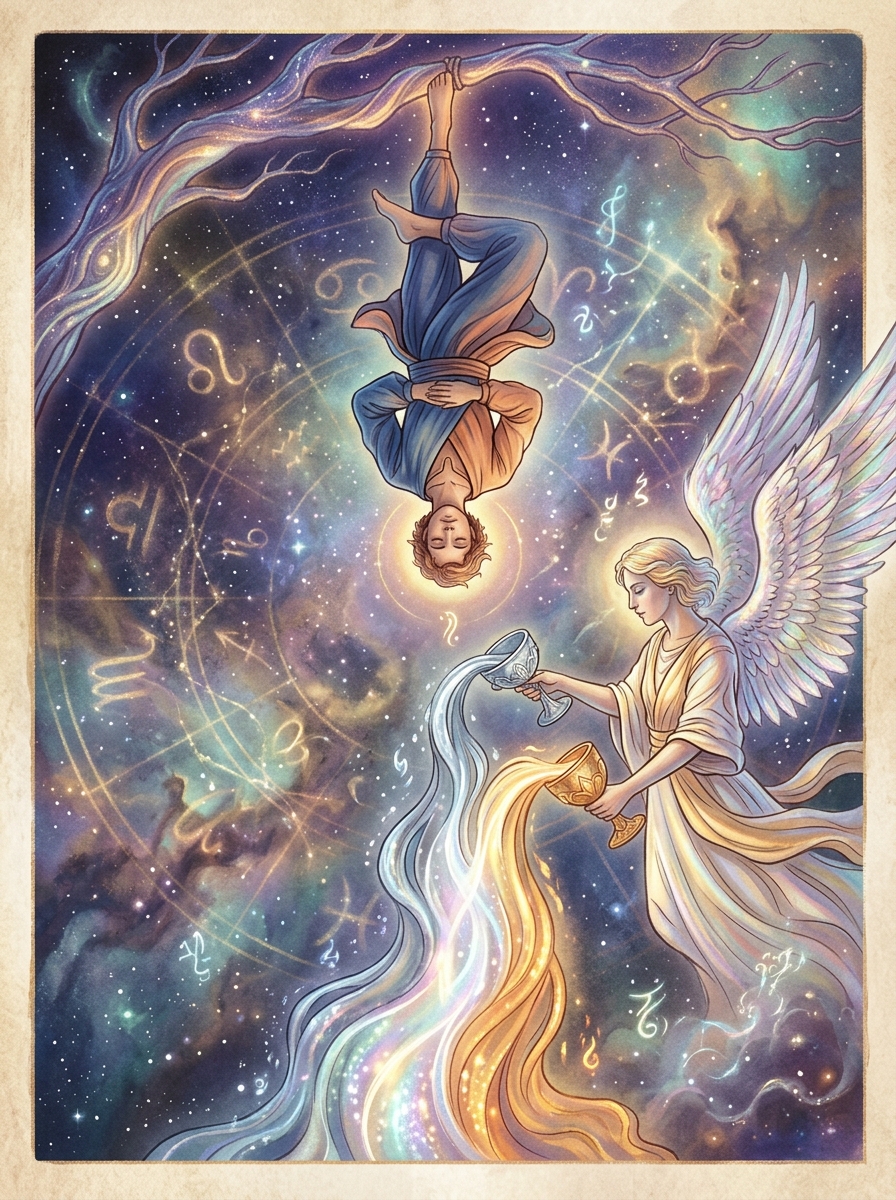
The Archetypal Dynamics of The Hanged Man and Temperance
There are tarot pairings that merely add up, and there are pairings that multiply into something neither card could produce alone. The Hanged Man (Arcanum XII) and Temperance (Arcanum XIV) belong firmly in the second category. On the surface, one shows a figure suspended upside-down from a living tree, serene and motionless, while the other shows a winged being pouring liquid between two cups in an endless, unhurried flow. But look longer — the way a good reader learns to look — and you start to see these two cards as consecutive chapters in a single initiatory story.
The Hanged Man stops time voluntarily. He is not a prisoner; the foot looped around the branch is relaxed, not bound by force. In the Rider-Waite-Smith imagery, Arthur Edward Waite emphasized that this suspension is chosen, mystical, a willful dive into the unknown depths of the psyche. C. G. Jung would have recognized the move immediately: it is the ego's deliberate descent into the unconscious, the beginning of what he called nigredo — the blackening, the dissolution phase of alchemical transformation in which everything solid is broken down so that something new can be distilled. The Hanged Man does not know yet what he will become. He only knows he cannot proceed without first surrendering his old orientation to the world.
Temperance, by contrast, is all flow and precision. The winged figure — sometimes read as the archangel Michael, sometimes as Iris, messenger of the rainbow — stands with one foot on dry land and one in water, mediating between the material and the spiritual with an ease that comes only from long practice. In Aleister Crowley's Thoth Tarot, this card becomes "Art," and the alchemical metaphor is made explicit: the blending of opposites into a living third thing. The hot and cold, the solar and lunar, the active and receptive — all of these are held in a dynamic, renewable tension that produces gold.
When these two cards appear together, the reading is describing a process, not a static condition. The querent is somewhere in the middle of a genuine transformation: they have already passed through — or are currently living through — the suspension phase of The Hanged Man, and Temperance is appearing to say that integration is available, healing is in motion, and the alchemy is real. The invitation is to trust the process without rushing it, to understand that what looks like stagnation from the outside is actually incubation from the inside.
This combination carries a particular kind of grace. It asks for patience not as passivity but as active receptivity — the way a field is receptive to rain without doing anything that looks like effort.
The Initiatory Sacrifice: The Mystery of The Hanged Man
To fully appreciate what The Hanged Man brings to this pairing, it helps to understand the mythological and psychological roots of the archetype. The card's most direct ancestor is Odin on Yggdrasil. According to the Hávamál, the Norse god hung himself from the World Tree for nine days and nine nights — wounded, fasting, without food or water — not because anyone forced him to, but because he wanted the runes. He wanted wisdom that could not be purchased or learned from a teacher. He wanted the kind of knowing that only comes through voluntary ordeal.
This is the essential note of The Hanged Man: the suffering is purposeful. The suspension is not a punishment but a passage. What distinguishes it from ordinary waiting — from mere procrastination or avoidance — is the inner quality of the pause. The Hanged Man is aware and present in his suspension. He is not scrolling through distractions, not anesthetizing himself with busyness. He is watching the world with new eyes because hanging upside-down genuinely changes the angle of perception.
The Neptunian Dimension
Astrologically, The Hanged Man is associated with Neptune and Pisces, and through Pisces, with the 12th House — that vast, oceanic sector of the chart that rules retreats, institutions, the hidden psyche, and what Steven Forrest calls "the monastery and the prison." The 12th House is where we go when ordinary ego-management breaks down, when the self needs to dissolve before it can reform. Neptune's energy is fundamentally about permeability: it dissolves boundaries, melts fixed identities, and invites the soul into experiences of unity that the rational mind cannot achieve through effort alone.
When The Hanged Man appears, something in the querent's life is asking to be released from the grip of the ego's need to control outcomes. This can feel like loss, confusion, or even grief. In Jungian terms, the nigredo is rarely comfortable — it is the dark night of the soul, the encounter with what the shadow has been storing for years. But its purpose is purification, not punishment.
The Gift of the New Perspective
Liz Greene, in her work on Neptune and the transpersonal planets, writes about the way Neptunian experiences can feel like drowning — until the moment you realize you can breathe underwater. The Hanged Man's upside-down serenity represents exactly that moment of adaptation. The halo around his head in the Rider-Waite-Smith imagery is not accidental: Waite was suggesting that genuine enlightenment — even a small, temporary flash of it — is the harvest of the willing sacrifice.
In practical terms, this means that the waiting the Hanged Man brings to a reading is not empty. Something is being reorganized at a level below conscious awareness. Dreams become more vivid. Patterns that were invisible suddenly become obvious. The person who can tolerate the suspension — who can resist the anxious urge to force resolution — often emerges with insights that could not have been reached any other way.
Healing Through Time: The Virtue of Temperance
If The Hanged Man is the dissolution, Temperance is the beginning of the reconstitution. The alchemical terminology here is precise and intentional: after nigredo comes albedo, the whitening phase, in which the dissolved material is washed, purified, and held in a kind of luminous suspension before it is ready to become the gold of rubedo. Temperance is the albedo in action — patient, steady, and quietly miraculous.
The imagery of Temperance in the Rider-Waite-Smith tradition rewards close attention. The figure stands at the edge of water and land simultaneously, feet in both worlds. The cups being tilted between the two hands are not pouring water — the liquid is flowing upward, defying gravity, suggesting that something more subtle than ordinary fluid mechanics is at work. This is the flow of prana, of life-force, of what the Hermetic tradition calls the Anima Mundi: the soul of the world moving through a skilled and receptive vessel.
Sagittarius, Jupiter, and the Ninth House
Temperance is associated astrologically with Sagittarius, Jupiter, and the 9th House — the sector of the chart that governs philosophy, long journeys, higher education, and the expansion of meaning. This is a significant departure from what we might expect of a card called "Temperance," a word that in everyday English often implies restriction or reduction. But the deeper meaning of the word is proportion, not deprivation. Sagittarius temperance is not about drinking less; it is about understanding the precise right measure of everything so that the larger journey can be sustained.
Jupiter's influence here adds a quality of benevolence and faith. This card carries a gentle optimism — not the naïve optimism that ignores difficulty, but the seasoned optimism of someone who has been through the fire and knows that the fire transforms rather than destroys. When Temperance follows The Hanged Man, the message is that the larger philosophical understanding — the meaning extracted from the trial — is on its way.
The Art of Moderation as Spiritual Practice
What Crowley understood about this card — and why he renamed it "Art" — is that true moderation is a skill, not a temperament. It requires the sensitivity to read the moment, the discipline to override impatience, and the creativity to find the middle path between opposites that are both genuinely valuable. This is not the grey compromise of splitting the difference. It is the gold that is neither fire nor water but their alchemical child.
In daily life, Temperance in this combination shows up as the person who has been through hell and comes out the other side with a softened, clearer presence. The sharpest edges of the ego have been worn down by the suspension. The urgency that used to drive decisions has been replaced by a more rhythmic, organic sense of timing. This is not a small achievement.
Love and Relationships: Patience, Depth, and the Prevention of Codependency
In the context of romantic and close personal relationships, The Hanged Man and Temperance together carry a message that is both tender and precise. This pairing almost always signals a relationship that is operating at a significant depth — one where the emotional stakes are high, the psychic connection is real, and the challenge is to let that depth be a source of growth rather than entanglement.
The Pause in Love
When The Hanged Man appears in a love reading, one or both partners is in a period of suspension. A decision that feels necessary is not yet ready to be made. A conversation that seems urgent needs more time to ripen. This can be agonizing for anyone who values clarity and momentum — and it can easily be misread as rejection, indifference, or avoidance. But the Hanged Man is none of those things. He is present in the pause, not absent.
Temperance alongside him says: this pause is productive. The emotional alchemy is happening in real time. What is being refined through the waiting is not just a decision but a whole orientation toward this person, toward intimacy itself. The question Temperance asks in a love context is: How do you love without losing yourself? How do you give fully without giving away the boundaries that make a real self possible?
Healthy Boundaries as Alchemical Vessels
The alchemical vessel — the vas hermeticum — is a crucial image in this context. Alchemy cannot happen in a container that leaks. The transformation requires a bounded space. In relationship terms, this means that the healing this combination promises is only possible when both people are willing to function as distinct individuals within the relationship's container, rather than merging so completely that neither can access their own interior life.
Liz Greene's work on Saturn and relationships, while focused on a different archetype, is instructive here: she argues consistently that the most enduring and generative relationships are those built on what she calls "the paradox of separateness within union." The Hanged Man and Temperance, working together in a love reading, are essentially asking the querent to hold that paradox: to be deeply present without being consumed, to be vulnerable without dissolving, to love with intensity and proportion simultaneously.
The warning embedded in this pairing — and it is a gentle but real warning — is against codependency. When the Hanged Man's surrender becomes a surrender of self rather than of ego, and when Temperance's flow becomes an enabling accommodation rather than a genuine blending, the beautiful alchemy curdles. Watch for patterns of over-giving, for waiting that has no inner movement, for patience used as an excuse to avoid confronting what needs to be confronted.
Career and Finance: Strategic Patience and Ethical Foundations
In career and financial readings, The Hanged Man and Temperance together describe a situation that rewards the long view almost exclusively. This is not a combination that blesses impulsive moves, aggressive gambles, or rapid pivots. It is a combination that blesses sustained effort, intelligent waiting, and the gradual accumulation of skill and credibility over time.
The Professional Pause
The Hanged Man in a career reading often indicates that a project, a job, or a professional direction is in suspension. Funding is pending. A decision is being made above the querent's pay grade. A creative project has reached a necessary fallow period before the next stage of development becomes clear. This suspension is real and often uncomfortable — careers feel stalled, resumes feel static, and the social pressure to produce and achieve can make the pause feel like failure.
But look again at the card's imagery: the Hanged Man is not panicking. His face is calm. His halo suggests that even in apparent professional stagnation, some kind of inner development is actively underway. The skills being honed might be invisible to a performance review. The network being quietly deepened might not yet produce visible results. The vision being clarified in the silence might take another season to become a plan.
Temperance in Financial Decisions
When Temperance enters the career or financial picture, it advocates for a specific set of behaviors: measured risk-taking, incremental investment, conservative pacing, and — crucially — ethical partnerships. The blending imagery of Temperance suggests that the best financial moves right now involve finding genuine complementarity with others: partners, collaborators, or institutions whose strengths genuinely offset the querent's limitations, and vice versa.
This is not a time for zero-sum competition. The alchemical metaphor is instructive: you cannot make gold by adding more of the same element. You need the right combination of different substances, held at the right temperature, for the right duration. Financial decisions made under this influence should ask: Who do I need to blend my resources with, and what does genuine balance look like in this arrangement?
Strategic Non-Action as a Professional Move
One of the more counterintuitive gifts of this pairing in a professional context is the validation of strategic non-action. In American business culture, which tends to valorize speed, hustle, and visible output, it can feel radical to choose not to apply for that position, not to launch that product before it's ready, not to respond to that offer before more information arrives. But The Hanged Man and Temperance together are unambiguous: the move that looks like no-move is sometimes the most sophisticated move available. The chess master who can sit with ambiguity longest often has the clearest view of the board.
Spiritual Growth: Alchemical Initiation and the Path of Integration
Taken at the level of spiritual development, The Hanged Man and Temperance describe one of the most significant arcs in the Major Arcana — a genuine initiatory sequence that parallels the descent and return motif found across world mystical traditions. Though we are firmly in the Western esoteric tradition here, the psychological truth is universal: transformation requires dissolution before reconstitution.
The Dark Night and the Dawn
The Hanged Man in spiritual readings points to what the Christian mystics called the via negativa — the path through negation, silence, and the stripping away of everything the ego thought it knew about God, meaning, and self. John of the Cross wrote about the "dark night of the soul," a passage that can last weeks, months, or years, in which the spiritual practitioner is deprived of the consolations and certainties that previously made faith easy. This is not abandonment; it is the intensification of the initiatory pressure.
When Temperance follows this card in a spiritual reading, it says that the dark night has a morning. The integration of what was learned in the suspension is now beginning. The spiritual work shifts from endurance to assimilation — from hanging in the tree to learning how to walk with the wisdom the tree gave you.
Jung's Individuation Process
Carl Jung described individuation as the lifelong process of becoming who you most essentially are — integrating the shadow, developing the functions that were previously unconscious, and moving toward what he called the Self, the organizing archetype at the core of the psyche. The Hanged Man and Temperance together map almost perfectly onto a single crucial phase of this process: the moment when the ego has surrendered its monopoly on reality (The Hanged Man) and the Self begins to emerge as a more comprehensive organizing principle (Temperance).
In practical spiritual terms, this combination encourages specific practices: contemplative prayer or meditation that emphasizes receptivity over petition, journaling that tracks the emerging patterns of dream and synchronicity, and engagement with a teacher or therapist who can help metabolize what the unconscious is surfacing. The key is that the work happening now is integrative, not acquisitive — the goal is not to add more spiritual content but to digest what has already been received.
The Rainbow Bridge
Temperance's figure often stands with the path behind it leading toward a crown of light in the distance — a mountain peak, a sunrise, a vanishing point of pure radiance. This is the destination, not the method. The method is the steady, unremarkable, daily practice of pouring from one cup to the other, maintaining the flow, trusting that the alchemy is cumulative. Steven Forrest, writing about Sagittarius energy, describes the sign's deepest gift as the capacity to mean something — to organize life around a philosophical center that gives coherence to all the disparate experiences. Temperance carries that gift when it appears alongside The Hanged Man: it says that the chaos of the suspension is being reorganized around a new center of meaning.
Combined Advice and Evolution: Embracing the Pause, Aligning with Organic Timing
When The Hanged Man and Temperance appear together, they are offering guidance that runs counter to most of the productivity advice available in contemporary culture. They are not telling you to optimize, iterate, or pivot. They are telling you to wait well, which is its own profound skill.
Practicing Active Patience
Active patience is not the same as passive waiting. The person practicing active patience is not simply marking time until conditions change. They are using the pause to deepen their understanding, refine their values, and clarify what they actually want on the other side of the suspension. They are journaling, meditating, having honest conversations, or doing nothing at all — but doing nothing with full presence, without the anxious undercurrent of I should be doing something.
The difference between productive suspension and stagnation is almost entirely interior. Externally, they can look identical. Internally, one is alive with quiet attention while the other is deadened by avoidance. The Hanged Man and Temperance together invite you to check honestly: which kind of pause are you inhabiting?
Aligning with Organic Timing
One of the most liberating ideas this combination can deliver is the concept of organic timing — the understanding that some things ripen on their own schedule, and that efforts to force them to ripen faster typically damage them. This is not fatalism. It is the recognition that the universe has its own metabolic rate, and that human willpower, while genuine, is not the only force in play.
The Sagittarian dimension of Temperance contributes an important faith component here: faith not in a specific outcome, but in the goodness of the process. Liz Greene writes about Jupiter as the planet of intuitive optimism — not blind positivity, but a bone-deep sense that the story is moving toward meaning rather than meaninglessness. When Temperance brings this faith to The Hanged Man's suspension, the waiting becomes sustainable. You can endure what you trust.
The Transition from Sacrifice to Healing
The final evolution this combination describes is the transition from the experience of sacrifice to the experience of healing. The Hanged Man represents the sacrificial phase — the moment of giving something up that the ego valued, whether that is a plan, a relationship, a self-image, or a certainty. Temperance represents the healing phase — the gradual reconstitution of the self around a more spacious, more flexible, more genuinely alive center.
This transition does not happen all at once. It happens the way the alchemical process happens: through repeated cycles of heating and cooling, dissolving and consolidating, reaching and releasing. Each time the querent chooses the moderate path over the extreme, each time they choose presence over escape, each time they choose the long view over the immediate gratification, they are performing a small act of Temperance. And those small acts, accumulated over the weeks and months of the Hanged Man's suspension, eventually produce the gold.
Frequently Asked Questions
What does it mean when The Hanged Man and Temperance appear together in a tarot reading?
This combination signals a period of meaningful, transformative suspension that is being slowly alchemized into wisdom and healing. The Hanged Man represents voluntary surrender and a radical shift in perspective — a willingness to stop forcing outcomes and allow a deeper intelligence to reorganize the situation. Temperance confirms that this pause is productive, that the energies at play are healing rather than destructive, and that patient, moderate engagement with the process will yield genuine transformation. Together, these cards are saying: you are in the middle of something important. The outcome is not yet visible, but it is real and it is growing.
Is this combination a sign that I should wait, or that I should take action?
Generally, this pairing leans heavily toward waiting — but not passive waiting. The quality of engagement matters enormously. The Hanged Man and Temperance together are asking you to remain fully present and attentive during the suspension, rather than numbing yourself or forcing premature resolution. If specific actions feel genuinely called for, Temperance suggests they should be measured, incremental, and oriented toward long-term balance rather than short-term relief. Large, dramatic moves — quitting the job, ending the relationship abruptly, making the major financial gamble — are not what this combination is endorsing.
How does this pairing apply to a relationship that feels stuck?
In a relationship context, The Hanged Man and Temperance together suggest that the stuckness is temporary and purposeful. Something significant is being clarified — perhaps about what each person truly needs, perhaps about whether the relationship's current form can evolve into something healthier, perhaps about unspoken dynamics that have gone unexamined. The key is to use the pause for honest interior work rather than anxious action. Temperance specifically cautions against codependent patterns: make sure that the patience you are practicing is growing your individual self, not eroding it. The relationship that this combination blesses is one where two distinct people choose each other freely and consciously — not one held together by mutual need or fear of the alternative.
What is the spiritual significance of this combination?
Spiritually, The Hanged Man and Temperance together describe a genuine initiatory arc — one of the most significant passages available in the Major Arcana. The Hanged Man's connection to Neptune, Pisces, and the 12th House places the querent in contact with the deep unconscious: the realm of archetypes, dreams, mystical experience, and the dissolution of the smaller self. Temperance, linked to Sagittarius and Jupiter, represents the integration of what that contact reveals — the translation of mystical experience into lived philosophical wisdom. Taken together, these cards say: you are being initiated. The process is real, even when it is invisible. Trust the arc, practice presence, and let Temperance do its slow, steady, miraculous work.
Can this combination indicate a positive outcome in career or financial matters?
Yes — but the timeline is likely longer than the querent might prefer. This pairing does not bless quick wins or impulsive financial moves. What it does endorse is the kind of patient, strategic, ethically grounded effort that compounds over time. Professionally, it often indicates that a period of apparent stagnation is actually a period of deep skill development or network maturation that will eventually produce results disproportionate to the visible effort. Financially, it favors steady accumulation, conservative but genuine risk-taking, and partnerships built on genuine complementarity. The harvest is real; the growing season is longer than usual.
How do I know if I am practicing the patience The Hanged Man and Temperance are asking for, or simply avoiding what needs to be addressed?
This is one of the most important questions this combination raises, and honest self-examination is essential. The key distinction is interior: genuine Hanged Man patience is alive — it is characterized by heightened awareness, vivid dreaming, new patterns of perception, and a sense (however uncomfortable) that something is actively reorganizing beneath the surface. Avoidance, by contrast, feels deadened — it is characterized by numbness, distraction, the suppression of anxiety rather than its transformation, and an unwillingness to look honestly at what the suspension is revealing. If your pause feels like the latter, Temperance's invitation is to bring just a little more moderate, steady attention to what you are afraid to look at. Not all at once — one cup at a time.
Comments
Loading comments…