The Hanged Man and The Devil: Suspended Will, Shadow Appetite, and the Price of Awakening
The Core Dynamic — Suspension in the Shadow’s Grip
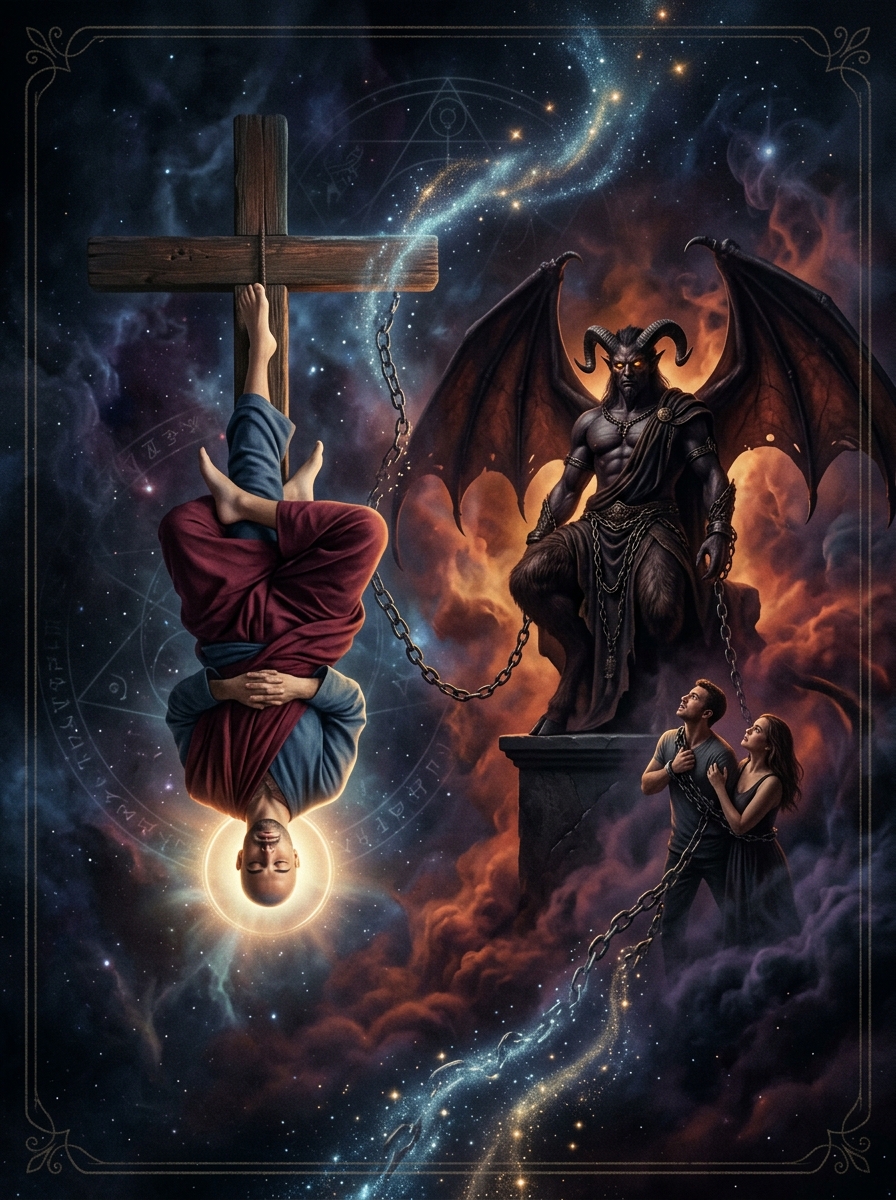
When The Hanged Man and The Devil appear together, the reading does not ask you to escape. It asks you to see. The Hanged Man’s upside-down stillness is a chosen pause, a refusal to keep hammering a false solution. The Devil’s throne is the infrastructure of unconscious appetite: status, fear, dependency, desire hardened into rule. Between them lies a single uncomfortable truth — you can be hanging in patience while the chain is already around your ankle.
This is not the clean surrender of meditation. It is the arrested moment when the psyche can no longer perform its usual tricks, yet the hidden payoff keeps the pattern alive. The ego may say it has let go, but the Devil shows where that letting go is itself a strategy. You may be waiting for grace while secretly feeding a bond, a debt, a habit, a role that has become a shrine. The pair exposes the difference between suspension that opens perception and suspension that merely postpones confrontation. For the foundational grammar of each card, see the individual meanings of The Hanged Man and The Devil. Together they sharpen into a single question: What are you really doing while you wait?
The Psychological Architecture — How Sacrifice Becomes Addiction
Both cards involve constraint, but only one is chosen. The Hanged Man accepts limitation to see from a new angle. The Devil imposes limitation through unconscious compulsion. In Jungian terms, the first suspends the ego’s agenda; the second reveals the shadow’s leverage — the hidden rewards that keep you attached even as you claim to release.
This is where the pairing becomes psychologically rich. The ego can imitate surrender while remaining deeply attached to control. You say you are being patient in a relationship, but the Devil shows the emotional payoff of that patience: being needed, being the martyr, avoiding the terror of claiming your own desire. You say you are enduring a career limbo for practical reasons, but the Devil exposes the fear of visibility or the comfort of a familiar grievance. The sacrifice becomes its own currency. The waiting becomes the identity.
What makes this dynamic so stubborn is that it feels noble. The Hanged Man is a card of sacred pause, after all. But when it pairs with The Devil, the sacred gets co-opted. The higher meaning is used to shield a lower attachment. This is not hypocrisy; it is the psyche’s natural economy. Every sacrifice serves something. The question is whether that something is truth or habit. The pairing demands that you name the hidden transaction. Compare this with The Lovers and The Devil, where the choice is more conscious — here the choice has already been made, but you haven’t admitted it.
The Ego’s Favorite Alibi: Spiritualized Avoidance
One of the most insidious expressions of this pair is when you dress avoidance as enlightenment. “I’m not leaving because I need to learn non-attachment.” “I’m not setting a boundary because I’m cultivating compassion.” The Hanged Man provides the spiritual vocabulary; The Devil provides the actual attachment. The result is a stalemate that feels profound but produces nothing real. The difference between a sacred pause and a shadow stall is whether the stillness is leading to new sight or just repeating old pain. The cards ask you to drop the alibi and look at what you are actually clinging to — even if that clinging is to the story of having let go.
Maturation and Shadow — Sacred Pause Versus Self-Abandonment
The healthy expression of this combination is a lucid suspension. You see the chain, you stop pretending it isn’t there, and you allow yourself to hang in that awareness without immediately trying to break free. This is not resignation; it is the precondition for real change. The Hanged Man’s inverted perspective lets you view the Devil’s domain — your appetites, your dependencies, your compromises — from a place that is not reactive. From that stillness, you can begin to unwear the pattern instead of fighting it.
The shadow expression is different. Here the self-abandonment is complete. You identify with the hanging so thoroughly that you forget there was ever a choice. The patience becomes a prison you defend. The Devil’s chains are internalized as fate. You say, “This is just how it is,” or “This is just who I am,” and in that sentence the cage door closes. The pair then shows a person who has mistaken endurance for wisdom and has stopped asking whether the endurance serves anything true.
The way out is not force — the Hanged Man teaches that force is exactly what failed. The way out is precise seeing. You must name what you are feeding, what you are afraid would collapse if you stopped cooperating, and what reward — recognition, safety, identity — the pattern gives you. For a deeper map of this excavation, the Shadow Work Tarot Spread offers a structured path from attachment to awareness. Related pairings like Strength and The Devil show the same confrontation in a more active register; here the action is in the pause itself.
How This Pairing Speaks Through Your Life — Love, Work, and the Patterns You Protect
This section does not need to re-derive the dynamic. It needs only to show where that dynamic takes shape in everyday experience.
In Relationships
The most common form is a bond that feels fated but functions as mutual captivity. One partner hangs in sacrifice — waiting, forgiving, absorbing — while the other holds the emotional leverage. The Devil is the intensity that keeps you tethered: intermittent affection, shared trauma, a sense that leaving would be betrayal. The Hanged Man is the role of the patient one. Together they create a devotional trap. The relationship may not be ending, but it is exposing the psychic price of staying unchanged. If the connection is healthy, the cards simply show a necessary pause around a pattern that has become overcharged. But more often they reveal that the waiting has become a substitute for honesty. Compare this with The Death and The Devil, where the chain breaks through loss; here the chain holds because you keep choosing to hang.
In Career
Professionally, this pairing often describes a limbo that looks strategic from the outside but feels draining within. You may be in a role that demands you mute your values, tolerate a toxic hierarchy, or postpone your ambitions because the practical benefits are real. The Devil is the machinery of salary, status, leverage; The Hanged Man is the person suspended in that machinery, making the best of it. The moment of danger is when accommodation becomes complicity. The cards do not always say to quit — sometimes the suspension is genuinely necessary. But they do require you to stop romanticizing delay. Ask: Am I waiting, or am I hiding? The Decision Tarot Spread can help distinguish structural constraint from the shadow of fear.
In Spiritual Practice
Here the pairing is most subtle. You may have built a spiritual identity around surrender, patience, and non-attachment — and used it to avoid engaging with your own appetites. The Hanged Man becomes a badge; The Devil becomes the messy reality you refuse to integrate. True maturation requires you to bring the shadow into the stillness: to feel the greed, the fear, the desire, without spiritualizing them away. That is the price of awakening — not transcendence of appetite, but conscious relationship with it. For a related alchemical process, see Temperance and The Devil, where excess is metabolized rather than denied.
The Only Question That Matters
The Hanged Man and The Devil together offer no comfortable answer. They offer precision. The central revelation is that the thing you most need to release may be the identity that says you have already released it. Stop negotiating with the obvious. Something in your life has reached the point where patience is no longer neutral. It is either wise suspension or active self-betrayal. The way out is not a dramatic escape — the Hanged Man teaches that force is the old strategy. The way out is to see the chain, name the shadow reward, and hold that seeing long enough for the chain to lose its grip. That is the only awakening worth the price.
Related
- The Hermit and the Hanged Man: The Quiet Intelligence of Surrender
- The Hanged Man and Death: When Surrender Becomes the Doorway
- The Hierophant and The Hanged Man Tarot Combination: Sacred Law Under Suspension
- The Justice and The Hanged Man Tarot Combination: Verdict, Pause, and the Ethics of Surrender
- Strength and The Devil: The Lion, the Chain, and the Inner Bargain
Comments
Loading comments…