Strength and The Devil: The Lion, the Chain, and the Inner Bargain
The core dynamic: appetite meets its keeper
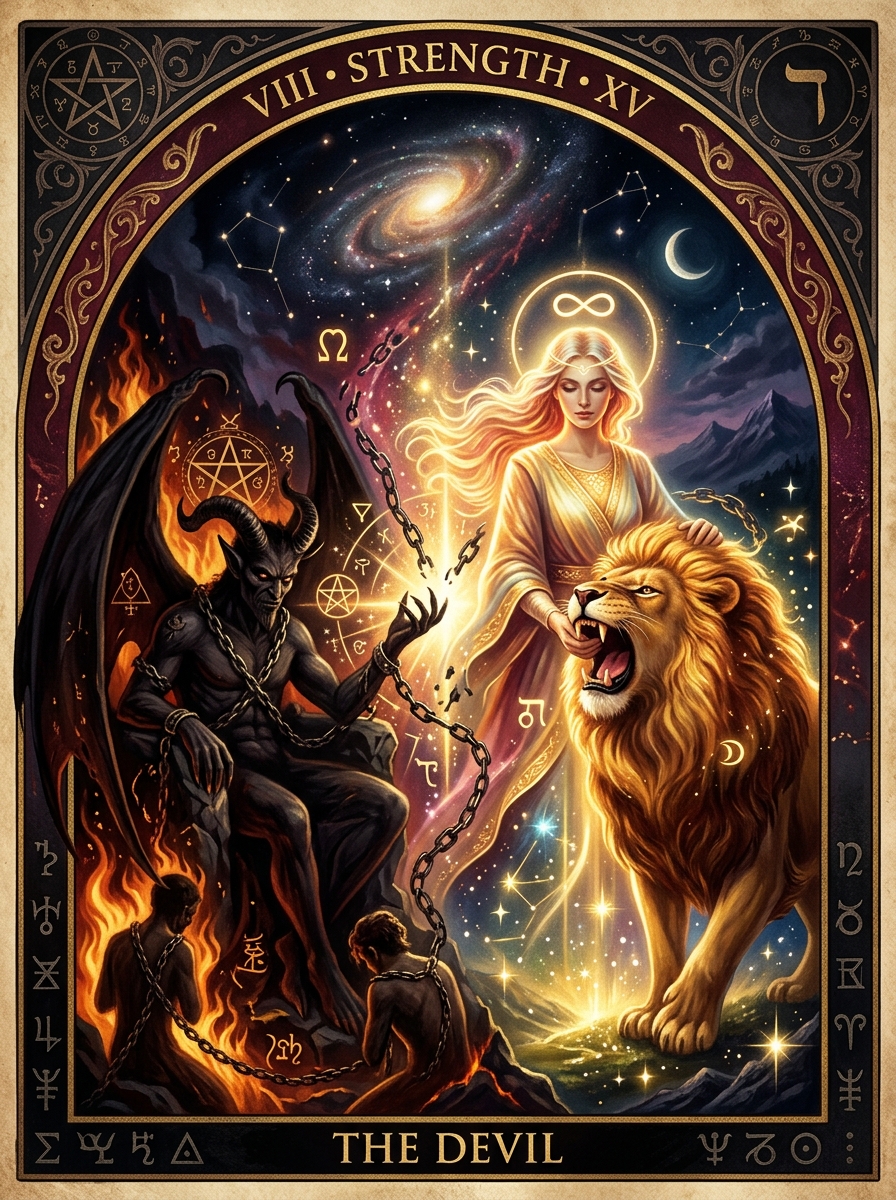
Strength and The Devil together describe a psyche negotiating with its own appetite—not from a position of innocence, but from one that has already tasted the cost. The lion in Strength is not slain; it is soothed. The chain in The Devil is loose enough to slip; the bondage is partly maintained by belief. This is the pairing that asks whether you can want something without being owned by it. The question is not about the desire itself—whether it is good or bad, sacred or profane—but about the structure of your relationship to it. Are you the one who holds the leash, or are you the one who, for the relief of not having to choose, pretends the leash is locked?
In the Major Arcana sequence, these two cards face each other across the abyss of instinct. Strength (VIII) is the calm hand on the beast, a mature nervous system that does not panic at intensity. The Devil (XV) is the force that turns instinct into compulsion when it is denied, glamorized, or overfed. Together they form a closed loop: desire that has become a cage, and the courage required to stay present inside it. The thesis, stated once and held through every section that follows: liberation is not the absence of desire, but the end of its tyranny.
Psychological architecture: how the shadow gets built
The Devil in tarot rarely points to external evil. It names the place where pleasure and guilt have fused, where security has become dependency, and where the self has outsourced its authority to a habit, a person, or a role. The figures in the classic image have horns and tails, but their chains are not locked; the bondage is maintained by the belief that the beast is stronger than they are. That belief is the core of the shadow.
Strength enters as the antidote to repression, not to desire. Repression—calling a part of yourself bad and trying to bury it—is often the very fuel that turns a manageable impulse into a tyrannical compulsion. The more you label a craving as shameful, the more it goes underground, distorts, and returns with the face of a demon. Strength proposes a different strategy: measured contact. The woman opens the lion’s mouth without fear, not because she has conquered it, but because she has learned to read its breath. She stays present with what is wild.
This is why the pairing feels psychologically precise. It invites what Jungians call relationship with the shadow rather than possession by it. In contrast to a pairing like Strength and The Hermit, where the emphasis is on inward silence and self-discipline, Strength + The Devil is about negotiating with appetite itself—not steering it away, but sitting with it long enough to see what it actually wants. For a similar distinction, The Chariot and Strength emphasizes willpower and directed force; this pair asks whether that willpower is real or only aesthetic.
The test of embodiment: when compulsion meets compassion
The Devil is not only vice; it is attachment, fascination, and the seductive logic of “just this once.” In a reading, this card often appears when a person is fused with a pattern that has been rewarded too many times to dissolve by moral declaration alone. The addiction—whether to intensity, validation, sex, status, control, or self-sabotage—is not stupid. It worked once. It may still work in the short term. The question is whether the cost has become invisible.
Strength tests whether your resolve is embodied or merely conceptual. Can you remain yourself when temptation flatters your wounds? When the Devil shows a chain, Strength points to the loop that keeps it in place: the exact place where discomfort is anesthetized, where attention is bartered, where suffering is mistaken for depth. This is not a spiritual test in the abstract. It is a highly diagnostic moment. The cards ask you to notice where the chain is attached and who benefits from keeping it there.
For those familiar with similar shadow terrain, the pair resonates with The Magician and The Devil—which warns about misused agency—and Temperance and The Devil—which explores the chemistry of moderation. Strength adds the missing ingredient: compassion under strain. The beast is not the problem; unconscious relationship to the beast is the problem.
How it lives: love, work, and the chain in context
Because the core dynamic is already established, the expressions in love and career can be stated briefly, each as a specific application of the same principle.
In love, Strength + The Devil is magnetic and perilous. The attraction is real, often overwhelming, but the risk is that chemistry becomes a substitute for intimacy. Passion burns hot; intimacy is whether two people can remain distinct in the heat. The pair often appears when one or both partners are acting out old wounds: needing to be chosen to feel real, needing to be desired to feel safe, or mistaking inconsistency for excitement. The essential question is whether desire is being used as a bridge or a cage. For a fuller exploration of choice under pressure, compare this to The Lovers and The Devil, where the same force appears with the added dimension of willful decision.
In career, the same dynamic takes on a transactional edge. Strength here is not sentimental; it is the discipline to stay upright when reward systems are distorted. The Devil names the trap: selling too much of yourself for a paycheck, accepting coercion as professionalism, or letting status become a substitute for meaning. This combination often appears in high-pressure environments—sales, entertainment, law, finance, startups—where people are rewarded for endurance while being slowly depleted. If you find yourself skilled enough to win inside a system that is not good for you, the cards are not celebrating your competence. They are showing you the transaction. For a deeper diagnostic, The Career Tarot Spread can help distinguish between vocation and attachment to security. When illusion is also in play, The Devil and The Moon reveals how fear and fantasy compound the trap.
Guidance: what the pair asks of you
The advice of Strength and The Devil is neither “indulge” nor “purify yourself.” It is to become conscious enough that desire loses its power to impersonate fate. That means telling the truth about what hooks you, where you overreach, and which discomfort you have been trying to anesthetize. The pair often appears when you are ready to outgrow a coping strategy without yet knowing what replaces it.
Read the chain, not just the beast. Which craving, fear, or role keeps getting rewarded? What do you receive by staying stuck—attention, protection, excitement, numbness, identity? The work is not abstract enlightenment; it is pattern recognition. The cards ask you to name the pleasure in the trap, because only then can the trap loosen. A dedicated Shadow Work Tarot Spread can map these hidden agreements with precision. When the structure itself is about to break, The Devil and The Tower describes the moment of collapse; Strength + The Devil is earlier in the cycle, the moment before crisis, when the soul still has a chance to choose consciousness over compulsion.
Sometimes the most spiritual act here is not dramatic rupture but disciplined containment. Strength does not demand asceticism. It asks for proportion: boundaries around a relationship, sobriety from a compulsive habit, reduced exposure to an exploitative workplace, a more honest contract with your own body. The combination does not rush. It exposes. And what it ultimately reveals is that the beast inside the chain is not the enemy—it is the part of you that has been waiting for someone to show up and stay.
Related
- Temperance and The Devil: Alchemy Against Compulsion
- The Hanged Man and The Devil: Suspended Will, Shadow Appetite, and the Price of Awakening
- The Magician and Strength: The Art of Directed Power
- The Devil and The Fool: Temptation, Freedom, and the Edge of the Leap
- The Devil and the Moon: Desire, Deception, and the Night Mind
Comments
Loading comments…