Saros Eclipse Families: Tracking the Mystical Blueprint of Biography
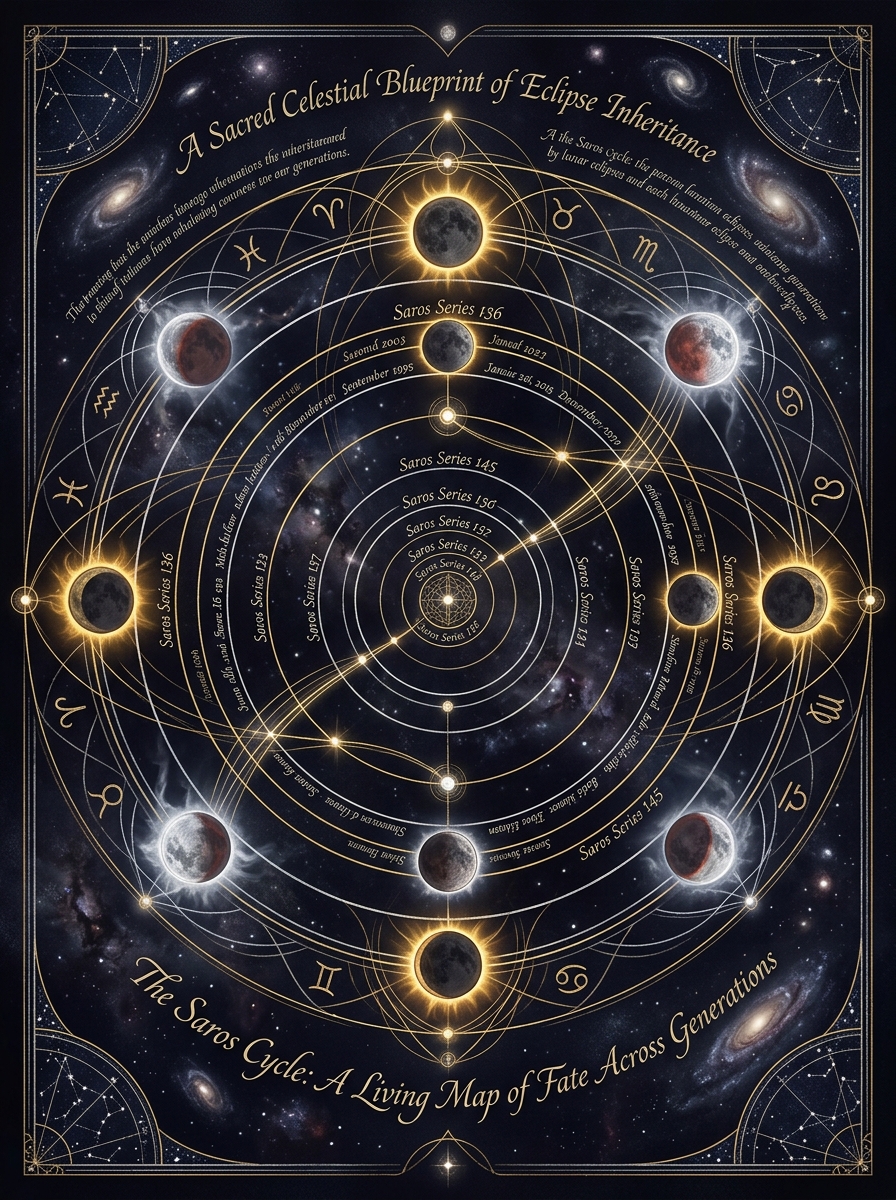
1. The Astronomical Mechanics of the Saros Cycle: The Synchronization of Three Lunar Paths
To fully appreciate the profound astrological import of Saros families, one must first dismantle and inspect the elegant clockwork of the heavens. Eclipses are not random celestial events; they are the highly ordered consequence of three distinct lunar cycles synchronizing over a vast span of time. The term Saros, derived from the Babylonian word saru (meaning a unit of measure or the number 3,600), describes a cycle of approximately 18 years, 11 days, and 8 hours (precisely 6,585.3211 days). Within this precise window, the Sun, the Moon, and the Earth return to almost the exact same relative geometry, producing an eclipse that is nearly identical in characteristics to the one that preceded it in the series.
To understand why this happens, we must look at the three distinct rhythms of the Moon's orbit around the Earth, each governing a different dimension of lunar movement:
- The Synodic Month (Phase Cycle): This is the familiar phase cycle of the Moon, measured from one New Moon to the next, lasting approximately 29.53059 days. For an eclipse to occur, the Moon must be either new (for a solar eclipse, where the Moon blocks the Sun) or full (for a lunar eclipse, where the Earth’s shadow falls upon the Moon). Without this conjunction or opposition, eclipses are impossible.
- The Draconic Month (Node Cycle): This is the time it takes for the Moon to return to the same orbital node—the points where the Moon's tilted orbit intersects the ecliptic (the Earth's orbital plane around the Sun). This cycle lasts approximately 27.21222 days. An eclipse can only occur when the New or Full Moon is close to one of these nodes. If the Moon is too far from a node, its shadow misses the Earth (or the Earth's shadow misses the Moon).
- The Anomalistic Month (Distance Cycle): This is the cycle of the Moon's distance from the Earth, measured from perigee (closest point) to apogee (farthest point) and back, lasting approximately 27.55455 days. This determines the apparent size of the Moon in the sky. If an eclipse occurs when the Moon is near perigee, it appears large enough to completely cover the Sun, resulting in a total solar eclipse. If it occurs near apogee, the Moon appears smaller, leaving a ring of light, resulting in an annular solar eclipse.
The magic of the Saros cycle lies in the mathematical resonance of these three periods. If we multiply these cycles, we discover a remarkable alignment:
- 223 synodic months = 6,585.3211 days
- 242 draconic months = 6,585.3567 days
- 239 anomalistic months = 6,585.5374 days
The extraordinary synchronization of these three values means that after 223 synodic months, the Moon returns to the same phase (New or Full Moon), is at the same distance from the Earth (apogee or perigee), and is located at almost the exact same position relative to the lunar nodes. Because of this orbital alignment, the resulting eclipse will "rhyme" with the previous one, carrying the same geometry, magnitude, and shadow characteristics.
However, the alignment is not absolutely perfect. There is a tiny mismatch of about 0.035 days relative to the nodes and a fractional shift in latitude. Furthermore, the extra 8 hours (the 0.3211 day fraction) in the cycle means that the Earth rotates an additional 120 degrees westward before the next eclipse in the series occurs. Consequently, each successive eclipse in a Saros series is shifted 120 degrees of longitude to the west on the Earth's surface.
After three Saros cycles—a period of 54 years and approximately 33 days, known as the Exeligmos cycle—the fractional 8 hours accumulate to 24 hours (a full day's rotation), returning the eclipse to nearly the same geographical longitude on Earth. This 54-year cycle has historically been observed as a powerful macro-cycle in both mundane events and individual biographies, representing a grand alignment where the solar shadow returns to the same third of the globe, bringing its initiatory lessons back to the land and the personal charts of those born under its original signature.
Historically, ancient Babylonian astronomers noticed that eclipses occurred in families. Through meticulous recording of celestial events over centuries, they discovered this 18-year period. By identifying the repeating pattern, they were able to predict solar and lunar eclipses with remarkable accuracy, despite having no understanding of gravity, heliocentrism, or three-dimensional orbital mechanics. They viewed the Saros not merely as a math trick, but as a grand cosmic heartbeat, a rhythmic breath of the universe that structured human time and marked the rise and fall of empires.
2. The Astrological and Psychological Tapestry: Biography Mapping and Jungian Individuation
When we translate these complex astronomical mechanics into the language of the soul, the Saros cycle emerges as a profound instrument for biographical mapping and psychological integration. In the psychological astrology tradition, spearheaded by figures such as Liz Greene and influenced by C.G. Jung, the natal chart is not a static blueprint of a fixed destiny. Instead, it is a dynamic map of the psyche's potential, depicting the archetypal forces that seek expression over the course of a lifetime. Under this framework, eclipses act as dynamic catalysts, disrupting the ego's fragile structures to make way for the emergence of the unconscious.
Because eclipses belonging to the same Saros series recur every 18 years and 11 days, they establish a thread of continuity across our personal histories. They act as "biographical rhymes," bringing back similar archetypal themes, emotional complexes, and relational dynamics at predictable intervals. The ages of 18, 36, 54, and 72 represent major initiatory gateways where the same Saros families return to cross-examine our progress.
The Dynamics of Astrological Rhyming
Astrological rhyming does not mean that history repeats itself literally. Instead, the thematic essence of the events remains consistent. For example, if a particular Saros eclipse family stimulated a profound crisis of identity and a subsequent shift in career direction at age 18, its return at age 36 will reactivate that same core developmental prompt, albeit at a higher turn of the spiral. The individual is asked: How have you integrated the lessons of self-actualization and personal authority since the last time this portal was open?
This cyclical recurrence aligns beautifully with Jung's concept of individuation—the process by which a person becomes their true, whole self by integrating the disparate parts of their conscious and unconscious mind. Eclipses, by casting a temporary shadow over the solar light of the conscious ego or the lunar light of the emotional self, create an opening. In these moments of darkness, the shadow self (the unacknowledged, repressed, or split-off parts of the psyche) is projected outward or experienced through sudden events and encounters.
       [ EGO CONSCIOUSNESS ]
                |
     ==== ECLIPSE PORTAL ==== (Conscious light temporarily obscured)
                |
     [ UNCONSCIOUS SHADOW SHIFT ]
                |
   [ INTEGRATION & INDIVIDUATION ] (Age 18 -> 36 -> 54 -> 72)
By tracking which Saros families are active during our major life transitions, we can begin to see our biographies not as a random series of chaotic events, but as a structured, purposeful narrative. Liz Greene frequently references the concept of fate not as an external force imposing doom, but as the unfolding of inner psychological necessity (Ananke). When a Saros eclipse triggers a sensitive natal point, it represents a moment where inner necessity meets outer circumstance, demanding that we confront what has been left in the dark.
From a depth-psychology perspective, when an eclipse from a specific family aspects a natal planet, it temporarily suspends the ego's control over that planetary function. If it hits Venus, our habitual way of relating and valuing is eclipsed, allowing repressed desires, unresolved relationship patterns, and hidden artistic impulses to flood the conscious mind. If it hits Mars, our drive, assertion, and anger are brought to light, forcing us to examine how we handle conflict and personal power. By viewing these occurrences through the lens of the Saros cycle, we realize that these disruptions are part of a long-term, 18-year developmental curriculum designed to mature the specific planetary functions.
3. The Birth of a Lineage: Bernadette Brady's Methodology
The modern astrological community owes much of its understanding of Saros families to the ground-breaking work of astrologer Bernadette Brady. In her seminal text, Predictive Astrology: The Eagle and the Lark, Brady revolutionized the way astrologers interpret eclipses by shifting the focus away from isolated events and toward the historical lineage of the Saros series.
Brady pointed out that each Saros series has a specific birth, a lifespan, and an eventual death. A typical Saros series begins as a tiny, barely perceptible partial eclipse at either the North or South Pole. Over the course of approximately 1,200 to 1,300 years, the series slowly migrates across the globe, moving from pole to pole, producing total eclipses when it crosses the equator, and eventually tapering off as minor partial eclipses at the opposite pole before fading out entirely. A single series will contain between 70 and 80 individual eclipses.
The Anatomy of a Saros Series Birth
According to Brady’s methodology, the key to unlocking the astrological "theme" or character of any given Saros series lies in its origin. The very first eclipse of a series—the moment it first touches down at the pole—contains the genetic code of the entire family. By casting an astrological chart for this initial eclipse (using the precise time and coordinates where the shadow first touches the Earth), we can analyze the planetary configurations, aspects, and node placements active at the birth of the lineage.
               [ NORTH / SOUTH POLE ]
             (Initial Eclipse / Birth)
                        |
                        v  ~1,200 - 1,300 Years Migration
             [      EQUATORIAL REGIONS      ]
            (Total Eclipses / Mature Peak)
                        |
                        v
               [ OPPOSITE POLE ]
            (Final Eclipse / Dissolution)
Decoding the Blueprint of the Initial Eclipse
When interpreting the initial chart, Brady suggests focusing on the major planetary aspects made to the Sun and Moon, as well as any tight midpoint configurations. For instance:
- A Saros series born with a tight conjunction between Mars and Pluto in the initial chart will infuse every eclipse in that series with themes of power struggles, intense transformations, and the necessity of confronting raw ambition.
- A series born with a strong Venus-Neptune signature will manifest as cycles of idealism, romantic disillusionment, creative surrender, or spiritual awakening when its subsequent eclipses touch an individual's natal chart.
By identifying the theme of the Saros family affecting our chart, we gain a crucial interpretive filter. Instead of interpreting a transit eclipse solely based on the sign and house it falls in, we must view it through the lens of its family origin. A solar eclipse at 15 degrees of Taurus belongs to a larger family story; its expression will be radically different if it belongs to a Saros series defined by sudden Jovian breakthroughs than if it belongs to a series defined by Saturnian restriction. This perspective elevates astrology from superficial event-prediction to a deep, archetypal dialogue with time.
Furthermore, Brady’s research categorizes these series into "North" or "South" families (e.g., Saros Series 1 North, 2 South) depending on the pole of origin. The astrological interpretation of a series relies heavily on the specific planetary aspects formed in its birth chart. For example, if Saturn is square the initial eclipse, the entire series carries a theme of structure, responsibility, facing limitations, and rebuilding foundations. When an eclipse from this family occurs, the individual must prepare to do the hard work of organizing their life, rather than expecting effortless luck. Conversely, if Uranus is trine the initial eclipse, it carries a theme of sudden liberation, breakthroughs, and rapid, unexpected shifts that open new doors.
4. The Weave of the Nodes: North and South Node Dominance
Eclipses are, by definition, the celestial meetings that take place at the crossroads of the Sun's path and the Moon's orbit—the Lunar Nodes. In evolutionary astrology, as articulated by Steven Forrest and other modern practitioners, the Lunar Nodes represent the evolutionary axis of the soul. The South Node represents our default settings, past-life conditioning, ancestral habits, and the areas of life where we tend to seek comfortable but ultimately stagnant refuge. The North Node, conversely, represents the evolutionary frontier—the unfamiliar, challenging, and spiritually necessary qualities we must develop to achieve balance and growth.
Because Saros families migrate from one pole to the other, they are structurally divided into two distinct polarities: North Node Saros series and South Node Saros series. This distinction determines the primary evolutionary momentum of the eclipses within that family.
The North Node Portal: Initiating Unfamiliar Growth
A North Node Saros family consists of eclipses where the Moon is crossing the ecliptic from south to north. Astrologically, these families carry a distinct future-oriented charge. When a North Node eclipse triggers a natal planet or house:
- It acts as a compelling pull toward the unfamiliar.
- It introduces developmental pressure that forces us out of our comfort zones.
- It often coincides with sudden invitations, new relationships, or unexpected opportunities that demand we stretch our capacities.
- The psychological sensation is one of being propelled forward, even if the ego feels unprepared for the transition.
In evolutionary terms, a North Node eclipse family behaves like an engine of individuation that demands we claim latent potential. It is a cosmic demand to step into the dark territory of our future self, leaving behind the safety of known horizons. This requires courage, as the ego often resists the unknown and prefers the comfortable patterns of the past. The North Node Saros family forces a shift by presenting circumstances that cannot be resolved using old coping mechanisms.
The South Node Portal: Resolving Ancestral Echoes
A South Node Saros family consists of eclipses where the Moon is crossing the ecliptic from north to south. These eclipses carry a distinct past-oriented, clearing frequency. When a South Node eclipse activates a chart:
- It initiates periods of release, purging, and the dissolution of outdated patterns.
- It brings up unresolved karma, childhood conditioning, or ancestral themes that must be faced and integrated.
- It frequently coincides with endings, departures, and the necessity of letting go of attachments that no longer serve the soul's growth.
- The psychological sensation can feel like a psychic clearing, where we must pay historical debts to our own development.
Rather than viewing South Node eclipses as negative or malefic, evolutionary astrology recognizes them as essential phases of spiritual composting. We cannot step into the North Node's light without first clearing the accumulated debris of the South Node's shadow. The South Node Saros families provide the structured containers for this necessary work of release and resolution. During a South Node eclipse, we are asked to surrender our grip on relationships, habits, or roles that we have outgrown, acknowledging that their departure is a prerequisite for our continued evolution.
5. Constructing Your Biographical Map: A Practical Guide
To bring the loftiness of these celestial patterns down to earth, you can engage in a systematic process of biographical mapping. By aligning the timeline of your life with the movement of the Saros families, you can decode the hidden architecture of your personal development.
Step 1: Locating the Eclipses in Your Natal Chart
First, examine your natal chart to identify if you were born close to an eclipse, or if specific eclipse families have repeatedly made close aspects to your natal planets and angles.
- Identify the degree and sign of your natal planets, particularly the personal planets (Sun, Moon, Mercury, Venus, Mars) and the angles (Ascendant, Midheaven, Descendant, IC).
- Look for eclipses that have occurred within an orb of 2 to 3 degrees of these sensitive points. Eclipses that land within this tight range will have the most noticeable impact on your life.
Step 2: Constructing the Temporal Grid
Create a chronological timeline of your life, noting the years when you experienced major, life-altering events—shifts in career, the beginning or end of significant relationships, geographical moves, health crises, or profound psychological awakenings.
Once your personal timeline is established, overlay the historical dates of the eclipses that triggered your chart. You will want to note:
- The calendar date of the eclipse.
- The zodiacal degree and sign.
- The Saros series number (e.g., Saros 140, Saros 119).
- Whether it was a Solar or Lunar eclipse, and whether it was a North or South Node eclipse.
Personal Life Events:
[ Age 18: Move to College ] ---> [ Saros 119 Eclipse on Natal Moon ]
[ Age 36: Career Pivot    ] ---> [ Saros 119 Eclipse returns to Natal Moon ]
[ Age 54: Legacy Transition ] -> [ Saros 119 Exeligmos Return to Natal Moon ]
Step 3: Tracking the Recurring Themes
Analyze the correlation between the Saros numbers and your life events. Look specifically at the 18-year intervals. For example, if you experienced a major shift in your identity or relationships around the age of 18, look at the eclipse that occurred during that period. Identify its Saros number. Now, look forward to when you were 36 years old. Did a similar theme, emotional pattern, or archetypal conflict arise?
When tracing these cycles, keep an eclipse journal. Write down the narratives of these periods, focusing on the internal psychological shifts rather than just the external events. Note how the theme of the initial eclipse of that Saros series (which you can research using Brady's tables or astrological databases) matches the emotional tone of your life at those key milestones.
To deepen this practice, pay attention to the Exeligmos cycle at age 54. This represents the third return of a specific Saros series, occurring at the same geographical longitude and nearly the same zodiacal degree. It is often a time of massive synthesis and integration, where the patterns of the first return (age 18) and second return (age 36) are finally understood in a unified biographical context. The individual can look back and see how the seed planted at 18, cultivated at 36, has finally borne fruit or reached its natural resolution at 54.
6. Integration, Boundaries, and Ethical Astrology
As with any advanced astrological technique, the study of Saros families requires psychological maturity and ethical boundaries. In the hands of an untrained or fatalistic practitioner, eclipse cycles can easily be misused to induce anxiety or project rigid, predictive outcomes. It is vital to approach this work with a respect for human agency and the complexity of the psyche.
The Dangers of Predictive Fatalism
An eclipse is not a celestial sentence. It does not guarantee disaster, nor does it guarantee unearned fortune. Eclipses are simply moments of intense energetic focus and alignment. When we tell a client or ourselves that a specific Saros eclipse will bring "catastrophe" or "inevitable loss" because of its historical theme, we are practicing a regressive form of astrology that strips the individual of their conscious participation in their own evolution.
As Liz Greene wisely notes, the outer planets and major cycles represent the archetypal forces of the collective unconscious. When they break through into our personal lives, they demand that we make room for them. If we resist, the archetype will often manifest externally in a raw, disruptive form. However, if we consciously engage with the archetypal theme—seeking to understand what it is asking us to face, release, or build—we can co-create with the cycle, steering its expression toward creative integration rather than destructive eruptions.
A Complementary Tool, Not a Replacement
It is also important to maintain perspective. Saros cycle analysis is a macro-astrological tool. It operates as a background frequency, helping us understand the long-term chapters of our lives. It should never replace the fundamental layers of astrological analysis:
- The natal chart structure (houses, signs, planetary aspects).
- Personal transits (especially Saturn, Uranus, Neptune, and Pluto cycles).
- Secondary progressions and Solar Return charts.
Think of the Saros cycle as the deep ocean current, while daily transits are the surface waves. Both are real, and both affect the ship, but they operate on entirely different scales of time and depth. Integrate the Saros families as a tool for synthesis, helping to connect the dots of a life story over decades, providing comfort and meaning to the winding road of individuation.
Ethically, when working with clients or analyzing your own chart, always frame eclipse themes as developmental questions rather than external declarations. Instead of predicting "a breakup" during a Venus-related Saros eclipse, ask: "What values or relational patterns are being highlighted for assessment and release during this window?" This shift in phrasing moves the client from a passive recipient of external fate to an active agent of psychological growth.
7. Frequently Asked Questions
What is the difference between a Solar and Lunar Saros series?
While both solar and lunar eclipses belong to Saros cycles, solar and lunar Saros series are tracked separately. A Solar Saros series tracks the recurring alignments of Solar Eclipses (New Moons), whereas a Lunar Saros series tracks Lunar Eclipses (Full Moons). Solar series are often associated with external shifts, structural changes, and the redirection of our outer life path and conscious purpose. Lunar series tend to operate more internally, triggering deep emotional purges, shifts in relationship dynamics, and the release of unconscious habits or dependencies.
How do I find the initial eclipse chart for a specific Saros series?
To find the initial eclipse chart, you will need access to an astronomical database of eclipses, such as the NASA Eclipse Web Site, or specialized astrological software that includes Saros tracking (such as Solar Fire). Once you identify the Saros number of the eclipse you are researching, look up its historical start date—the very first partial eclipse in that series. You then cast the astrological chart for the date, time, and geographical coordinate where the Moon's shadow first touched the Earth during that initial eclipse.
Can an eclipse from a Saros series affect me if it doesn't aspect my natal chart directly?
While every eclipse changes the collective energetic climate, a Saros eclipse will have a negligible personal impact unless it makes a direct, tight aspect (conjunction, opposition, square, or trine) to a planet or angle in your natal chart. The standard orb for eclipse impact is tight—typically within 2 to 3 degrees. If an eclipse falls in an empty area of your chart, it will simply pass as a general background shift rather than a major biographical turning point.
Why do some Saros series seem to bring positive growth while others bring intense challenges?
The character of a Saros series is determined by the planetary alignments in its initial birth chart. If a series is born under supportive, harmonious alignments (such as a Venus-Jupiter trine), its subsequent eclipses tend to manifest as opportunities, breakthroughs, and creative inspirations. If a series is born under tense alignments (such as a Mars-Saturn-Pluto t-square), its eclipses will naturally carry a more challenging, confrontational signature, requiring hard work, crisis management, and the dismantling of old structures to facilitate growth.
How long does the effect of a Saros eclipse transition last in our daily lives?
The astrological influence of an eclipse is not confined to the day of the event. Psychologically and circumstantially, the portal of an eclipse opens approximately a month before the actual event (as the Sun approaches the node) and can remain active for six months to a year afterward, serving as the dominant thematic backdrop until the next set of eclipses occurs. In the case of a major Saros return that hits a personal planet directly, the developmental integration of that cycle can unfold over a period of 18 to 24 months.
How do I integrate Saros cycle analysis with my current understanding of personal transits?
Saros cycle analysis should be used as a macro-developmental lens that sits on top of your standard transit and progression tracking. When you see a major transit occurring, look to see if a Saros eclipse is activating the same area of your chart. If it is, the transit will likely carry the thematic signature of that Saros family, signaling that the transit is not a standalone event but part of a larger, long-term developmental cycle. This integration helps you identify the deeper archetypal meaning behind the specific events.
Comments
Loading comments…