Planetary Hours: The Complete Guide to Astrological Timekeeping
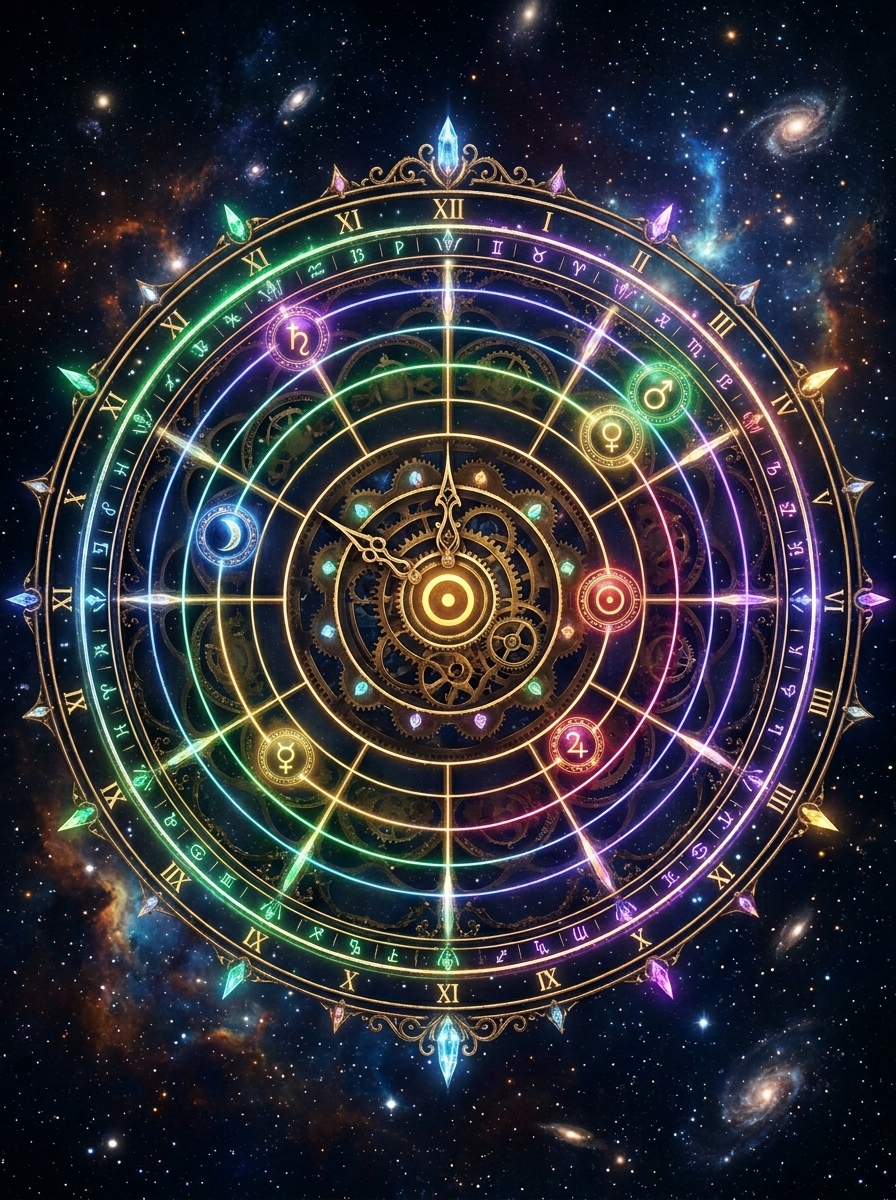
The Chaldean Order and Historical Origins
The human measurement of time has always been a dance between the mechanical and the mystical, a search for order within the infinite vault of the heavens. Long before the advent of ticking quartz crystals and atomic clocks, ancient civilizations observed that time was not a uniform, flat line of identical seconds. Instead, time possessed a distinct, qualitative flavor. Among the most enduring methods developed to capture this cosmic rhythm is the system of planetary hours—an ancient astrological timekeeping method that divides the day and night into twenty-four seasonal segments, each governed by one of the seven classical planets of antiquity. To fully appreciate this system, we must return to its historical origins, exploring the Babylonian, Hellenistic, and Hermetic roots that laid the foundation for this elegant celestial framework.
The Babylonian Genesis of Time
The origins of planetary hours are inextricably linked to the Chaldean order, a specific hierarchical arrangement of the seven visible celestial bodies based on their relative speed of motion as observed from our geocentric perspective. The Chaldeans—astronomers and astrologers of ancient Mesopotamia—mapped the heavens with mathematical precision. They observed that from Earth's point of view, Saturn moved the slowest across the background of the stars, followed in descending order of duration by Jupiter, Mars, the Sun, Venus, Mercury, and the Moon.
This ordering of the planets from slowest to fastest became the backbone of astrological philosophy. It was not merely a physical observation; it was a map of cosmic density and proximity. In the ancient mind, the slower-moving outer planets represented higher, more remote spheres of consciousness and divine law, while the rapid, ever-shifting Moon represented the immediate, sublunary realm of physical manifestation. This Chaldean sequence—Saturn, Jupiter, Mars, Sun, Venus, Mercury, Moon—forms the repeating pattern upon which the planetary hours are calculated.
Hellenistic Codification and Hermetic Wisdom
While the Babylonians observed these celestial rhythms, it was during the Hellenistic period, particularly in Ptolemaic Egypt, that the system of planetary hours was formally codified and integrated with the twenty-four-hour day. Hellenistic astrology synthesized Babylonian astronomy with Egyptian timekeeping and Greek philosophical frameworks. It was during this intellectual renaissance that the Hermetic philosophy of "as above, so below" found its most practical application. The Hermetic teachings, attributed to the mythical sage Hermes Trismegistus, asserted that the microcosm of human existence directly mirrored the macrocosm of the universe.
Planetary hours emerged as a direct application of this cosmic sympathy. Esoteric thinkers like the legendary astrologer Vettius Valens and later Western occultists like Arthur Edward Waite, who heavily influenced the Hermetic Order of the Golden Dawn, recognized that these hourly divisions were not arbitrary. Instead, they represented specific windows of time when the veil between human intention and cosmic archetype was thinnest. In the Golden Dawn tradition, planetary hours were used to schedule the consecration of talismans and the performance of specific evocations, ensuring that the magician was working in harmony with, rather than in opposition to, the prevailing celestial currents.
Archetypes and Synchronicity in Modern Practice
In contemporary practice, particularly within the lineage of psychological astrology championed by figures like Liz Greene and Steven Forrest, planetary hours are understood not as deterministic forces, but as archetypal energies. Rather than viewing the planets as distant physical bodies casting literal rays of influence down to Earth, modern astrologers often turn to Carl Jung's theory of synchronicity. Jung defined synchronicity as an acausal connecting principle, where events are linked by meaning rather than physical cause and effect.
From this perspective, a planetary hour is a cosmic mirror. When we align our activities with a specific planetary hour, we are engaging in a conscious act of synchronistic alignment. We are choosing to work with the natural flow of the universe's symbolic current. The slow, structured energy of Saturn, the expansive optimism of Jupiter, or the analytical precision of Mercury are seen as psychological archetypes residing within the collective unconscious. By tracking these hours, we learn to recognize when the cosmic tide is rising for specific endeavors, enabling us to act with greater psychological efficacy and spiritual alignment.
The Mechanics of Time: Calculating Variable and Seasonal Hours
To the modern mind, an hour is a fixed unit of measurement: exactly sixty minutes, or three thousand six hundred seconds, unchanging regardless of the season or the position of the sun. This rigid, uniform timekeeping is a product of the industrial revolution, designed to synchronize factories and schedules. Ancient timekeeping, however, was organic, fluid, and deeply tied to the natural world. To calculate planetary hours, one must discard the concept of uniform clock hours and embrace the system of variable, seasonal hours.
Understanding Seasonal Unequal Hours
The core mechanical principle of planetary hours is that the day and the night are treated as two distinct halves, each divided into twelve equal portions. However, because the length of daylight and darkness changes constantly throughout the year, the actual duration of a planetary hour fluctuates depending on the season and the geographical latitude of the observer.
During the summer solstice in the Northern Hemisphere, the period between sunrise and sunset is at its longest. Consequently, each of the twelve daytime planetary hours will be significantly longer than sixty minutes—sometimes stretching to seventy-five minutes or more. Conversely, the twelve nighttime hours during the summer will be correspondingly shorter, perhaps lasting only forty-five minutes. During the winter solstice, this dynamic is reversed: the daytime hours shrink, and the nighttime hours expand. Only on the vernal and autumnal equinoxes, when day and night are of equal length, do planetary hours align precisely with the sixty-minute clock hours we use in daily life.
This variable system forces the practitioner to pay active attention to the natural environment. To calculate these hours, one cannot simply look at a standard clock; one must know the exact local times of sunrise and sunset. This alignment with the actual physical movement of the sun anchors the practice in local reality, bridging the gap between abstract astrological theory and concrete, bodily experience.
The Step-by-Step Mathematical Calculation
Calculating planetary hours manually is an excellent way to internalize the mathematics of the cosmos. The process requires establishing separate calculations for the daytime period and the nighttime period. Here is the step-by-step methodology:
First, determine the exact local time of sunrise and sunset for your specific location on a given day. These times must be highly accurate, adjusted for your specific latitude and longitude.
Second, calculate the total duration of the daytime. Subtract the sunrise time from the sunset time. Convert this total duration entirely into minutes. For example, if sunrise is at 6:00 AM and sunset is at 8:00 PM, the daytime duration is fourteen hours, which equals eight hundred and forty minutes.
Third, divide this total daytime duration by twelve. The resulting number is the length of a single daytime planetary hour for that specific day. In our example, eight hundred and forty minutes divided by twelve yields exactly seventy minutes. Therefore, each daytime planetary hour on this day lasts seventy minutes.
Fourth, calculate the total duration of the nighttime. Subtract the sunset time of the current day from the sunrise time of the following day. Convert this duration into minutes and divide by twelve to determine the length of a single nighttime planetary hour. If the nighttime duration is ten hours (six hundred minutes), each nighttime planetary hour will last fifty minutes.
Fifth, construct the schedule for the day. The first planetary hour of the day begins at the exact moment of sunrise. In our example, Hour 1 runs from 6:00 AM to 7:10 AM. Hour 2 runs from 7:10 AM to 8:20 AM, and so on, until the twelfth hour concludes at the exact moment of sunset (8:00 PM). The thirteenth hour—which is the first hour of the night—begins at sunset and runs for fifty minutes (from 8:00 PM to 8:50 PM), continuing through the night until the final hour ends at sunrise the next morning.
Planetary Significations: The Seven Celestial Rulers
Each of the planetary hours is colored by the specific archetypal quality of its ruling celestial body. To utilize this system effectively, we must understand the core significations, psychological dimensions, and practical applications of each of the seven classical planets. These rulers follow the Chaldean order, creating a continuous loop of shifting cosmic influences throughout the day and night.
Saturn: The Hour of Structure and Boundary
Saturn, the outermost of the classical planets, represents the principles of structure, limitation, discipline, time, and boundaries. In the psychological astrology of Liz Greene, Saturn is the archetype of the Shadow and the Senex (the wise old man), representing the necessary boundaries we must construct to navigate the material world.
During the hour of Saturn, the cosmic atmosphere becomes heavy, serious, and slow. This is not a time for lighthearted socializing or spontaneous play. Instead, it is the ideal window for activities requiring deep concentration, organizational structure, planning, and facing difficult realities. It is a highly effective time for editing written work, organizing files, establishing boundaries, saying no to unwanted commitments, and performing structural maintenance. In esoteric ritual, the hour of Saturn is utilized for binding spells, protection work, honoring ancestors, and working with the earth or stones. It is a period to confront limitations and cultivate patience.
Jupiter: The Hour of Expansion and Fortune
Following Saturn in the Chaldean order is Jupiter, the planet of expansion, benevolence, wisdom, philosophy, and abundance. Culturally associated with luck and growth, the Jupiter hour is widely considered one of the most auspicious periods of the day for launching new initiatives, seeking financial advice, and engaging in intellectual or spiritual growth.
When the Jupiter hour begins, the psychological atmosphere shifts toward optimism and generosity. It is the perfect time to pitch a project, ask for a raise, sign contracts, travel, or engage in philosophical study. In magical practice, this hour is prized for consecrating wealth talismans, performing rituals for prosperity, and seeking spiritual guidance. It is an hour of broad perspectives, helping us step back from mundane details to see the larger patterns of our lives.
Mars: The Hour of Action and Severance
Mars represents energy, drive, physical action, courage, and cutting through obstacles. Psychologically, Mars is the raw drive of the ego, the force that allows us to assert our individuality and defend our boundaries.
The Mars hour brings a surge of physical energy, but also an increased risk of conflict, impatience, and impulsiveness. This hour is best utilized for activities that require physical exertion, decisive action, and courage. It is an excellent time for intense exercise, initiating difficult conversations, tackling hard physical labor, or cutting ties with toxic habits or relationships. In esoteric rituals, the Mars hour is chosen for operations involving strength, banishing negative influences, severing ties, and cultivating courage. It requires conscious channeling to prevent the energy from degenerating into arguments or accidents.
The Sun: The Hour of Sovereignty and Essence
The Sun sits at the center of the solar system and, in astrology, represents the core self, vitality, creative expression, and conscious awareness. Psychologically, it is the Jungian Self—the coordinating center of the entire personality.
During the hour of the Sun, the focus turns to visibility, leadership, and authenticity. This is the prime time to present yourself to the public, speak in front of audiences, showcase creative work, or seek the favor of authority figures. It is an hour to celebrate life, express joy, and connect with your inner vitality. Esoterically, the Sun hour is used for rituals of success, vitality, self-confidence, and connecting with solar deities or guides. It is a period of illumination, making it easier to see truths that were previously hidden in the shadows.
Venus: The Hour of Connection and Beauty
Venus is the planet of love, beauty, harmony, relationships, values, and aesthetics. Psychologically, it represents our capacity for connection, our aesthetic taste, and our sense of self-worth.
The Venus hour softens the energetic landscape, bringing a spirit of cooperation, pleasure, and artistic appreciation. It is the most auspicious hour for socializing, going on dates, engaging in artistic creation, purchasing beautiful items, or resolving interpersonal conflicts. It is also an excellent time for self-care and indulging the senses. Esoterically, the Venus hour is the primary choice for love spells, beauty rituals, and consecrating items related to harmony, friendship, and art. It reminds us of the value of receptivity and relational harmony.
Mercury: The Hour of Cognition and Exchange
Mercury rules communication, intellect, logic, commerce, technology, and local travel. Psychologically, it represents the processing of data, the translation of experience into language, and the neural networks of the mind.
The Mercury hour is characterized by a rapid, buzzing mental energy. The mind becomes active, analytical, and curious. This is the optimal window for writing, studying, answering emails, coding, negotiating business deals, and engaging in lighthearted debates. It is also an opportune time for running errands and organizing logistics. In magical work, the Mercury hour is used for rituals involving communication, intelligence, safe travel, and business transactions. Practitioners must be mindful of mental overload during this hour, as the nervous system can become overstimulated.
The Moon: The Hour of Receptivity and Flow
The Moon, the closest celestial body to Earth, rules the subconscious, emotions, intuition, domestic life, and the physical body's basic needs. Psychologically, it represents the emotional foundation, the inner child, and our instinctual reactions.
During the Moon hour, the energetic tide recedes, calling us to turn inward. It is a time for rest, reflection, emotional processing, and tending to the home and family. It is an excellent hour for meditation, journaling, cooking, and activities that require intuitive insights. Because the Moon is associated with flux, this hour is less suited for rigid, analytical tasks or long-term commitments. Esoterically, it is the classic hour for divination, dream work, emotional healing, and honoring lunar archetypes.
Planetary Days of the Week and Dominant Rulers
The connection between the planetary hours and the days of the week is one of the most beautiful mathematical symmetries in ancient astrology. To the modern observer, the naming and sequencing of the weekdays—Sunday, Monday, Tuesday, Wednesday, Thursday, Friday, Saturday—can seem arbitrary. However, this sequence is a direct consequence of the Chaldean order when applied to the twenty-four hours of the day.
The Seven-Day Structure and Celestial Names
Each day of the week is named after and ruled by one of the seven classical planets. In English, French, Spanish, and many other languages, this etymological connection is clear:
- Sunday: Ruled by the Sun (Latin: Dies Solis)
- Monday: Ruled by the Moon (Latin: Dies Lunae)
- Tuesday: Ruled by Mars (Norse equivalent: Tiw; Latin: Dies Martis)
- Wednesday: Ruled by Mercury (Norse equivalent: Woden; Latin: Dies Mercurii)
- Thursday: Ruled by Jupiter (Norse equivalent: Thor; Latin: Dies Iovis)
- Friday: Ruled by Venus (Norse equivalent: Frigg; Latin: Dies Veneris)
- Saturday: Ruled by Saturn (Latin: Dies Saturni)
The planet that rules a specific day exerts a dominant, overarching influence on the entire twenty-four-hour period, serving as the "Lord of the Day." The planetary hours of that day operate within this larger systemic context. For example, a Mercury hour on a Wednesday (the day of Mercury) will feel far more potent, focused, and pure than a Mercury hour on a Saturday (the day of Saturn, which adds a layer of restriction or gravity to the mental process).
The Mathematical Proof of the Weekday Order
The sequence of the weekdays is determined by a simple, mathematically elegant formula. The rule states that the planet ruling the first hour of sunrise on a given day is the ruler of that entire day.
Let us trace this cycle mathematically using the Chaldean order: Saturn, Jupiter, Mars, Sun, Venus, Mercury, Moon.
Assume we begin on Saturday at the moment of sunrise. The first hour of Saturday is ruled by Saturn. The second hour is ruled by Jupiter. The third hour by Mars. The fourth by the Sun. The fifth by Venus. The sixth by Mercury. The seventh by the Moon. This completes the first seven-hour cycle. The eighth hour returns to Saturn, the fifteenth hour is Saturn, and the twenty-second hour is Saturn. Let us continue counting:
- Hour 22: Saturn
- Hour 23: Jupiter
- Hour 24: Mars
This completes the twenty-four hours of Saturday. The twenty-fifth hour—which is the first hour of the next day, Sunday, at sunrise—naturally lands on the next planet in the Chaldean sequence after Mars, which is the Sun. Because the first hour of this new day is ruled by the Sun, Sunday is ruled by the Sun.
Now, let us calculate the hours of Sunday, starting with the Sun as Hour 1:
- Hour 1: Sun
- Hour 8: Sun
- Hour 15: Sun
- Hour 22: Sun
- Hour 23: Venus
- Hour 24: Mercury
The twenty-fourth hour of Sunday is Mercury. The twenty-fifth hour—the first hour of Monday at sunrise—is the Moon. Thus, Monday is ruled by the Moon.
By continuing this mathematical cycle of twenty-four hours using the Chaldean order, we generate the exact order of the weekdays: Saturday (Saturn), Sunday (Sun), Monday (Moon), Tuesday (Mars), Wednesday (Mercury), Thursday (Jupiter), and Friday (Venus). This interlocking structure demonstrates that the seven-day week is not a random human invention but a mathematically precise system designed to weave the seven planetary spheres into a continuous, unbroken tapestry of time.
Modern Practical Integration: Ritual, Intention, and Daily Planning
In our fast-paced modern world, where schedules are dictated by digital calendars and immediate demands, incorporating planetary hours might seem like an unnecessary complication. However, integrating this ancient system into daily life can act as a powerful tool for mindfulness, intentionality, and psychological alignment. Rather than viewing the hours as rigid constraints, we can use them as a framework for structuring our days to flow with the natural tides of human experience.
Daily Planning and Professional Efficacy
One of the most practical ways to apply planetary hours is to align your work tasks with the ruling planet of the hour. This approach optimizes your mental and creative energy by matching the nature of the task with the corresponding archetypal climate:
- Mercury Hours: Use these blocks for tasks requiring intense focus, communication, and detail-oriented analysis. Write reports, clear out your email inbox, engage in editing, hold brief meetings, or brainstorm ideas.
- Saturn Hours: Reserve these times for heavy, demanding work that requires solitude and concentration. Review budgets, analyze project risks, implement structural changes, edit draft materials, or tackle organization tasks you have been putting off.
- Jupiter Hours: Schedule client meetings, pitch presentations, collaborative brainstorming sessions, or long-term strategic planning during these times. The expansive, optimistic quality of Jupiter helps build rapport and foster positive outcomes.
- Venus Hours: Excellent for design work, creative brainstorming, team-building activities, or resolving conflicts with colleagues. It is also the perfect time to step away from your desk for a lunch break or a coffee chat.
- Sun Hours: Use these times for self-promotion, launching campaigns, presenting your work to leadership, or leading workshops. It is a period when your natural authority and creative presence are naturally highlighted.
- Mars Hours: Channel this physical, assertive energy into tasks that require determination and drive. Clean your workspace, tackle difficult physical chores, make decisive phone calls, or dive into tasks that require sheer willpower.
- Moon Hours: Ideal for resting, reflecting, catching up on tasks that don't require high-level cognitive focus, or checking in on the well-being of team members. It is a time to recharge your mental battery.
Ritual Timing and Esoteric Practice
For those engaged in esoteric study, ceremonial magic, or personal ritual, planetary hours provide the traditional timing mechanisms for spellwork and talismanic creation. In the Western esoteric tradition, performing a ritual in the hour ruled by the planet matching the intention is believed to significantly amplify the ritual's focus.
For example, if you are performing a ritual to attract prosperity or expand your career opportunities, you would ideally schedule the ritual for a Thursday (the day of Jupiter) during a Jupiter hour. If you are conducting a binding ritual, setting firm boundaries, or working with ancestral spirits, you would choose a Saturday (the day of Saturn) during a Saturn hour.
This alignment requires careful planning, as the ideal hour may fall in the middle of the night or during a busy workday. This logistical challenge is viewed by esotericists as part of the ritual preparation itself—an act of devotion and intent, where the practitioner organizes their life to align with the cosmic order.
Astrological Limitations, Nuances, and Healthy Integration
While planetary hours offer a beautiful, detailed framework for aligning our lives with the cosmos, it is essential to approach this practice with psychological maturity and common sense. Astrological tools are meant to serve human growth and agency, not to induce anxiety, fatalism, or rigid paralysis.
Avoiding Astrological Paranoia
A common pitfall for beginners is falling into a state of "astrological paralysis," where they refuse to make decisions, have conversations, or perform tasks because the planetary hour is deemed unfavorable. For instance, someone might refuse to answer a phone call from a friend because it is a Saturn hour, fearing the conversation will be cold or difficult, or they might avoid driving during a Mars hour out of fear of an accident.
This fatalistic approach contradicts the deeper philosophical intent of the Hermetic and Jungian traditions. Planetary hours represent the prevailing archetypal weather, not absolute destiny. If it is raining outside, you do not cancel your life; you simply bring an umbrella. Similarly, if you must have an important conversation during a Saturn hour, you can consciously prepare to speak with discipline, clarity, and mature boundaries, turning the Saturnian energy into an asset rather than a liability.
Steven Forrest frequently emphasizes that astrology describes the question, not the answer. The planetary hour indicates the theme of the moment; how we respond to that theme is a matter of free will and conscious choice.
The Natal Chart Interaction
Another crucial nuance is that the influence of a planetary hour is not identical for everyone. How you experience a specific hour depends heavily on your unique birth chart (natal chart).
For example, a person with a strong, well-integrated Jupiter in their birth chart will likely find Jupiter hours exceptionally supportive and easy to navigate. Conversely, a person who has a highly challenged Saturn in their natal chart may find Saturn hours particularly draining or challenging, requiring them to practice greater self-compassion and mindfulness during those blocks.
Furthermore, the overall astrological transits of the day must be taken into account. If Mercury is currently retrograde and forming a challenging aspect to Saturn in the sky, a Mercury hour on that day may be more prone to miscommunications or technical delays than usual. Understanding these layers prevents us from viewing planetary hours in isolation, encouraging a holistic, integrated perspective on astrological cycles.
Frequently Asked Questions
How do planetary hours differ from standard clock hours?
Standard clock hours are fixed units of sixty minutes, calculated by dividing the Earth's daily rotation into twenty-four equal segments of uniform time. Planetary hours are variable, seasonal hours calculated by dividing the daytime (sunrise to sunset) and the nighttime (sunset to sunrise) into twelve hours each. Because the length of day and night changes throughout the year, planetary hours expand and contract with the seasons, aligning only on the equinoxes.
What happens if I perform an activity during an "unfavorable" planetary hour?
There are no inherently "bad" hours, only different archetypal energies. Performing an activity in an hour ruled by a planet that does not match the task simply means you may face different psychological currents. For example, trying to negotiate a contract during a Saturn hour might require more patience, compromise, and attention to detail than doing so during a Jupiter hour. It does not doom the activity; it merely shifts the quality of the experience.
How do planetary hours interact with Daylight Saving Time?
Daylight Saving Time (DST) is a human-made adjustment to clock time and does not affect the actual positions of the sun. Because planetary hours are calculated using the absolute physical times of sunrise and sunset, they automatically adjust for DST. The calculation remains exactly the same: find the local sunrise and sunset, calculate the minutes between them, and divide by twelve. Your clock times will shift, but the natural cycles of light and dark remain unchanged.
Do planetary hours work the same way in the Southern Hemisphere?
Yes, the mathematical rules for planetary hours apply globally. However, because the seasons are reversed in the Southern Hemisphere, the length of the hours will be opposite to those in the Northern Hemisphere. For example, during June, a practitioner in the Southern Hemisphere will experience short daytime hours and long nighttime hours, while a practitioner in the Northern Hemisphere will experience the opposite. The sequence of planetary rulers remains identical.
Can I use planetary hours without knowing my birth chart?
Absolutely. Planetary hours represent the general archetypal climate of the day and can be utilized by anyone seeking to live in greater harmony with natural cycles. While knowing your birth chart adds a layer of personal nuance, the general significations of the hours—such as using Mercury for writing or Venus for connection—remain universally applicable and beneficial as a daily mindfulness practice.
Comments
Loading comments…