The Astrological Equinox: Balance, Beginnings, and the Turning of the Cosmic Wheel
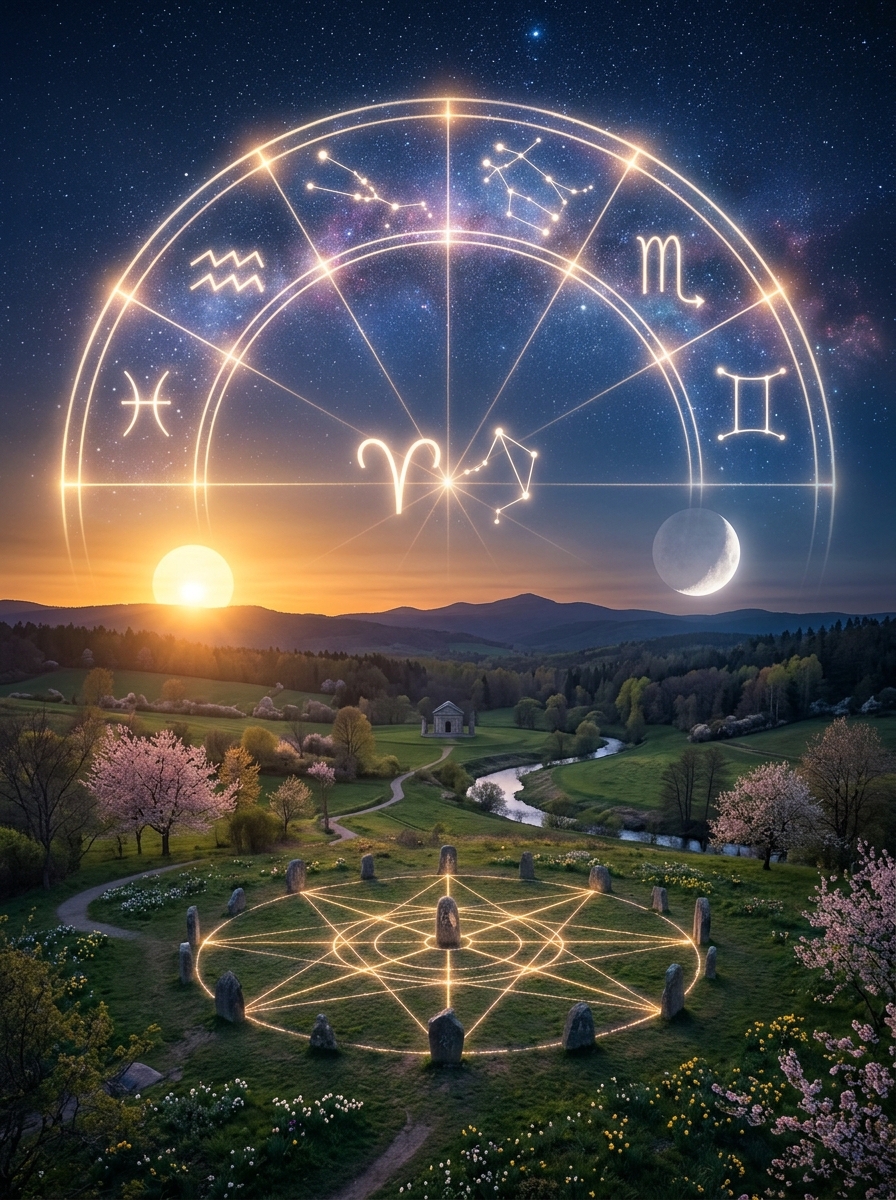
There are two moments each year when the sky performs a perfect act of equilibrium. Day and night, light and shadow, expansion and contraction — all held in exact balance for a single, luminous pause. These are the equinoxes: not merely astronomical benchmarks on the calendar, but portals through which the cosmos speaks in the language of duality and reconciliation. For the astrologer, the psychologist, and the seeker, the equinoxes are among the most charged moments the solar year has to offer.
Understanding the equinoxes means holding two lenses simultaneously: the precise, quantifiable language of astronomy and the symbolic, interior language of astrology and Western esotericism. These lenses do not cancel each other out. They converge, the way two rivers meet to form something wider and deeper than either stream alone.
Etymology and Symbolism: What "Equinox" Actually Means
The word equinox derives from the Latin aequinoctium, a compound of aequus ("equal") and nox ("night"). It names the condition: a night that equals the day. But etymology rarely exhausts meaning, especially in matters esoteric. The equal night is not a moment of stasis — it is a moment of dynamic tension, the way a scale holds two perfectly matched weights not by collapsing but by finding the precise center of gravity.
In Western esoteric tradition, polarity is not a problem to be solved. It is the engine of manifestation. The Hermetic axiom "As above, so below" points to a universe that operates through complementary opposites: active and receptive, solar and lunar, conscious and unconscious. The equinox is the cosmological dramatization of this principle. When the Sun crosses the celestial equator — moving northward in March or southward in September — the sky itself is modeling the reconciliation of opposites that the esoteric traditions have always described as the precondition for transformation.
Carl Jung, writing from the depth psychology tradition that so profoundly shaped modern astrological practice, understood that the union of opposites — what he called the conjunctio oppositorum — was not a theoretical abstraction but the lived drama of psychological wholeness. The Self, for Jung, emerges through the integration of shadow and light, masculine and feminine, known and unknown. The equinox, with its astronomical precision, gives this interior process an exterior mirror. It says: look up. The sky is doing what you are trying to do.
The Symbol of the Scale and the Sword
In Western iconography, justice is almost always depicted at the equinox's themes: scales held in balance, a sword of discernment raised. The Egyptian goddess Maat, embodiment of cosmic order and truth, was famously associated with the feather — the counterweight placed on the scale against the human heart in the Hall of Two Truths. The Greek Astraea, goddess of innocence and purity, eventually became the constellation Virgo and is closely associated with Libra's scales. Both figures point to the same underlying intuition: that the moment of balance is not passive, but requires active moral and spiritual attention.
This is why astrologers have always treated the equinoxes as moments that demand something of the practitioner — not merely passive observation, but intentional engagement.
Astronomical Mechanics: The Geometry of Equal Days
Before we can work with the equinox symbolically, it helps to understand what is physically happening. The Earth orbits the Sun on a tilted axis — approximately 23.5 degrees relative to its orbital plane, the ecliptic. This tilt is responsible for the seasons. In summer, the Northern Hemisphere leans toward the Sun; in winter, away from it. At the equinoxes, the axis is oriented neither toward nor away, and the Sun sits directly above the equator.
The precise moment of an equinox is when the Sun crosses the celestial equator — the projection of Earth's equator onto the sky. At this crossing, the ecliptic (the Sun's apparent path through the zodiac) intersects the celestial equator at one of two points: the vernal point (0° Aries) or the autumnal point (0° Libra). These are not arbitrary zodiac designations. They are geometrically defined. The tropical zodiac, which Western astrology uses, is anchored entirely to these two points and the solstices. It is a calendar of light, not of fixed stars.
Atmospheric Refraction and the Optical Equinox
Here is something that often surprises people: on the exact date astronomers call the equinox, day and night are not actually of perfectly equal duration at most locations on Earth. Atmospheric refraction bends sunlight around the curve of the planet, causing the Sun to appear slightly above the horizon even when it is geometrically below it. This means that sunrise appears earlier and sunset later than a geometrically perfect calculation would predict. The day when day and night are exactly equal — sometimes called the equilux — occurs a few days before the vernal equinox and a few days after the autumnal equinox, depending on latitude.
Far from diminishing the equinox's significance, this detail enriches it. The sky appears to give more than it owes, bending its own rules in a gesture of generosity. The light lingers. In symbolic terms, this is the liminal zone — the threshold space where one condition has already ended but the new one has not yet fully taken hold.
Geomagnetic Phenomena: Equinoctial Auroras
There is another astronomical curiosity worth noting. Geomagnetic storms — and the auroras they produce — are statistically more common around the equinoxes than at other times of year. This is the Russell-McPherron effect: the geometry of Earth's magnetic field relative to the Sun's interplanetary magnetic field is more favorable for energy transfer around the equinoxes. The result is that the skies near the poles are more likely to ignite in green, violet, and crimson light in March and September than at the solstices.
For the astrologically inclined, this feels less like coincidence and more like confirmation. The sky does not merely represent cosmic energy at the equinoxes — it channels it. The geomagnetic storms are real. The light shows are real. The ancients who built their monuments to track these moments were responding to something genuinely present in the natural world.
The March Equinox: The Astrological New Year and the Aries Ingress
When the Sun crosses the vernal point and enters 0° Aries, Western astrology marks the beginning of a new solar year. This is not a cultural convention layered onto an arbitrary date. It is the original astronomical rationale for the zodiac's starting position: the Sun at the vernal equinox defines Aries. The Aries ingress chart — cast for the moment the Sun enters Aries — has been used for centuries as a forecast tool for the coming year's collective themes.
Aries is the first fire sign, ruled by Mars, and its symbolism is blunt and energizing: initiation, willpower, individual assertion, the forward thrust of new life. Spring in the Northern Hemisphere is its natural correlate — grass pushing through frozen ground, animals emerging from dens, days visibly lengthening. The collective energy, if you attune to it, often does carry a quality of restless urgency in late March. People make plans. Impulses quicken. The horizon seems closer.
Psychological Dimensions of the Aries Ingress
Liz Greene, in her many works synthesizing Jungian psychology and astrology, has written extensively about fire signs as the carriers of what she calls pneuma — the breath of spirit animating matter. Aries specifically corresponds to the archetype of the hero at the threshold: full of potential, not yet tested, but compelled to move forward. The March equinox activates this archetype collectively.
Steven Forrest, one of the most eloquent voices in contemporary evolutionary astrology, describes the Aries archetype in terms of courageous self-definition. This is not selfishness — it is the necessary act of becoming a distinct self, separate from the collective. Without it, the relational work that Libra later demands would have no subject to perform it. The March equinox is where that subject is born.
Practically, this means the weeks surrounding the vernal equinox are psychologically potent for beginnings. Starting a new creative project, making a commitment to a health practice, having a difficult conversation that has been delayed — these are actions that align with the season's symbolic current. The energy is available. The question is whether you choose to work with it.
Ostara and the Neopagan Spring Celebration
In the Wheel of the Year — the liturgical calendar used by many modern Pagans and Wiccans — the March equinox is celebrated as Ostara (sometimes spelled Eostre, after the Germanic goddess of spring and dawn). Ostara typically falls between March 19 and March 21 and marks the second of the year's four "cross-quarter" markers.
The symbolism of Ostara is unmistakably about renewal and fertility: eggs painted in bright colors, hares (symbols of abundance and the moon in many traditions), flowers placed on altars, seeds blessed before planting. The egg is perhaps the most resonant symbol — a self-contained potential, awaiting only warmth and time to become something wholly other than it currently is. Neopagan Ostara practice often includes rituals of intention-setting, the blessing of seeds (literal or metaphorical), and work with the element of air, which governs new beginnings and the transmission of ideas.
Contemporary practitioners often combine the astronomical precision of the equinox moment with longer devotional practices — an Ostara altar maintained for the week surrounding the equinox, journaling about what is being planted and what is being released, sunrise meditations timed to the moment of solar crossing.
The September Equinox: The Libra Ingress and Cosmic Reckoning
Six months after Aries, the Sun returns to the celestial equator, this time crossing southward into 0° Libra. The September equinox arrives in the Northern Hemisphere as summer cedes to autumn, the light softening and the days beginning to yield more darkness than they hold. It is the astrological moment when the year's impulsive energy begins to move toward assessment, integration, and relationship.
Libra is an air sign, ruled by Venus, and it governs the sphere of partnership, negotiation, aesthetic discernment, and justice. Where Aries asks who am I?, Libra asks who are we? The psychological movement between the two equinoxes mirrors, in many ways, the developmental arc of human maturation — from individuation to relationship, from self-assertion to co-creation.
The Shadow Side of Balance
It is worth being honest about Libra's shadow, because equinox work that ignores the shadow is not doing the full work. Libra's desire for balance and harmony can express itself as avoidance of conflict, indecisiveness, or a compulsive need for approval. Aleister Crowley, always the iconoclast, described Libra in terms that emphasize its essential difficulty: the scales can only balance if the weighing is honest, and honest weighing requires courage. You have to know what things actually weigh before you can place them on the scale.
The September equinox, then, is not merely a celebration of harmony — it is a call to reckoning. What has the year produced? What relationships are truly serving your growth, and which ones have become comfortable substitutes for genuine connection? What have you been avoiding in the name of keeping the peace?
The Libra Ingress Chart
Mundane astrologers — those who practice astrology as a tool for understanding collective events — cast a chart for the Libra ingress just as they do for the Aries ingress. The September chart is particularly useful for understanding the collective's relationship concerns, legal and diplomatic developments, and aesthetic or cultural shifts that will color the autumn season. Planets conjunct the Sun at the moment of ingress, or occupying the angles of the ingress chart, are read as significant forces shaping the coming months.
This practice has roots deep in the astrological tradition, going back to medieval Islamic astrologers who used the ingress charts of all four cardinal points as primary mundane forecasting tools. It was carried into the European Renaissance through figures like Guido Bonatti and John Dee, and it remains in active use among contemporary practitioners.
Sacred Architecture and the Mythology of Solar Alignment
Ancient peoples did not simply observe the equinoxes — they built monuments to mark them with precision, at a scale and sophistication that still commands respect. These structures were not primitive calendars. They were cosmological instruments, embodying a worldview in which the movements of celestial bodies were inseparable from the social, agricultural, and spiritual life of the community.
Stonehenge and the British Isles
Stonehenge on Salisbury Plain in Wiltshire, England, is most famous for its solstice alignments, but equinoctial observation was almost certainly part of its function. The Avenue — the ceremonial approach to the stones — aligns with the solstice axis, but some researchers argue that the broader landscape of the Stonehenge complex, including the cursus and surrounding barrows, encodes a comprehensive seasonal calendar. The equinoxes would have been among the year's most significant ritual occasions.
What is clear is that the builders of Stonehenge — over multiple phases spanning roughly 1500 years, from around 3000 BCE to 1500 BCE — were engaged in a long-term, communally sustained project of cosmic orientation. The monument is a statement: we know where we are in time, and we are attending to it together.
Chichen Itza and the Feathered Serpent
The El Castillo pyramid at Chichen Itza in the Yucatán Peninsula of Mexico presents one of the most dramatic equinox spectacles on Earth. At the spring and autumn equinoxes, the afternoon sun casts a series of triangular shadows along the north staircase of the pyramid, creating the visual illusion of a feathered serpent — the deity Kukulkán — descending the staircase to meet the carved serpent heads at its base.
The precision required to produce this effect is extraordinary. The pyramid's geometry must be calibrated to exact solar angles that only occur twice a year, at a specific time of day. Thousands of people gather each year to witness the phenomenon. Whatever one thinks of the specific mythology, the engineering intention is unmistakable: the structure was built to make the equinox visible, to translate an astronomical moment into communal religious experience.
Maat, Astraea, and the Deities of Justice
Across ancient cultures, the equinox's symbolism of balance consistently attracted deities associated with justice, truth, and moral order. The Egyptian Maat was the personification of ma'at — the cosmic principle of order, truth, and harmony that maintained the universe against chaos. Her feather was the measure by which souls were judged. She was depicted wearing a single ostrich feather on her head, and her scales appear everywhere in funerary art.
Astraea, the Greek goddess who personifies justice and innocence, is mythologically associated with the end of the Golden Age — she was the last of the immortals to leave Earth as the world declined into the Iron Age, eventually being placed in the heavens as the constellation Virgo. In many traditions, she is associated with the Libra scales as well, which were once considered part of the Virgo constellation before being separated as a distinct zodiacal figure. Her dual presence in Virgo-Libra, straddling the autumnal equinox, is mythologically coherent.
Neopagan Rituals and Festivals: Working with Equinox Energy
The Wheel of the Year gives contemporary practitioners two equinox celebrations: Ostara in March (discussed above) and Mabon in September. Mabon — named after a figure from Welsh mythology, the Divine Youth stolen at birth — is the autumn equinox celebration, typically observed between September 21 and 23.
Mabon: The Witch's Thanksgiving
Mabon is often called the "Witch's Thanksgiving" because it coincides with the second harvest — a time of abundance and gratitude, but also the recognition that the growing season is ending and preparation for winter must begin. It is a feast and a reckoning simultaneously. Traditional Mabon practice includes sharing meals made from seasonal produce, expressing gratitude for the year's blessings, making offerings to land spirits and ancestors, and beginning the psychological work of letting go.
The dual quality of Mabon — celebration and release, fullness and impending scarcity — mirrors the astrological tension of Libra itself. The harvest is real. The gratitude is genuine. But the darkness that follows is also real, and pretending otherwise would be a failure of honesty.
Equinox Rituals Across Traditions
Contemporary practitioners working outside any specific Wiccan or Neopagan tradition have developed equinox practices drawn from multiple currents: ceremonial magic, folk herbalism, contemplative Christianity, depth psychology, and astrological timing. Some common threads include:
Threshold rituals: Because the equinox is a liminal moment — between seasons, between periods of expanding and contracting light — threshold work is particularly potent. This might involve physically walking through a doorway with intention, writing what you are leaving behind on one side of a piece of paper and what you are moving toward on the other, or performing a ritual at dawn on the equinox day as the Sun rises.
Elemental balancing: Fire and water, air and earth — many practitioners work with the four classical elements at the equinoxes, seeking to assess and rebalance their presence in one's life. Fire might represent passion and will; water, emotional depth and intuition; air, thought and communication; earth, physical health and material stability.
Astrological timing: For those who work with planetary hours and electional astrology, the exact moment of the Sun's ingress into Aries or Libra is considered especially potent for initiating new undertakings (Aries) or formalizing partnerships and agreements (Libra).
How the Equinoxes Influence Personal Charts
One of the most practically useful things to understand about the equinoxes is how the ingress charts interact with your natal chart. When the Sun enters Aries or Libra, it does so at 0° of that sign. If you have natal planets at or near 0° of any of the four cardinal signs (Aries, Cancer, Libra, Capricorn), the equinox Sun will be in close aspect to those planets — in conjunction, square, or opposition — making the ingress period personally charged.
Transits to Natal Angles
The Aries and Libra ingresses are particularly significant when the ingress chart's Sun falls near one of your natal angles: the Ascendant, Descendant, Midheaven, or IC. An ingress Sun conjunct your natal Ascendant, for example, may mark the beginning of a period of heightened personal visibility and self-assertion. An ingress Sun conjunct the Descendant emphasizes partnership and other people's influence on your life trajectory.
Steven Forrest's evolutionary astrology framework invites practitioners to ask not just what is happening but what is this experience for? — what soul-level intention does this transit serve? At the Aries ingress, the question is: what new chapter of your story is beginning? At the Libra ingress: what relationships or imbalances are asking for honest attention?
Annual Profections and the Lord of the Year
In traditional Hellenistic astrology, the technique of annual profections moves the Ascendant forward one sign per year on each birthday. The "Lord of the Year" is the planet ruling the sign into which the profected Ascendant has moved. When the Lord of the Year is the Sun, the equinox ingresses carry extra personal weight — the Sun's ingress chart effectively becomes a sub-forecast embedded within your annual profection year.
This layering of techniques — natal chart, annual profection, ingress chart, transits — is characteristic of serious astrological practice. Each layer adds resolution to the picture. The equinox ingresses are not floating in isolation; they are events in an ongoing, densely structured conversation between the sky and the individual chart.
Frequently Asked Questions
What is the difference between an equinox and a solstice?
The equinox and solstice are the four cardinal points of the solar year, marking the Sun's ingresses into the four cardinal signs of the zodiac. At the equinoxes (March and September), the Sun crosses the celestial equator — the midpoint of its annual declination cycle — and day and night are approximately equal in duration. At the solstices (June and December), the Sun reaches its maximum northern or southern declination, producing the year's longest and shortest days. Astrologically, the equinoxes are associated with initiation and balance (Aries and Libra), while the solstices correspond to cultivation and consolidation (Cancer and Capricorn). Together, the four ingresses form the structural skeleton of the astrological year.
What is the Astrological New Year, and why does it start with Aries rather than Capricorn?
The Astrological New Year begins when the Sun enters 0° Aries at the March equinox. This is the original astronomical definition of the zodiac's starting point: the tropical zodiac is defined by the Sun's position relative to the equinoxes and solstices, not by fixed stars (which is what the sidereal zodiac uses). The Sun at the vernal point equals Aries by definition. Capricorn is associated with the December solstice — the Sun's ingress into the cardinal earth sign — and carries its own New Year symbolism in some traditions (it's not coincidental that the Gregorian calendar's January 1 falls shortly after the Capricorn ingress). But in Western astrological tradition, Aries is unambiguously the first sign because it is keyed to the vernal equinox.
How can I work with equinox energy in my personal practice?
The equinoxes offer two primary modes of engagement: astronomical timing and symbolic alignment. For astronomical timing, note the precise moment of the Sun's ingress into Aries or Libra (readily available from astrological software or ephemerides) and consider beginning important new projects or rituals within the 24-hour window surrounding that moment. For symbolic alignment, the March equinox invites work around initiation, identity, and willpower — Aries themes. Consider what new chapter of your life is beginning, what you are choosing to become. The September equinox invites reflection on relationships, justice, and integration — Libra themes. What needs to be honestly assessed and rebalanced? Journaling, altar work, sunrise observation, and deliberate intention-setting are all accessible practices that do not require any specific religious affiliation.
Why are equinox auroras more common than solstice auroras?
The increased frequency of geomagnetic activity around the equinoxes is a genuine, well-documented phenomenon known as the Russell-McPherron effect. It occurs because of the geometry of Earth's magnetic field relative to the interplanetary magnetic field carried by the solar wind. Around the equinoxes, the orientation of these two fields is more favorable for the transfer of solar wind energy into Earth's magnetosphere, increasing the likelihood of geomagnetic storms — and the auroras they produce. This effect peaks near the equinoxes and is weakest around the solstices. For those who work with sky observation as a spiritual practice, the equinoctial auroras are a natural invitation to look up.
Are the March and September equinoxes equally powerful astrologically?
They are equally significant as cardinal ingress points, but they carry different qualities and ask different questions. The March equinox is the more overtly active and initiatory of the two — it aligns with the Aries archetype of beginnings, assertion, and the forward impulse of spring. In the Northern Hemisphere, it is experientially accompanied by the visible acceleration of natural growth. The September equinox is more reflective and relational — Libra's energy tends toward assessment, integration, and the willingness to see the other. In the Northern Hemisphere, it arrives as the natural world begins to slow and harvest. Neither is more important than the other; they are complementary poles of a single axis, and working with both deepens the practice considerably.
What role did the equinoxes play in the Western esoteric tradition?
The equinoxes were central to the ritual calendar of many Western esoteric orders and were treated as moments of heightened magical potency. The Hermetic Order of the Golden Dawn, with which figures like Arthur Edward Waite and Aleister Crowley were associated, held its Equinox Ceremonies biannually — using the vernal and autumnal equinoxes as the occasion for initiations, officer changes, and collective magical workings. Crowley's system of Thelemic magick continued this tradition, with the vernal equinox marking the beginning of the Thelemic year (the writing of The Book of the Law in April 1904 was tied to this seasonal current). Liz Greene's work, more psychologically oriented, draws on the seasonal cycle as a framework for understanding collective unconscious patterns that surface and recede throughout the year, using the equinoxes as inflection points in that pattern.
Comments
Loading comments…