Thurisaz Rune Meaning: The Thorn, the Giant, the Threshold
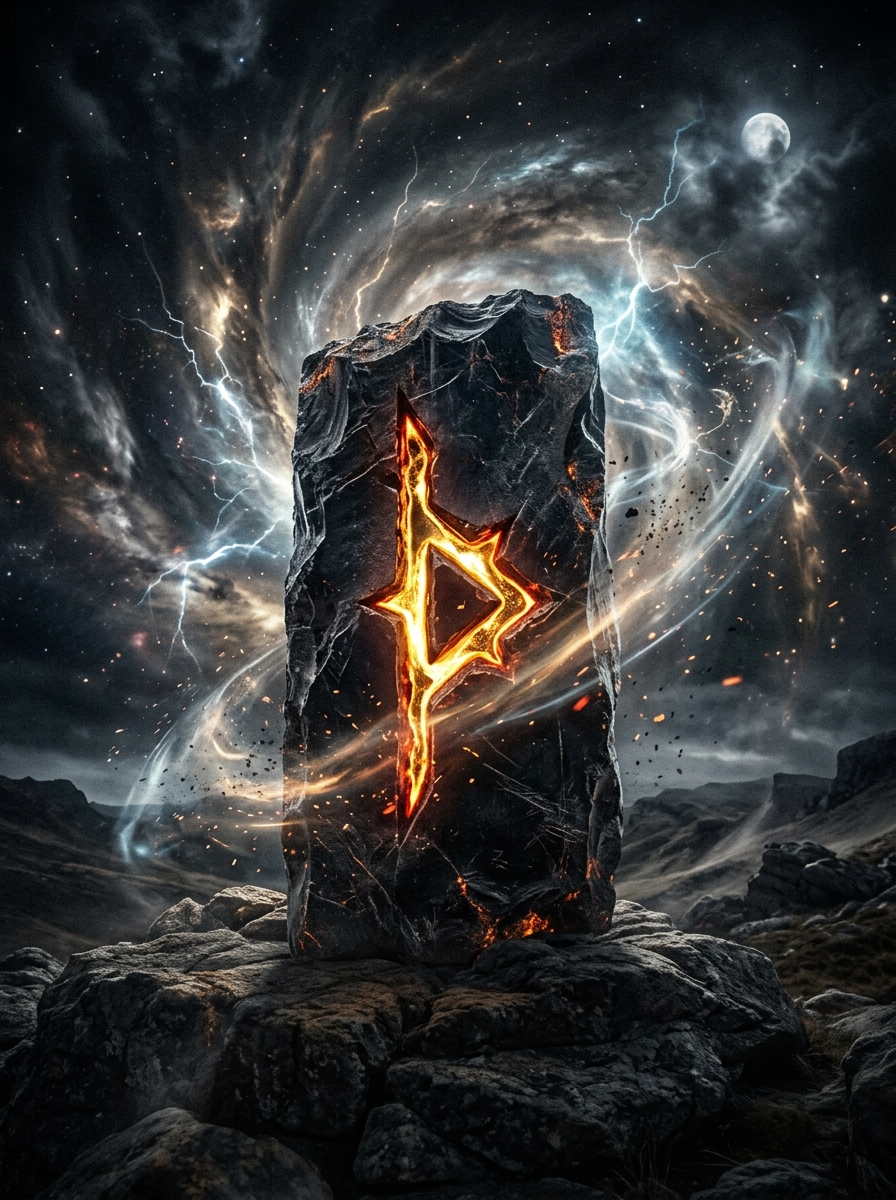
The Thorn That Protects and Provokes
Thurisaz is the Elder Futhark rune of the thorn, the giant, and the pressure point where contact becomes fate. Its name carries a double charge: the literal sting of a thorn and the mythic presence of the þurs—the hostile primal power that stands outside ordered civilization. In divination, this is the rune of impact: contact that is sharp, local, and never neutral. It can defend, break, awaken, repel, or wound. The core message is simple: something is pressing on your boundaries, and how you meet that pressure matters more than the pressure itself.
That is why Thurisaz is not merely “conflict” or “challenge.” It is the moment before a gate swings, before a barrier gives way, before a sleeping force stirs. A thorn concentrates force: a tiny thing with a disproportionate effect. It protects the plant by making approach costly, and it pricks because contact has consequences. When Thurisaz appears, the issue is usually where a boundary has been ignored, where a truth has become impossible to evade, or where the psyche has begun generating a defensive response because something unresolved has come too close. The rune asks whether you are acting from clarity or reflex, from protection or retaliation. It respects the fact that some forms of power are best handled by delay, containment, and precise timing.
The Giant at the Gate: Psychological Roots
The old Germanic þurs evokes the untamed, pre-civilized powers that stand beyond the human order. The “giant” aspect of Thurisaz is not about size; it is about alterity. It represents what is larger than the ego, older than etiquette, and indifferent to our preferred narrative—chaos, raw instinct, the shadow, or any force that refuses to be domesticated. In mythic terms, the giant is the outsider that tests the gate. That does not make the rune evil. It makes it dangerous in the old sense: powerful, consequential, and not designed to accommodate wishful thinking.
Psychologically, Thurisaz forms when the self encounters an “other” that cannot be assimilated or ignored. The thorn is the intelligent pain that makes that encounter conscious. A thorn does not argue; it interrupts. It ends a fantasy of easy access. In personal growth, this often appears as a confrontation that clarifies—a sharp realization that strips away illusion, a defense that prevents enmeshment, or a refusal that protects vulnerable ground. The rune’s wisdom is martial but not reckless: force is most effective when disciplined by judgment. The question is always whether the boundary is being drawn from genuine self-knowledge or from fear.
Conscious Defense vs. Internalized Shadow
Upright Thurisaz points to protection that is not passive. This is not the rune of serene openness. It is the rune of the locked door, the bristling hedge, the clenched jaw that says enough. In practical terms, it describes a situation where you need to defend your time, your body, your work, or your truth. The upright form often favors strategic refusal over engagement. Not every provocation deserves an answer. Not every opening deserves entry.
Upright Thurisaz can also signal a catalytic obstacle—an obstacle that exists to create transformation, not to block growth indefinitely. Think of the pressure that cracks a seed open or the thorn that compels a new route. The rune often appears when a direct approach will fail because the situation requires a different angle. Something must be met with patience, precision, or an interior shift before it can move. The hard truth hidden inside the irritation is what matters. What complacency is being interrupted? What illusion is the thorn stripping away?
Reversed or merkstave Thurisaz suggests force that is blocked, distorted, or turned against the self. The protective instinct is still present, but it is no longer clean. Instead of a clear boundary, there may be hesitation, resentment, or a defensive pattern that creates the very harm it tries to prevent. One may strike first out of fear, or freeze because the threat feels too large to name. This is the rune of badly timed reaction: a sharp reply that damages trust, a suspicion that becomes a prophecy, a refusal that is less discernment than panic.
The merkstave form often points inward, toward shadow material that has become congested. The giant is no longer outside the wall; it is inside the structure, distorting perception. Old anger, humiliation, fear, or mistrust that has not been integrated can cause the psyche to read neutral situations as hostile. Reversed Thurisaz counsels restraint—not because action is impossible, but because the first impulse is likely contaminated. Step back, slow down, and let the charge drain before deciding what the situation actually requires. The wisdom here is not passivity; it is the refusal to let fear choose your next gesture.
Thurisaz in a Life: Boundaries in Love, Work, and the Self
In relationships, Thurisaz often shows charge around boundaries, desire, and self-protection. It can indicate attraction mixed with fear, intimacy mixed with suspicion, or a pattern in which one person uses sharpness to keep the other at a safe distance. It may also mark a relationship that needs clean limits in order to remain viable. The psychological nuance is crucial: Thurisaz is not automatically “toxic.” Sometimes it names the necessary edge that prevents enmeshment. Sometimes it reveals that anger is serving as a guardian for something more vulnerable. The question is not whether the thorn exists—it is whether it is being used consciously or compulsively.
In work and creative life, upright Thurisaz can appear as a competitive pressure that forges skill, a critical feedback that cuts to the core, or a hard deadline that forces real output. Reversed, it may show self-sabotage through defensiveness—refusing collaboration out of fear of being controlled, or holding onto a position past its usefulness. The rune asks whether your boundaries are strategic or reactive.
In inner work, Thurisaz is the gatekeeper of the shadow. Upright, it helps you defend your psychological space from external intrusion while keeping you aware of the giant inside. Reversed, it exposes where the ego has identified with the wound—where every touch feels threatening because a splinter from the past remains lodged. Integration comes not by removing the thorn, but by learning to see it clearly: a signal that something has come close enough to require a response.
The Rune's Edge: Magical and Divinatory Use
In a rune casting, Thurisaz is rarely ornamental. It marks a place where the reading has edge. If it lands near runes of speech or contracts, look for words that wound, promises that require boundaries, or agreements that have been too loose. Near runes of movement or breakthrough, it can describe a gate that opens only after resistance is met directly. Near runes of feeling or partnership, it indicates defense, attraction with caution, or the need to keep emotional pressure from becoming coercive. The rune’s divinatory strength lies in its precision: it asks what is being defended, what is being provoked, and whether the current form of protection still serves the deeper need.
As a magical symbol, Thurisaz belongs to warding more than attraction. It is the rune of energetic fencing, containment, and counterpressure—not softening or glamour. Its logic is to interrupt intrusion, to reinforce thresholds, to stop an unwanted pattern from advancing. Because it is so closely tied to the ethics of force, it works best when the intention is clean. Defensive magic that has become vindictive can easily turn Thurisaz into its own problem. The symbol’s power lies in discrimination: what is allowed in, what is kept out, and what must be faced rather than avoided.
Thurisaz reveals its full character when contrasted with neighboring runes. Where Kenaz illuminates, Thurisaz pierces. Where Algiz shelters and raises a spiritual defense, Thurisaz bristles with more immediate, earthly threat-awareness. Where Tiwaz directs force toward principle and justice, Thurisaz is more primal, more reactive, and more ambivalent. It is the raw edge before ideology refines it.
That edge remains relevant because modern life has not abolished thresholds; it has multiplied them. Boundaries now include attention, bandwidth, digital access, consent, and emotional availability. Thurisaz addresses the same ancient problem in a new costume: how to remain open without becoming exposed, and how to defend without becoming cruel. Upright, it can protect and awaken. Reversed, it can expose self-defeating defenses and buried shadow. In either form, it asks the same uncompromising question: what happens when contact can no longer be avoided?
Related
- Nauthiz Rune Meaning: Need, Friction, and the Fire It Makes
- Eihwaz Rune Meaning: The Axis of Endurance, Thresholds, and Hidden Change
- Uruz Rune Meaning: The Raw Power of Vital Force
- Hagalaz Rune Meaning: The Hail That Breaks the Pattern
- Ingwaz Rune Meaning: The Seed, the Closure, the Quiet Force of Gestation
Comments
Loading comments…